Solid Wood Table with Leaf: A BILTRITE Buyer’s Guide


One more chair. That's usually how it starts.
Your daughter brings a friend home from college. Grandpa decides he feels good enough to join Sunday supper. The neighbors stop by after the game. Suddenly that dining table that felt just right on Tuesday feels awfully small by Saturday.
Around Milwaukee, we've seen that scene play out for generations. Older bungalows, tidy condos, busy suburban homes, senior apartments, first houses with tiny dining areas. Different homes, same question. How do you make room for everyone without letting a table take over the whole room every day?
That's where a solid wood table with leaf earns its keep. It gives you a comfortable everyday size, then opens up when life gets fuller. And life always gets fuller.
Tables like this aren't some new gimmick, either. The idea goes back centuries. The invention of the table leaf in the 16th century changed furniture history by letting solid wood tables expand for larger gatherings, and later designs like gateleg and drop-leaf tables made that flexibility even more useful in smaller homes, as described in this history of table leaves.
Finding Room for Everyone at the Table
A Milwaukee family doesn't need a mansion to host well. Most of the time, they need a table that adapts.
Think about a normal week. On Wednesday, it's homework, takeout, and mail stacked on one corner. On Friday, it's fish fry. At the holidays, it becomes the center of the house. Cookies cool there. Stories get told there. Somebody always claims the “good chair.”
A solid wood table with leaf works because it respects real life. Closed up, it fits the room you live in. Opened up, it welcomes the people you love.
Why this matters in everyday homes
Not everyone has a formal dining room. Plenty of homes around here ask one room to do several jobs. That's been true for a long time. Earlier extension designs became popular because homes needed furniture that could shift with the day, especially when families didn't have dedicated rooms for every activity.
That's still the big appeal now. You don't buy one table for daily life and another for holidays. You buy one good table that knows how to do both.
A good dining table shouldn't force you to choose between elbow room on Tuesday and enough seats on Thanksgiving.
The problem a leaf solves
People sometimes hear “leaf” and think only of special occasions. I think that sells it short. A leaf solves several practical problems at once:
- Extra seating when plans change. You can handle one more cousin, one more kid, one more casserole.
- Better use of floor space. The table stays smaller when you need walking room.
- Less furniture turnover. You're less likely to outgrow it after one move or one life change.
- A steadier daily routine. Instead of dragging in card tables, you use the same sturdy surface every time.
That's the quiet beauty of it. It doesn't just add space. It removes stress.
The Enduring Beauty of Real Solid Wood
A lot of confusion starts with two words: solid wood.
If you're shopping quickly, many tables can look similar from across the showroom. Nice stain, nice shape, nice top. But what the table is made from matters just as much as how it looks on day one.
What solid wood really means
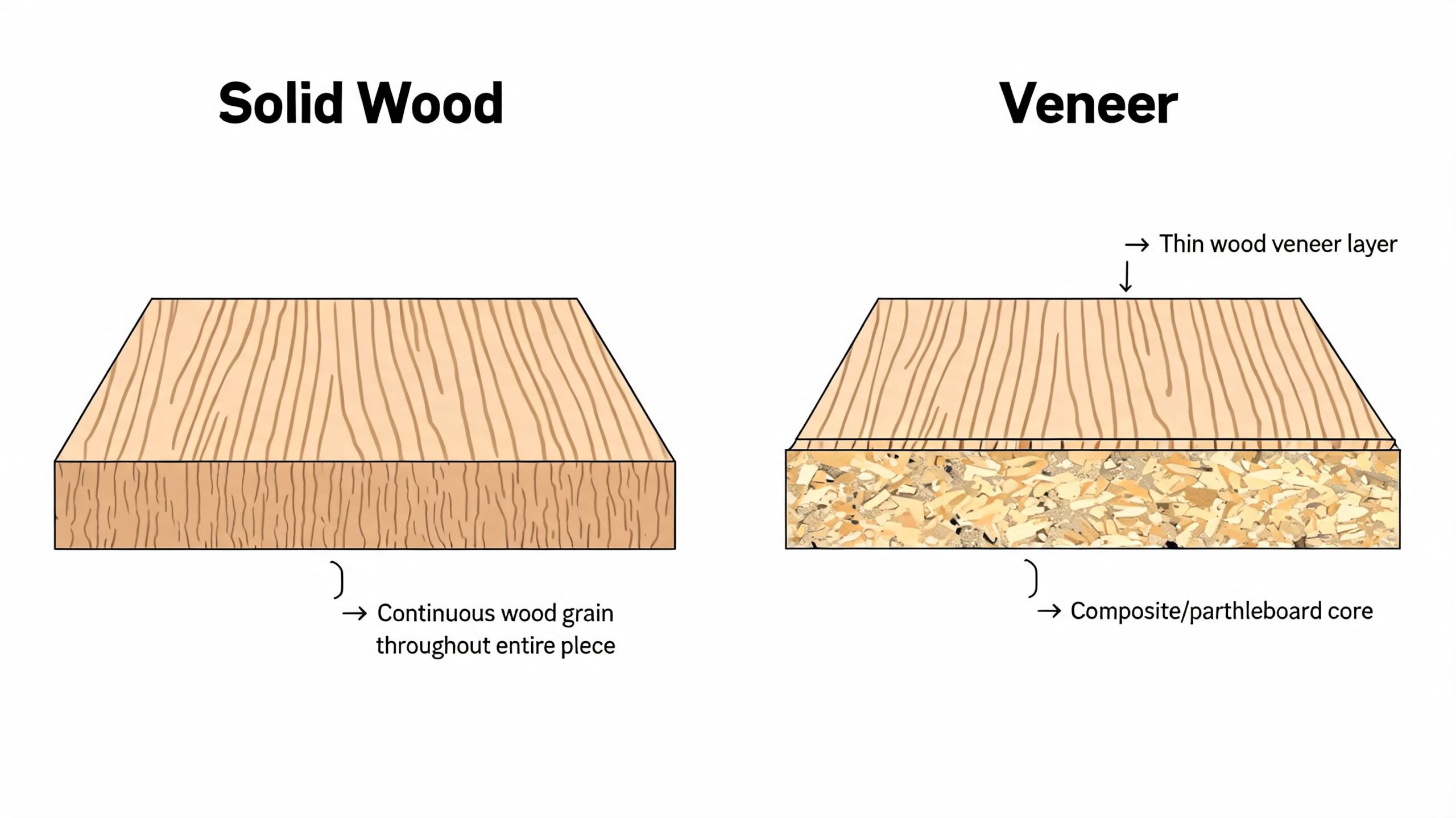
A solid wood top is made from actual lumber throughout the piece, not just a thin wood layer over another core. That matters because dining tables live hard lives. They get bumped by belts, soaked by sweating glasses, scraped by homework caddies, and leaned on by people who always promise, “I'm not sitting on it.”
Solid wood handles that kind of life with more honesty. It can gain character. In many cases, it can also be repaired or refreshed more gracefully over time.
If you've never compared them before, think of it this way:
| Construction | What you're looking at | Long-term feel |
|---|---|---|
| Solid wood | Real wood through the piece | Natural character, strong heirloom potential |
| Veneer over core | Thin wood surface over another material | Can look attractive, but the surface has less forgiveness for deep wear |
Why families keep coming back to solid wood
There's a reason farmhouse-style solid wood tables have stayed loved for so long. They were built for use, not for show alone. Many surviving examples have lasted 50-100+ years, with thick plank tops and sturdy legs made for heavy daily use, as noted in this look at farmhouse table history.
That's a meaningful standard for a dining table. You're not just buying a spot to eat. You're buying a future craft table, card table, pie-crust table, school-project table, and maybe one day the table your kids argue over.
For shoppers trying to understand the material difference in plain English, this guide to the benefits of solid wood furniture is helpful because it explains why real wood keeps earning loyalty year after year.
The beauty is in the variation
Some buyers get nervous when they see grain variation, knots, or small color shifts from board to board. I'd tell you not to fear that. That's not a defect. That's the charm.
Real wood has personality. One board might be lively, another calmer. Put together by skilled hands, those differences give the table warmth that mass uniformity can't fake.
Practical rule: If you want a table that can become part of family history, start by asking what it's made of before you ask what color it is.
Choosing Your Wood Species and Finish
Once you know you want solid wood, the next question is usually, “Which wood should I choose?”
That's a smart question, especially in Wisconsin. The species affects not just appearance, but how the table behaves through changing seasons and years of use. The finish matters too, because the leaf mechanism depends on parts moving smoothly when you need them.
Start with your household, not the stain card
Different woods have different personalities.
White oak tends to feel grounded and strong. It's a favorite for families who want visible grain and a time-tested look that can work in farmhouse, transitional, or cleaner modern rooms.
Maple usually reads a bit smoother and more understated. If you like a simpler grain pattern or want a finish that feels fresh without being trendy, maple often lands nicely.
Both are strong choices for extension tables. Premium domestic hardwoods like white oak and maple show 50% less seasonal movement than some alternatives, according to these finish and wood performance notes. That matters because less movement can mean fewer headaches around leaves, seams, and alignment.
The finish is doing more work than most people realize
When people shop tables, they usually notice shape first, stain second, and mechanism third. The finish often gets overlooked. That's a mistake.
A dining table finish protects the wood, yes, but on an extension table it also helps preserve function. A stronger finish helps moisture stay from creating problems around joints and sliding parts.
Here's the key comparison from the same source:
- Commercial-grade 2K polyurethane can last 8-10 years.
- Basic lacquer may break down in 3-5 years.
- The result is practical, not just cosmetic. Better finish performance helps prevent stuck leaves and supports long-term function.
If you'd like a simple companion read on finishes before you shop, this overview of the best wood finish for dining table use lays out the basics clearly.
A simple way to match wood to your life
Use this quick filter when you're deciding:
- Busy family with kids. White oak makes sense if you want durability and character that wears in gracefully.
- Calmer, cleaner look. Maple fits homes where you want strength without a bold grain pattern.
- You plan to keep the table for decades. Put extra attention on the finish quality, not just the stain name.
- You'll use the leaf often. Ask how the finish and joinery work together around the extension system.
The best wood species isn't the one a stranger likes online. It's the one that fits your home, your habits, and how often you'll ask that table to expand.
Understanding Different Table Leaf Mechanisms
Many shoppers appreciate the idea of a leaf but remain unclear on how the mechanism works. That is understandable. If you have not purchased a dining table in years, the terminology can seem more complex than necessary.
The main thing to know is this: each mechanism solves a different household problem.
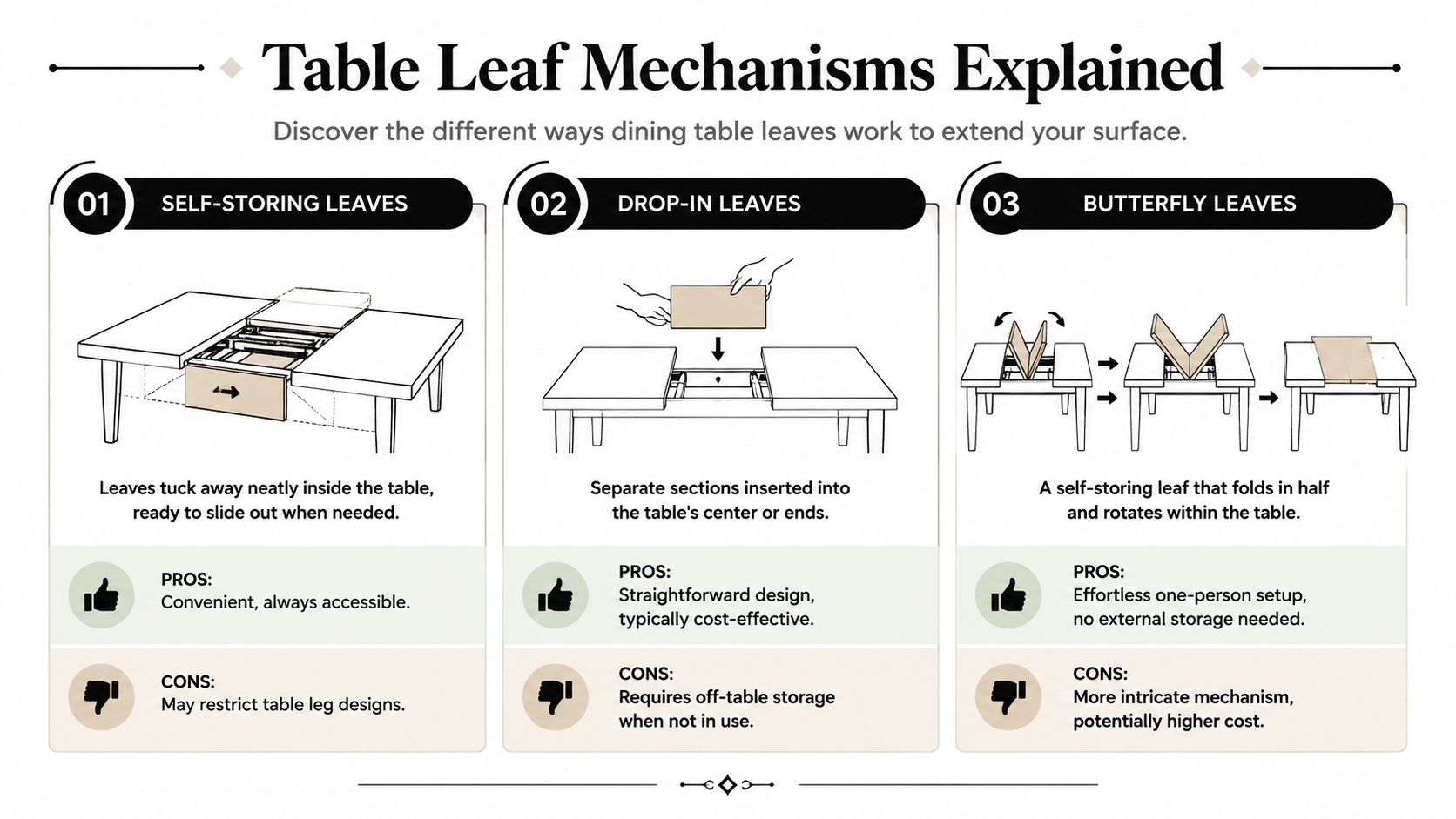
Self-storing leaves
This is the crowd-pleaser for people who hate storing extra parts. The leaf lives inside the table, so you don't need to keep it in a closet or spare room.
That convenience is real. Self-storing systems can add up to 28 inches of length and can save 15-20 cubic feet of separate storage space, according to these self-storing leaf specs and mechanism notes. Well-built versions use precision hardwood construction and self-aligning hardware to help prevent twisting when extended.
This style is especially appealing in condos, apartments, and homes where every closet already has a job.
Best fit: households that want quick setup and no off-table storage.
Drop-in or removable leaves
This is the straightforward classic. You separate the table, place the leaf in, and store it elsewhere when not in use.
The upside is simplicity. The downside is obvious too. You need a safe, flat place to keep that leaf. If you've got decent storage and like a traditional setup, this can be a very sensible route.
Best fit: people who host larger gatherings at times but don't mind handling and storing a separate piece.
Butterfly leaves
A butterfly leaf is a special kind of self-storing setup. The leaf folds, usually in half, and tucks inside the table. Open the table, unfold the leaf, lock it in place, and you're set.
Many shoppers love this because it feels easier for one person to operate. A table like the 66 pedestal table with 18 butterfly leaf is a good example of the style that combines convenience with a clean footprint.
Best fit: anyone who wants a one-person-friendly setup and doesn't want to hunt for a stored leaf before company arrives.
Which mechanism makes sense for you
Use this side-by-side check:
| Leaf type | Main strength | Main tradeoff | Often works well for |
|---|---|---|---|
| Self-storing | No separate storage needed | Design can be more specialized | Apartments, condos, busy families |
| Removable | Familiar, direct design | Leaf must be stored elsewhere | Larger homes, occasional hosts |
| Butterfly | Fast setup, hidden storage | More intricate mechanism | Daily flexibility, one-person use |
If your first thought is “Where would I even keep the leaf?” you're probably already leaning toward a self-storing or butterfly design.
How to Measure for Your New Dining Table
A beautiful table that doesn't fit the room is still the wrong table.
Many people encounter challenges during this stage. They measure the tabletop but overlook the space required for daily activity around it. Chairs need to move. People need to walk by. Doors need to open. In older Milwaukee homes, radiators, trim, and tight transitions can change what looks good on paper.
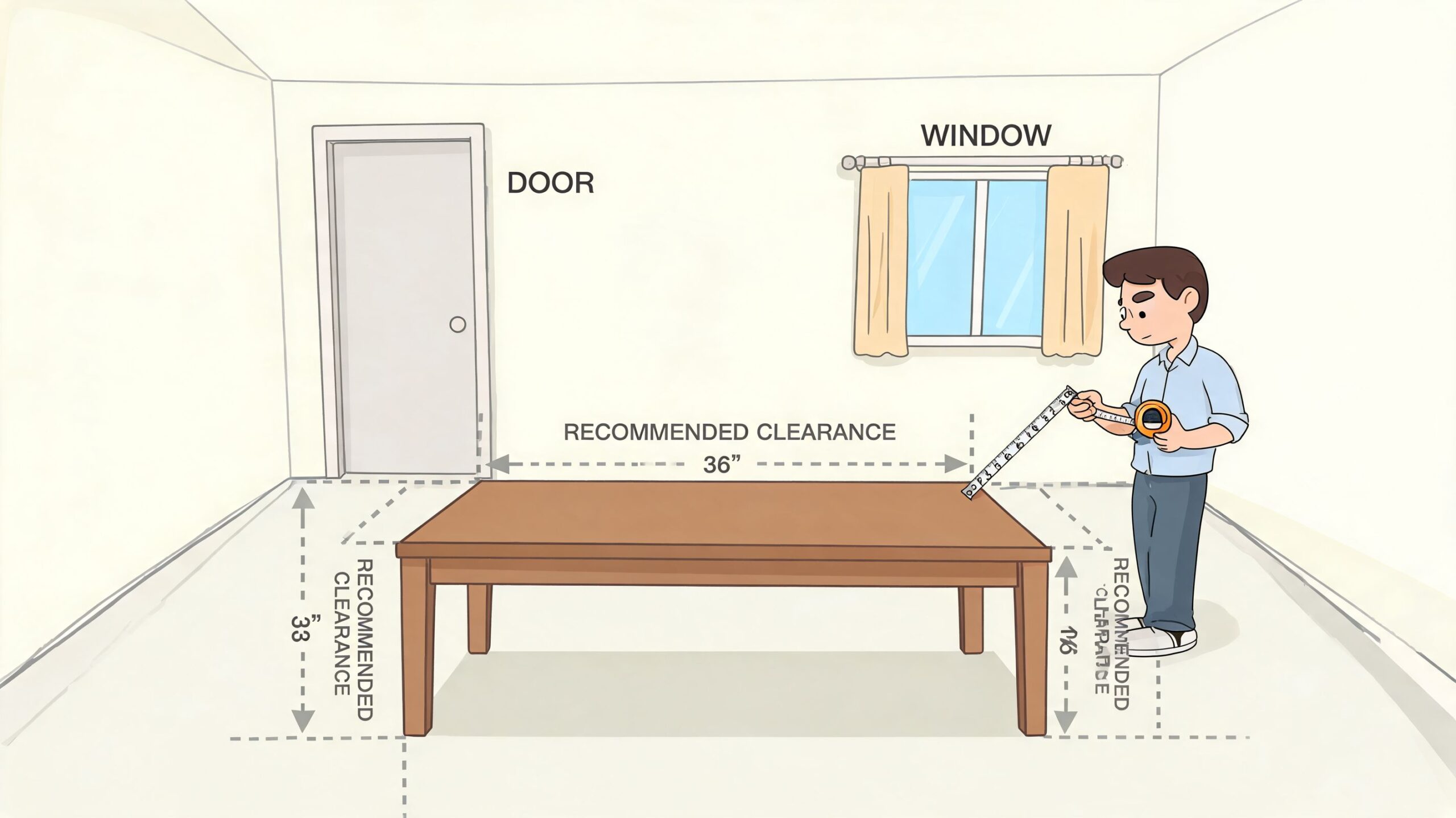
Measure the room in its real condition
Don't measure an empty idea of the room. Measure the room as you live in it.
That means noting heat vents, nearby hutches, windows that swing low, traffic paths to the kitchen, and whether someone uses a walker or needs easier chair access. In apartments and senior settings, this matters even more because every inch gets used.
Some newer small-scale Amish designs are built with these realities in mind. Certain pull-out leaf tables can add 18-24 inches to a 36-inch base, and some come-apart trestle bases break down into lighter pieces for narrow doorways, according to this overview of compact extendable Amish tables.
A simple measuring routine
Follow this in order:
Measure your dining area length and width
Write down the room dimensions, but also mark where doors, islands, and walkways affect usable space.Decide the table's everyday size first
A solid wood table with leaf should serve your normal week well. Don't buy only for the two holidays when everyone shows up.Check the expanded size second
Open dimensions matter, but so does whether the room still feels livable with the leaf in place.Think through chair movement
Chairs don't stay tucked in forever. People slide them back, turn them, and leave them angled after dinner.
For a practical planning tool, this dining table size guide can help you sketch the options before you visit a showroom.
Don't forget the path into the home
This one gets overlooked all the time. A table may fit the room and still be miserable to deliver.
Check:
- Front entry width. Especially in older homes with storm doors.
- Stair turns. Basement rec rooms and upper flats can get tight fast.
- Hallway pinch points. Corners matter as much as width.
- Elevator access. Condo buyers know this one well.
Pedestal or legs
A quick rule of thumb helps here.
| Base style | Why people like it | Good match for |
|---|---|---|
| Pedestal | Easier chair placement around the table | Tight seating plans, mixed chair sizes |
| Leg table | Familiar look, often classic and grounded | Rooms with more breathing room |
| Trestle | Strong visual presence, can be very sturdy | Larger spaces or come-apart delivery needs |
If a room is tight, pedestal tables often feel easier to live with because chairs can shift around without bumping into corner legs.
Caring For Your Table in a Wisconsin Climate
Wisconsin is beautiful for people and hard on wood.
We get humid summers, dry winters, and enough seasonal swing to make a table react. That doesn't mean you should avoid solid wood. It means you should understand it. Wood moves because it's natural, and good furniture is built with that in mind.
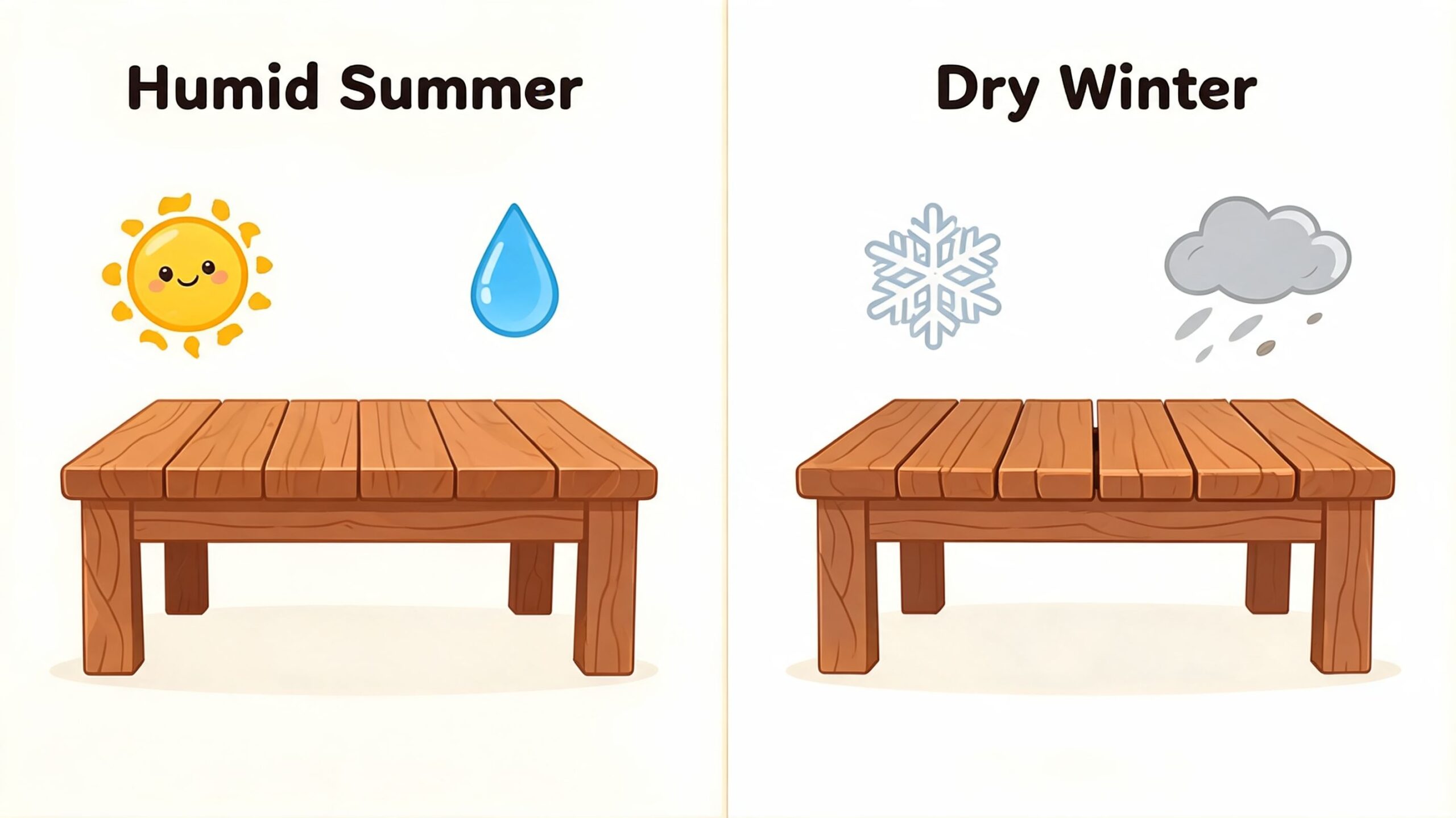
What movement looks like
Seasonal movement often shows up as slight seam changes, especially where a leaf meets the main top. That can worry people the first winter. Usually, it's the wood doing what wood does.
Material choice helps. Quartersawn white oak expands 3-5%, compared with 8-10% for flatsawn red oak, and that can reduce seam gaps by 50%, according to this guidance on extendable dining tables in Midwest conditions.
That's one reason many quality-minded buyers ask detailed questions about cut and species, not just color.
Two habits that protect your table
The first habit is patience. A new table should live indoors and adjust to your home before heavy use. Proper acclimation for 7-14 days is a small step, but it can make a meaningful difference.
The second habit is smart cleaning and storage. Keep the surface clean with gentle methods, and if your table uses a removable leaf, store it flat in a stable indoor environment rather than a garage or unheated area. For everyday upkeep, this guide on how to clean wood furniture covers the basics well.
Local care reminders that actually help
- Keep indoor conditions steady when you can. Big swings are harder on wood than normal, gradual changes.
- Wipe spills promptly. Water left around seams and joints invites trouble.
- Store leaves flat indoors. A leaf tucked in the wrong spot can develop problems before you even need it.
- Expect a little change. Tiny shifts from season to season are part of owning a natural wood piece.
Wood isn't misbehaving when it moves a bit in January. It's responding to the same air your skin and houseplants respond to.
A BILTRITE Table is a Milwaukee Family Tradition
Some furniture gets used. Some furniture gets remembered.
A dining table belongs in that second group. It's where your family gathers when life is ordinary, and also where life gets marked. First apartments. Bigger homes. New babies. Visiting relatives. Graduation cakes. Quiet dinners after long weeks.
That's why many Milwaukee families still care where a table comes from and who made it. They want something with roots. Something built by people who respect the material and the home it's going into.
Why local tradition still matters
There's comfort in buying from people who understand this area. Milwaukee homes aren't all built the same. Some have compact dining nooks. Some have formal rooms that only come alive when everyone's in town. Some need heavy-duty construction. Some need small-scale flexibility without feeling flimsy.
That's where Amish and American craftsmanship still stands out. These tables are often built with a kind of patience you can feel when you slide the top open or run your hand along the edge. The work looks quiet, but it isn't simple.
A table should fit the life ahead of you
The smartest dining table purchase usually isn't the one that fits only your current season. It's the one that can move with you.
Maybe today you need a compact round table in a city condo. Later, you may want that same piece to serve in a suburban breakfast room or as the main gathering spot when your family grows. A well-chosen solid wood table with leaf can bridge those chapters better than a table bought only for a moment.
Here's what experienced shoppers often value most:
- A table that adapts instead of forcing a replacement later.
- Construction they can trust when the table gets used every day.
- A look that ages well across changing homes and styles.
- Craftsmanship with a story that feels worth keeping in the family.
That's not sentimentality for its own sake. It's practical. The pieces you keep longest are usually the ones that were made with care from the start.
Your Milwaukee Dining Table Questions Answered
Shoppers around here tend to ask very practical questions, and I love that. Good furniture decisions usually come from honest, grounded concerns.
Will a solid wood table with leaf fit in an older Milwaukee home
Often, yes, but don't trust the room measurement alone. Older homes can have narrow entries, sharp hallway turns, chunky trim, and tighter dining areas than newer builds.
Bring your room dimensions, doorway widths, and any delivery concerns with you when you shop. If the home has a tricky path, mention that early. Base style and whether a table can be disassembled may matter just as much as tabletop size.
Is a leaf table a good idea if I live in a condo or apartment
Absolutely. In fact, it can be one of the most sensible choices because it lets one room do more than one job.
Look closely at compact extension designs, especially if you need a smaller everyday footprint. Also think about where the table sits when expanded. A good fit means you can still move comfortably when guests are over.
Are leaf mechanisms hard to use
Some are easier than others. That's why it helps to try them in person instead of guessing from a photo.
Butterfly and other self-storing styles often appeal to buyers who want less lifting and less storage hassle. Traditional removable leaves can still be a strong option if you don't mind handling a separate piece and have a good place to store it.
How do I match a new table to wood floors or older trim
Don't chase an exact copy so hard that you miss the bigger picture. In many homes, a close complementary tone looks more natural than a forced match.
Bring photos of the room, your flooring, and any nearby furniture. Daylight photos help. So do cabinet-door samples or finish samples when you have them.
A dining table doesn't need to disappear into the room. It should belong there.
Will solid wood be too much maintenance for our family
Not if you go in with the right expectations. Real wood asks for normal care, not constant worry.
Use placemats when it makes sense, wipe spills reasonably fast, and pay attention to indoor conditions through the seasons. Over time, many families find the character that develops is part of the pleasure.
Why do people care so much about Amish-made tables
Because the workmanship often shows in the details that matter later. Joinery, fit, finish, stability, and the way the extension system feels after repeated use all matter more than flashy first impressions.
There's also something meaningful about supporting craftspeople who still build with long-term use in mind. In a world full of disposable furniture, that approach feels refreshingly grounded.
If you're ready to see a solid wood table with leaf in person, we'd love to help at BILTRITE Furniture-Leather-Mattresses. Our fourth-generation family has served Metro Milwaukee since 1928, and we're proud to offer affordable, better-quality furniture with a strong focus on USA-made, Amish-made, solid wood pieces built for real homes and real gatherings. Stop by our Greenfield showroom, say hi, and let our experienced team help you find a table that feels right for your space, your family, and the years ahead.