How to Choose a Leather Sofa Bed with Storage


The guest room has become a home office, the blankets have taken over the closet, and relatives are coming to Milwaukee for the weekend. A leather sofa bed with storage sounds like a sensible answer, until shopping turns into a blur of upholstery labels, folding frames, and compartments that look roomier than they are.
The right choice starts with daily life, not a photograph. For a household that needs comfortable seating, occasional sleeping space, and somewhere for the linens, the details underneath the cushions deserve just as much attention as the leather.
Table of Contents
- Why a Leather Sofa Bed With Storage Makes Sense
- Pull-Out Versus Internal Sleeper Mechanisms
- Reading the Label on Real Leather
- Screening the Frame, Mechanism, and Storage
- The Mattress Inside the Sofa
- Measuring Your Space Before Delivery Day
- Care Habits That Make It Last
Why a Leather Sofa Bed With Storage Makes Sense
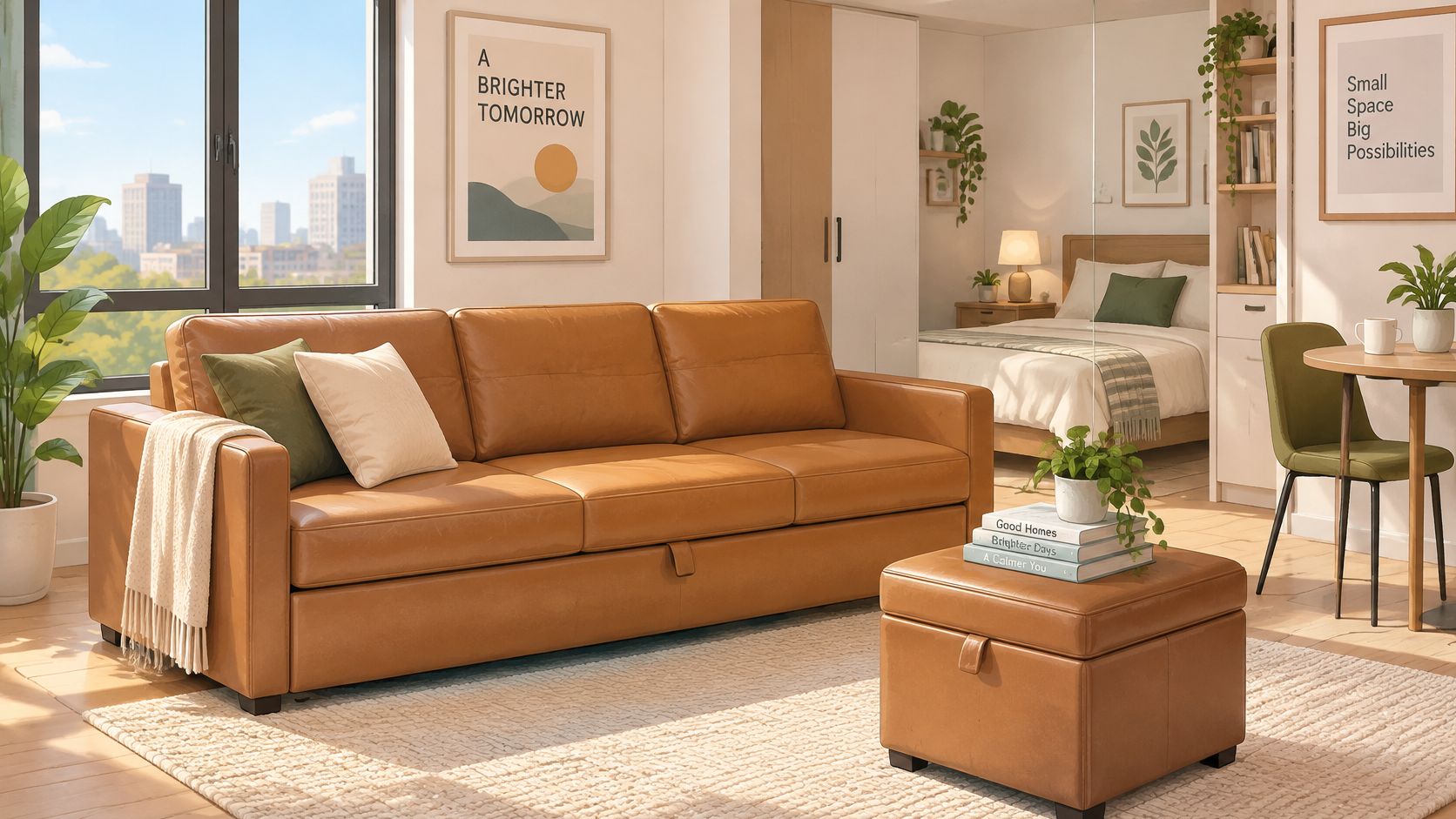
Consider a small spare room with a desk beside the window and barely enough floor space for visiting family. A permanent bed would crowd the workspace, while an ordinary sofa would leave guests without a sleeping surface. A convertible piece with usable storage can serve both needs without adding a linen cabinet.
That's the appeal: seating, sleeping, and bedding storage in the same footprint. Built-in storage can hold pillows, blankets, or seasonal textiles, helping households reduce the number of separate furniture pieces in a room.
Where the combination earns its space
The strongest candidates are rooms that change jobs. A finished basement might host movie night most evenings and overnight company during holidays. An apartment living room might need to accommodate visiting grandparents without becoming a permanent bedroom.
- Small homes and apartments: Consolidating functions can preserve space for everyday movement.
- Guest rooms and offices: A sofa can provide daytime seating without leaving a bed permanently open.
- Senior living suites: Compact furnishings can help, provided the intended user can comfortably operate the mechanism.
For a family-owned showroom rooted in Metro Milwaukee across generations, these are familiar furnishing puzzles. The practical recommendation is straightforward: choose the functions the household will use, rather than paying for the longest feature list.
Practical rule: Storage adds value only when it holds the bedding that otherwise needs a home.
A sleeper may be unnecessary if overnight guests rarely stay and a separate guest bed already exists. Likewise, a storage compartment adds little if accessing it requires moving furniture every time.
Leather deserves a separate decision, too. Its appearance shouldn't excuse an uncomfortable seat or awkward conversion. A useful sofa bed must work as furniture first, with each added function earning its place.
Pull-Out Versus Internal Sleeper Mechanisms
Choose the opening action before choosing the color. A beautiful sofa becomes a nuisance if the person making the bed struggles to operate it. The mechanism should suit the household's strength, room layout, and sleeping routine.
A conventional pull-out sleeper stores a folding mattress and support frame inside the sofa. Opening it creates a sleeping surface separate from the everyday seating cushions. The important question isn't whether the label says “pull-out,” but how that particular frame unfolds, supports the sleeper, and closes.
Fold-flat or click-clack designs use the seat and backrest to form the sleeping surface. Other convertible arrangements use unfolding panels or an extending platform. “Internal sleeper” is a broad description, not a guarantee that different models operate alike.
Compare the complete bedtime routine
| Decision | Pull-out sleeper | Fold-flat or convertible design |
|---|---|---|
| Sleeping surface | Inspect the mattress and its support together | Check cushion transitions and any center seam |
| Room arrangement | Allow room for the extended frame | Check forward extension and any space needed behind the back |
| Setup | Try cushion removal, unfolding, and closing | Try every release, adjustment, and locking position |
| Storage | Verify its location independently | Confirm which compartment remains accessible during conversion |
BILTRITE's guide to sofa bed mechanisms provides a useful starting point for understanding the different opening actions. The showroom test should still settle the decision.
A sales associate should demonstrate the complete operation, then let the intended user repeat it. That includes returning the furniture to sofa mode, which deserves equal attention. Any requirement to jerk, twist, or force the mechanism calls for clarification before purchase.
- For frequent overnight use: Give sleeping comfort and repeatable operation priority over a compact-looking silhouette.
- For occasional company: Acceptable trade-offs may include a firmer surface or a more involved setup, provided neither causes difficulty.
- For limited mobility: Test reach, grip, lifting effort, and standing clearance rather than assuming a simpler-looking design is easier.
Neither category automatically wins on weight or durability. Construction and operation matter more than the category name.
The deciding question is simple: Can the household comfortably make this bed when everyone's tired?
Reading the Label on Real Leather
“Leather” isn't a complete upholstery specification. Genuine leather, split leather, bonded leather, and coated imitation coverings shouldn't be treated as interchangeable purchases. A shopper needs the material description in writing, not just a reassuring adjective on a display card.
The FAO's overview of leather production and end uses identifies bovine leather as suitable for upholstery alongside other established uses. That broad material category, however, doesn't establish the construction or expected performance of an individual sofa.
Compare construction rather than appearance
| Covering description | Shopping priority |
|---|---|
| Top-grain or full-grain leather | Request the exact grade, finish, and care requirements |
| Split leather | Ask where it appears on the furniture and how its surface is finished |
| Bonded leather | Require a clear composition description and applicable coverage |
| Coated imitation leather | Identify the covering material and ask about coating-related exclusions |
BILTRITE's explanation of top-grain and full-grain leather differences can help shoppers prepare more precise questions. The purchase paperwork should identify what covers the seats, arms, sides, and back.
A showroom sample can clarify a description, especially when the reverse side is available for inspection. Grain appearance alone shouldn't settle the matter. Neither a uniform pattern nor a soft feel replaces a documented specification.
A leather upgrade should be something the paperwork explains, not something the shopper has to guess.
Ask about thickness and finish, then examine the seat fronts, arm caps, seams, and folding areas. Any cracking, lifting coating, or visible stress on a display deserves a direct explanation.
Coated products can perform well in an abrasion test yet remain vulnerable to peeling or moisture-related deterioration. That's why a sweeping promise about “durability” isn't enough.
The sensible recommendation is to favor documented construction and clear warranty language over dramatic claims about lifespan. No covering should be sold on the assumption that genuine leather automatically develops a desirable patina or that every imitation fails on the same timetable. Finish, use, and care all belong in the decision.
Screening the Frame, Mechanism, and Storage
Four generations of helping Milwaukee families furnish tight guest rooms has taught us the same lesson over and over: touch it before you buy it. Sit, recline, open the bed, and inspect the storage compartment before anyone starts talking upholstery colors.
A practical showroom screen
- Identify the upholstery. Request the material, thickness, finish, and written care requirements. Examine high-contact areas for seam reinforcement and coating stress.
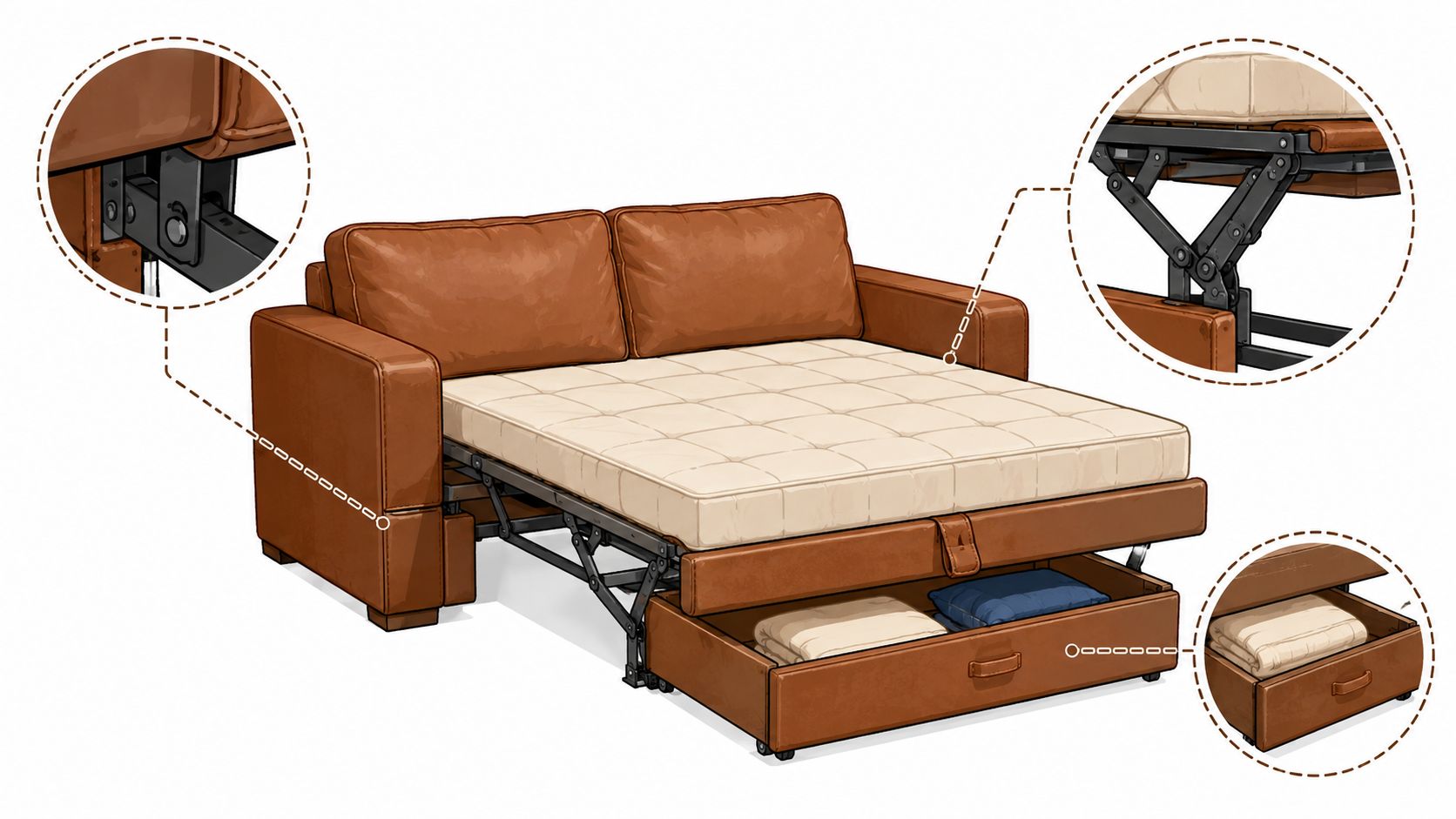
- Check the underlying construction. Ask about frame materials, joinery, mechanism attachment points, and warranty coverage. With the associate's help, inspect accessible connections. A substantial-looking arm does not guarantee a substantial frame.
- Operate and occupy it. Open and close the sleeper, then sit and lie down the way a guest would. Ask for a straight explanation of any wobble, rubbing, or uneven support.
- Load the storage realistically. With permission, test real bedding or compare its packed dimensions against the opening and interior. Contents should stay clear of moving hardware.
Our checklist of things to look for in a new sofa or chair adds more questions worth asking about the furniture beneath the upholstery.
Put abrasion numbers in their place
A frequent-use upholstery benchmark is at least 15,000 Wyzenbeek double rubs or 25,000 Martindale cycles, but those figures primarily describe textiles and shouldn't replace leather thickness and finish specifications. Both methods are defined in published test standards, including ASTM D4157 for the Wyzenbeek procedure, so you can verify exactly what the numbers measure before leaning on them.
For a leather sofa bed that hosts guests several nights a week, the stronger purchasing priorities are documented upholstery construction, reinforced contact points where the sleeper frame meets the deck, and a warranty that separates structural failure from cosmetic wear.
Storage needs its own scrutiny. A drawer, a lift-up compartment, and the cavity beneath a chaise each answer a different access question. The model on the floor should demonstrate the advertised arrangement, because a catalog illustration proves nothing about daily use.
A compact phone checklist keeps the visit focused:
- Construction: Materials and attachment points explained.
- Comfort: Both seating and sleeping positions tested.
- Operation: Conversion completed without forcing.
- Coverage: Frame, mechanism, and upholstery terms understood.
No engineering degree required. Clear answers and written specs are what leave the showroom with you.
The Mattress Inside the Sofa
The leather attracts attention, but the sleeping surface deserves a separate decision. A guest shouldn't have to discover the mattress's limitations after the room lights go out.
Start by confirming whether the mattress detaches or forms part of an integrated sleeping platform. That distinction affects replacement questions as well as compliance. For detachable mattresses, ask which replacements the frame is designed to accept.
Evaluate the whole sleeping system
Innerspring, memory foam, and hybrid descriptions are starting points for a comfort test, not reliable rankings. Compare pressure at the shoulders and hips, ease of turning, and support beneath the lower back. A shopper should also check whether transitions, edges, or underlying hardware are noticeable.
Thicker isn't automatically compatible. Any proposed replacement must meet the mechanism's permitted dimensions and folding requirements. BILTRITE's sleeper sofa mattress replacement guide is useful preparation for that conversation.
Ask the associate to distinguish between what the current frame accepts and what merely shares a familiar mattress size name. Obtain the actual measurements and replacement specifications rather than planning to improvise later.
- Comfort: Test the sleeping position the intended guest usually prefers.
- Compatibility: Confirm approved length, width, thickness, and construction.
- Bedding: Ask which sheets and protectors fit the actual sleeping surface.
- Closure: Confirm what must be removed before folding the bed away.
Treat compliance as a separate question
The Consumer Product Safety Commission's upholstered furniture guidance states that furniture covered by 16 C.F.R. Part 1640 must comply with TB 117-2013, while detachable sofa-bed mattresses generally fall under mattress rules, including 16 C.F.R. Parts 1632 and 1633. Request the applicable documentation for the furniture and mattress instead of assuming a sofa label covers everything.
BILTRITE also has a broad mattress department for households comparing a guest sleeper with a dedicated bed. That comparison matters when overnight use becomes routine.
Good enough for occasional guests is a reasonable standard. It shouldn't become an excuse to skip the comfort test or accept unclear compatibility.
Measuring Your Space Before Delivery Day
The closed sofa dimensions are only the beginning. A workable plan must account for delivery, conversion, storage access, and movement around the opened bed.
A room can accommodate the sofa against a wall yet become awkward once the bed extends. A bedside route, nearby desk chair, or closet door may become the deciding constraint. Marking the arrangement on the floor makes those conflicts easier to spot before delivery.
Save this measurement checklist
- Closed footprint: Record the sofa's overall width, depth, and height.
- Opened footprint: Obtain the fully extended dimensions and any clearance behind the back.
- Operating space: Allow room for the person opening the bed and accessing storage.
- Delivery route: Measure entrances, interior doors, stairways, landings, turns, and elevator access where relevant.
- Compartment opening: Check whether the intended pillows and folded bedding can pass through it.
- Usable interior: Measure around hinges, supports, and other obstructions rather than relying on exterior dimensions.
BILTRITE's sofa bed dimension guide can help organize the room measurements. Photographs of narrow approaches and stair turns also give the delivery team useful context.
BILTRITE carries come-apart sofas and sectionals, but shoppers shouldn't assume a particular sleeper disassembles the same way. The delivery plan needs confirmation for the exact model.
Measure the route the furniture must travel, not just the space where it will finish.
Give stored bedding room to breathe
Storage beneath a sofa bed isn't a moisture-proof container. The guidance on under-bed storage and mold prevention recommends breathable fabric storage and airflow gaps rather than tightly packed plastic containers.
Store only clean, fully dry textiles, avoid overfilling, and periodically allow air to circulate. Bedding that feels almost dry still doesn't belong in a closed compartment.
The final room plan should also identify where removed cushions and the coffee table will go. A storage compartment may hold linens without accommodating every loose sofa cushion. Planning those temporary landing spots keeps a compact guest room usable when company arrives.
Care Habits That Make It Last
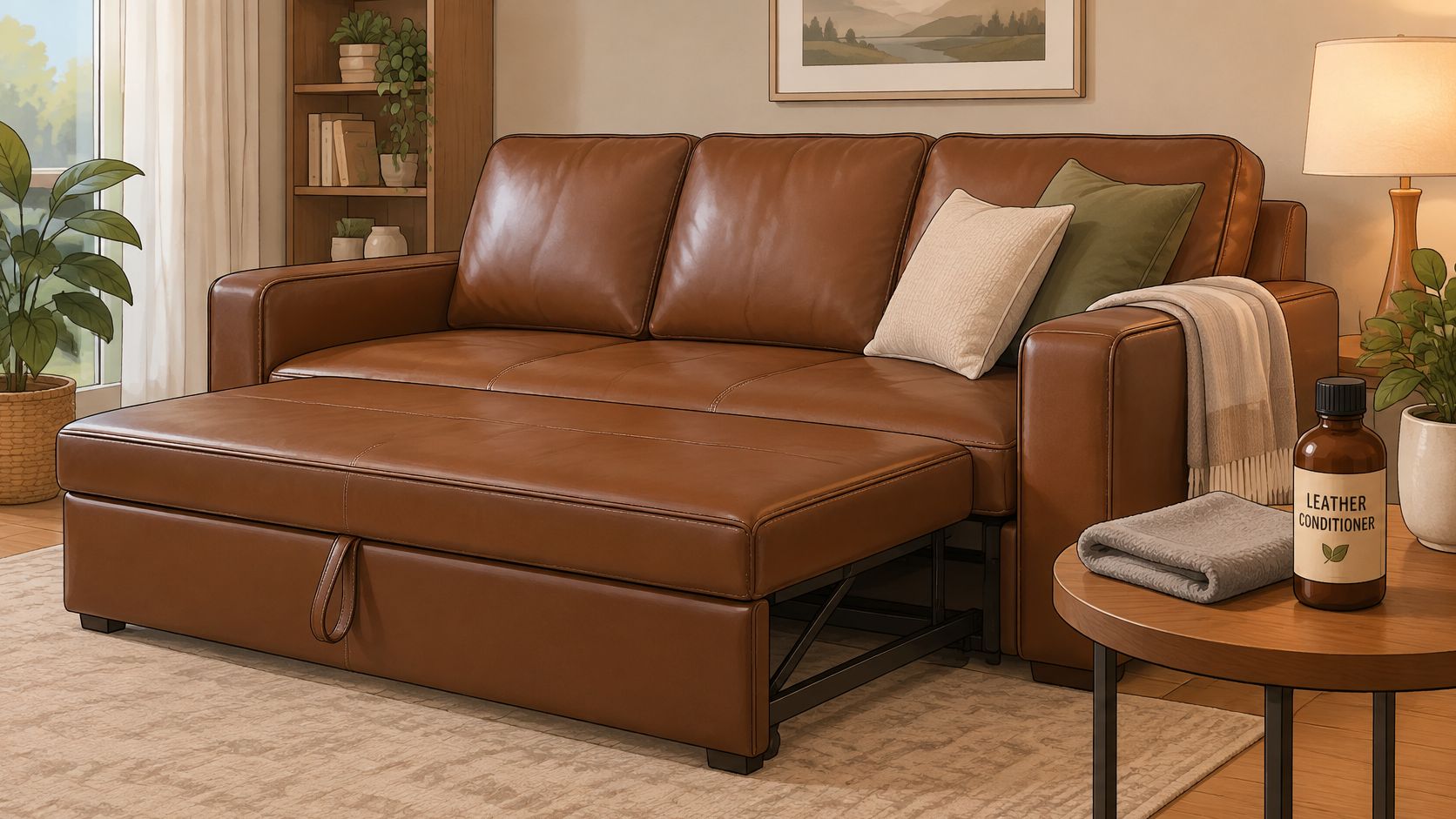
A leather sofa bed earns its keep when everyone uses it, so keep care simple enough to stick with. Ask the furniture maker for instructions specific to the upholstery finish, including whether conditioner is suitable and which products to avoid.
In our showroom, we recommend wiping away dust with a soft, dry cloth or vacuuming with an appropriate attachment. Dust left on the surface can contribute to wear. Blot spills promptly with a clean, dry, white cloth; rubbing can spread the mark or work it deeper into the leather.
Keep the routine simple
- Remove dust gently: Use a soft cloth or a suitable vacuum attachment.
- Blot spills promptly: Lift moisture without scrubbing the surface.
- Treat stains according to the finish: A lightly dampened white cloth may suit some water-based stains. Don't use water on oil-based stains.
- Follow the maker's instructions: A general leather cleaner or conditioner may not suit every covering.
A cleaner's label doesn't tell you whether it's right for your sofa. Follow the upholstery maker's care directions.
Choose a sensible location
Keep the sofa bed away from heaters and strong, direct sunlight, which can dry leather and fade its color. Check the spot in both sofa and bed configurations so the opened sleeper also stays clear of heat and sun.
At our family-owned Milwaukee showroom, we've helped generations of local families furnish smaller homes and guest rooms. The right choice balances upholstery care with everyday use, storage needs, and the way the sleeper operates. BILTRITE carries small-scale and heavy-duty furniture, including USA-made, Amish-made, and solid-wood pieces, with an emphasis on affordable, better-quality options.
BILTRITE doesn't sell online, and the showroom is closed Sundays and Mondays for family time. Associates can help you test comfort, operate the sleeper, and ask care questions in person, without pressure.
For leather seating, sleeper options, and help balancing comfort with storage, BILTRITE Furniture-Leather-Mattresses offers affordable, better-quality furniture and mattress guidance. Bring room measurements and bedding requirements to the Greenfield showroom to test comfort, compare available mechanisms, and ask questions in person.