Entertainment Center with Glass Doors: A Smart Buyer’s Guide


A family in Metro Milwaukee has just brought home a new television. The screen looks sharp, but the living room quickly fills with game consoles, remotes, streaming boxes, cables, movies, and a few favorite decorations. A well-chosen entertainment center with glass doors can bring order to that setup without making the room feel heavy or closed in.
Glass doors aren't only about appearance. They affect dust control, remote signals, ventilation, child safety, cleaning, and the way a cabinet's materials perform over time. Since 1928, the fourth-generation, family-owned furniture store in Greenfield has helped local households think through those everyday details, from small-scale apartment pieces to sturdy furniture for busy family rooms.
Table of Contents
- Why a Glass-Door Entertainment Center Is Worth a Second Look
- Popular Styles to Match Your Living Room
- Must-Have Features for Real-Life Use
- Choosing the Right Glass for Safety and Style
- Sizing Your TV and Your Cabinet the Right Way
- What the Cabinet Is Really Made Of
- Setting It Up Safely in Your Home
- Care, Maintenance, and Seeing It in Person
Why a Glass-Door Entertainment Center Is Worth a Second Look
The family starts by placing the television on a low console. The game system sits beside it, controllers spread across the shelves, and cords trail toward the wall. A glass-door cabinet changes the scene quickly. Consoles, media players, remotes, and accessories stay organized behind the doors, while the room still feels open because the contents remain visible.
The clear panels also make daily use easier. A remote can often communicate with equipment through glass, so the doors don't need to stay open every time someone changes a program or starts a game. Components remain easier to see than they would behind solid doors, which helps when a family needs to check a power light, locate a controller, or reach a disc.
A calmer look with useful protection
Glass can limit dust entering an enclosed compartment, although it doesn't replace regular cleaning. It also gives a solid-wood cabinet a lighter visual presence. That balance works well in a traditional living room where a completely solid cabinet might feel bulky, but an all-open shelf could look unfinished.
Shelves behind glass can hold framed photos, collectibles, or children's artwork. Those items remain part of the room's decoration while gaining some protection from curious hands and accidental bumps. Heavy or valuable objects still need secure placement, and glass doors shouldn't be treated as childproof barriers.
Television furniture became a recognizable household category because television ownership expanded widely. The International Telecommunication Union's worldwide television ownership data reported approximately 1.4 billion households with at least one television in 2009, representing about 79% of households worldwide and giving roughly 5 billion people access to television at home. The same data showed ownership rising from 73% of households in 2002 to 79% in 2009.
Practical rule: Glass doors solve a visibility and storage problem. They don't solve stability, ventilation, or child-safety problems by themselves.
That distinction matters as the family compares cabinets. The right questions involve more than finish and shelf space. Buyers should ask what kind of glass is used, how the cabinet handles heat from electronics, what the case is made of, whether the top supports the television, and how the unit attaches to the wall.
Popular Styles to Match Your Living Room
Different rooms call for different shapes. A low console, a tall wall unit, a corner cabinet, and a hutch-style piece can all include glass doors, but they create very different traffic patterns and storage options.
| Style | Best For | Footprint | Storage |
|---|---|---|---|
| Low console | Open-concept rooms and modern screens | Wide and low, usually close to the wall | Components, games, remotes, and selected display items |
| Full wall unit | Traditional or craftsman rooms needing extensive storage | Tall and broad, often covering much of one wall | Electronics, books, speakers, display pieces, and cabinets |
| Corner center | Rooms where two walls meet or floor space is limited | Triangular or angled footprint | Compact media storage with room for decorations |
| Hutch-style piece | Homes combining television storage with display space | Solid lower base with an upper cabinet | Media equipment below, collectibles or dishes behind glass above |
Low console living
The low console usually suits a room where the television is mounted above the cabinet or sits on a broad top. It keeps the sightline open and works well in an apartment, condo, or open-concept living area where tall furniture could interrupt the flow between rooms. The tradeoff is limited vertical storage, so it suits households that don't need a place for a large book collection or extensive display pieces.
A full wall unit makes a stronger architectural statement. Tall towers can hold books and decorations, while bridging shelves may frame a television and leave space for speakers. This format suits a larger traditional or craftsman-style room, but the height and width need careful measurement before delivery.
Corner and hutch options
A corner entertainment center can turn an awkward junction into a useful focal point. It keeps the main walking path clearer than a wide cabinet might, making it practical for compact rooms or layouts with multiple doorways. The television viewing angle deserves attention, since a corner placement can affect seating and glare.
A hutch-style cabinet places glass-door storage above a substantial lower base. It can display memorabilia, dishes, or framed objects beside the television, but upper storage creates more forward pull if the piece isn't secured properly. Shoppers comparing furniture styles can review different furniture types and styles before narrowing the selection.
The best choice depends on more than the room's decorating style. A family with children and game equipment may need a low, stable base with closed lower storage. A collector may prefer glass display space. Someone furnishing a smaller home may gain more from a corner format than from a tall wall unit.
Must-Have Features for Real-Life Use
A pretty cabinet can become frustrating if its practical details don't match the household. The useful features are the ones that prevent small daily annoyances from becoming repeated problems.
Shelves that adapt
Adjustable shelves let a cabinet change with the equipment. A streaming box may fit on one shelf today, while a taller receiver or center-channel speaker may need more room later. Shelf pins should seat fully, and the shelf should feel stable when equipment is moved.
Ventilation openings matter because electronics create heat during use. Look for slots, perforated grilles, or open rear areas that allow air to move around consoles, receivers, and media boxes. A Saturday movie session or long gaming period puts more demand on airflow than a short television program.
Cables and doors
Cable management keeps power cords and HDMI cables away from the front of the cabinet. Rear cutouts, grommets, and channels can make the setup easier to service without leaving a visible tangle. Cords should still remain accessible enough for safe unplugging, and openings shouldn't be so tight that they pinch cables.
Soft-close hinges reduce slamming. That protects the household's peace when a child is sleeping and reduces repeated impact on the door and frame. A gentle closing action can also indicate that the hinges are properly seated and adjusted.
Door clearance deserves a real-life test. An outward-opening door may meet a sofa arm, side wall, doorway, or nearby lamp. In a showroom, the family should open each door fully and imagine removing a console from the shelf, not just standing back to admire the closed cabinet.
A cabinet also needs enough room around its electronics. Glass may contain visual clutter, but it shouldn't block the airflow specified for the equipment. Product documentation should explain the intended loading and ventilation arrangement.
Choosing the Right Glass for Safety and Style
The glass panel is only one part of the safety system, but it deserves careful attention. Ordinary annealed glass isn't the preferred choice for furniture doors where impact is possible.
The National Glass Association explains that tempered glass is approximately four times stronger than comparable annealed glass and breaks into substantially smaller fragments after impact. Laminated glass uses a polymer interlayer that helps hold broken pieces together. Buyers can review the association's furniture glass safety guidance when discussing specifications with a showroom associate.
| Feature | Tempered Glass | Laminated Glass |
|---|---|---|
| Break behavior | Breaks into smaller fragments after impact | May crack while remaining attached to the interlayer |
| Main benefit | Greater strength and reduced laceration risk compared with annealed glass | Helps retain fragments after breakage |
| Useful setting | Hinged or sliding furniture doors with regular household use | Homes prioritizing added retention around children or high traffic |
| Buyer check | Look for permanent safety marking and seated edges | Confirm the interlayer and applicable compliance marking |
For larger panels, ASTM F2813 provides a procurement benchmark. Panels measuring at least 9 square feet, or 0.84 square meters, should meet ANSI Z97.1 Class A performance, while smaller panels should meet at least Class B, according to the cited National Glass Association guidance. The panel should be permanently marked as tempered or laminated and identify applicable compliance.
Style and signal considerations
Clear glass keeps the cabinet bright and makes equipment easy to see. Frosted glass hides some visual clutter, while bronze-tinted glass adds warmth. Low-iron glass offers a clearer appearance, but any tinted or treated panel should be tested with the household's remotes because signal strength can vary.
The frame matters as much as the pane. Buyers should inspect door edges for chips, ask whether the glass sits in a full perimeter frame, and check that hinges or pivots are properly seated. A panel can be strong across its center yet vulnerable to concentrated edge loads, repeated impacts, or misaligned hardware.
A nearby glass furniture collection can help shoppers compare clarity, framing, and edge details in person. The associate should also explain certification marks, replacement terms, and warranty coverage before the cabinet leaves the showroom.
Sizing Your TV and Your Cabinet the Right Way
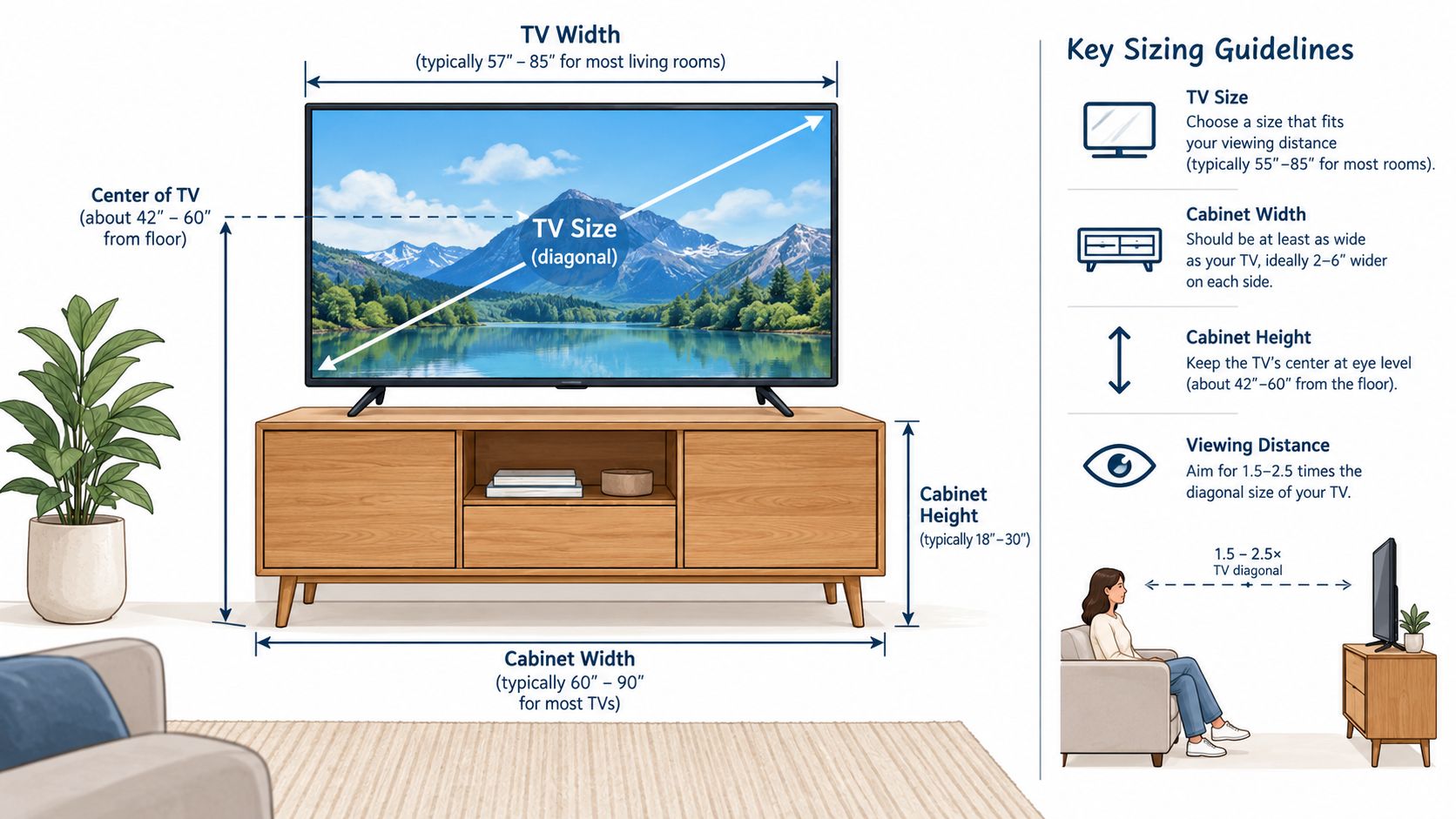
Television size is advertised by diagonal measurement, but a cabinet must support the actual width, height, stand footprint, and weight. A measuring tape prevents a costly mismatch.
Start with the television
Measure the television with its stand attached if the screen will sit on the cabinet. Record the full width, height, depth, and stand footprint. Compare those measurements with the cabinet's usable top surface and interior opening rather than relying only on the listed screen size.
A television should sit fully on the intended surface without an unstable overhang. The top must also be explicitly rated for the television's weight and footprint. Add the weight of any center-channel speaker or other item placed on the same surface, then compare the combined load with the manufacturer's rating.
Viewing distance is another part of the fit. For 4K televisions, Sony's guidance recommends sitting about 1.5 times the TV's vertical screen height from the display. Its examples include approximately 39 inches for a 55-inch 4K TV, 47 inches for a 65-inch model, 55 inches for a 75-inch model, and 63 inches for an 85-inch model, as shown in Sony's television viewing guidance. For high-definition television, the same guidance recommends roughly three times the screen's vertical height.
Match the cabinet to the wall
A cabinet shouldn't look stranded beneath a large screen, but it also shouldn't crowd a narrow wall. A useful visual rule is to choose a console that relates to the wall's width while leaving breathing room around nearby doors, windows, and walkways. The exact proportion depends on the room, so photographs and a simple floor sketch can help.
Measure the seating location before choosing the cabinet. The screen may fit beautifully on the furniture, yet viewers could end up too close, too far away, or off to one side. More guidance on placement is available in this guide to finding an optimal television position.
What the Cabinet Is Really Made Of
Glass doors reveal the contents, not the quality of the cabinet beneath them. The case, back panel, shelves, joinery, finish, and adhesives determine how the unit handles equipment weight, heat, movement, and years of opening and closing. Those hidden details matter in a busy family living room.
| Material | Strength | Cost | Best Use |
|---|---|---|---|
| Solid hardwood | Strong, repairable, and visually distinctive | Often higher | Long-term furniture with substantial shelves and a durable case |
| Furniture-grade plywood | Stable and strong across broad panels | Moderate to higher | Cabinet sides, shelves, and cases requiring dimensional stability |
| Veneered MDF | Smooth and consistent for finished surfaces | Moderate | Stable painted or veneered panels away from concentrated edge damage |
| Particleboard | Functional when properly supported and sealed | Often lower | Budget construction with careful loading and protected edges |
Solid oak, maple, and walnut add warmth and can last for years, although wood movement still requires sound construction. Furniture-grade plywood works well for broad panels because it combines strength with stability. Veneered MDF provides a smooth surface for painted or wood-look finishes. Particleboard can serve in budget construction when its edges are protected, its panels are well supported, and its hardware is properly fitted. For a closer comparison, see a comparison of solid wood versus particleboard construction.
Ask about the hidden surfaces
The back panel should contribute to the cabinet's structure rather than serve as a thin cover. A reasonably substantial back can help the case stay square while leaving room for practical cable routing and ventilation. In the showroom, inspect the corner joinery, shelf supports, and hinges or other hardware connecting the doors to the case.
Drawer boxes, if included, offer another useful clue. Dovetail or doweled joints may suggest careful construction, but examine the surrounding case as well. A thin spray finish may look appealing at first, while a catalyzed conversion varnish or properly applied hand-rubbed oil finish provides different surface protection. Ask the associate to identify the actual finish instead of judging the whole cabinet through its glass.
Indoor air quality belongs in the material discussion. The Environmental Protection Agency identifies pressed-wood products made with urea-formaldehyde adhesives as important household sources of formaldehyde. Its formaldehyde and indoor-air-quality guidance recommends ventilation, moderate humidity, and lower-emitting materials, and explains that furniture can contribute to indoor sources, with peak exposures expected within the first year after manufacture or use.
Material question: Ask whether the case, shelves, and back panel are solid wood, plywood, MDF, or particleboard. Then ask what documentation covers emissions and finish materials.
A glass front does not confirm low emissions. After delivery, ventilation can help clear new-furniture odors, while sealed surfaces may reduce contact with unfinished panels. Ask for applicable emissions certifications or manufacturer documentation rather than relying on appearance.
Setting It Up Safely in Your Home
A family room can look perfectly arranged until a glass door hits a sofa arm, a cord crosses the walking path, or a child pulls on a handle. Set up the entertainment center with those everyday moments in mind. Choose a level location with room for the doors, cords, airflow, and seating. Keep the unit away from radiators and prolonged strong sunlight, which can stress finishes and affect materials.
Build the anchoring plan first
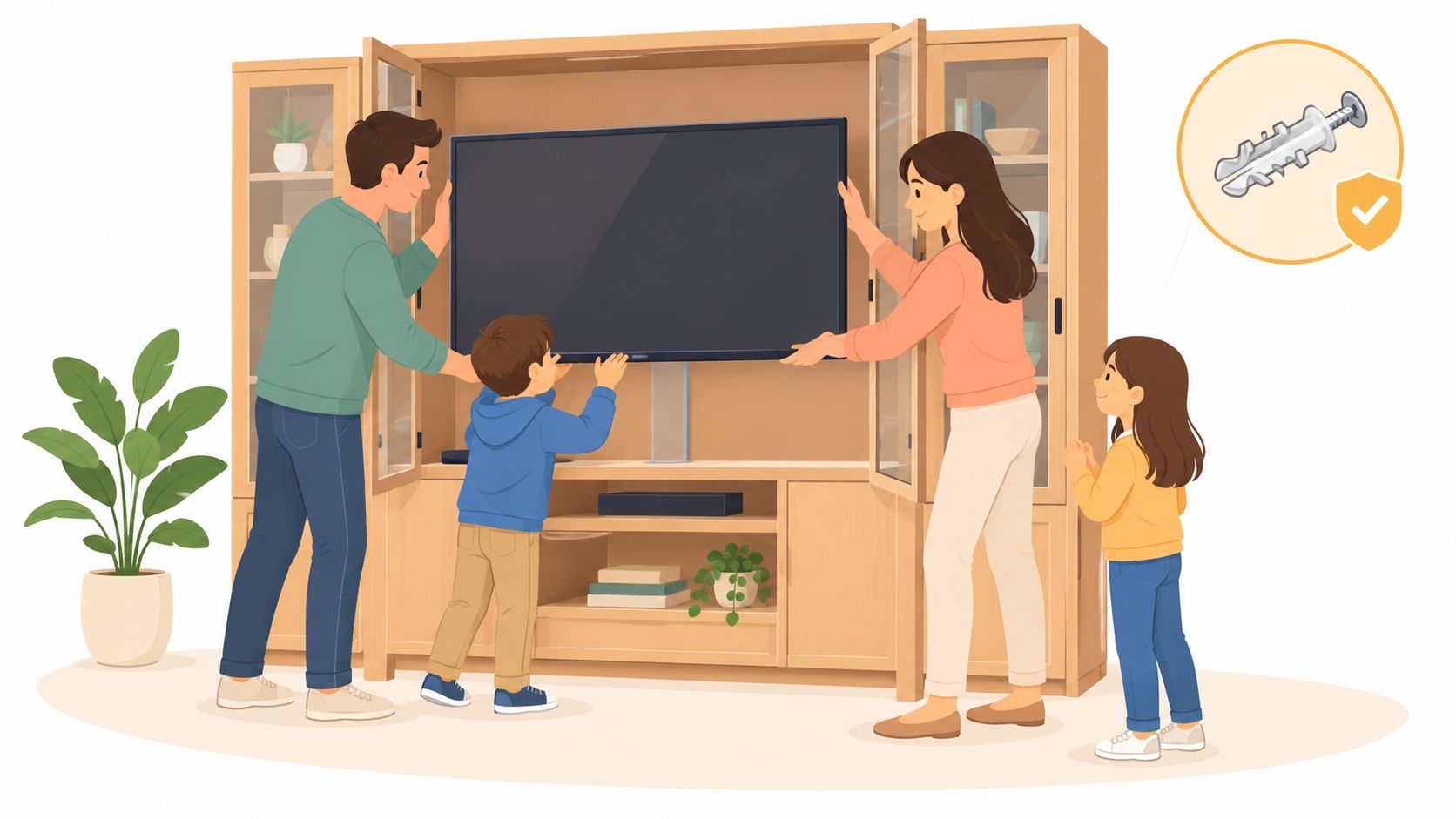
Before moving the cabinet into place, locate wall studs with a stud finder and mark the connection points. Install the supplied anti-tip restraint as soon as the furniture is positioned. A tall wall unit may need a stronger strap system approved for both the furniture and the wall construction. If your room layout calls for a different approach, review a guide to wall-mounted television units before deciding where the cabinet and screen will go.
The risk deserves attention. The U.S. Consumer Product Safety Commission reported 592 furniture-, television-, and appliance-tip-over fatalities between 2000 and 2021, with 81% involving children younger than 18. Of the 482 child fatalities, 88% involved children under age five, and 70% of child fatalities involved a falling television, according to the CPSC Anchor It safety information.
The agency also reported that 93% of television tip-over incidents involved head injuries. Opening a glass door can shift weight forward, while a child pulling a handle or reaching for a remote can create a sudden load. Anchoring both the furniture and television reduces that stability risk.
Use a room-by-room check
Living room: Place the television on a sturdy, low base designed to support it. Keep heavier components on lower shelves, and move toys, remotes, and appealing objects away from the edges.
Cable route: Use built-in grommets or a properly finished rear opening. Keep power cords out of walking paths, and prevent HDMI cables from hanging where children can pull them or pets can chew them.
Door area: Open each glass door fully. Check clearance from walls, sofa arms, lamps, and doorways. The door should close flush without rubbing.
Electronics area: Leave the equipment's required ventilation space open. A convenient upper glass compartment is still the wrong place for a heavy component if it blocks airflow or raises the center of gravity.
CPSC guidance recommends sturdy, low furniture, placing the television as far back as possible, keeping cords out of children's reach, and using furniture designed to hold the television. Families unable to anchor should follow the agency's television and furniture safety precautions, though anchoring remains the stronger choice whenever possible.
After the household has used the cabinet for a while, inspect the hardware again. Retighten hinges and anchor connections after relocation or seasonal rearrangement, and check that doors still latch evenly. Keep magnets, remotes, and game controllers out of reach when young children are present.
Care, Maintenance, and Seeing It in Person
A glass-door entertainment center stays attractive when cleaning is simple and consistent. Dust the wood frame with a microfiber cloth, then apply a streak-free glass cleaner to the cloth rather than spraying directly onto the panel. Direct spray can run into seals, hinges, or the cabinet interior.
Glass benefits from an anti-static cloth, especially in a home where dust quickly gathers around electronics. Tempered and laminated panels still need inspection for chips along the edges. A small edge defect deserves attention because doors experience repeated movement and concentrated loads around hinges and pivots.
Keep the hardware working smoothly
Soft-close hinges should move quietly and stop the door without a hard impact. Tighten loose screws as part of seasonal furniture care, but don't force a screw that no longer holds securely in the case. A silicone-based spray can help lubricate suitable hinge mechanisms when the product instructions allow it.
Magnetic catches can wear or shift. If a door starts drifting open, check alignment before replacing parts. A flush-closing door protects the contents from dust more effectively and reduces the chance that someone will catch a shoulder or sleeve on an open panel.
Wood finishes need care suited to their specific coating. A paste wax or furniture polish used every few months may help protect an appropriate finish, particularly during dry winter conditions in Milwaukee. The product's care instructions should take priority, since oil, wax, and spray cleaners aren't interchangeable across all finishes.

Why an in-person visit helps
Photographs rarely show how a door feels when it opens or how clear glass looks under living-room lighting. In a showroom, families can open the doors, test the soft-close action, inspect shelf adjustments, check door clearance, and compare wood tones with existing furniture. A shopper can also bring room photos, wall measurements, television dimensions, and equipment weights so the conversation stays practical.
The Greenfield showroom offers small-scale furniture for apartments and condos, heavier options for active households, American-made and Amish-made solid-wood pieces, custom choices in fabric, leather, wood, finish, and hardware, and a mattress department with more than 60 models. The sales associates bring more than 400 years of combined experience across the team, with an emphasis on helping households choose furniture without pressure. The store is closed on Sundays and Mondays so the family-owned business can protect family time, a value that remains part of its Metro Milwaukee identity.
BILTRITE Furniture-Leather-Mattresses offers entertainment furniture for different room sizes, including consoles, corner media cabinets, and larger storage units, along with USA-made and Amish-made furniture options. Families can bring their television measurements and room photos to BILTRITE Furniture-Leather-Mattresses in Greenfield, open the doors, inspect the construction, and talk through a safe glass-door setup with the showroom team.