Ashley Furniture Mirror: Buying Guide & Alternatives


You’ve got a blank spot on the wall, the dresser looks unfinished, or the bedroom just needs that one last piece to feel pulled together. That’s where a mirror comes in. And for a lot of shoppers, the search starts with a familiar term like ashley furniture mirror.
That makes sense. Ashley is a big, recognizable name, and they offer a wide mix of looks, from bedroom mirrors that attach to dressers to full-length floor mirrors for hallways and closets. But a mirror isn’t only about style. Size matters. Materials matter. Safety matters. And if you care about how a piece will look after years of daily use, construction matters a lot.
As a fourth-generation furniture family here in Metro Milwaukee, we’ve spent a long time helping people sort through those details without making it complicated. A mirror should fit your room, match how you live, and feel worth bringing home. Let’s walk through that together in plain English.
More Than Just a Reflection
A mirror does more work than people expect. It can finish a bedroom set, brighten a darker corner, help a small room feel more open, or give you a last look before heading out the door. That’s why shoppers often start broad. They search styles, compare prices, and look at popular brands first.
An ashley furniture mirror usually comes up early because the brand has broad name recognition and a lot of variety. If you want traditional carved detail, a cleaner casual look, or a decorative floor mirror, there’s a good chance you’ll find something in their lineup that catches your eye. For many homes, that’s a practical starting point.
Still, mirrors can be tricky to shop for online because the photo only tells part of the story. The questions that matter most tend to come later.
What shoppers often miss
People usually focus first on shape and finish. Then practical questions show up:
- Will it fit the wall or dresser correctly
- Will the frame hold up to everyday bumps and moving
- Is it safe for kids, seniors, or busy households
- Does it feel substantial in person or a bit light
- Will it work in a smaller condo, apartment, or bedroom
Those are smart questions. They’re also the difference between a mirror that looks nice for a season and one you’re still happy with years later.
Practical rule: Don’t shop for a mirror as wall decor alone. Shop for it as a piece of furniture with glass in it.
That little shift helps. Once you start thinking about a mirror as both a design piece and a functional household item, your choices get clearer. You stop asking only, “Do I like the look?” and start asking, “Does this make sense for my room, my family, and the long haul?”
A Practical Guide to Ashley Furniture Mirrors
Ashley earned attention in the furniture world by offering a huge range of home furnishings at accessible price points. To understand that scale, consider this: in a court case, the company reported selling 37,000 mirrors as part of just two bedroom collections between 2004 and 2008, and that volume helped it become the largest furniture retailer in the U.S. by 2007, according to the U.S. District Court record in Ashley Furniture Industries, Inc. v. Lifestyle Enterprise, Inc..
That kind of reach explains why so many people encounter Ashley first. The brand has produced mirrors for coordinated bedroom groups, accent collections, and freestanding floor use. If you’re comparing options, it helps to understand what you’re really getting.
The main types you’ll see
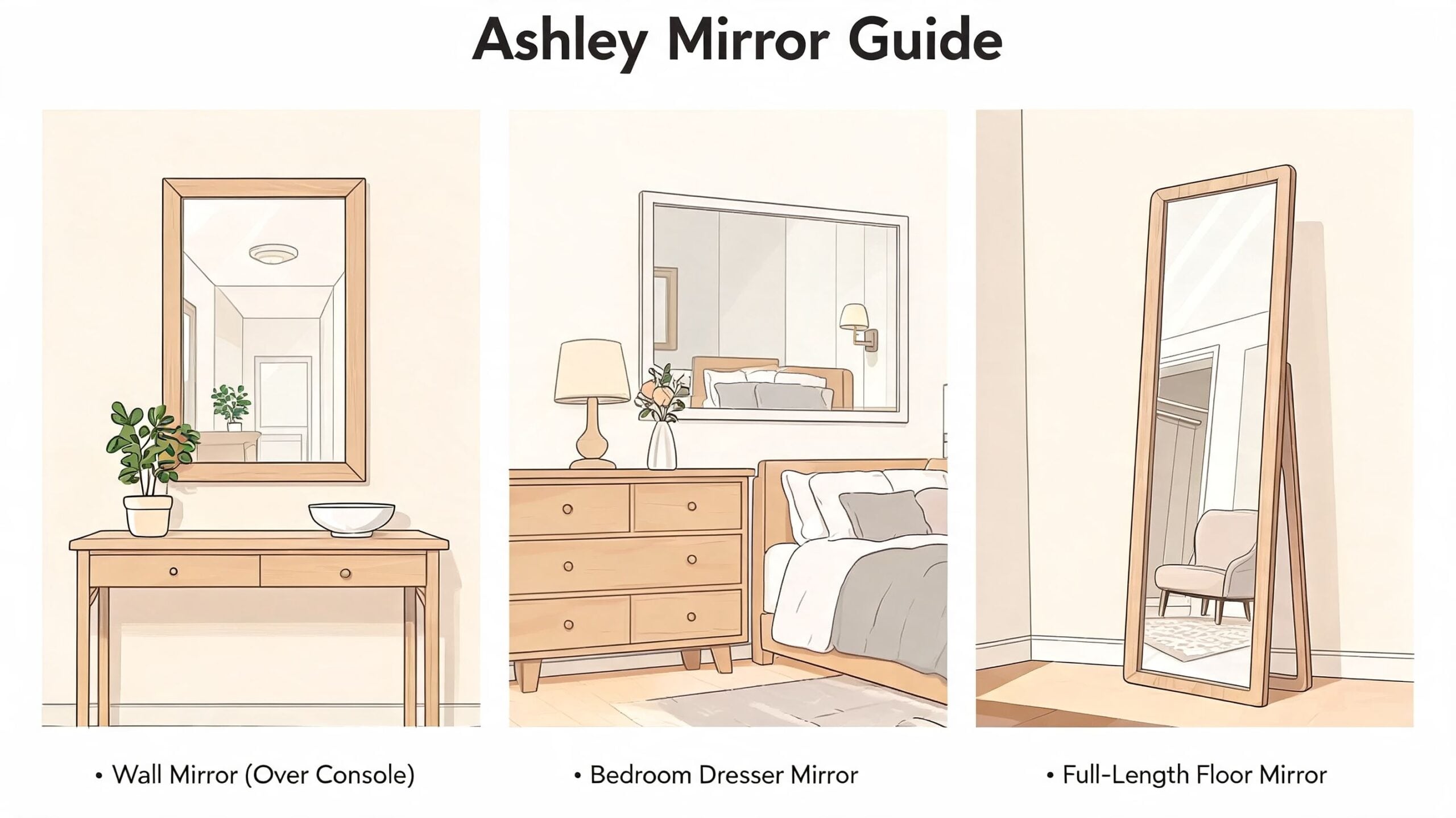
Ashley mirrors usually fall into a few familiar categories:
- Dresser mirrors that pair with a matching bedroom collection
- Accent wall mirrors that act more like decor
- Full-length floor mirrors for bedrooms, dressing areas, or entry spaces
Each type serves a different purpose. A dresser mirror leans toward everyday function. A floor mirror helps with full outfit checks and can visually open up a room. A decorative wall mirror is often more about balance, brightness, and style.
Why Ashley appeals to so many shoppers
Ashley’s strength is variety. You’ll see ornate traditional frames, simpler farmhouse-inspired options, glam looks, and more contemporary designs. That wide style range makes the brand approachable for shoppers who want a coordinated room without hunting through a dozen stores.
Materials are a big part of that equation too. In mass-market furniture, mirrors are often built with engineered wood, veneers, decorative laminates, resin details, or mixed materials. Those choices can help keep costs lower and allow manufacturers to produce many looks at scale.
That doesn’t automatically make a mirror bad. It just means you should know what you’re paying for. Some shoppers are happy to prioritize appearance and budget. Others want heavier construction and more natural materials.
A mirror can look rich in a photo and still be built for value first. That’s not a flaw. It’s just a buying category.
If you’re reading product listings, pay close attention to the wording. Terms like engineered wood, laminate, veneer, poly resin, or mixed materials tell you a lot about how the piece is made. If you want help interpreting those labels, this guide on how to read furniture product descriptions and buy with confidence is useful.
Where shoppers can get confused
The biggest confusion usually comes from mixing up style value with material value.
A mirror may offer:
- a fashionable finish,
- a coordinated look with a dresser,
- and a wallet-friendlier price,
but still not deliver the same long-term feel as a solid wood piece.
That’s why Ashley mirrors are often a sensible baseline. They show what’s popular, what sizes are common, and what design directions are available. Then you can decide whether that level of construction matches your home and expectations.
How to Choose the Right Mirror for Any Room
Brand matters less once you know what the room needs. A good mirror choice starts with function first, then scale, then style. If you reverse that order, you can end up with a pretty piece that feels awkward on the wall.
Living room and dining room placement
In a living room, a mirror often works best when it has something to relate to. That might be a sofa, a mantel, or a console table. You want it to feel connected, not like it’s floating by itself.
In a dining room, mirrors can help bounce light around and make evening gatherings feel warmer. A framed mirror can also break up a big blank wall without the visual heaviness of a cabinet or artwork set.
A few practical checks help:
- Keep the scale believable so the mirror doesn’t overpower the furniture below it.
- Watch reflections because what the mirror shows matters as much as the mirror itself.
- Think about height so people see themselves naturally, not just the ceiling fixture.
Designer’s shortcut: Stand where you usually sit or walk. If the mirror reflects a window, lamp glow, or a pleasant part of the room, you’re on the right track.
Bedroom mirrors and dresser mirrors
Bedrooms are where shoppers most often search for an ashley furniture mirror, especially when they want a mirror that matches a dresser. This is one area where dimensions really matter.
For example, the Ashley Realyn bedroom mirror measures 44 inches wide by 40 inches high, with a slim 2.63-inch depth, according to the Realyn mirror listing. That depth is practical because it doesn’t stick out far from the wall or dresser area.
Here’s why that matters. A bedroom mirror that’s too deep can feel bulky in a narrower room. A slimmer profile often looks cleaner and is easier to live with in tighter spaces.
If your bedroom is compact, this kind of planning matters even more. You might enjoy this article on how to make a small room feel big, especially if the mirror is part of a broader space-saving plan.
Entryways, hallways, and full-length use
Full-length mirrors are great near bedrooms, closets, or entry areas, but they need enough breathing room. You want enough distance to step back and use them. In a tight hallway, a wall-mounted mirror may make more sense than a floor model.
Here’s a quick comparison:
| Room | Best mirror role | Main thing to watch |
|---|---|---|
| Bedroom | Dresser mirror or full-length | Width and depth |
| Living room | Decorative focal point | Reflection and proportion |
| Dining room | Light-enhancing accent | Placement across from light |
| Entryway | Last-look mirror | Traffic flow and safety |
The best mirror is rarely the biggest one. It’s the one that fits the furniture around it, reflects something useful or attractive, and doesn’t create hassle in daily life.
The BILTRITE Difference Why Shopping Local Matters
There’s a big difference between seeing a mirror on a screen and standing in front of it in person. You notice the finish. You notice whether the frame feels light or substantial. You notice whether the color works with your room or only looked good under studio lighting.
That’s one reason local furniture stores still matter so much. You’re not guessing. You’re comparing real pieces with real help from people who do this every day.

Why in-person shopping changes the decision
A mirror can fool you online. Finishes can read warmer or cooler than they really are. Frame thickness can be hard to judge. And it’s not always easy to tell whether a piece feels sturdy or just looks the part.
In a showroom, shoppers can do what matters most:
- Check the frame closely for finish quality and construction details
- Compare sizes side by side instead of guessing from dimensions
- See color accurately under normal indoor lighting
- Ask better questions about materials, delivery, and fit
That kind of shopping is slower in the best way. It gives people room to make a confident choice instead of a rushed one.
Family ownership changes the experience
A family-run furniture store tends to look at the purchase differently. The goal isn't just to move a box. It's to help someone furnish a home well. That usually leads to better conversations about durability, room size, and whether a piece fits the way a customer lives.
For shoppers who care about buying American-made furnishings, local stores often make that process easier too. If that matters to you, this overview of USA-made furniture stores is a helpful place to start.
Local shopping gives you something a product page can’t. Context. You get to ask, compare, and make a decision with your hands and eyes, not just a mouse click.
There’s also a community side to it. When people buy from long-standing local businesses, they support local jobs, local service, and the kind of showroom experience that still values conversation over pressure. In Metro Milwaukee, that matters. Furniture is personal, and it’s easier to get it right when you’re dealing with neighbors.
Exploring Our USA-Made and Amish-Made Mirror Collections
The conversation then shifts from style alone to craftsmanship. A lot of shoppers start with a popular brand, then realize they want something with more substance. That’s often when they begin looking at USA-made and Amish-made mirrors.
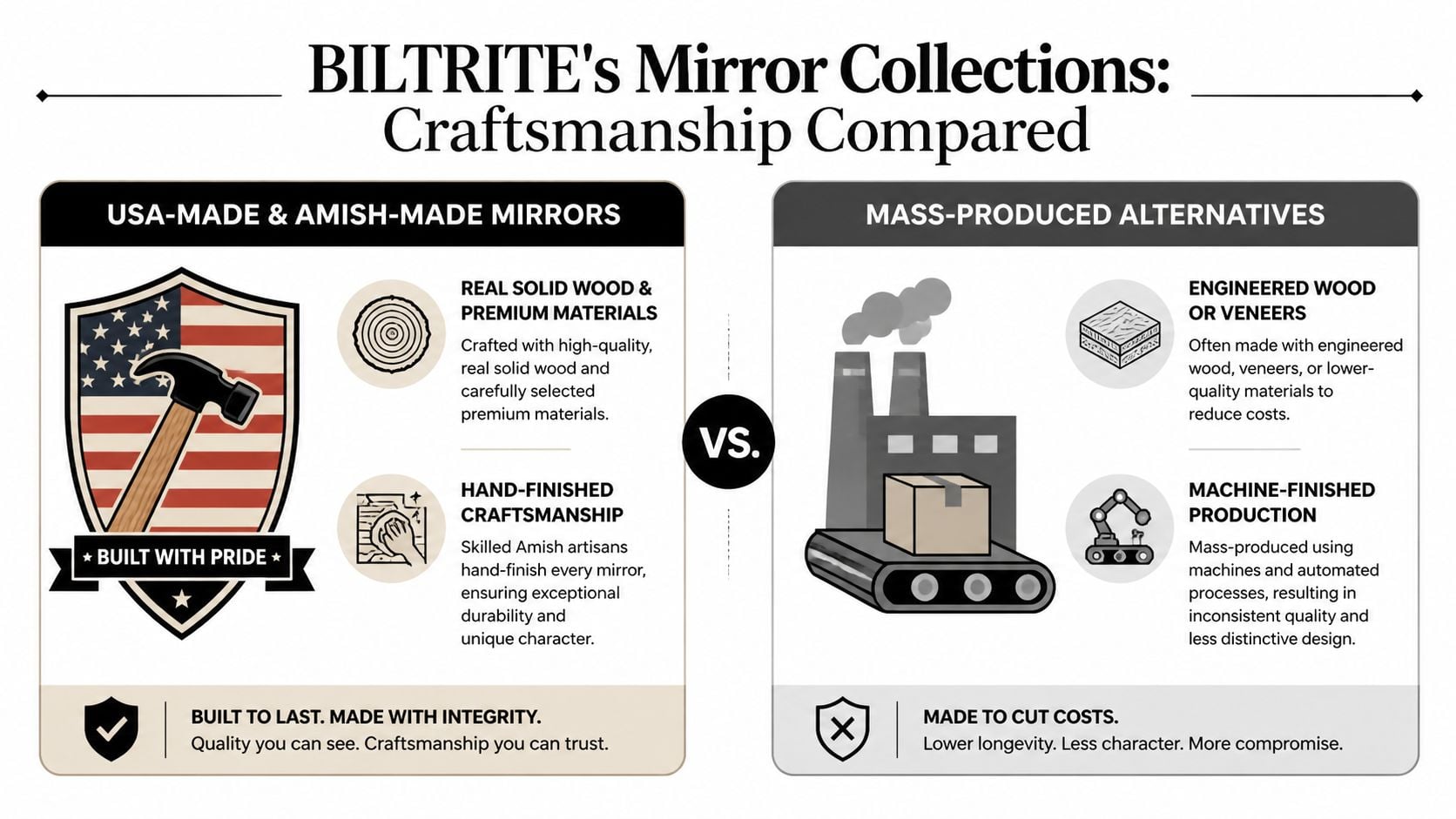
The big difference usually comes down to materials, joinery, and finish work. A mass-produced mirror may deliver a look. A solid wood mirror is more likely to deliver a look plus staying power.
What shoppers are really asking
Many people don’t phrase it in technical furniture language. They ask things like:
- Will this frame chip easily?
- Is this real wood or just made to look like wood?
- Will it still look good after moves, kids, pets, and regular cleaning?
- Does it feel like something built to last?
Those are fair questions. And they matter because many shoppers worry about the long-term durability of frames made from particle board or veneers. Consumer reviews for some mass-market brands occasionally mention frame fragility, which is one reason solid wood options stand out for lasting strength, as noted in this discussion around mass-market mirror construction concerns.
A side-by-side way to think about it
| Feature | USA-made and Amish-made mirrors | Mass-produced alternatives |
|---|---|---|
| Frame material | Often real solid wood | Often engineered wood, veneers, or mixed materials |
| Construction feel | More substantial and furniture-like | Can vary widely by model |
| Finish character | Often hand-finished or detail-oriented | Often more uniform and production-driven |
| Long-term appeal | Strong for buyers who value durability | Strong for buyers focused on look and budget |
That doesn’t mean every mass-produced mirror is a poor choice. It means the buying priorities are different. One category leans toward speed, scale, and price accessibility. The other leans toward craftsmanship, repairability, and longer ownership.
Why Amish-made pieces get so much respect
Amish-made furniture has earned its reputation the old-fashioned way. Builders focus on careful woodworking, solid materials, and time-tested construction. Many shoppers love that these pieces don’t feel disposable. They feel grounded.
Another bonus is flexibility. Amish furniture often gives buyers more say in wood species, finish tone, and matching pieces. That’s a major advantage if you’re trying to coordinate a bedroom or dining room without settling for a close-enough look.
If you’d like a deeper look at what sets those pieces apart, this article on the advantages of Amish furniture lays it out well.
Worth remembering: Solid wood doesn’t just change how a mirror looks. It changes how it ages.
Why this matters in real homes
A mirror frame gets touched, dusted, bumped, and moved. In busy households, that’s not a small thing. The frame around the glass is doing real work. If you want a piece that can handle years of normal living and still feel good in the room, better materials usually pay you back in peace of mind.
That’s why so many Milwaukee-area shoppers move from “What mirror looks nice online?” to “What mirror will still make me happy later?” Once you ask the second question, USA-made and Amish-made options become much more compelling.
Finding Your Mirror at BILTRITE From Small Spaces to Heavy Duty
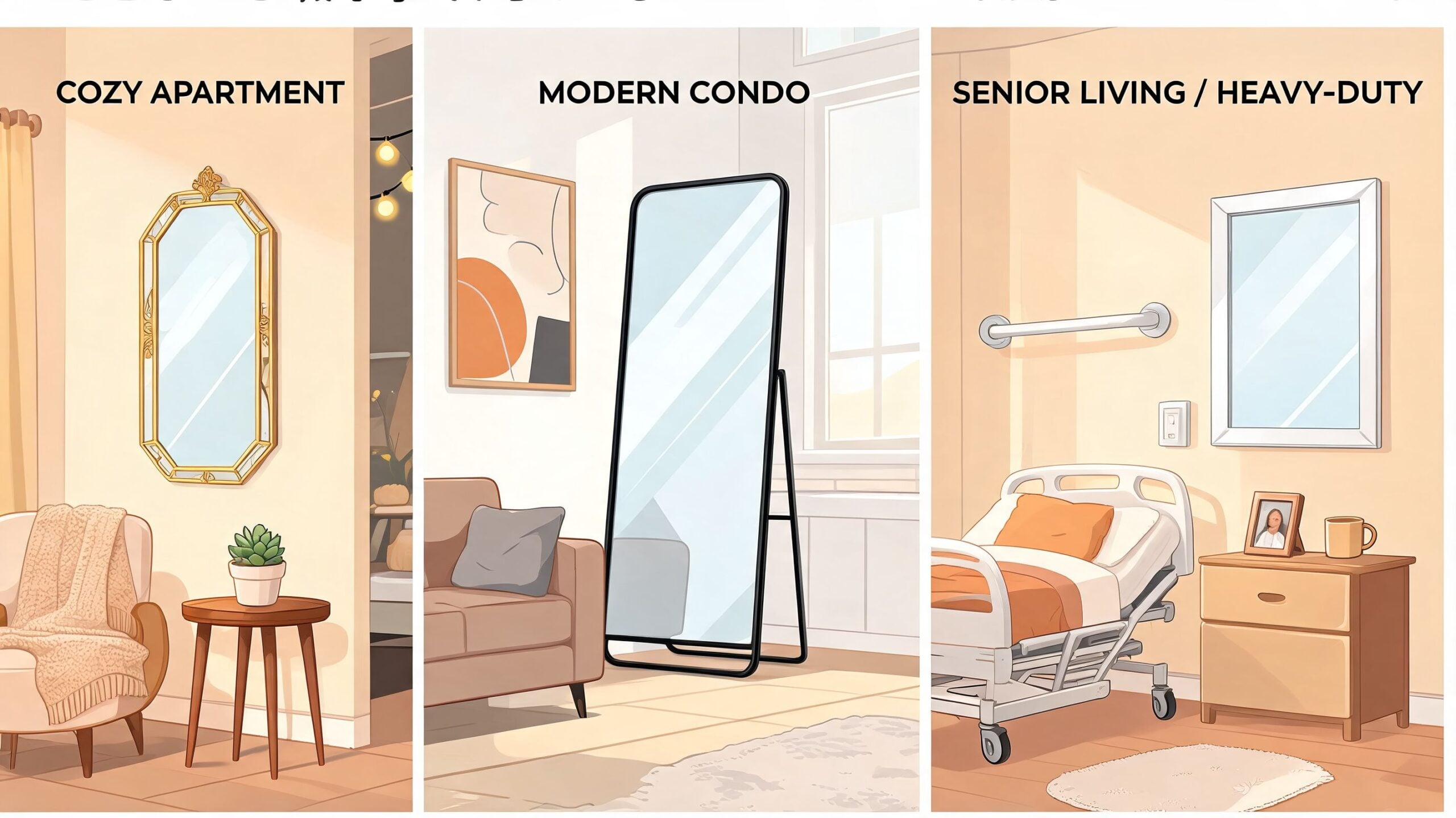
Mirror shopping gets easier when you match the piece to the way the home functions. A condo, apartment, family room, and senior living space don’t all need the same thing. The smart choice is the one that respects space, traffic flow, and who uses the room every day.
Small spaces need smart scale
A smaller room benefits from a mirror that adds light without adding bulk. Slimmer dresser mirrors, clean-lined wall mirrors, and thoughtfully sized floor mirrors can all help a room feel more open. The trick is choosing a piece that works with the room instead of crowding it.
That’s especially important in apartments, condos, and senior communities where every inch matters. A mirror should make the room easier to use, not harder to move through.
Safety and heavy-duty thinking
Homes with kids, pets, or seniors should think about safety right along with style. For households where safety is a top priority, sturdy construction is a must, and some high-quality floor mirrors even feature scatter-prevention glass, a safety film that can reduce the risk of injury from broken glass by up to 90%, according to Ashley’s floor mirror product category information.
That kind of feature is worth asking about, especially for full-length mirrors. Beyond the glass itself, stability matters too. A well-built frame gives more confidence in daily use.
If your household needs furnishings built with durability in mind, this page on heavy-duty living room furniture speaks to that same practical mindset.
A mirror should fit your life
Some people need a mirror that helps a small bedroom breathe. Others want a more substantial piece that pairs with solid wood furniture and feels steady in a busy household. Both are valid goals.
The good news is you don’t have to guess your way through it. Seeing mirrors in person, asking about materials, and checking scale up close makes the whole process simpler. That’s still the best way to find a piece that looks right and lives right in your home.
If you’re ready to compare an ashley furniture mirror with better-built local alternatives, we’d love to help at BILTRITE Furniture-Leather-Mattresses. Visit our Greenfield showroom, see the mirrors in person, and talk with a friendly team that’s been helping Metro Milwaukee families furnish their homes since 1928. If you’re also shopping for more than just mirrors, you’ll find USA-made and Amish-made furniture, heavy-duty options, small-scale pieces, and a huge mattress department with over 60 models. Come say hi and let’s help you find a mirror, and maybe a whole room, that feels right for your home.