OPEN MONDAY, NOVEMBER 23 10AM TO 6PM!
GREBE'S DONUT GIVEAWAY MONDAY, NOVEMBER 23 ONLY!
BLACK FRIDAY + SMALL BUSINESS SATURDAY DEALS ON NOW!
NO CREDIT CARD FEES!
1000's of Items IN-STOCK + 500 Mattresses!
Largest selection of USA Made Furniture & Mattresses + Amish Made!
FREE In-Store Design Services!
BUY LOCAL & LOVE YOUR HOME!
Tuesday-Thursday 10am to 6pm | Friday 10am to 7pm | Saturday 10am to 5pm | Sunday Closed To Be With Family & Friends | Monday Showroom Closed
5430 West Layton Ave, Greenfield - Metro Milwaukee
A couple stands beside a queen mattress, wondering whether both adults, the dog, and that thick new mattress are more than the bed was built for. The mattress feels sturdy, but the frame underneath has been through several moves, and nobody remembers what its label said.
That's a sensible question, not an awkward one. Mattress weight capacity is about matching the whole bed to the household, including the support underneath and the way people use it.
Buying guides often put conventional queen and king mattresses near 500 pounds total, while some specialized designs are described around 1,000 pounds, according to this mattress weight-limit guide. Those are starting points for shopping, not promises about every mattress in those sizes.
There isn't one industry number that applies to every family bed. A size name describes sleeping space; it doesn't establish how much the mattress, foundation, and frame can carry together.
Typical total capacity ranges to start from
The figures below are screening figures from the buying guide cited above. The closest household situation helps identify which paperwork matters before a bed becomes a serious contender.
Situation
Figure often cited
What usually limits it
How to read it
One adult on a standard mattress
Often inside a shared total near 500 lb on queen or king
Mattress or frame, whichever is lower
Don't treat a shared total as a per-person allowance
Couple on a conventional queen or king
About 500 lb total
Lowest of mattress, foundation, and frame
Don't double a per-sleeper number
Reinforced or heavy-duty design
Roughly up to 1,000 lb
Still the lowest-rated component
A higher limit isn't the same as better pressure relief
Adjustable base
A separate, model-specific base limit
Base deck and motor rating
Verify the base on its own
New mattress on an older frame
The older frame's documented rating may be lower
Center support, slats, rails, and legs
Queen and larger frames generally need rigid center support to the floor
For a single adult, the first row prevents a common misunderstanding: a shared bed rating isn't automatically an allowance for each person. For a couple, the second row calls for combined body weight, not separate comparisons against the same total.
The heavy-duty row deserves an equally careful reading. Reinforcement can make a model worth considering, but the label doesn't establish a particular pound limit or guarantee a comfortable feel. Guidance on choosing a mattress for heavier people can help separate support needs from firmness preferences.
Read the small print before trusting the big number
A printed capacity may mean per person, per side, or total. It may also include the mattress itself, or describe occupants only. Foundations and adjustable bases can carry different limits from the mattress above them.
Laboratory loading figures aren't substitutes for these specifications. A controlled firmness test or a weight applied to a small test patch describes a testing method, not a household allowance.
Shopping rule: A capacity number isn't useful until its label explains what counts toward it.
The last table row is especially important when keeping an existing frame. A generous mattress rating can't make up for weak rails, missing legs, or inadequate support beneath the middle.
How to Add Up the Load on Your Bed
A pencil, a sheet of paper, and the product specifications are enough to make this manageable. The aim is one household load record, with clearly marked adjustments wherever a component's rating includes different things.
Support and warranty guidance makes the foundation and frame part of the decision, rather than treating them as accessories; the bed-support FAQ also explains why appropriate center support and slat construction matter.
Six steps for a household load record
Write down the sleepers. Include the body weight of everyone who sleeps on the bed at the same time. In a hypothetical household, adults weighing 180 pounds and 220 pounds total 400 pounds before anything else is added.
Add regular bed-sharing companions. Include children or pets who commonly share the bed. Rare overnight guests don't belong in the nightly total, but planned occasional use still needs to remain within the applicable rating.
Check the bedding wording. Count bedding and pillows when the manufacturer says they're included. If the wording is unclear, mark that line for clarification rather than leaving the load out.
Add mattress weight where required. Frame, foundation, and adjustable-base limits may include the mattress. Use its listed product weight, not a guess based on thickness.
Write separate comparison lines. Record the mattress, foundation, frame, and adjustable-base ratings, where applicable. Beside each, note whether it covers occupants only or everything supported.
Identify the controlling limit. Circle the most restrictive applicable rating. Compare like with like, adding mattress weight to the household load wherever that component requires it.
Household load worksheet
This example uses hypothetical sleeper weights, not a recommended capacity.
Load to write down
What counts
Example
Compare it with
Sleepers on the bed together
Body weight of each person at the same time
180 lb + 220 lb = 400 lb
Mattress total, unless the maker clearly says per person
Kids or pets who share most nights
Regular extra bodies, not rare guests
Add their actual combined weight
The same total rating
Bedding and pillows
Only if the rating says they're included
Ask; don't guess
The wording on the spec sheet
Mattress weight
Only when the frame or base rating includes it
Use the listed mattress weight
Frame, foundation, and adjustable base
The controlling number
The lowest applicable written limit in the set
Circle it after all ratings are confirmed
Whichever part is lowest
For the example couple, the people alone account for a substantial load. Adding a mattress to a frame's total-load calculation can change whether that frame is suitable, even when the mattress's occupant rating looks adequate.
A per-side figure and a total figure aren't interchangeable. Unless the paperwork expressly says per person, treat the number as a whole-bed ceiling pending clarification, not permission to multiply it.
If a tag is missing, record the model information and obtain the specification. Twin, queen, king, and heavy-duty aren't replacement numbers. The finished worksheet should show a household total, any component-specific additions, and one documented controlling limit.
Why the Whole Bed Sets the Limit
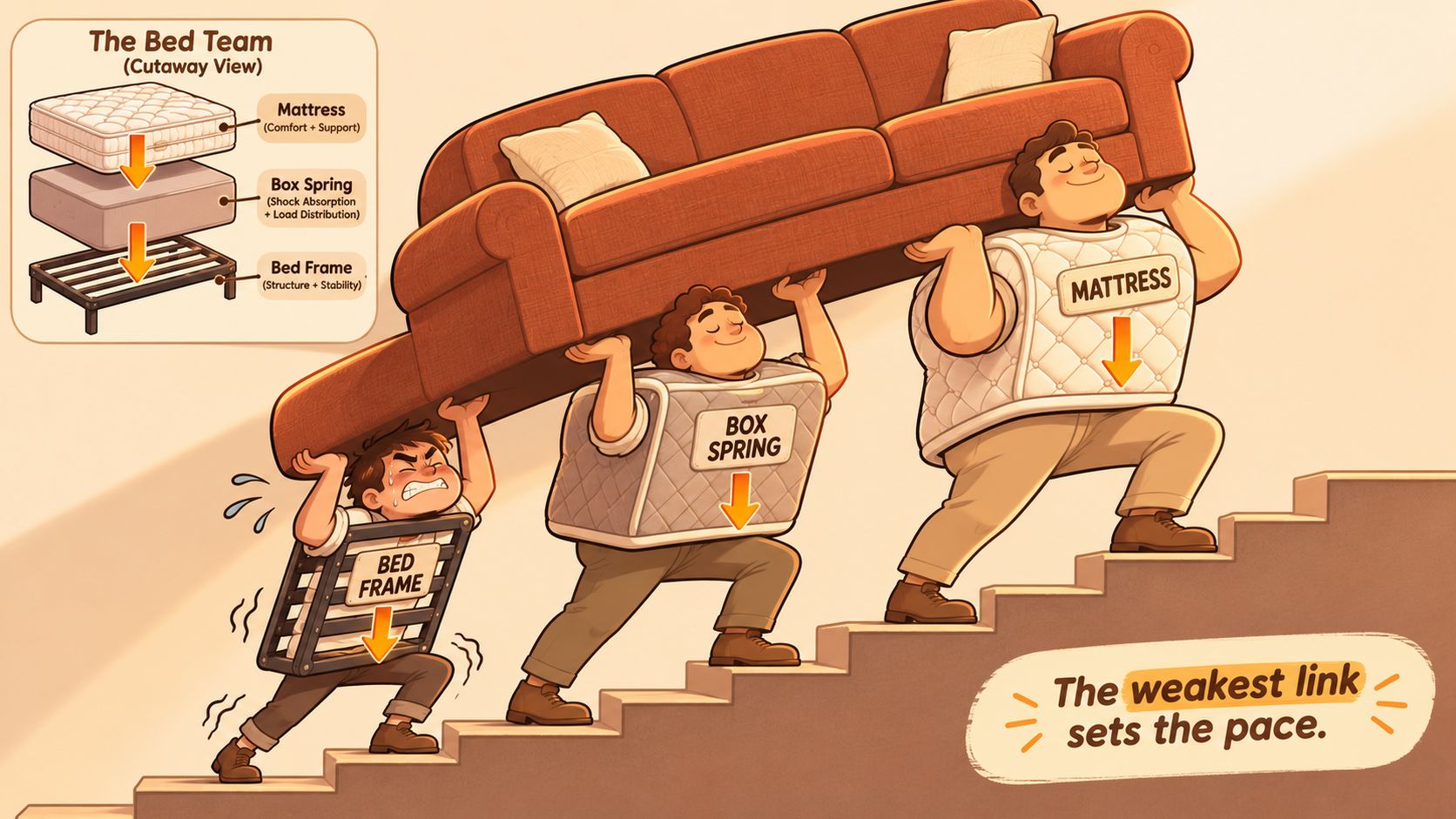
A team carrying a couch upstairs can move only as securely as the person with the weakest grip. The strongest person can't make another person's slipping hand hold tighter.
A bed works much the same way. The mattress, foundation or box spring, slats or platform, center support, side rails, legs, and any adjustable base all have jobs to do.
The mattress weight-limit explanation describes how the support core, foam characteristics, coils, and edge construction affect load handling, while foundations and frames impose additional structural limits. A strong mattress doesn't upgrade an underrated frame, and a stout frame doesn't make an unsuitable mattress provide better body support.
Follow the load all the way to the floor
Consider a new mattress placed on an older bed. Its surface may look level while nobody's using it, yet a missing center leg can allow the middle support to bow under the household's load.
The load travels through the mattress into the base, then through rails and legs to the floor. A loose connection or unsupported span anywhere along that route deserves attention.
International bed-safety testing reflects this assembled-system approach. The bed-testing overview of EN 1725 describes evaluation of bed frames, mattress-support structures, and components supplied together, including strength, durability, impact, and stability.
The practical inspection isn't complicated: center supports should reach the floor, connections should be secure, and slats should meet the mattress's stated spacing and width requirements. A guide to the parts of a bed helps identify pieces that are easy to overlook beneath a bed skirt.
Separate safety, warranty, and comfort life
These are related questions, but they aren't the same question:
Structural safety concerns whether the assembled bed can carry its permitted load under its specified conditions.
Warranty compliance concerns whether the setup meets the written requirements for its foundation, frame, installation, and use.
Comfort life concerns how long the mattress continues to feel supportive and comfortable for its sleepers.
A bed can remain standing while its comfort has become disappointing. A mattress can also feel comfortable initially while resting on a base that doesn't satisfy its warranty.
That's why a showroom test and written specifications belong together. Each part needs its own documented limit, and the most restrictive applicable limit governs the setup.
Couples Edges and Heavier Sleepers
Consider the same hypothetical 400-pound household load in different rooms. In one, a couple lies across the mattress, spreading their weight over a broad area. In another, a heavier sleeper sits in the same edge spot to read and get dressed.
In a third room, a caregiver helps someone sit upright and swing their legs over the side. Even with the same combined weight present, those activities don't place the same demands on the bed.
A seated load asks something different of the edge
Sitting concentrates weight on a smaller patch than lying down. The mattress perimeter, nearby side rail, and floor-contact points must handle that localized demand.
The ISO 19833 bed-testing document describes a reference loading method distributing 75 kilograms, about 165 pounds, over roughly 300 by 300 millimeters, or a circular area about 340 millimeters across, with static forces generally held for about 10 seconds. That controlled patch illustrates why load placement matters; it isn't a consumer edge-sitting allowance.
A reinforced foundation can help control excessive bending beneath a compatible mattress. It can't repair an undersized frame or replace a missing support.
For a household with frequent edge sitting, mattress edge support deserves its own hands-on check. This guide to mattress edge support helps explain what to assess beyond the feel in the middle.
Test ordinary movements, not just a sleeping pose
Seniors and people with mobility limitations need more than a high capacity number. Pressure relief, a stable sitting surface, and a manageable transfer height are separate considerations.
Sit as usual. The sleeper should try the position used for dressing or putting on shoes, with appropriate assistance when needed.
Check floor contact. Feet should feel securely placed during the intended transfer, rather than leaving the person perched awkwardly.
Include the caregiver's routine. Space, access, and the bed's behavior during assistance matter alongside the sleeper's comfort.
Try the complete arrangement. Mattress thickness and base height together determine the finished sleeping and sitting height.
A body impression and a broken rail are different problems. Neither should be dismissed simply because the other hasn't happened.
Comfort can deteriorate before anything cracks. An edge that feels tiring or unstable during ordinary use deserves attention even when the bed remains within its published load limit.
Changing only part of the setup still calls for this check. An old mattress on a new platform, or a new mattress on an old frame, can produce a different sitting height and edge feel.
What Lab Tests Do Not Tell You
A test used a particular weight, so that must be the mattress's capacity. It sounds reasonable, but it's the wrong conclusion.
ASTM F1566 provides comparative test methods for innersprings, box springs, finished mattresses, and mattress sets; it doesn't establish pass/fail criteria or one required maximum occupant weight. Firmness, durability, impact response, and changes in height answer different engineering questions.
Test loads describe procedures
A laboratory controls the loading area, speed, repetitions, and recovery time. Household use involves different bodies, positions, movements, and support arrangements.
Firmness testing in the ASTM firmness procedure.pdf) includes lowering a platen twice at 250 millimeters per minute to 778 newtons, about 175 pounds-force, using a round platen approximately 344 millimeters across. After a six-minute rest, resistance is recorded in roughly half-pound-force increments at 12.5-millimeter intervals until that load is reached.
Durability and impact testing, described in the ASTM mattress-testing overview, includes 100,000 roller cycles followed by 60 minutes of recovery; an impact procedure uses a 79.5-kilogram, about 175-pound, 14-inch platen, initially dropped from about 1 inch, with increasing drop heights until about 0.75 inch of permanent deformation or structural failure.
Crib-mattress testing belongs to a different product category: the federal crib-mattress requirements describe a 30-pound impactor dropped for 1,000 cycles across specified locations. Those figures aren't adult mattress ratings.
Static bed testing likewise evaluates controlled loading of defined areas. It doesn't promise that every real-world movement, concentrated edge load, or mismatched foundation will perform identically.
Look for the conclusion the test actually supports
A firmness result can help compare resistance to compression. A durability procedure can show how a sample changes after repeated loading. Neither result automatically supplies the permitted household weight for a finished bed.
Evidence check: Tested for durability and rated for a household load are different statements.
The useful purchase question is whether the manufacturer documents an appropriate load for the exact model and its compatible support. A technical test description can inform confidence in construction, but it can't fill a blank capacity line.
Laboratory evidence also doesn't choose comfort. A mattress may perform well in a controlled procedure and still feel too yielding, too firm, or difficult to exit for a particular sleeper.
How to Check the Specs Before You Buy
A clear specification should answer an ordinary question in ordinary language. Shoppers shouldn't have to translate a large capacity claim into a series of guesses about what sits underneath.
The most useful questions identify the exact model, the load included, and the required support. A photograph of the current frame and its label can also help prevent confusion about which pieces are staying.
Spec checks before you say yes
Part
Ask this
A good answer names
If the answer is weak
Mattress
Is the limit per person, per side, or total, and does it include the mattress?
A written total for that model
Don't guess from the size name
Foundation
What load is this foundation rated for by itself?
Its own pound limit
Don't copy the mattress number onto it
Frame on queen or larger
Is there rigid center support to the floor?
Center support plus rail and leg limits
Missing support can cause bowing or a warranty problem
Slats
How close and how wide are the slats?
Support suited to that mattress
Wide gaps can allow an otherwise strong mattress to sag
Adjustable base
What occupant-plus-mattress load is approved?
A base rating separate from a flat foundation
A flat-frame number doesn't transfer
Warranty
Which base is required, and what uses are excluded?
The required foundation or frame in writing
The wrong base can affect warranty help later
“Is this base approved beneath this mattress?” is particularly useful for an adjustable setup. A capacity figure alone doesn't establish compatibility.
For an existing frame, “What documentation confirms this frame's limit?” is better than “Does it look strong enough?” A heavy-duty mattress-frame guide can help organize the support details worth checking.
Put the answers on a note card
A small record keeps appealing showroom comfort from overshadowing an unanswered structural question. It also makes comparisons easier when similar-feeling mattresses require different bases.
Household load, What is the regular simultaneous load, with component-specific additions clearly marked?
Written limits, What are the mattress, foundation, frame, and adjustable-base limits?
Warranty sentence, What exact wording describes the support required beneath the mattress?
Open questions, Which rating, inclusion, or compatibility answer still needs confirmation?
“Which uses are excluded?” deserves a direct answer too. The warranty may address improper foundations, missing center support, or platforms whose openings exceed the mattress's requirements.
If similar models feel equally comfortable, clear total-load documentation makes one easier to evaluate responsibly. Missing information isn't a reason to invent a generous allowance.
The decision remains practical: keep each applicable household load below its documented limit and use the support the warranty requires. A higher published capacity doesn't independently establish easier edge sitting or a longer comfortable life.
Come Try the Support in Greenfield
A note card gets the numbers organized. A showroom visit lets the household assess what those numbers can't describe: pressure at the shoulder, support beneath the hips, and the feel of sitting down at the edge.
BILTRITE Furniture-Leather-Mattresses is a fourth-generation, family-owned business serving Metro Milwaukee since 1928. Its associates bring more than 400 years of combined experience, with a no-pressure approach to questions about comfort and support.
Bring the household's real routine
Who shares the bed? Does someone sit along the same edge to dress, or need a caregiver's help during transfers? Those details make a comfort test more useful than a quick press of the hand.
Bring the paperwork. Model names, frame photographs, and the household worksheet make the discussion specific.
Try normal positions. A practical guide to testing a mattress helps turn a showroom visit into a meaningful comparison.
Allow time for questions. Capacity, base compatibility, and warranty requirements deserve attention alongside feel.
Explore the options without rushing
BILTRITE Furniture-Leather-Mattresses's Mattress Center, updated in 2025, includes more than 60 models and an expanded gallery of flip-able, two-sided, and heavy-duty mattresses. All mattresses are USA made, 100% handmade, brand new, and factory fresh; select model sets include a free mattress protector or free heavy-duty bed frame. The broader selection includes apartment-scale and heavy-duty furnishings, plus USA-made and Amish-made solid wood furniture, with an emphasis on affordable, better-quality value rather than the lowest price.
For households also considering mobility seating, Wisconsin power lift recliners are exempt from sales tax. These provide lifting assistance; lift recliners don't swivel.
BILTRITE doesn't sell online, and the showroom is closed Sundays and Mondays to support family time. Local shopping gives families an opportunity to test comfort in person rather than choose from a capacity claim alone.
BILTRITE Furniture-Leather-Mattresses offers affordable, better-quality mattresses and supportive furniture for households with different bodies, spaces, and mobility needs. Families can bring their load worksheet and frame questions to BILTRITE Furniture-Leather-Mattresses in Greenfield for a no-pressure visit, a hands-on comfort test, and help comparing the support beneath the mattress.