Full Foundation Mattress Guide: Types, Sizes and Fit

If a mattress, foundation and bed frame all say full, shouldn't they fit together automatically? Not necessarily. The label describes a size category, but the actual measurements, support structure and warranty requirements decide whether those pieces work together.
A full foundation mattress search often brings up mattresses, box springs, platforms and frames side by side. That's understandable, but they aren't interchangeable. A mattress provides the sleeping surface; the foundation supports it; and the frame holds the assembly. Sorting out those jobs makes choosing a comfortable bed much simpler.
Table of Contents
- Full Foundation Types Compared at a Glance
- How Big a Full Mattress Really Is
- Matching Your Foundation to Your Mattress Type
- Slat Gaps, Center Support and Why They Matter
- Which Full Foundation Suits Your Bedroom
- How to Check a Foundation Fits Before You Buy
- Choose Your Full Foundation with Help in Greenfield
Full Foundation Types Compared at a Glance
Box springs, platforms, slatted foundations and adjustable bases support a mattress in different ways. The right fit depends on the mattress, the bed frame and the support rules for that mattress.
A mattress foundation carries weight and provides a level surface. A soft mattress still needs firm, level support beneath it.
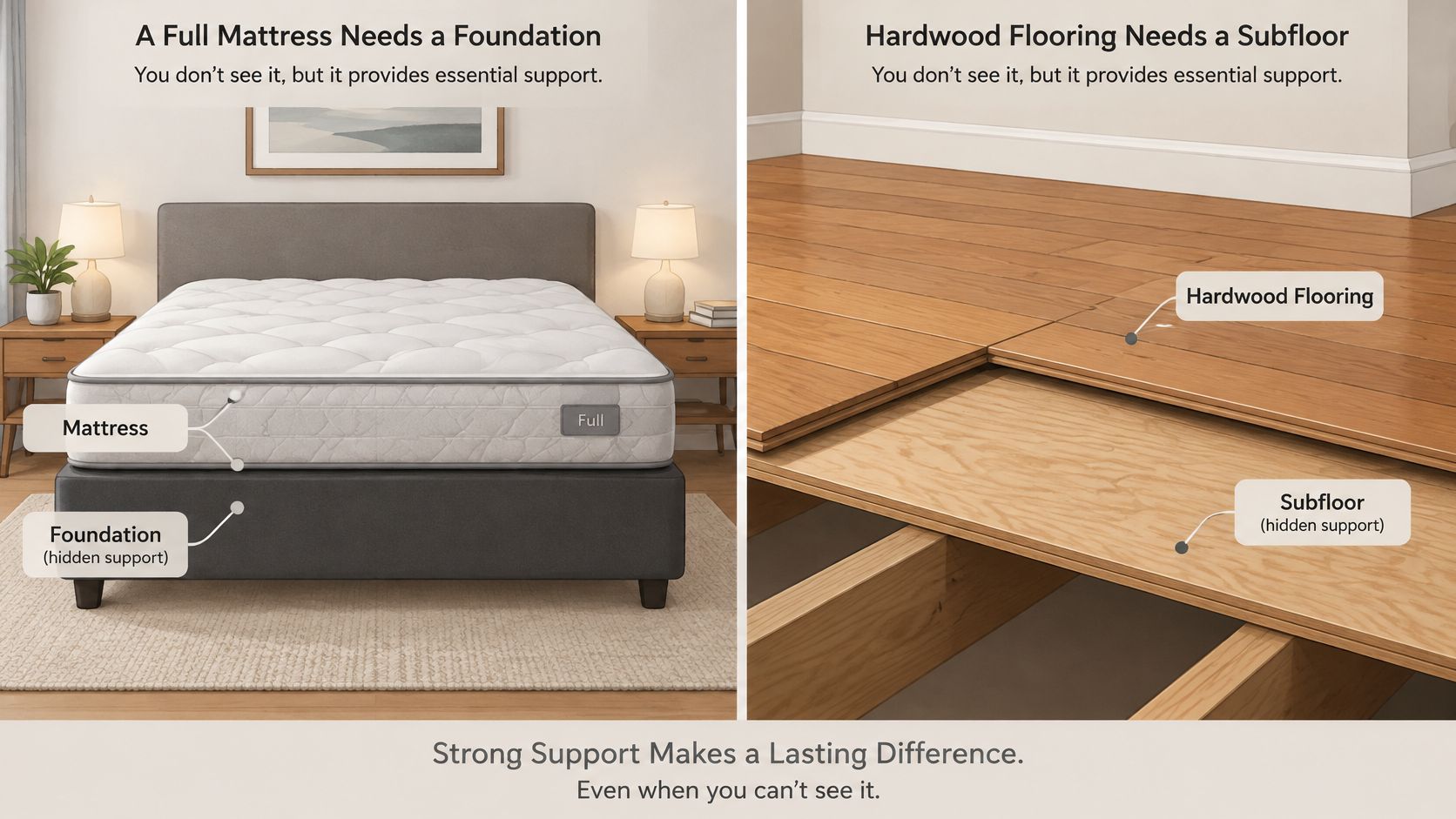
Full foundation types at a glance
These names describe how each support system is built. Height varies by model, so check the product's specifications before deciding how high the finished bed will sit.
| Type | How It Supports the Mattress | Typical Height | Main Trade-off |
|---|---|---|---|
| Box spring | Springs under fabric cushion the mattress | Varies by model | Adds height and weight |
| Platform | Solid deck, often on short legs, without springs | Low-profile construction; check deck height | Less give; needs a sound deck |
| Slatted | Spaced slats hold the mattress; gaps determine support | Set by the frame | Gaps must stay within the mattress maker's limit |
| Adjustable base | Motorized support raises the head and foot | Set by the base model | Needs power and a compatible mattress |
A traditional box spring contains springs. Some fabric-covered bases, however, are rigid foundations rather than spring systems. Check the construction, not just the name.
A platform supports the mattress on a deck. A slatted foundation spreads support across individual slats, so the size of the gaps matters. An adjustable base changes position and needs a mattress designed to bend with it.
Identify the structure before adding another layer
Some bed frames need a separate foundation. Others have a suitable built-in deck, so an extra layer may be unnecessary unless the mattress's support requirements call for one. The flat box spring and foundation guide can help clarify the difference between these support types.
Practical rule: Choose the mattress and its support system together. Then check that the setup works with the frame and doesn't add unwanted height or unsupported areas.
How Big a Full Mattress Really Is
A full mattress, also called a double, is approximately 54 inches wide by 75 inches long, or 137 by 190.5 centimeters, according to this U.S. full mattress dimensions guide. That footprint covers roughly 28.1 square feet or 2.62 square meters; it's 15 inches wider than a twin, retains the twin's 75-inch length, and gives a pair of sleepers about 27 inches of width each.
That makes a full appealing for a teenager, a single adult or a guest bedroom. For a couple, however, the available personal space can feel restrictive compared with a queen. Taller adults should also test the sleeping length rather than choosing by room size alone.
Full foundation dimensions compared
Actual foundation measurements can be smaller than the mattress's nominal footprint. The following figures distinguish the mattress size from published foundation specifications; they aren't instructions to accept a particular amount of overhang.
| Item | Size | Note |
|---|---|---|
| Full mattress footprint | 54 x 75 in (137 x 190.5 cm) | About 28.1 sq ft or 2.62 sq m |
| Twin mattress width | 39 in, calculated from the width difference | 15 in narrower than full, with the same 75 in length |
| Published full foundation A | 52.5 x 74 in | Narrower than the nominal full mattress footprint |
| Published full foundation B | 53.5 x 74.5 in | Slightly larger than foundation A |
| Low-profile full foundation height | 2 to 6 in | Construction determines the exact height |
| Cited full foundation height | 5.5 in | Changes the finished bed height |
For the low-profile height category, the full-size foundation selection guide describes options approximately 2 to 6 inches high. The individual foundation specifications in the table are addressed through the compatibility checks below.
Leave room for the whole bed
The mattress footprint isn't the bed's exterior footprint. Side rails, a headboard and a footboard can extend beyond the sleeping surface, and a footboard may also make a short sleeping area feel more enclosed.
A shopper furnishing a small apartment should mark the assembled bed's outline on the floor with painter's tape. Open nearby drawers and wardrobe doors, then walk the route between the bed and doorway.
The full-size bed dimensions guide provides additional planning context. The useful measurements are both the bedroom's available space and the frame's inside opening, not just the size printed on the mattress tag.
Matching Your Foundation to Your Mattress Type
A foundation can fit the frame and still be the wrong match for the mattress. Check the mattress maker's support requirements, then confirm that the foundation meets them. The earlier dimensions table covers footprint and height; the pairing question is about construction.
Mattress type and the support it needs
| Mattress Type | Support It Needs | Foundation That Usually Works |
|---|---|---|
| Innerspring | Support approved for the specific mattress | Compatible box spring or slats that meet the mattress maker's requirements |
| Memory foam | Continuous or closely spaced support | Platform or slats within the mattress maker's gap limit |
| Latex | Close, evenly distributed support | Approved platform or closely spaced slats |
| Hybrid | Support suited to its construction | Platform or slats that meet the mattress maker's requirements |
| Adjustable base mattress | Approval to flex with the base | Compatible adjustable base |
Use the table as a starting point, then check the exact mattress model's requirements. Choose an approved box spring for an innerspring mattress, and keep foam mattresses on a continuous surface or on slats within the maker's specified gap limit.
For example, a family replacing an innerspring mattress with memory foam should inspect the existing base before reusing it. Its support pattern, condition and approval for the new mattress matter more than whether it worked with the old one.
The guide to memory foam mattresses and box springs explains this common pairing question. Confirm the approved support construction, dimensional tolerances and whether the existing base can remain in service.
Check the finished height in person
Foundation height affects how easily someone can sit on the bed, stand up and reach the floor. Try the intended mattress-and-base combination if possible, especially if the sleeper has limited mobility.
A change in base height can also affect how much of a headboard remains visible and how bedding hangs beside the rails. Fitted sheets need to match the mattress depth, not the foundation height.
Slat Gaps, Center Support and Why They Matter
A mattress warranty may specify the support it needs, such as slat width, the maximum gap between slats, or floor-contact support beneath the frame. Check those instructions before choosing a slatted frame. If the mattress documentation calls for gaps of 3 inches or less, follow that limit rather than assuming wider spacing will work.
Follow the weight through the frame
The mattress, sleepers and bedding transfer weight through the slats, center support and frame to the floor. Strong outer rails cannot make up for a weak middle.
For a full bed, check that the center support reaches the floor and that the slats stay level and securely attached under load. The slatted bed frame guide explains the parts to inspect. Depending on the frame design, support may come from a reinforced center rail, floor-contact legs or another approved arrangement.
A slat that holds its place when the bed is empty should remain secure as someone sits, turns or gets out of bed.
Match the warning sign to the repair
A noisy or uneven bed needs inspection before a new mattress goes on top. Look for these clues:
- A dip through the middle: Inspect the center rail, its connections and any floor-contact legs. Replace damaged parts or use manufacturer-approved reinforcement.
- Creaking during movement: Check fasteners and joints for looseness or rubbing. Tighten hardware as appropriate, then inspect for cracks.
- Slats that slide: Restore their retaining hardware or approved attachments. Loose boards can shift out of position.
- An uneven sleeping surface: Check that the frame is level and its intended support points are in contact.
- Early localized sagging: Compare the slat spacing with the mattress documentation, then inspect the mattress and base separately. A new mattress cannot fix a failing frame.
Measure both the width of each slat and the clear opening between neighboring slats. Check the center support and its connections too, since a suitable gap alone does not ensure that the whole frame is properly supported.
Which Full Foundation Suits Your Bedroom
Start with how the bed needs to work in the room. A foundation affects the bed's height, how easy it is to get in and out, and whether the existing frame can support the setup.
In a guest room with a low ceiling, a lower bed may feel less imposing. In a small apartment, a higher bed may leave more clearance underneath. Storage needs and ease of access should decide between them.
Compare everyday situations
For a teenager's room, look at the support structure and its stated weight capacity. A decorative headboard alone doesn't show how much weight the bed can support.
If you plan to keep an inherited frame, its condition and support arrangement shape the choice. The foundation also needs to fit the frame's interior opening.
- Guest room: Choose straightforward support and a height that works for the visitors who may use it.
- Limited mobility: Check whether the bed height makes sitting down, standing up and getting into a sleeping position manageable.
- Reading in bed: An adjustable base requires a compatible mattress and an accessible electrical outlet.
- Tight budget: A sound existing frame may be usable. Damaged support components can make keeping it a poor fit.
Count the whole load
Check what a published weight rating covers. It may include the mattress, sleepers, bedding and other items on the bed, so read the manufacturer's definition before comparing capacities.
This matters especially when the bed will see heavier daily use. A rating only helps you choose if you know which parts of the total load it includes.
Choose a mattress and frame arrangement that work together, then select a foundation that fits that setup. The right choice supports the bed's use without making access or fit harder.
How to Check a Foundation Fits Before You Buy
Will the foundation fit your frame, support the mattress, and leave the bed at a comfortable height? A tape measure, straightedge, flashlight, and phone camera can help you record the details. Measure the furniture as it stands, including worn or damaged parts.
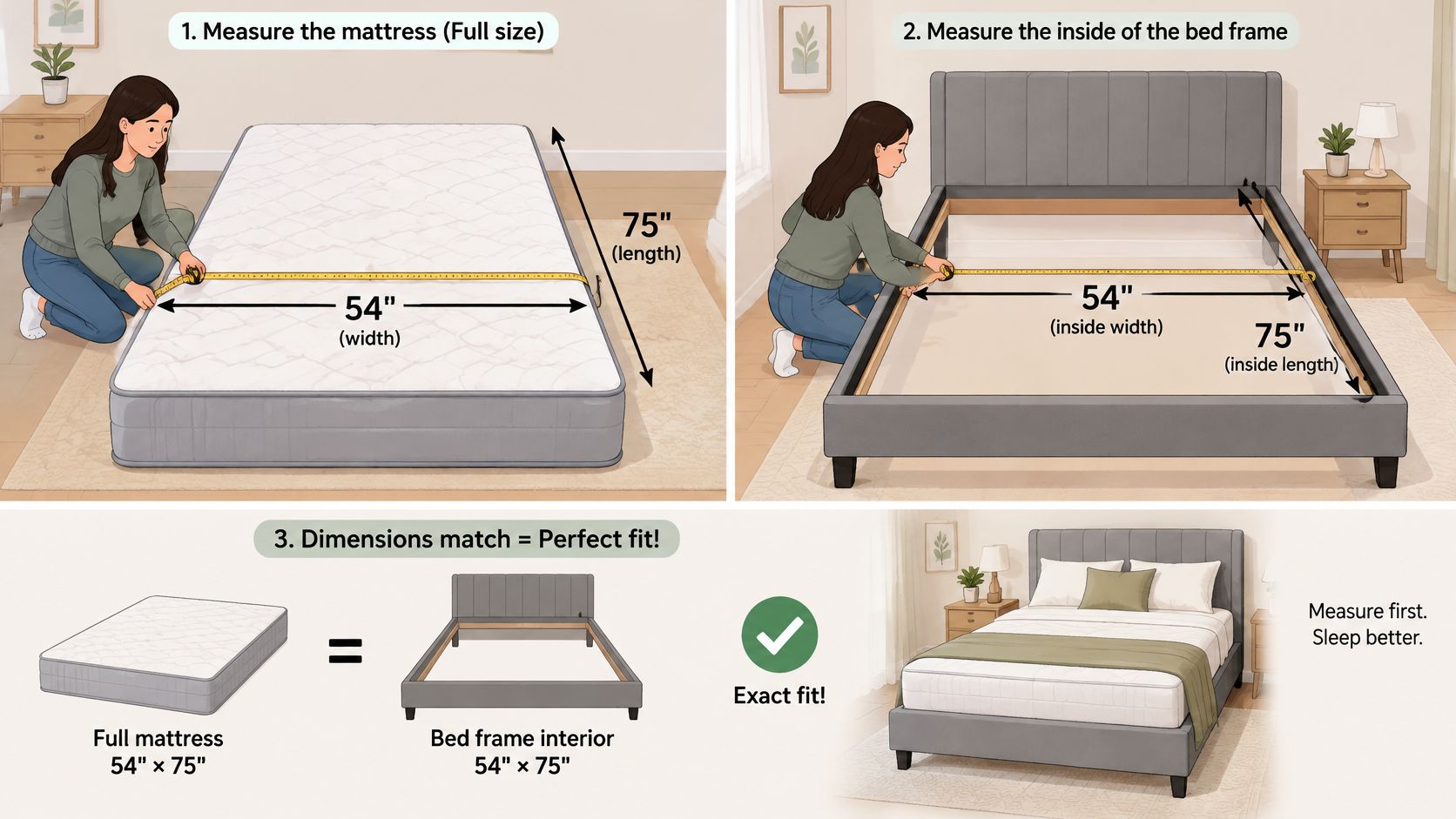
Record the fit and support details
Measure the mattress. Record its width and length without compressing the edges. Photograph the identification tag so you can match the exact model to its support instructions.
Measure inside the frame. Take readings between the inner rails and between the head and foot supports. The frame's exterior dimensions won't show whether a foundation will fit inside its opening.
Check the finished height. Add the frame's support elevation, the foundation height, and the mattress thickness. Try sitting at a similar height to see whether getting in and out feels comfortable.
Count the supporting legs. Note where they sit and whether they touch the floor. A missing, bent, or suspended leg needs attention before the bed is used.
Inspect the frame's condition. Check rail connections and braces for damage or looseness. Photograph the underside if possible, and don't lift heavy components alone.
Check support requirements. Compare the frame and foundation details with the exact mattress and foundation instructions, including the specified slat spacing.
Confirm capacity. Find out what the weight rating includes. Count the mattress, sleepers, bedding, and other items if the manufacturer includes them.
Keep the paperwork. Store warranties, purchase records, tags, measurements, and installation photographs together. These details make it easier to confirm that the complete setup meets the instructions.
Verify dimensions before accepting the fit
Published foundation dimensions can differ by half an inch. That difference may matter when the frame opening is tight, so check the proposed foundation's actual dimensions against your measurements before accepting delivery.
Before accepting delivery: Confirm that the foundation's dimensions and support requirements match the frame and mattress instructions.
The guide to measuring a mattress can help you record its dimensions. Once assembled, the bed should sit level and remain stable during normal use.
Choose Your Full Foundation with Help in Greenfield
Does a full foundation fit your room, frame and mattress requirements? Measurements help answer that, while an in-person visit can help you compare comfort and discuss how the pieces work together.
BILTRITE Furniture-Leather-Mattresses is a fourth-generation, family-owned showroom serving Greenfield and Metro Milwaukee since 1928. Its mattress selection includes over 60 models, with options in different types and comfort levels.
Turn measurements into a hands-on test
Bring the frame's dimensions and mattress support requirements, then explain what parts of the bed you plan to keep. If room access or getting in and out of bed is a concern, mention that too.
A useful mattress test means lying in your usual sleeping positions, not just pressing the surface with a hand. If you share the bed, try it together and consider whether a full mattress leaves enough sleeping space for both people.
- Bring the fit details: Include your frame measurements and the mattress's support requirements.
- Describe everyday needs: Explain any room or access limits, and whether you want to keep existing furniture.
- Ask about the full setup: Clarify which components provide support and which ones surround or hold them.
Compare relevant options without pressure
BILTRITE carries Hybrid, Innerspring, Memory Foam, Latex, Adjustable Base, Flip-able, Heavy Duty and Semi-Heavy Duty mattress options. Available sizes include Twin, Twin XL, Full, Full XL, Queen, King, California King, King 2PC and California King 2PC. Free white glove delivery is offered on mattress-only purchases of $999 or more.
The showroom also offers USA-made and Amish-made solid wood furniture, including small-scale and heavy-duty choices. Those categories can be useful when room size, durability or accessibility is part of the decision.
For a full foundation, the key is whether its dimensions and support structure suit the mattress and frame you intend to use. A showroom conversation can help clarify the options; you can also use the Mattress Finder tool on BILTRITE's website to explore mattress choices.
BILTRITE Furniture-Leather-Mattresses offers mattresses, foundations and bedroom furniture in Greenfield. Bring your fit questions and measurements to BILTRITE Furniture-Leather-Mattresses to discuss which full foundation arrangement suits your setup.