3 DAY MATTRESS SALE! THURSDAY - FRIDAY - SATURDAY!
98TH ANNIVERSARY SALE-A-BRATION ENDS SATURDAY, NOVEMBER 7TH AT 5PM!
NO CREDIT CARD FEES!
1000's of Items IN-STOCK + 500 Mattresses!
Largest selection of USA Made Furniture & Mattresses + Amish Made!
FREE In-Store Design Services!
BUY LOCAL & LOVE YOUR HOME!
Tuesday-Thursday 10am to 6pm | Friday 10am to 7pm | Saturday 10am to 5pm | Sunday Closed To Be With Family & Friends | Monday Showroom Closed
5430 West Layton Ave, Greenfield - Metro Milwaukee
A lift chair recliner is a powered recliner whose base raises and tilts the seat to help someone stand or sit, then reclines for rest.
But does a chair that helps someone stand automatically suit that person's body, living room, and insurance coverage? Not necessarily. Those are separate questions, and sorting them out makes shopping much less confusing.
For a Metro Milwaukee family helping a parent, spouse, or neighbor choose supportive seating, the starting point isn't the upholstery. It's whether the chair makes an everyday movement feel manageable, without introducing another struggle.
What a Lift Chair Recliner Is and How Its Lift Works
A standard recliner lets someone lean back and raise their feet. A lift chair recliner adds powered assistance for getting into and out of the seat. Its lifting base changes the seat's height and angle, bringing the seated person forward and upward.
After watching a movie, for example, someone may want to stand and get a snack. In an ordinary recliner, they return the chair upright, plant their feet, and push up using their own strength. A lift chair helps with the transition by raising the seat toward a standing position.
The motion should feel steady, not like a shove. The chair brings the person closer to standing, while they remain responsible for finding their balance and completing the transfer. That distinction matters: the chair assists with movement, but it does not do all the work for the person.
Following the Motion From Rest to Standing
When reclining, the back moves backward and the leg rest rises to support the legs. Before the lift begins, the chair returns toward an upright sitting position and retracts the footrest. Then the seat rises and tilts forward.
The reverse motion helps someone sit down. The user approaches the raised seat, backs toward it, and lowers the chair with its control. Instead of dropping onto a low cushion, they descend as the seat moves down.
The basic design has a long history. U.S. Patent US5931532A, filed February 3, 1997 describes powered movement between sitting, standing, and reclining. Motor arrangements vary: some coordinate movement with one motor, while others use separate actuators for different adjustments. A powered lift-base patent describes a frame, motor, and linkage that raise and tilt an upholstered chair.
A power recliner can offer electric reclining alone; a lift recliner adds stand-up assistance. The difference lies in the base's movement, not just the presence of a remote or motor.
Understanding the Control and Power Supply
A handheld control typically operates the lift and recline functions. During a demonstration, practice stopping partway through a movement. The useful position is the one that suits the person's transfer, rather than automatically choosing the chair's highest or lowest point.
The chair needs electrical power. Backup arrangements depend on the model, so a battery should not be assumed. Check the instructions to learn what happens during an outage and whether any backup is intended only to return the chair to a usable position.
Practical distinction: A lift recliner helps a seated person move toward standing. It does not carry someone along a staircase or replace equipment designed to lift and transport a person.
Lift Chair Recliner Versus a Standard Recliner
The table separates the chair's everyday features from the lift function. A lift chair recliner pricing guide gives a typical price range of $500 to more than $2,500, depending on size, brand, and features. Treat that as a broad shopping range, not a quote for a particular chair.
Feature
Standard recliner
Lift chair recliner
Stand-up help
Sitter pushes up using their own strength
Motor raises the seat and tilts it forward
Recline
Back and footrest change position
Back and footrest move, with lift assistance as well
Control
Lever or recline button
Handheld control for lift and recline
Motion feel
Manual effort or powered reclining
Controlled movement operated by the user
Typical price
Often lower
$500 to more than $2,500
Insurance
Not a seat-lift device
The lift mechanism may qualify for some people
A higher price or a longer list of buttons does not establish that a chair suits someone. The practical test is whether its movement helps that person transfer comfortably and use the chair in the room where it will sit.
Recline Positions and the Specs That Matter
Recline style describes resting positions, not stand-up assistance. A shopper comparing position labels is choosing how the chair supports reading, television time, and rest. The lifting function answers a different question: how the person gets into and out of that resting place.
Position names are useful shorthand, but they aren't a substitute for operating the actual chair. The available range, whether components move together, and where movement can pause should all be demonstrated.
Recline Styles Versus the Lift Motion
Style
What the chair does
When it fits
Two-position
Upright plus a reclined lounging position
Simple lounging
Three-position
Upright, a feet-up TV angle, and a deeper recline
Everyday TV time and naps
Infinite-position
Back and footrest can pause between their endpoints, with independent adjustment on appropriate models
Joints that need a custom angle
Lift motion
Separate from the recline count; seat rises and tilts forward, then lowers
Getting in and out with less effort
These labels describe general positioning categories rather than guaranteeing a fixed set of stopping points. A basic chair may still pause within its movement range, while an infinite-position model should be checked for exactly which components operate independently.
Consider someone who likes reading with the back fairly upright and the legs supported. That person should test that combination rather than assume that a deeper recline will be more comfortable. Someone who regularly naps may care more about back support throughout the recline range.
Reading the Specifications With a Purpose
The most useful specifications connect the chair to the person and the room:
User weight rating: The stated capacity must accommodate the user. A wider seat alone doesn't establish a higher rating.
Seat measurements: Width, height, and depth determine whether the person sits with useful support rather than sliding, perching, or reaching.
Arm height: Armrests should offer accessible support without forcing the shoulders upward.
Overall dimensions: Width and closed-footrest depth help establish the chair's footprint before its moving parts need additional space.
A larger user may need a higher-capacity design, while a compact apartment may call for a smaller overall frame. The guide to lift chair weight capacity helps keep capacity separate from appearance.
Heat, massage, power headrests, and adjustable lumbar support appear on some models. Only the chair's actual specifications establish which features it includes. Those extras deserve attention after the basic sitting, reclining, and transfer positions feel suitable.
The sensible order is straightforward: choose the recline arrangement for resting habits, then evaluate the lift and dimensions for everyday access.
Who a Lift Chair Helps Day to Day
Which part of getting up causes trouble: starting the movement, continuing it, or keeping your balance afterward? A lift chair changes how the seat moves beneath the user. Pressing its control raises and tilts the seat forward, helping the person move toward standing. The practical benefit is less effort during a transfer. The chair supports the movement; the user still needs to manage the steps that follow.
That distinction helps families judge the chair for one person in one room, rather than assuming that any difficulty standing means the same thing. Someone with sore knees may want to leave a favorite chair for morning coffee without repeated rocking or asking a spouse to pull them up. Another person may find a lift mechanism less useful if the main difficulty is balance after standing.
Matching Assistance to Everyday Tasks
People with hip or knee discomfort, stiffness after illness, fatigue, or a neuromuscular condition may find ordinary seating difficult to leave. A deep, soft cushion can make rising harder because the body sinks down and has less firm support to push against. A lift mechanism may help with that transfer when the person can use the chair safely.
The difference can show up in ordinary routines:
After breakfast: A controlled rise may help someone leave the chair without several unsuccessful attempts.
During a movie: Powered reclining lets the user adjust the back and footrest with the control.
Before a nap: The user can return the chair toward an upright position using the control, rather than pushing a footrest closed by hand.
For a caregiver, reducing the need to pull someone up can ease a routine task. That matters especially when the spouse or family member has physical limitations too. The right goal is a transfer the user can carry out safely and consistently, with as much independence as their abilities allow.
A successful transfer ends with a person who can manage the next step, not merely a seat that has reached its highest position.
Recognizing the Limits
A lift chair does not replace walking, a prescribed mobility aid, or clinical advice. If someone becomes dizzy when standing, cannot reliably bear weight, or needs hands-on assistance, those needs call for assessment. Furniture alone may not address them.
The person also needs to understand and operate the control. Buttons that seem straightforward to a family member may be difficult for someone with limited hand movement, vision changes, or trouble following their functions. Consider whether the intended user can reach and use the control as part of the everyday routine.
The everyday lift chair benefits guide can help families think through how a chair might fit household routines. Start with practical questions: Which transfers are difficult? What help does the person currently need? Can this chair support the movement without creating a new problem?
Families may value easier movement at home even when a purchase does not qualify for insurance reimbursement. The Medicare's seat-lift policy addresses coverage requirements, while the everyday decision is about whether the chair's motion and controls suit the user's abilities and routine. A useful choice fits the person, the task, and the room.
What Medicare Covers and What It Does Not
What part of a lift chair might Medicare reimburse, and what costs may still fall to the family? Medicare may cover a qualifying seat-lift mechanism while leaving the upholstered chair to the buyer. The Medicare lift-chair coverage explanation describes circumstances in which a seat lift may be considered medically necessary, including severe hip or knee arthritis, muscular dystrophy, or another qualifying neuromuscular disease.
Eligibility Is More Specific Than Sore Knees
Medical necessity depends on documented function and treatment, not discomfort alone. The treating clinician must include the device in a course of treatment intended to improve the condition or prevent deterioration, and the medical record must support the need.
Key considerations include:
A qualifying condition: A diagnosis by itself does not establish that all coverage requirements are met.
A documented functional limitation: The person must be unable to rise from an appropriate ordinary armchair, rather than an unusually low or soft seat.
A treatment purpose: The medical record must support the device's role, including the alternative of confinement to a chair or bed without it.
Usable assistance: The person must be able to operate the mechanism and walk after standing.
The CMS seat-lift coverage criteria require smooth, user-controlled assistance and exclude spring-release designs that cause sudden, catapult-like movement. Abrupt motion does not provide the controlled support described by the criteria.
Use these points to prepare for a conversation, not to predict approval. The prescribing clinician and a Medicare-participating durable-medical-equipment supplier can confirm the documentation and purchasing requirements that apply.
Separating Coverage From the Family's Budget
Even when the mechanism qualifies, the buyer may still pay for the chair itself. The CMS seat-lift policy article distinguishes reimbursement for the mechanism from the furniture. Deductibles, coinsurance, and price differences may also affect the final expense.
Before ordering, ask the supplier which item will be billed, what documentation is needed, and what amount the family may owe. Getting those answers first helps prevent an expected reimbursement from shaping a purchase that the coverage may not support.
Budget reminder: A prescription does not guarantee payment for the upholstered recliner.
The guide to lift chair costs can help with the furniture-budget side of the discussion. Ask the supplier to explain the chair and mechanism charges separately, then confirm the expected out-of-pocket amount with the appropriate Medicare contacts. A chair may still suit the household when coverage is unavailable, as long as the family has a clear picture of the expense.
Fit Clearance and a Safe Transfer
How can one chair work well for a person and still fit through the doorway and into the room? Check the user's seated position, the chair's full movement, and the route it must travel. A close fit supports the body; extra space around the chair helps it move safely.
Checking the Person and the Room
Use this checklist to assess fit and transfer safety:
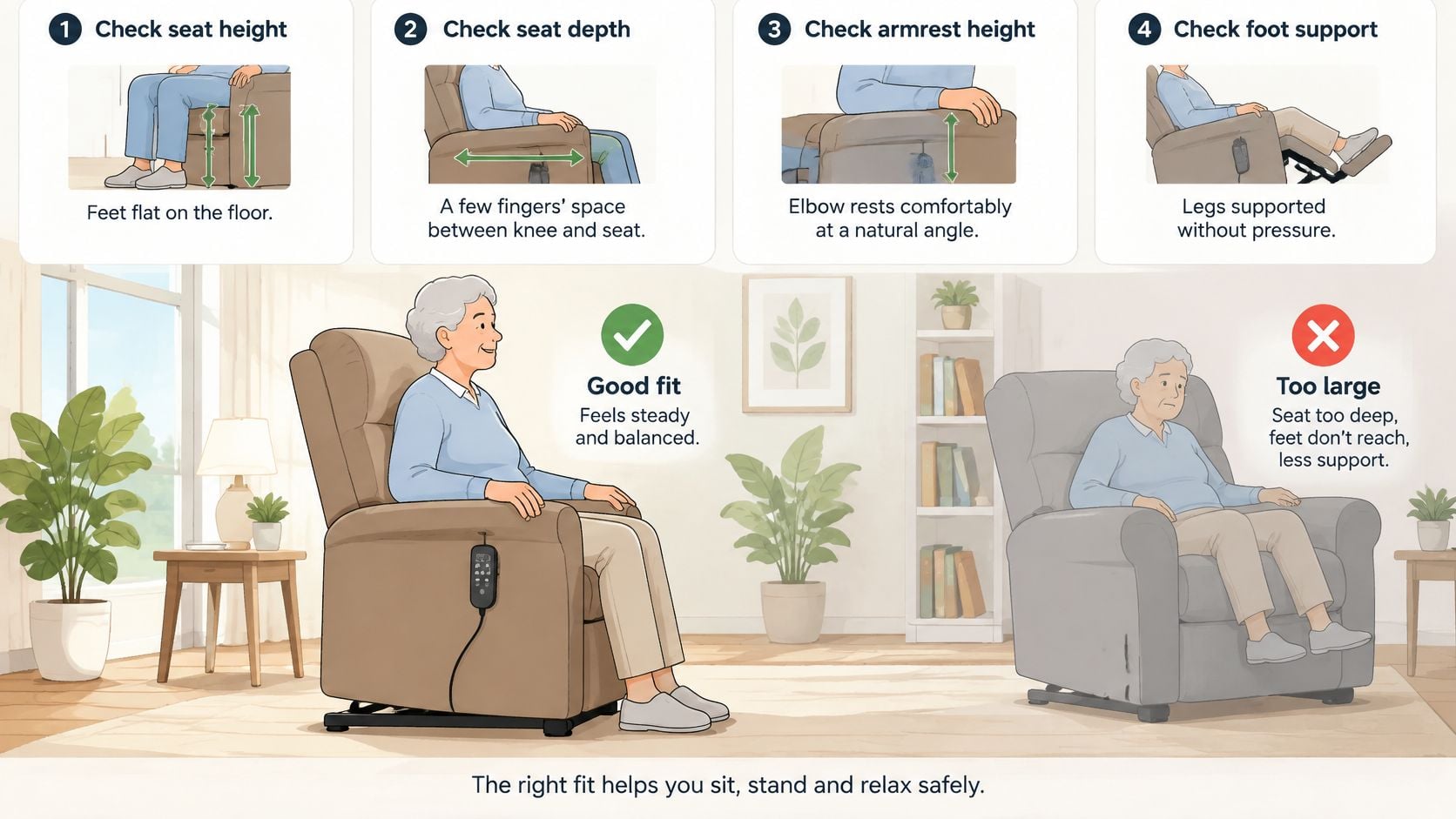
Seat height: With the chair upright and the user seated back, check that both feet reach the floor.
Seat depth: The thighs should feel supported, with no pressure from the cushion edge behind the knees.
Arm height: Ask the user to rest both hands on the arms. The support should be reachable without shrugging.
Weight rating: Compare the user's weight with the manufacturer's stated capacity for that exact model.
Footrest space: Extend the footrest fully. Check that it clears nearby tables and the usual walking route.
Doorway fit: Compare the chair's overall width and closed-footrest depth with the narrowest clear opening along the route.
Delivery route: Walk the full path through the entry, halls, stairs, landings, and final room. Note tight turns.
Removable back: Check whether the selected chair's back detaches for delivery.
Moving clearance: Run the full recline and lift cycle. Check for contact with walls, side tables, or other furniture.
Remote usability: Ask the intended user to select, start, and stop the needed functions independently.
Power arrangement: Locate an accessible outlet and review the model's outage procedure before relying on powered movement.
After-standing stability: Confirm that the user can regain balance and proceed safely toward the intended walking route.
Measuring More Than the Door Label
Measure the clear opening at its narrowest point. Trim, stops, and hardware affect the space available, so the door's stated size alone may not reflect the passage a chair must use.
Use a tape measure to record the narrowest usable width, then check tight turns as well as straight sections. A substantial chair frame may need room to change direction through a hall or landing.
Ask whether the chair back comes off for delivery, and measure the remaining base against the route. Once assembled, the chair also needs room to recline and lift without touching nearby furniture.
The lift chair dimensions guide can help organize measurements before a showroom visit. A simple floor sketch with doorways, nearby furniture, and the planned chair position makes it easier to assess the space.
The test is personal and practical: Can this person make a stable transfer in this chair, in this room? Answer that before choosing upholstery.
Try a Lift Chair in Our Greenfield Showroom
Which question matters most: how the chair moves, whether it helps someone stand, or whether Medicare may reimburse the cost? Those are separate questions, and a visit to BILTRITE's Greenfield showroom lets the intended user assess the chair's comfort and movement in person.
BILTRITE is a fourth-generation, family-owned furniture, leather, Amish furniture, and mattress showroom serving Greenfield and Metro Milwaukee since 1928. At 5430 West Layton Avenue in Greenfield, families can compare chairs and see how the controls, seat, and lift feel in use.
Making the Visit Useful
Whenever possible, bring the person who will use the chair, wearing their usual footwear and bringing any mobility aid they normally use. A family member can bring room measurements and describe which part of sitting down or standing up feels difficult.
Take time to sit upright, adjust the recline, read the remote, and practice rising from the chair. The movement may look simple, but the user should be comfortable operating the controls and feel steady through the transition.
Help during your visit: Wheelchairs are available for use in the stores as needed.
Questions before you travel: Call BILTRITE at 414-238-2020 to plan your visit.
The power recliner chair guide explains powered seating features and can help families prepare questions about the difference between reclining and lift assistance.
Local Choices and Straightforward Expectations
BILTRITE has 48 models of power lift chairs, along with furniture that includes USA-made, Amish-made, and solid-wood options, as well as small-scale and heavy-duty choices. Its senior living furniture and mattress offerings may also be relevant when comfort and accessibility are part of the decision.
A chair's movement does not determine whether Medicare will reimburse it. Ask about coverage separately, and confirm any potential reimbursement with Medicare or the relevant plan before making a purchase. Wisconsin sales-tax treatment is also a separate question, so check applicable rules rather than assuming every lift recliner receives the same treatment.
The showroom is closed Sundays and Mondays, so check the schedule before traveling. During a visit, focus on the individual fit: Does the seat feel supportive? Can the user manage the controls? Does the lift help them rise at a comfortable pace?
Bring the intended user and room measurements, then give the chair a practical trial. The right choice should suit that person's daily routine and the room where it will be used.