3 DAY MATTRESS SALE! THURSDAY - FRIDAY - SATURDAY!
98TH ANNIVERSARY SALE-A-BRATION ENDS SATURDAY, NOVEMBER 7TH AT 5PM!
NO CREDIT CARD FEES!
1000's of Items IN-STOCK + 500 Mattresses!
Largest selection of USA Made Furniture & Mattresses + Amish Made!
FREE In-Store Design Services!
BUY LOCAL & LOVE YOUR HOME!
Tuesday-Thursday 10am to 6pm | Friday 10am to 7pm | Saturday 10am to 5pm | Sunday Closed To Be With Family & Friends | Monday Showroom Closed
5430 West Layton Ave, Greenfield - Metro Milwaukee
A sintered stone table has a resin-free engineered ceramic top, fired at about 1,200°C, that resists stains and heat but isn't impact-proof at edges and overhangs. Its everyday durability comes from the whole table design, including the slab, supporting frame, and corners, not just the surface name.
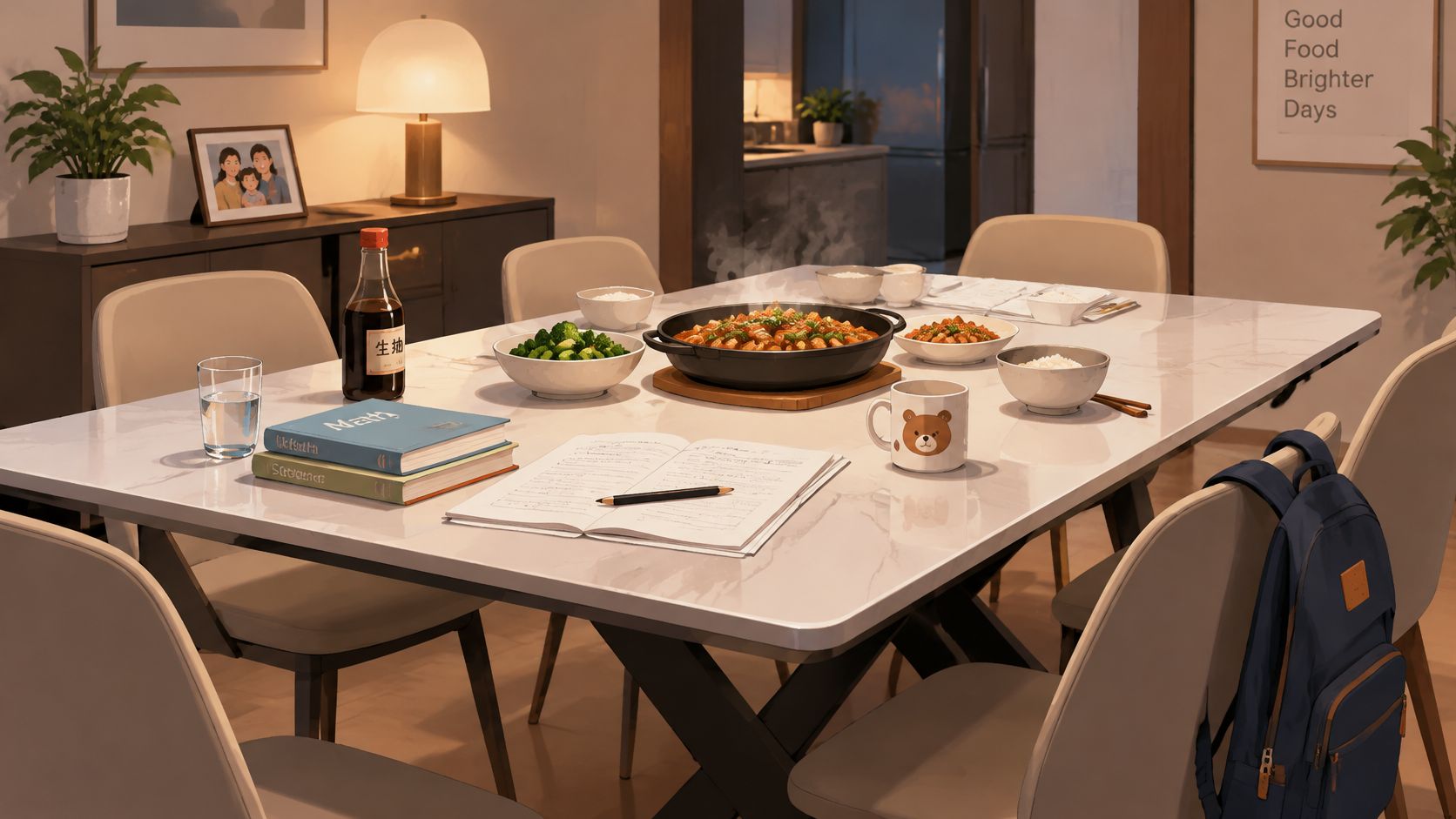
For a Milwaukee family comparing dining tables, that distinction matters. A table might need to handle spaghetti sauce, homework, and a steaming serving dish before anyone clears space for a board game. A handsome pattern is a good starting point, but the better question is whether that particular table suits the household.
On a typical weeknight, someone spills sauce while another person slides a homework folder away from dinner. A sintered surface can make that cleanup straightforward, but its name can cause confusion. Despite the word stone, the tabletop isn't a slab cut from a quarry.
It belongs to the dense, dry-pressed porcelain family. Think of a tough ceramic plate scaled up into a dining surface, with an important difference: a large tabletop needs carefully designed support beneath it.
From Mineral Powder to Dining Surface
Manufacturers combine feldspar, clay, kaolin, silica, and mineral oxides, then compress and fire the mixture until the particles fuse without resin binders. The manufacturing overview from Aaditya Interior describes pressures that can exceed 400 bar, firing above 1,200°C, and the ISO 13006 low-absorption category of no more than 0.5% water absorption.
That dense structure helps explain why oil, wine, and tea generally remain on the face rather than soaking into it. It doesn't mean spills should become permanent table decorations. Prompt cleanup still protects joints, nearby upholstery, and the supporting furniture.
Manufactured patterns can resemble marble, granite, or metal, with more controlled dimensions and finishes than quarried stone. A marble-looking top therefore doesn't necessarily need marble's care routine, and a substantial-looking edge doesn't necessarily mean the entire panel is equally thick.
Shopping distinction: A stone-look pattern describes appearance. Slab construction and support describe how the table handles daily use.
A well-made sintered stone table combines the surface with an appropriate base, sound fabrication, and an edge detail suited to the household. The ceramic-plate comparison helps here, too: a plate can resist years of washing yet chip when its rim strikes something hard. Toughness across the face and vulnerability at an edge can exist in the same material.
The base, delivery route, and handling plan need attention
These are published material benchmarks, not a universal table specification. A shopper shouldn't assume that every tabletop meets every figure in the table. The relevant document is the specification for the actual slab and finished furniture design.
Water absorption is commonly evaluated under ISO 10545-3 or ASTM C373, while flexural performance may be evaluated under ISO 10545-4 or EN 14617-2. Those test names are useful questions for a seller or fabricator, but they don't replace a finished table's load and support instructions.
What the Specifications Don't Promise
A bending-strength result describes a material under defined testing conditions. It doesn't establish how much weight a finished dining table can carry, how far its ends can project beyond the frame, or whether someone can stand on it to change a lightbulb.
The environmental declaration also identifies the material as dry-pressed porcelain, Group BIa under EN 14411:2016. That classification is more informative than a dramatic description on a sales tag. It places the surface in a recognizable ceramic product category.
For a long table, inspect where the supporting frame reaches. A narrow pedestal can look substantial from across the room while leaving a considerable portion of the slab beyond its support. Thin panels need an engineered construction, not attractive legs attached underneath.
Measure the Room and the Delivery Route
Weight affects more than moving day. The base must carry the top safely, and installers need a clear route through doors, stair turns, and hallways.
The dining table size guide helps connect tabletop dimensions with seating and room layout. Before choosing a pattern, obtain the actual slab thickness, substrate description, edge construction, and permitted overhang. A photograph can't answer those questions.
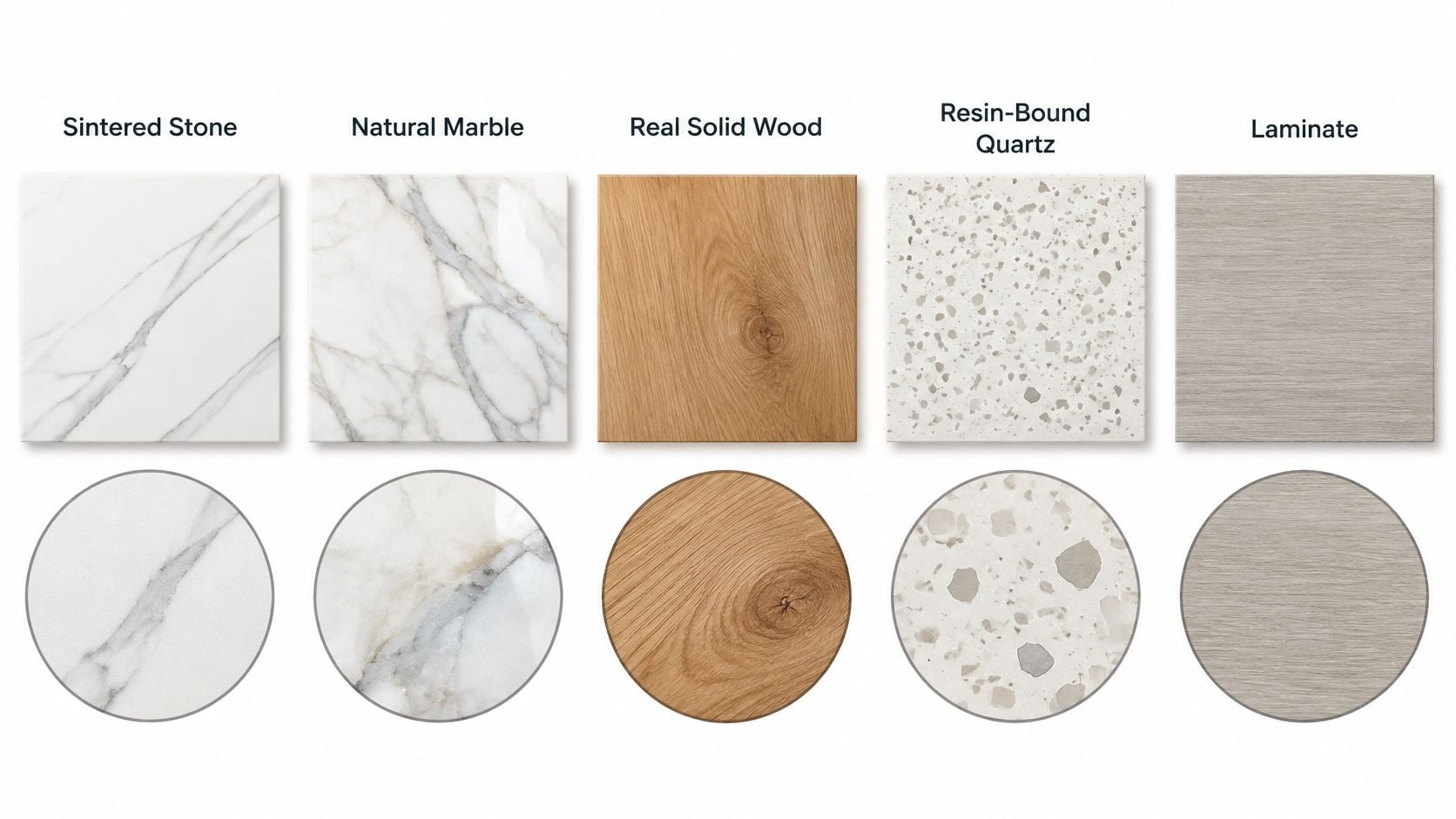
Sintered Stone Next to Other Table Tops
Surface
Heat
Stains and sealing
Scratches and impact
Best household fit
Sintered stone
Generally tolerates hot pans; avoid abrupt temperature changes near joints and cutouts
Very low porosity; periodic sealing usually isn't needed
Highly scratch-resistant, but exposed corners and edges can chip
Busy meals with an appropriately supported top
Natural marble
Trivets are wiser; some stones can mark or suffer thermal stress
Porous and acid-sensitive; often needs sealing
A softer face can scratch; edges can chip and acids can etch
Formal dining with owners comfortable with visible aging
Real solid wood
Trivets protect against heat rings and finish damage
Spills can stain; refinishing may restore the surface
More likely to dent than shatter; repairability is a strength
Families who value warmth and a renewable surface
Resin-bound quartz
High heat can affect its resin
Low porosity; sealing usually isn't needed
Good everyday wear resistance, with possible edge chips
A consistent stone-like pattern with careful heat use
Laminate
Limited heat resistance
The surface film resists spills while intact
Scratches can penetrate the wear layer; moisture entering edges can cause swelling
Lighter budgets and households anticipating moves
The best choice isn't the material with the longest list of advantages. It's the one whose limitations match the household's habits. A careful cook who always uses trivets may happily choose a different surface from a family whose biggest concern is red sauce and coffee.
Choose by the Kind of Wear That Matters
Sintered stone suits spill-heavy dining when the table's construction is sound. Its appeal is a stone-like appearance without a routine sealing schedule. The trade-off is that a chipped ceramic edge isn't something a homeowner can sand smooth.
Solid wood suits households that value repairability. A dent in a wood dining table can be disappointing, but it doesn't necessarily end the table's useful life. Depending on construction and finish, a professional can often repair or refinish it.
USA-made and Amish-made solid wood represent a different craftsmanship path, not a losing side in a material contest. The guide to solid wood dining tables can help readers evaluate that option without assuming a stone-look surface is automatically an upgrade.
Appearance and Aging Are Part of the Decision
Marble appeals to people who appreciate natural variation and are comfortable protecting it from acidic spills. Sealing can help with absorption, but it doesn't prevent acid etching. A pale ring from citrus isn't the same problem as a stain that has soaked into the stone.
Quartz offers a controlled appearance, but its resin makes heat management important. Laminate offers another practical compromise: a lighter, budget-conscious surface that needs protection at seams and edges.
A useful comparison isn't which top stays untouched forever. It's which kind of wear the household can prevent, accept, or repair.
For a formal room used gently, marble may be a satisfying choice. For a family that wants a warmer feel and a surface that can be renewed, real wood deserves close attention. For everyday dining dominated by spills, a properly built sintered stone table belongs on the shortlist.
How to Care for a Sintered Stone Table
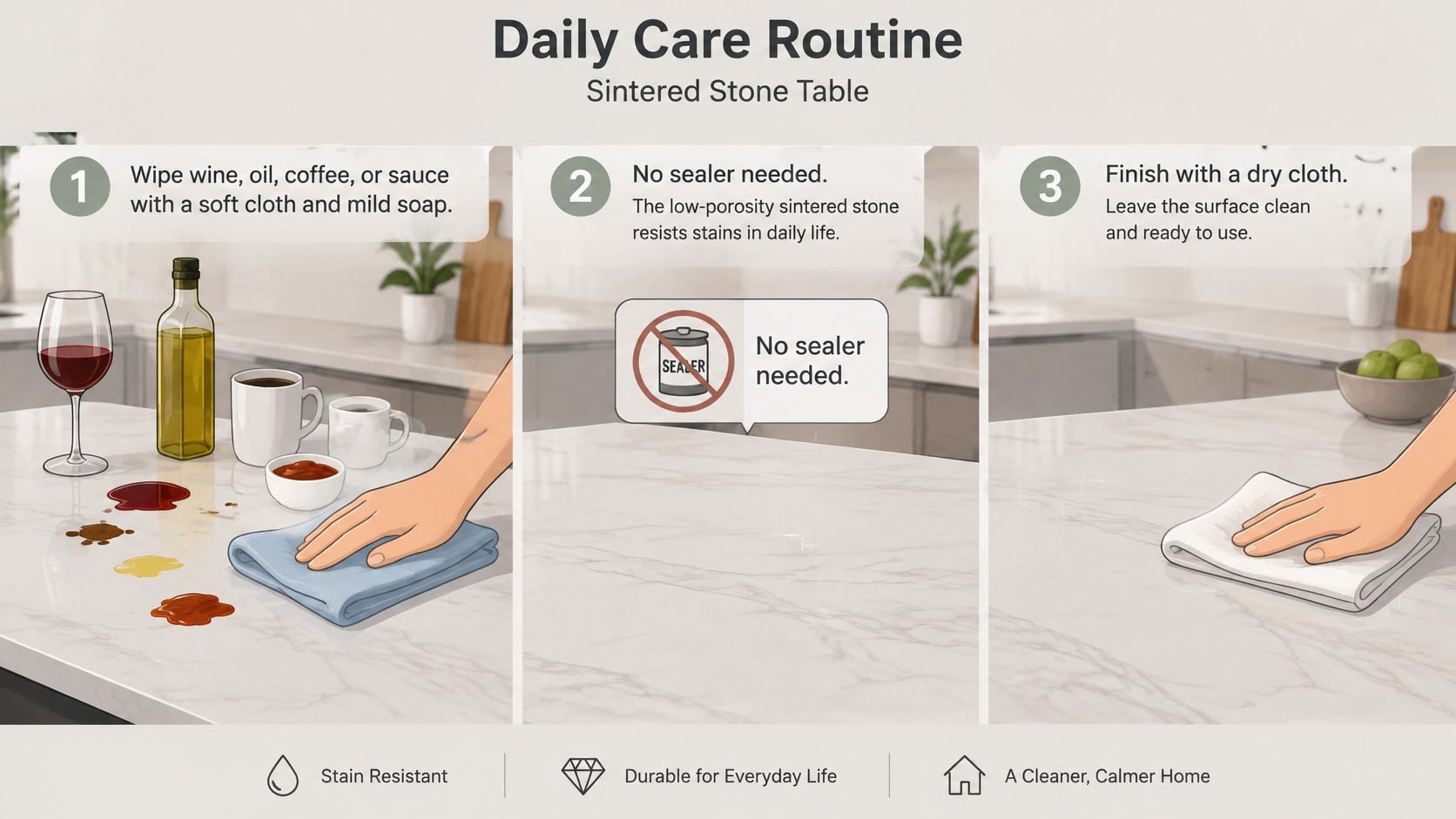
Wipe away everyday spills. Remove wine, oil, coffee, and sauce with a soft cloth, warm water, and mild dish soap. Follow with a clean damp cloth and dry the face, especially around joints and the perimeter.
Protect the finish. Skip harsh scouring pads on polished surfaces. A soft microfiber cloth keeps dried residue from turning an ordinary wipe-down into an abrasive scrub.
Cushion heavy objects. Put protective pads beneath heavy ceramic bowls, metal décor, and cast-iron pieces. Lift them instead of dragging them.
Manage hot cookware carefully. A broad, supported face is a better landing area than a cutout, joint, or thin edge, but a trivet remains a sensible precaution against concentrated heat.
Choose forgiving corners. For a fabricated top, request eased or rounded corners rather than sharp miters where the design permits.
Keep people off projecting ends. An overhang isn't a seat, step, or kneeling platform, even when the table feels sturdy.
This routine is simple because the surface doesn't usually require periodic sealing. The goal isn't constant fussing. It's preventing the concentrated force and abrupt temperature changes that a hard ceramic surface handles less forgivingly.
The Edge Needs More Respect Than the Face
The porcelain and sintered-surface comparison from Stonify describes scratch resistance around Mohs 6–8, along with resistance to heat, ultraviolet exposure, and many chemicals, while identifying exposed edges as vulnerable to impact. That combination explains why sliding a dinner plate and dropping a heavy pan against a corner are very different events.
A child knocking a cup across the face might leave nothing more than a spill. A heavy serving dish striking the rim can cause a chip. Protective pads help with contact beneath objects, but careful lifting matters at the perimeter.
Care priority: Prevent the hard hit on the edge, not just the visible mark on top.
Leave Alterations to a Fabricator
Cutting and drilling can generate respirable crystalline-silica dust. Those jobs belong with trained professionals using suitable wet methods, dust controls, and respiratory protection, not with a household drill in the dining room.
A fabricator should also be able to explain thermal-shock evaluation under EN 14617-6 and how the tested construction relates to the proposed table. Heat resistance isn't a reason to ignore the maker's installation details.
Different parts of a mixed-material table may need different care. A ceramic face and wood base shouldn't automatically receive the same cleaner; the wood furniture maintenance guide helps with that distinction.
If a chip appears, stop using the damaged area and keep hands away from a sharp edge. Don't grind it at home. Ask about professional repair or a replacement top.
Rooms, Styling and Support Checks
A table can suit a room visually and still be wrong for the way people move around it. The most useful check starts with an ordinary day, not a staged dining-room photograph.
Family Meals and Apartment Living
The family dining room. Weeknight meals bring sauce, cups, and dishes; weekend guests bring extra elbows and serving bowls. A pale veined top paired with a wood trestle can soften the stone look and suit a classic room, provided the trestle and supporting frame are engineered for the slab.
The limit is how people use the ends. The large-format slab installation guidance warns that overloading or sitting on unsupported areas can cause cracking. Extra seating should come from chairs, not from someone perching on the tabletop.
The compact apartment. A light pattern can provide a marble-like appearance without making a small dining corner feel visually heavy. A slim dark top and sturdy pedestal can also work, especially where chair legs would otherwise compete for floor space.
The limit is physical access and support. A 20 mm top still needs a suitable base and a workable path upstairs, regardless of how light it looks. Before delivery, measure stair turns and discuss how the top and base will be handled.
Sunny Corners and Work-and-Eat Spaces
The console by a Milwaukee window. A sintered surface can be useful where sunlight reaches a decorative tabletop. Its UV resistance makes the material appealing for a pale pattern in a bright interior, but the base, adhesives, and other components need their own suitability check.
The limit is the complete construction. Heavy pottery placed near a narrow console's front edge can create a problem even when the surface itself tolerates sunlight.
The open-kitchen work-and-eat table. A laptop, a hot serving dish, and paperwork can share one top, but the seating layout needs thought. A cantilevered end may look convenient until someone leans heavily on it while reaching for a charger.
The limit is the engineered support beneath the working area. A central pedestal must do more than leave knee room; its frame must support the intended span without encouraging unstable loading.
Before choosing a finish, obtain clear answers to these questions:
Slab and substrate: What is the actual ceramic thickness, and what supports it underneath?
Frame and overhang: Where does continuous support stop, and what projection is permitted?
Edges and loading: What corner profile and maximum load apply to this finished table?
Service options: Are professional repairs or replacement tops available?
For households with toddlers who climb chairs toward table corners, pause and reconsider the shape and placement. The dining table decorating guide can help with styling, but decorations shouldn't hide an exposed edge or crowd the useful eating area.
The fit test: If spills and heat are the main problem, sintered stone helps; if hard knocks and people sitting on edges are the main problem, rethink the design.
Come See Dining Tables in Greenfield
A sensible dining-table decision can start with a short list:
Choose sintered stone when spills and hot dishes dominate daily use, and the finished table has suitable thickness, support, and eased corners.
Choose real solid wood when warmth, repairability, and the possibility of refinishing matter more than a stone-like appearance.
Pause on any design that encourages people to sit on a projecting end or relies on unclear support instructions.
The final choice should feel comfortable in use, not just look appealing across a showroom. Chair height, knee clearance, and the position of the base can change how a table feels during a long family meal.
A Milwaukee Family Business
BILTRITE Furniture-Leather-Mattresses is a fourth-generation, family-owned and locally operated business whose family has served customers' home furnishing needs since 1928. Its Kerns-Komisar family history began when Irwin Kerns opened BILTRITE Upholstery in Milwaukee.
A Milwaukee Magazine history of BILTRITE documents that beginning and the move to Greenfield in 2006, where the showroom encompasses approximately 45,000 square feet. That local history supports a straightforward approach: help families understand what they're choosing and what the trade-offs mean at home.
BILTRITE Furniture-Leather-Mattresses specializes in affordable, better-quality USA-made, Amish-made, and real solid wood furniture, with small-scale options for apartments and heavy-duty options for busy households. The emphasis is value for the quality, not a claim to be the cheapest.
Make the Visit Useful
A room sketch, photographs, and measurements make an in-person conversation more productive. Include doorways, nearby cabinets, and the space needed to pull chairs out, not just the empty floor where the table will stand.
BILTRITE Furniture-Leather-Mattresses welcomes custom orders, and sales associates help customers find the right item. Appointments are available, and questions can also be discussed by phone at 414-238-2020.
There are no online sales, so the hands-on showroom visit is central to the process. The Greenfield showroom location information can help with planning, and the store is closed on Sundays and Mondays to support family time.
A no-pressure visit gives a household room to compare, sit, and ask practical questions. Bringing the support checklist is just as worthwhile as bringing a favorite finish sample.
BILTRITE Furniture-Leather-Mattresses offers dining furniture choices, including USA-made and Amish-made solid wood, with personal help comparing materials and construction. Visit BILTRITE Furniture-Leather-Mattresses in Greenfield to pull up a chair, test comfort, and discuss which tabletop trade-offs make sense for the family's home.