Twin Headboard Width: Standard Sizes and Fit Guide

A standard twin mattress is 38 inches wide by 75 inches long, so a headboard starts at 38 inches and often lands between 38 and 44 inches once frame and design are added. But if the mattress fits, does that mean the headboard will fit the bed and the room?
Not necessarily. The frame's outside edges, the headboard's posts, and the attachment hardware all matter. Getting twin headboard width right means measuring the whole setup, not just matching a size label.
Table of Contents
- Standard Twin Headboard Width at a Glance
- Why 38 Inches Is the Starting Point
- Twin Versus Twin XL for Headboard Fit
- Headboard Width Options by Construction
- How to Measure Your Frame Before You Order
- Room Clearance and Layout Math
- Mounting, Spacing and Fit Problems to Fix
- Confirm Your Width and Visit Our Greenfield Showroom
Standard Twin Headboard Width at a Glance
The mattress defines the bed size. The headboard is a separate piece that must work with the mattress, frame, and available wall space.
The RoomSketcher bed-size guide gives a standard U.S. twin mattress as approximately 38 inches wide by 75 inches long, equivalent to about 97 by 191 centimeters. That's a useful planning baseline, not a promise about the finished bed's outside dimensions.
Standard Bed Sizes and Headboard Starting Widths
| Bed size | Mattress width | Mattress length | Headboard starting point |
|---|---|---|---|
| Twin | 38 in (97 cm) | 75 in (191 cm) | 38 in minimum, about 41 in common |
| Twin XL | 38 in (97 cm) | 80 in (203 cm) | Same as twin, check frame length |
| Full | 54 in | 75 in (191 cm) | 54 in minimum |
| Queen | 60 in | 80 in (203 cm) | 60 in minimum |
| King | 76 in | 80 in (203 cm) | 76 in minimum |
Treat the headboard starting point as the width needed to visually match the sleeping surface. It isn't a mounting specification, and it doesn't include decorative extensions. A headboard can cover the mattress neatly while leaving the frame rails visible beside it.
That distinction matters when comparing a standalone panel with a complete bed. A complete bed's listed width may include posts and rails, while a standalone headboard's description may emphasize only its panel. Product drawings are more useful than a size label alone.
Practical rule: Find the mattress size, use its width as the starting point, then check the assembled frame before choosing any overhang.
What the Label Doesn't Settle
A twin label identifies the intended mattress category. It doesn't guarantee that separate furniture pieces share the same bracket arrangement, post placement, or outside width.
Before buying, compare these details:
- Listed dimensions: Look for overall width rather than relying on the product name.
- What's included: Confirm whether the measurement describes the headboard alone or the complete bed.
- Attachment details: Check whether brackets, legs, or mounting hardware are included.
- Room fit: Count any projecting trim or upholstery in the space the piece will occupy.
A narrow panel can be a smart choice for a tight wall. A broader panel can look more balanced above substantial rails. Neither choice is automatically better; the useful measurement is the one that matches the actual setup.
Why 38 Inches Is the Starting Point
A 1922 Bureau of Standards conference brought bed and mattress manufacturers together to adopt standard dimensions, including a 3-foot-3-inch twin bed with a 37-inch top surface, according to the Sizes mattress-history account. For buyers, that history explains why twin measurements offer a useful reference. It does not make 38 inches a required width for every headboard.
What Standardization Means for Buyers
Standard mattress categories help coordinate bedding, support systems, and furniture. Individual components can still differ in size and construction.
Consider a twin bed with a frame whose outside rails extend beyond the mattress. A headboard sized close to the mattress may leave those rails visible; a wider panel or posts can align with the frame and create a broader finish. Both designs can suit a twin bed, but they occupy different amounts of wall space.
The mattress defines the sleeping surface and the footprint the frame must support. The headboard is a separate part of the bed assembly, and its panel, posts, or trim may extend beyond that footprint. The product's listed dimensions determine how wide the complete piece is.
Names alone do not guarantee matching parts. A twin mattress, twin frame, and twin headboard may be intended for the same bed category while differing in outside width, post placement, or mounting arrangement.
The right width depends on what the headboard should align with. A flush panel can keep the bed visually compact, while an overhanging design may better balance substantial rails or create a wider backdrop. Before ordering, account for the frame's outer edges and the space the headboard will occupy, not just the mattress label.
Twin Versus Twin XL for Headboard Fit
Twin XL keeps the same nominal width as a standard twin, but adds length. The RTINGS mattress-size guide lists standard twin dimensions as 38 by 75 inches and Twin XL as 38 by 80 inches. That extra 5 inches extends toward the foot of the bed, so compare it with the space between the bed and the wall or furniture there.
The mattress width alone cannot confirm headboard fit. A headboard may suit either size across the panel, while its brackets or posts may not match both frames.
Check the Whole Bed Assembly
In a compact bedroom, a standard twin can leave more usable floor space at the foot of the bed. A taller adult may prefer Twin XL, but the room needs enough clearance for the longer mattress and frame. Measure the available space behind the bed before choosing.
In a dormitory, check the specific frame arrangement before ordering. The mattress label does not identify its brackets, rails, or rules for attaching a separate headboard. The Twin XL size guide can help with the mattress decision, while the frame model identifies the assembly you need to fit.
The mattress must be supported by a frame designed for its length. Avoid a shorter frame that leaves the mattress extending beyond the supported end, and confirm that the foundation or platform arrangement is suitable.
Match the Mounting and Visible Height
A different bed base can change how much of the headboard shows above the pillows. Check the assembled mattress height against the headboard's adjustment range, especially if you are replacing a frame. Twin XL does not automatically call for a taller headboard.
For a custom solid-wood headboard, distinguish the visible panel width from the outside post width. Ask for a drawing that shows attachment locations, particularly when the headboard and frame are purchased separately.
Before ordering, confirm the frame model and that it is designed for the intended mattress length. Then check the mattress designation, the headboard's mounting method, and how much panel will remain visible once the bed is assembled. A headboard that looks wide enough may still have incompatible attachment points, so use the frame's specifications to make the final choice.
Headboard Width Options by Construction
Will a flush panel or an overhanging headboard work better with your frame and room? A flush panel keeps the bed's width closer to the mattress. An overhang creates a broader backdrop for the bedding, but the headboard and frame together take up more space. Check the whole assembly, not just the mattress label.
A 41-inch headboard is a useful measured example: around 1.5 inches wider per side than a standard twin mattress. That modest overhang can frame the bed without making the headboard dominate the room.
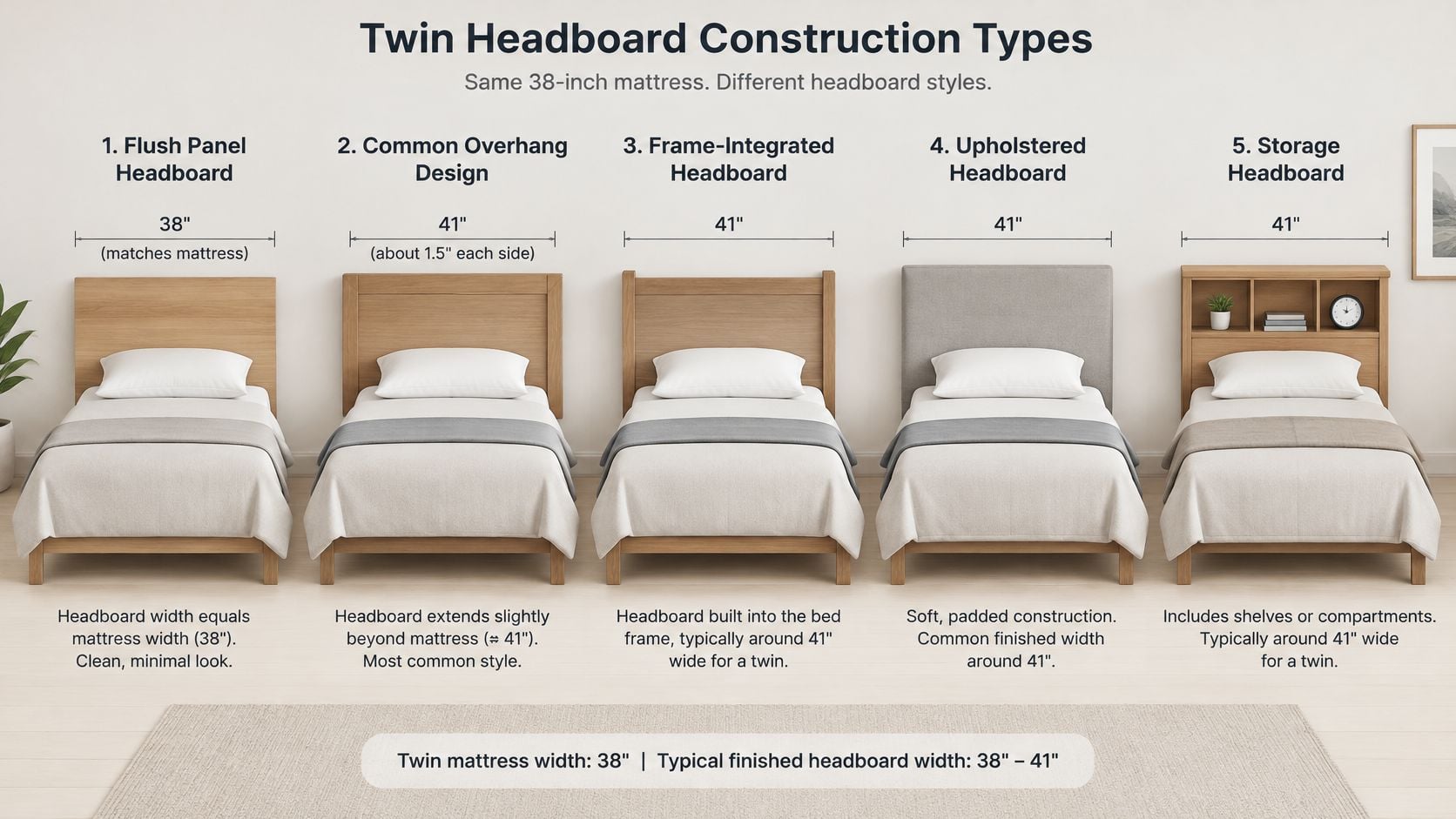
Headboard Types, Finished Widths and Mounting
A headboard-dimensions guide shows a twin frame-and-headboard assembly about 44 1/8 inches wide. Treat that as an example of an integrated bed, not a standard width for every headboard. The frame's outside dimensions may extend beyond the mattress and change the space the finished bed occupies.
| Headboard type | Typical outside width | Mounting | Best for |
|---|---|---|---|
| Flush panel | 38 in, matching the mattress | Frame or wall | Narrow rooms and tight walls |
| Common overhang | About 41 in | Frame posts or wall | A finished look and framed bedding |
| Frame-integrated bed and headboard | About 44 1/8 in in one example | Built into the frame | Shoppers who want a coordinated unit |
| Wingback or upholstered | Measure outside to outside, including wings | Frame or wall | A decorative, cozy style |
| Freestanding | Measure the full panel and base width | Floor standing, with any specified restraint | Layouts requiring independence from frame mounting |
These construction features can overlap. Upholstery describes the covering, while wings describe the shape; a solid-wood panel can also be flush or framed. Choose from the piece's actual outline and dimensions, rather than assuming its material determines its footprint. For other design options, see this guide to headboard styles.
Where Extra Bulk Hides
Wingback styles can look narrower from the front than they are in the room. Measure across the outermost wings and check the depth from the rear mounting surface to the frontmost edge. Both dimensions affect fit.
Depth has its own trade-off. A thick upholstered headboard can push the bed farther into the room even when its width fits the wall. Freestanding models also vary: some are self-supporting, while others need wall contact or a restraint. Use an away-from-wall layout only if the product's construction and installation requirements permit it.
Choose the silhouette after checking the footprint. Decorative wings are enjoyable until they occupy the space needed for a nightstand drawer.
BILTRITE specializes in USA-made, Amish-made, and real solid-wood furniture, with construction details shoppers can examine at the Greenfield showroom. Seeing the posts, joints, and mounting arrangement can make comparisons clearer than judging a front-facing photograph.
How to Measure Your Frame Before You Order
A tape measure, notepad, pencil, and phone camera are enough to prepare useful shopping information. Remove bulky bedding from the edges so the measurements describe furniture rather than a comforter.
Take photographs straight on and from the side. Include a close-up of the existing attachment brackets, particularly when the frame's model label is missing.
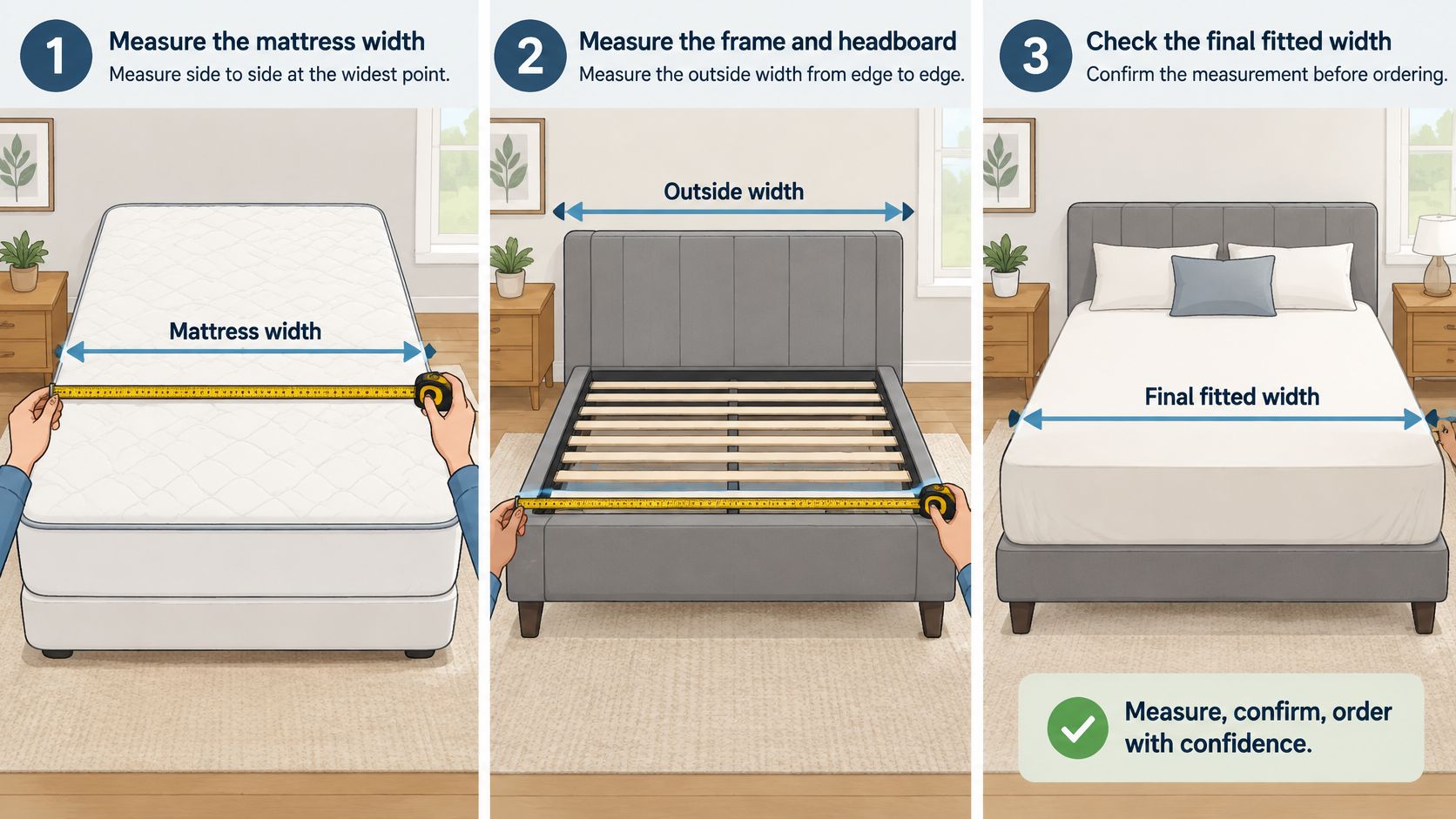
A Measuring Routine That Prevents Guesswork
Measure the mattress across its widest point. Run the tape side to side without compressing the edge. This confirms the actual sleeping surface instead of assuming the label describes it precisely.
Measure the frame's outside width. Include side rails, posts, and any projecting brackets at the head of the bed. Wide rails can make the assembly noticeably broader than the mattress.
Record the headboard's complete outside width. For a piece already available to measure, stretch the tape between its outermost points, including trim and wings. For a new purchase, request the dimensioned drawing rather than estimating from a photo.
Locate the attachment points. Measure vertically from the top of the frame rail to the mounting-hole centers, then record the spacing between corresponding attachment points. Note the hole or slot arrangement so a salesperson can compare the correct locations.
Measure the space behind the bed. Include baseboards, wall trim, and the depth available for brackets or upholstery. A wall-mounted piece may need space behind its panel that isn't obvious from the front.
Compare and label the results. Keep panel width, overall outside width, and mounting spacing as separate entries. Add the frame model and clear photos so the measurements can be interpreted correctly.
Make the Notes Easy to Use
Write down what each measurement describes. A bare number marked width is easy to confuse with the distance between posts or the span of the central panel.
Keep the tape level across horizontal measurements. When an attachment bracket has elongated slots, record their orientation and usable span instead of treating the slot as a single round hole.
The furniture measuring guide also helps with delivery planning. A headboard that suits the bedroom still has to pass through the route into it.
- Photograph the labels: Model information can settle questions that measurements alone can't answer.
- Sketch the connection: Mark which holes belong to the frame and which belong to the headboard.
- Include obstructions: Show baseboards, nearby outlets, and any radiator or window trim.
- Keep the original notes: Bring the measurements along rather than relying on memory.
Don't round a tight opening upward to make a desired piece seem workable. Allow for the actual hardware and installation arrangement before committing to a close fit.
Room Clearance and Layout Math
How much room will the complete bed assembly leave for movement? Start with the wall's usable span and subtract the headboard's total outside width, including posts or trim. The remaining space may not divide evenly. A doorway, closet opening, or off-center window can make one side tighter, so check the bed footprint as well as the headboard's widest point.
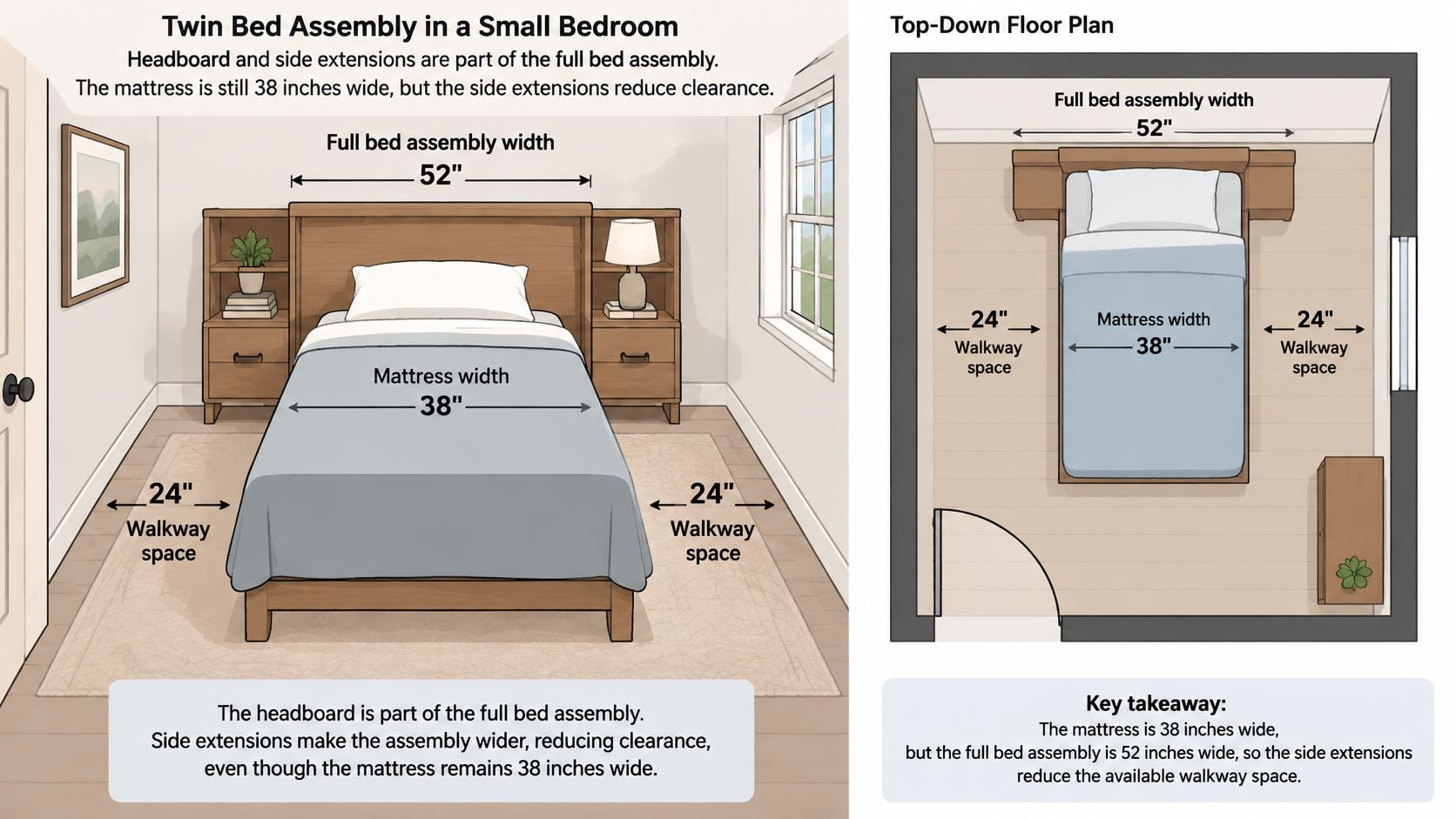
Clearance Guide for Twin Beds
The RoomSketcher bedroom-planning guide recommends at least 24 inches of usable side clearance, about 30 inches for more comfortable circulation, and approximately 36 inches for dresser or wardrobe access. Between twin beds, its guidance is roughly 24 inches minimum, with 30 inches or more preferred.
| Space | Minimum clearance | Comfortable clearance |
|---|---|---|
| Walkway beside an accessible side | 24 in (61 cm) | 30 in (76 cm) |
| Dresser or wardrobe access | 36 in (91 cm) | 36 in (91 cm) |
| Between two twin beds | 24 in (61 cm) | 30 in (76 cm) or more |
These are general furniture-planning guidelines, not accessibility-code requirements. A household using mobility equipment may need a different arrangement based on the person, equipment, and transfer method.
Test the Full Bed Footprint
For a small-room layout, subtract the selected headboard's outside width from the measured wall span. Divide the remainder between the sides only if the bed will be centered. Then account for nightstands and other bedside furniture. The space left over must still allow movement and let doors and drawers operate.
Measure the narrowest gap between the nightstand and the closet door, and compare it with 24 inches. Check the complete route, not just the open floor beside the panel.
Painter's tape makes the layout easy to test before furniture arrives. Mark the headboard, rails, and nightstand separately, then open nearby drawers and walk the route used for carrying laundry or changing sheets.
- Doors: Check the full swing, not only the closed position.
- Storage: Leave room to stand while a drawer or wardrobe door is open.
- Outlets: Keep plugs accessible and cords clear of the panel.
- Windows: Check trim, curtains, and access to handles.
In compact apartments and older Metro Milwaukee homes, a flush panel often preserves more flexibility for bedside furniture. A larger bedroom may have room for an overhanging design without reducing circulation. The bedroom furniture arrangement guide can help compare placements before choosing a wider silhouette. Use painter's tape to confirm the headboard, frame, furniture, and walking route fit together.
Mounting, Spacing and Fit Problems to Fix
Does the headboard fit the frame as well as the mattress? Check the mounting system, frame geometry, and overall dimensions before ordering. The mattress label alone cannot confirm that the frame holes will line up or that posts and trim will fit the room.
| Problem | Likely cause | Fix |
|---|---|---|
| Mounting holes do not line up | Spacing differs from the frame model | Compare the spacing with the exact frame model before buying |
| Headboard looks too narrow | Flush width on a wide frame | Choose a common overhang or wider design |
| Wings block an outlet or trim | Total width too large for the wall | Measure the wall and consider a flush panel |
| Wall-mounted piece sags | Fastened into weak drywall | Find studs and use hardware rated for the load |
| Total width is larger than expected | Posts and trim not counted | Measure the overall outside width, including posts |
Misaligned holes call for a compatibility check before drilling. An approved adapter may be available. Altering a structural post or frame bracket without guidance can weaken the connection.
A narrow-looking panel is usually a visual concern. If the attachment is secure and the room layout works, keeping it is a style choice; replacing it is not required to correct a mechanical problem.
Fix the Cause Before Changing the Furniture
When wings interfere with an outlet, check access for both the plug and its cord. Moving the bed may solve the obstruction, provided the new position does not block the opposite walkway or put the frame out of place.
A sagging wall-mounted headboard needs prompt attention. Stop using it until its supports and fasteners have been checked. Tightening screws in damaged drywall may not restore a dependable hold.
Find studs where the installation design allows. If anchors are suitable, choose hardware that matches the wall material, headboard weight, bracket arrangement, and expected use. For a heavy or uncertain installation, use a qualified installer.
Measure posts and trim, too. Compare the manufacturer's overall drawing with the room outline before opening up the installation area, so the assembly fits both the frame and the available space.
The guide to bed frames with hooks for headboards and footboards explains the difference between hook-on and bolt-on connections. Those systems are not interchangeable because both pieces are labeled twin.
- Identify the system: Check whether the connection uses hooks, bolts, brackets, or a wall cleat.
- Check supplied hardware: Separate fasteners provided for the headboard from those made for the frame.
- Avoid forced alignment: Pulling posts inward or outward to reach holes can strain the assembly.
- Retest after installation: Check for movement and follow the product's maintenance directions for connections.
A properly installed headboard should feel stable without improvised pressure, wedged furniture, or unsupported panels. Fix the connection that causes the mismatch before changing furniture that otherwise fits.
Confirm Your Width and Visit Our Greenfield Showroom
Before choosing a headboard, bring the panel width, its overall outside width, and the mounting spacing. Include the frame model and mattress-length information too. Those details help you compare the full bed assembly, not just a product labeled “twin.”
A showroom visit can clarify trade-offs that measurements alone cannot. A slim panel leaves more visible wall space, while a substantial wood design creates a stronger visual presence. Check how each option attaches to your frame and whether its width leaves comfortable room around the bed.
Local Guidance Without the Pressure
BILTRITE is a fourth-generation, family-owned and operated business serving Metro Milwaukee since 1928, with affordable, better-quality furniture that includes USA-made, Amish-made, and solid-wood options.
Its selection also includes small-scale pieces for compact homes and heavy-duty furniture for family use. Compare construction and fit with your needs in mind, rather than choosing by the mattress size alone.
- Experienced assistance: Ask sales associates to help compare dimensions and address questions about how a headboard fits your frame.
- Mattress choices: The mattress department offers a range of models, so you can consider mattress comfort alongside bedroom furniture.
- Hands-on shopping: BILTRITE's showroom lets you examine materials and construction in person.
- Family-first hours: The showroom is closed on Sundays and Mondays. Check current hours before making the trip.
Bring a few clear measurements and photographs of the bed area. That is usually enough to keep the conversation focused on width, attachment, and room layout.
At the Greenfield showroom, compare post thickness and finishes, then ask how a selected headboard connects to your frame. Check whether the connection points line up and whether the overall width works with nearby furniture and walkways.
A well-chosen headboard should suit the bed, attach correctly, and leave the room comfortable to use. Visit BILTRITE Furniture-Leather-Mattresses in Greenfield to compare headboard construction, test comfort, and ask measurement questions without pressure. Come on down to our showroom and see for yourself!