


Innerspring Sleeper Sofa vs Memory Foam, Air and Hybrid

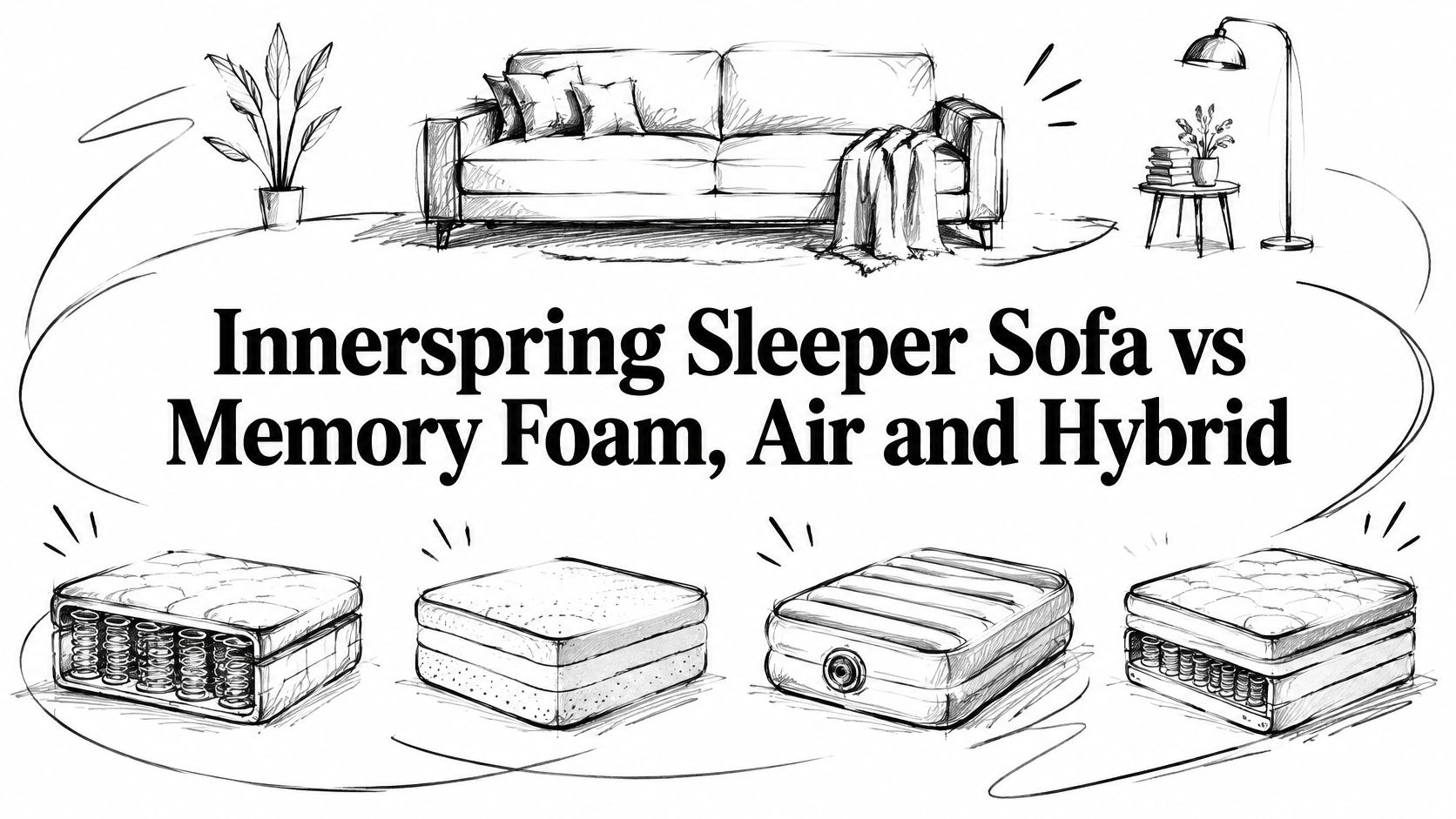
Can a better mattress really rescue a sleeper sofa if the frame underneath leaves a bar pressing into someone's back? That's the question worth asking before choosing an innerspring sleeper sofa over memory foam, air or hybrid. The mattress matters, but the complete sleeping system determines whether overnight guests settle in comfortably or spend the night searching for a better position.
Table of Contents
- Why the Mattress Inside Your Sleeper Sofa Matters Most
- How the Four Sleeper Mattress Types Compare
- How Each Mechanism Changes the Sleep Surface
- Comfort, Support and Coil Quality Compared
- Durability and Long-Term Wear by Sleeper Type
- Best Use Cases for Each Sleeper Type
- Test Your Pick in Our Greenfield Showroom
Why the Mattress Inside Your Sleeper Sofa Matters Most
Could a guest sleep comfortably on a mattress that folds inside a sofa? The answer depends on how the mattress and folding frame work together. A steel-coil mattress can feel familiar and responsive, but it is not automatically the better choice if the frame flexes, sags, or leaves pressure points beneath the sleep surface.
An innerspring sleeper sofa combines a convertible sofa bed with a steel-coil mattress. The design draws on two established ideas: spring mattresses and beds that fold away. A history of spring-bed engineering and the development of convertible sofa beds trace those technologies through earlier patents. The practical point is that a sleeper sofa has to fit a usable bed into a limited space, so its mattress and mechanism need to be assessed as one system.
Start With the Person Sleeping There
Mattress cushioning, responsiveness, and support shape how the bed feels. So do the mechanism, room layout, and how frequently the sleeper will be opened. Check the open bed for frame pressure and uneven support, rather than judging the sofa only in its closed position.
Practical rule: Test the sleeper sofa open, with someone lying on it.
For guest use, ask the host how many nights visitors usually stay and what they carry in. A short overnight visit and a weeklong stay call for different expectations around comfort, storage, and setup. BILTRITE is a fourth-generation, family-owned business serving Metro Milwaukee since 1928. Its showroom associates can help compare the mattress and folding frame together, so shoppers can check the fit for their room and intended use.
How the Four Sleeper Mattress Types Compare
Sleeper mattress types compared at a glance
| Sleeper Type | Typical Thickness | Feel | Motion Isolation | Heat and Airflow | Best Known For |
|---|---|---|---|---|---|
| Innerspring | Thin, folding profile; check the specific model | Bouncy, familiar, responsive | Interconnected coils transfer more movement; pocketed coils can limit it | Open coil space allows airflow | Traditional feel and responsive support |
| Memory foam | Folding profile varies by model | Body-contouring, slower recovery | Often limits movement transfer; test the actual mattress | Foam construction and cover affect warmth | Contouring and pressure relief |
| Air | Varies with chamber design | Firmness adjusts with a pump | Ask whether chambers are separate and sealed | Check the cover and whether the chamber design allows airflow | Adjustable firmness |
| Hybrid | Varies with coil and comfort-layer construction | Responsive support with cushioning | Check coil type and how the foam layers absorb movement | Coils allow airflow; foam layers affect warmth | A blend of support and cushioning |
Use the table to shortlist, then test the specific model. The mattress and folding frame work as one system: a supportive-feeling innerspring can still disappoint if the opened frame flexes or has uneven support beneath it. Check the actual specifications and feel of the sleeper you are considering.
For a guest who prefers a springy, familiar surface, start by trying an innerspring. If a sleeping partner's movements are disruptive, compare memory foam models, which respond more slowly. In either case, lie on the open bed together and check how the mattress and frame feel under both sleepers.
Match the Feel Before Comparing Features
An air design can suit someone who wants to adjust firmness. Ask how the pump operates, whether chambers are sealed or serviceable, and how a valve can be replaced. Confirm that the showroom has the model available to try before making the trip.
A hybrid may appeal to someone who wants cushioning while keeping a responsive feel. Read about hybrid mattress benefits, then check how the specific sleeper folds and feels: a standard hybrid mattress and a folding sleeper mattress have different space and construction requirements.
Keep surface preference and structural support in view. A comfortable first feel helps narrow your options, while the frame, mattress thickness, and support beneath the sleeper determine whether that comfort holds when the bed is open. If the base feels weak or uneven, compare another frame before choosing a mattress type.
How Each Mechanism Changes the Sleep Surface
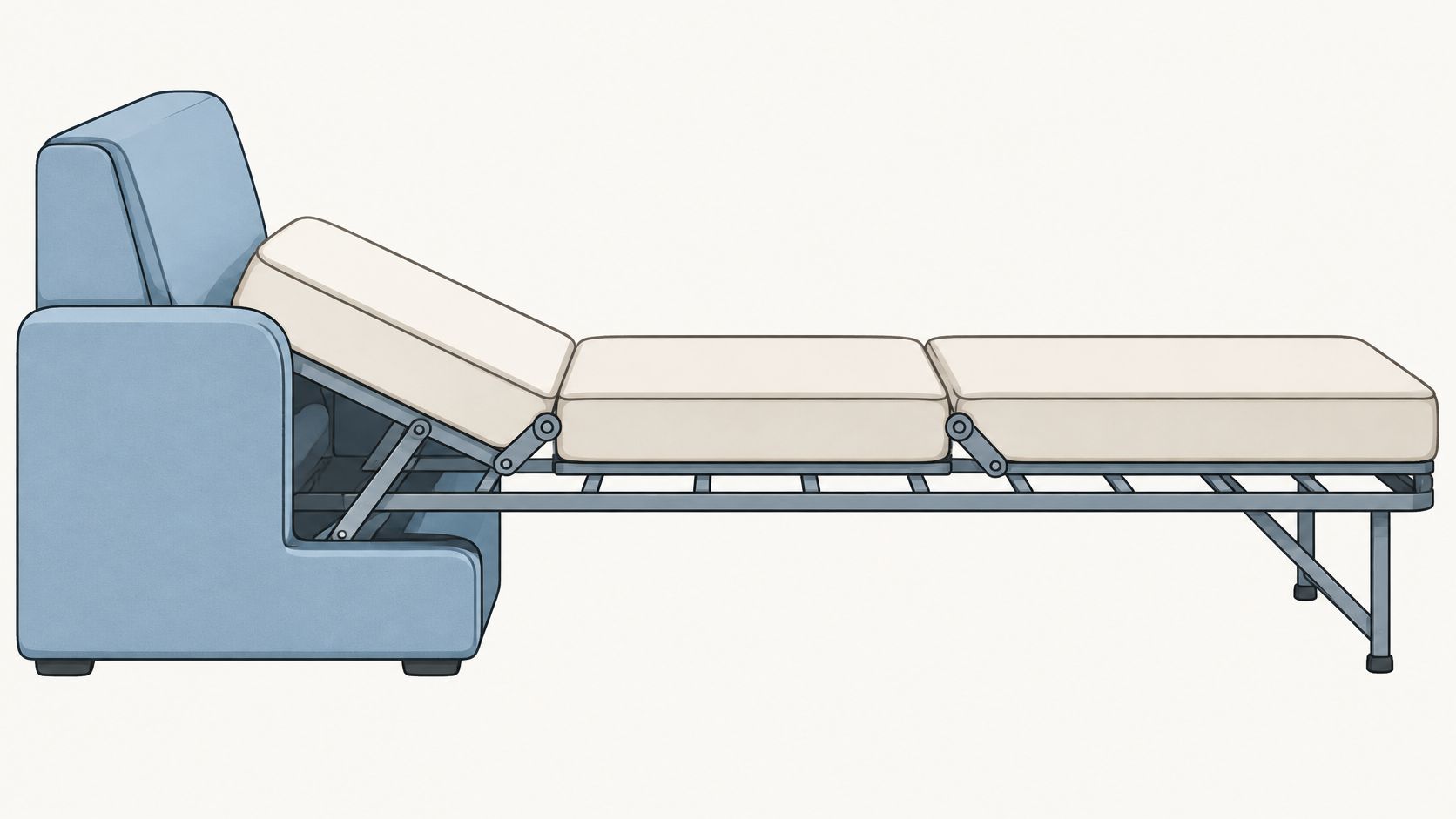
Does the opened bed feel even under the sleeper, or does the frame create pressure points the mattress cannot hide? A sleeper mattress must fold into the sofa, clear the mechanism, and lie on its support deck when opened. Bars, hinges, joints, and changes in deck height can all affect how the surface feels.
Many sofa-bed mattresses are about 4 to 5 inches thick, compared with roughly 8 to 14 inches for conventional mattresses. With less padding between the sleeper and the deck, the folding frame and thin mattress need to work as one system.
Where Each Construction Needs Attention
An adult settling onto an innerspring sleeper after a long drive may notice a ridge beneath the hips. Check whether that pressure comes from the coils, a transition in the deck, or a crossbar. The mattress type alone won't identify the cause.
A side sleeper on memory foam may find the shoulder cushioned while the middle sinks toward a low spot. Check the base and fold area before choosing softer foam. Cushioning can't substitute for a level foundation.
With an air design, inspect the chamber placement and hose routing as the bed converts. Ask staff to show how those parts stay clear of moving components. Adjustable firmness cannot correct a chamber that sits poorly or blocks the folding path.
A hybrid brings its own fit question: how does its comfort layer sit over the coil unit after folding and reopening? Added cushioning may soften a transition, but only if the mechanism can accommodate the mattress height.
Compare the Entire Assembly
A closer look at the sofa-bed mechanism and its moving parts can help explain how the frame supports the mattress. Assess the mattress in the sofa it is designed for, not as a standalone bed.
- Trace the transitions: Open the mechanism fully, then feel across the mattress where the frame changes direction.
- Locate pressure: Check whether any firm spot lines up with a bar, hinge, or deck joint.
- Inspect the setup: Ask staff to confirm that the legs and supports are positioned correctly and the mechanism is locked in place.
Innerspring isn't automatically the better choice. A substantial coil unit can still feel uncomfortable over a weak or uneven deck; a mattress that suits the frame may provide better support.
Comfort, Support and Coil Quality Compared
Does an innerspring sleeper sofa feel supportive because of its coils, or because the mattress and folding frame work well together? Gauge is one useful specification, but the complete sleep surface depends on the coil unit, cushioning, mattress thickness and the deck beneath it.
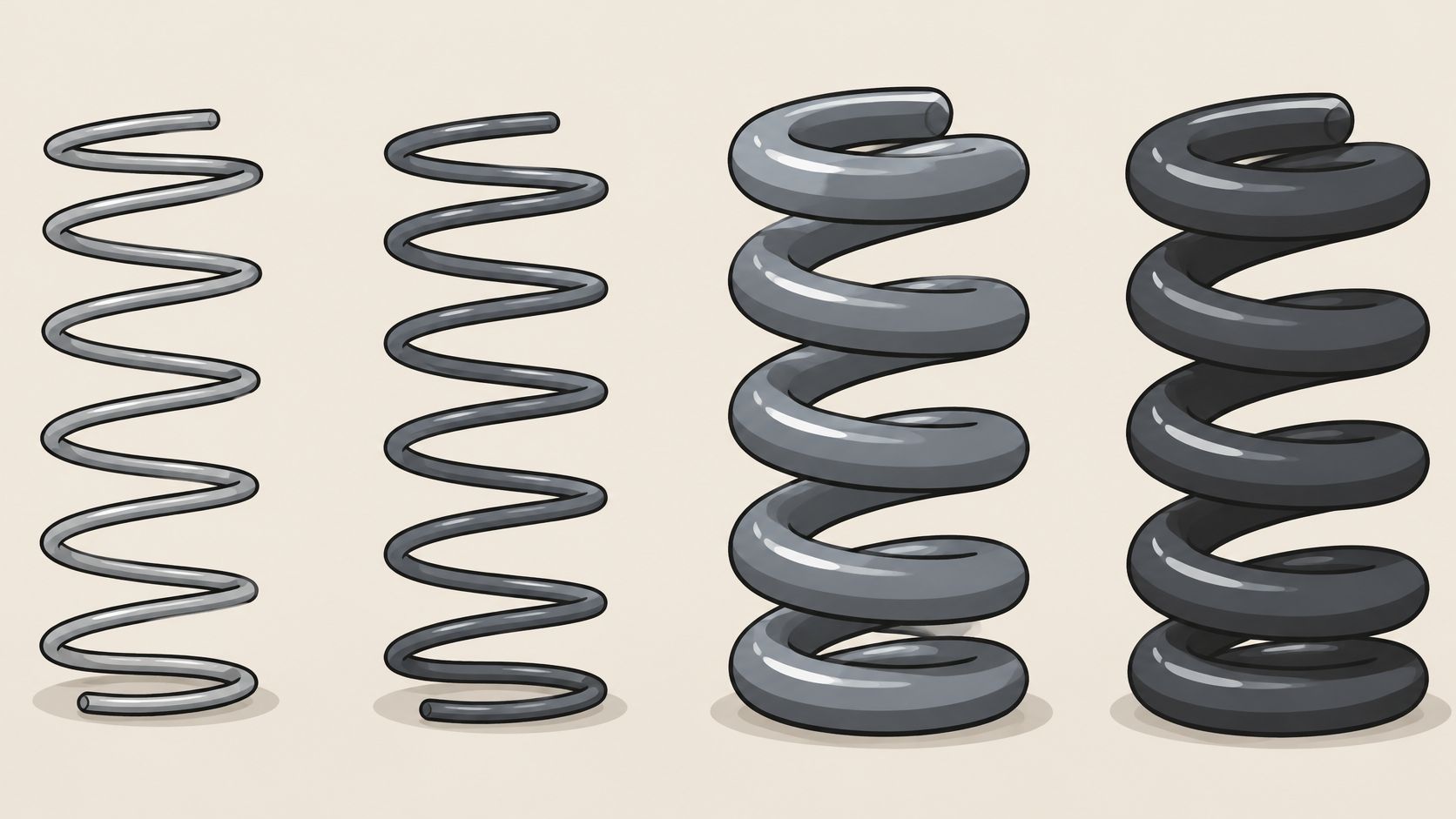
Coil gauge measures wire thickness: lower numbers indicate thicker wire. Innerspring systems commonly span 12 to 17 gauge, though the feel also depends on coil height, shape, steel treatment and surrounding materials. The guide to what an innerspring mattress is explains how the spring unit differs from the layers around it.
| Gauge Range | Wire Thickness | Typical Feel | Trade-Off |
|---|---|---|---|
| 12 gauge | Thick wire within the common mattress range | Firm, sturdy, less yielding | May feel too firm for a lighter sleeper |
| 15 to 17 gauge | Thinner wire | Softer and springier | Durability deserves closer attention under demanding use |
Coil Count Needs Context
A high coil count can look impressive on a sales tag, but it does not show how thick the wire is or how the spring unit is built. For a sleeper sofa, ask about the actual mattress construction rather than treating a count as a stand-alone quality measure.
A firmer feel is not the same as even support, and a softer feel does not by itself indicate a weak mattress. Lie on the open sleeper and notice whether your weight feels supported without a distinct pressure point or excessive sinking. Then consider the frame beneath it: coils cannot compensate for a deck that flexes or feels uneven.
Interconnected and Pocketed Coils Feel Different
Interconnected coils work together across the spring unit. They tend to provide a more unified, traditional spring feel, while movement can travel through the connected structure.
Pocketed coils sit in individual fabric encasements, allowing more localized movement and contouring. That may suit partners with different comfort preferences, though the mattress still needs a stable, compatible folding deck. Neither coil design makes a thin sleeper mattress behave like a full-depth bed mattress.
Ask for Specifications That Explain the Feel
A useful conversation goes beyond a single headline feature. Ask for the details that connect construction to the way the sleeper feels:
- Wire gauge and steel treatment: Ask for the wire thickness and whether the manufacturer identifies the steel type or tempering.
- Coil height and arrangement: Confirm the spring height and whether the coils are interconnected or individually encased.
- Comfort-layer materials: Find out what sits between the body and the spring unit.
- Actual mattress thickness: Check the stated thickness for the assembled mattress.
- Frame compatibility: Confirm that the specific mattress is intended for that sleeper mechanism.
If a specification is unavailable, ask to see the manufacturer's documentation and test the opened sleeper carefully. A showroom comparison is most useful when the mattresses are set up on the frames they are designed for. BILTRITE's Mattress Center carries over 60 models for comparing support preferences and specifications. That selection refers to mattresses generally, not a count of sleeper-sofa models, which have different thickness and folding requirements.
Durability and Long-Term Wear by Sleeper Type
A sleeper sofa shouldn't be assumed to age exactly like a dedicated bed. The mattress is compressed and folded, the mechanism moves, and the furniture also serves as everyday seating. Durability therefore involves several components, not just the sleeping layer.
For innerspring, watch for uneven rebound, a persistent low area or increasingly noticeable body impressions. The construction concerns discussed earlier make spring fatigue and sag important inspection points, especially when the sleeper will see regular use.
Look for Changes, Not Just Age
A memory foam sleeper deserves attention when impressions remain after use or the surface no longer feels evenly supportive. Warmth is a separate comfort issue: a mattress can remain structurally usable while still feeling too warm for its owner.
For air, ask about the pump, valves, seams and replacement process before purchase. If the surface gradually loses firmness, the next step is troubleshooting the system rather than compensating indefinitely with more frequent inflation.
A hybrid requires questions about both its foam and coil components. Ask what each warranty covers, how an impression is assessed and whether replacement parts or an approved replacement mattress are available.
Before buying: Ask how a comfort problem would be diagnosed, who handles the claim and which parts can actually be replaced.
Care Must Match the Design
BILTRITE's guide to how long mattresses last provides broader ownership context. For a sleeper, the manufacturer's folding and maintenance instructions should guide care.
- Rotate only when allowed: Don't assume a folding mattress can be flipped or turned in every direction.
- Use compatible protection: Choose a protector that doesn't interfere with proper storage.
- Clear the fold area: Remove objects and bedding as directed before closing the mechanism.
- Respect the open edge: Avoid treating an unsupported foot section as a regular seat.
- Check moving parts: Report binding, loose joints or a change in operation rather than forcing the frame.
BILTRITE specializes in USA-made, Amish-made and solid-wood furniture, but those craftsmanship categories are separate from sleeper-mattress performance. A well-made wooden sofa frame doesn't, by itself, establish the quality of the folding deck or sleeping layer. Each deserves its own questions.
Best Use Cases for Each Sleeper Type
Which sleeper suits a guest room, a small apartment, or nightly use? Start with how often the bed will be used, then assess the mattress and folding frame together. An innerspring mattress can feel responsive, but it cannot make up for an uneven or weak support deck.
Match the Assignment to the Construction
For occasional guests, innerspring and memory foam are both reasonable options. An innerspring may suit someone who prefers a springier feel; memory foam may appeal to a guest who wants more contouring at the shoulder. If possible, ask the person who will use the bed to lie on the actual model.
For nightly or near-nightly sleeping, consider a sturdy innerspring or a well-matched hybrid only after checking the whole system. Test how evenly the open frame supports the mattress, and confirm with the manufacturer that the mechanism is designed for frequent conversion. The mattress type alone does not establish suitability for regular use.
In a small apartment or condo, measure the sofa's full opening depth and protect the walkway you need to keep clear. Some compact designs extend about 68 inches, while traditional sleepers may take roughly 90 inches. Treat those figures as examples, not standard dimensions, and confirm the measurements of the specific model against your room.
A guest room that doubles as an office has two jobs. Choose a sofa that feels comfortable when closed, then assess the open bed separately. A mattress that suits your sleeping preference does not guarantee a comfortable seat.
For someone with mobility needs, check seat-to-floor height and test the rise from the sofa before considering the sleeper for regular use. Ask the intended user to sit down and stand up without assistance if that reflects how they will use it. Then assess the bed as a separate surface. A mattress label alone cannot establish whether the sofa is practical for transfers.
Which sleeper type fits which household
| Household Situation | Possible Fit | What to Check |
|---|---|---|
| Guests a few nights a year | Innerspring or memory foam | Compare responsive feel with closer contouring |
| Nightly or near-nightly sleeping | Sturdy innerspring or hybrid | Check the deck for even support and confirm the mechanism suits frequent use |
| Small apartment or condo | Compact-mechanism innerspring or memory foam | Measure the opened sofa and preserve the required walkway |
| Guest room that doubles as an office | Innerspring or hybrid | Test the closed sofa for seating comfort and the open bed separately |
| User with mobility needs | Evaluate the sofa and mattress in person | Measure seat-to-floor height and test sitting down and standing up |
Keep Mobility Needs Separate
A sleeper sofa is not a substitute for seating designed to assist standing. If a household also needs mobility-assistance seating, assess that category separately rather than assuming a sleeper will meet the same need.
BILTRITE carries small-scale furniture for compact homes and heavy-duty options for families. Its team can help compare choices against the user's needs and room measurements, with an emphasis on affordable, better-quality furniture rather than price alone.
Test Your Pick in Our Greenfield Showroom
Could the mattress feel comfortable while the frame still makes sleeping unpleasant? Treat the folding mechanism and thin mattress as one system: a well-made innerspring cannot compensate for a frame that sags, sits unevenly, or takes too much effort to operate.
Start with measurements, not upholstery samples. Record the room dimensions, delivery route, and the floor space needed when the sleeper is open. Then compare those numbers with the specific model's sleeping surface and footprint. A size label alone won't tell you how much usable space the mattress provides or whether the open sofa will block a walkway.
Follow a Hands-On Comfort Routine
Measure the room and delivery route. Check doorways, halls, stair turns, and clearance behind the sofa. A layout that works in the room is no help if the frame can't get through the entrance.
Operate the sleeper personally. With staff guidance, open and close the mechanism. Notice the effort required and check whether nearby furniture limits its movement.
Lie down for a full test. Spend at least 10 minutes on the open mattress, trying both back and side positions. Follow this practical guide to testing a mattress to make the showroom comparison more consistent.
Check the center and edges. Notice whether your hips sink more than the rest of your body or a hard line presses beneath you. A quick sit can miss localized pressure.
Confirm a level setup. Ask staff to check that each support is positioned correctly before judging the mattress.
Try an alternative. Compare innerspring with memory foam, hybrid, or air options where available. Use the same positions on each so the difference reflects your comfort, not a change in testing.
Ask for product paperwork. Check coil gauge, whether the sleeper suits frequent opening, warranty exclusions, and applicable flammability requirements. A comfortable first impression doesn't replace those details.
Bring household needs into the conversation. Discuss who will use the sleeper, how it will be stored, and any room limits. Those practical details help narrow the choices.
Understand What Compliance Covers
Mattresses and upholstered frames may be subject to different federal requirements. The federal upholstered-furniture guidance identifies mattress standards in 16 C.F.R. Parts 1632 and 1633, and upholstered-furniture requirements in Part 1640, including TB 117-2013.
A detachable sleeper mattress is generally evaluated under mattress standards, while the remaining sofa is covered by the upholstered-furniture rule. With a permanently attached mattress, the overall product generally falls under the upholstered-furniture framework. Ask which rules apply to the model rather than assuming one label covers every component.
BILTRITE doesn't sell online, so the Greenfield showroom lets you compare comfort and ask questions in person. It is closed Sundays and Mondays for family time. Confirm current hours before visiting.
BILTRITE Furniture-Leather-Mattresses offers sleeper options alongside USA-made, Amish-made, and solid-wood furnishings. Bring your room measurements and comfort questions to the Greenfield showroom, where you can open a sleeper, assess its support, and discuss what fits your household.