Recliner Lift Chair with Heat and Massage — Buyer’s Guide

A familiar recliner can become part of the family. It's the chair used for evening news, a favorite book, or a quiet rest after a long day in Greenfield. Then standing up starts requiring extra effort, a caregiver's steady hand, or a pause to gather balance. That's when a recliner lift chair with heat and massage begins to sound useful.
The important distinction is simple: the lift mechanism supports sitting and standing, while heat and massage add comfort. They aren't medical treatments, and they shouldn't be evaluated as though they replace professional care. A good chair should fit the person, operate smoothly, and support a safe transfer before anyone worries about extra buttons.
| Feature | What it does | What to judge first |
|---|---|---|
| Power lift | Raises the chair and moves the seat forward | Smooth movement, correct fit, stable transfer |
| Recline and leg elevation | Changes posture for resting | Comfortable support and easy control |
| Heat | Adds controlled warmth | Adjustable setting, timer, automatic shutoff |
| Massage | Provides localized vibration or motion | Gentle intensity, usable modes, accessible stop control |
| Chair construction | Supports daily use | Weight capacity, upholstery, warranty, service |
Table of Contents
- Why a Lift Chair With Heat and Massage Changes Everyday Comfort
- How Lift Chairs Actually Work
- Comparing Massage Types, Heating Tech, and Power Lift Specs
- When Heat and Massage Need Extra Caution
- Who Benefits Most From a Lift Chair
- Budget Versus Premium Lift Chairs and What Warranties Cover
- Test Before You Buy and Visit Us in Greenfield
Why a Lift Chair With Heat and Massage Changes Everyday Comfort
A caregiver in Metro Milwaukee may notice the change in small moments. A loved one still enjoys the same living room chair, but rising from it now involves rocking forward, pressing hard through the arms, or asking for help. The chair hasn't changed. The person's strength, balance, or confidence may have.
A power lift chair raises the seat from its base and angles the occupant forward, helping with the transition into standing. That can make an everyday transfer feel more controlled, especially for someone who has difficulty loading the knees, hips, or arms. The lift feature is the practical reason to consider this type of furniture, not the number of massage settings on the remote. Readers can explore related considerations in this guide to lift chair benefits.
Heat and massage serve a different purpose. Warmth may feel pleasant after sitting through a chilly evening, and gentle vibration may help someone relax while reading or watching television. Those experiences can matter, especially for people who spend much of the day at home, but comfort should not be confused with treatment.
The lift helps with position change. Heat and massage help with relaxation. They should be judged separately.
That separation also helps families make a clearer purchase. A chair can have attractive comfort features and still be the wrong height, depth, or width for the user. A well-fitted chair with modest extras may serve someone better than a feature-packed model that makes the feet dangle or leaves the back unsupported.
The wider need is substantial. The U.S. Administration for Community Living reported that 33% of adults aged 65 and older had at least one disability in 2022, including difficulty walking, running errands, or managing personal care (Administration for Community Living profile of older Americans). That doesn't mean every older adult needs a lift chair. It does explain why supportive seating deserves a thoughtful, person-by-person evaluation.
How Lift Chairs Actually Work
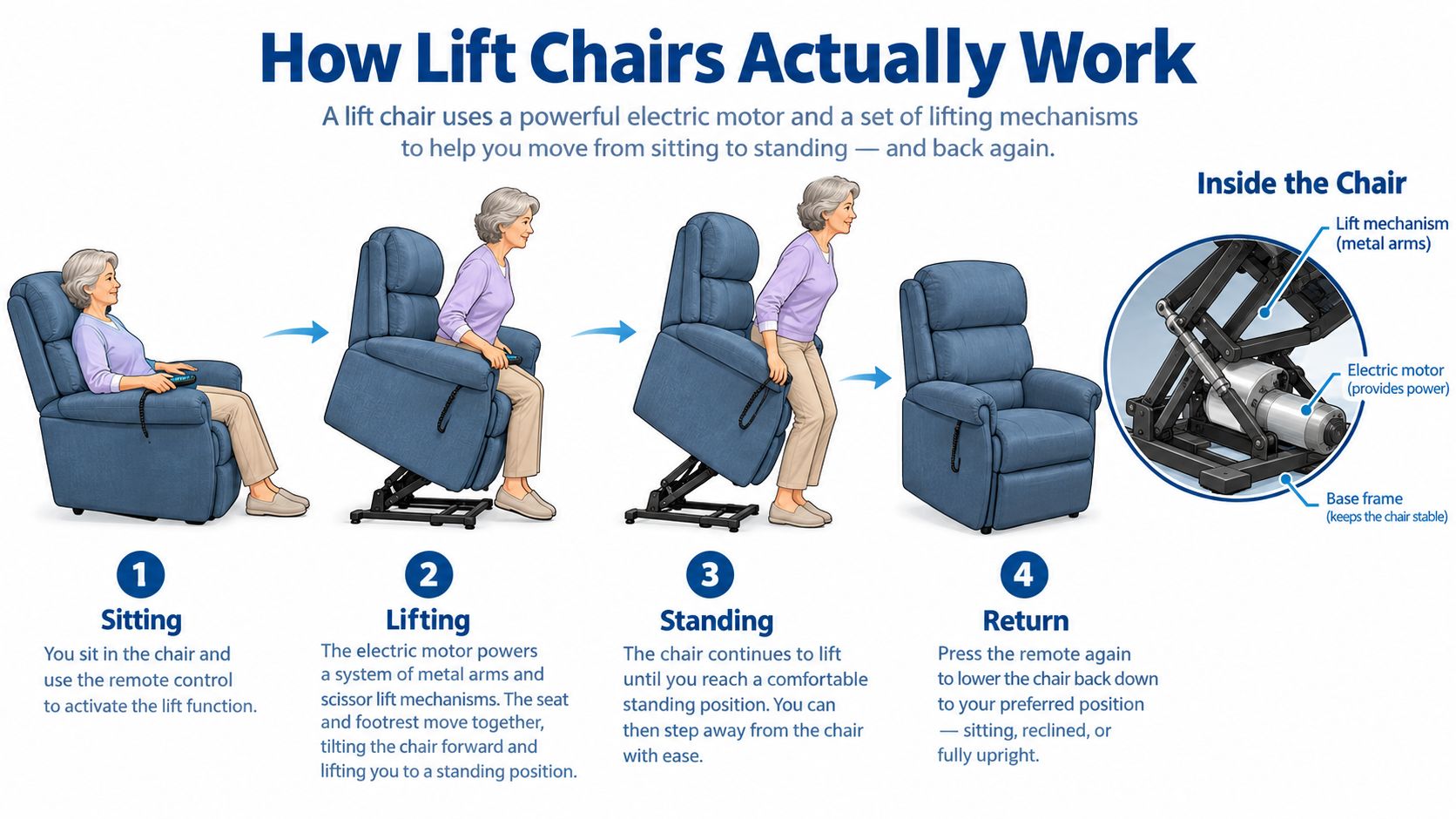
A lift chair isn't a recliner with a taller seat. Its powered base changes the chair's position so the user can move from sitting toward standing with less forceful pushing through the knees, hips, or arms. The mechanism raises the chair and moves the seat forward, creating a more favorable starting position for the transfer, as described in this overview of how lift chairs work.
The lift movement comes first
A typical sequence begins with the user seated fully back in the chair. The footrest retracts, the seat rises, and the chair tilts forward. The user should still participate in the transfer with whatever balance and leg strength remains. The mechanism assists the movement, but it doesn't automatically make an unsafe transfer safe.
A practical test starts with the feet. Before the lift begins, both feet should rest securely on the floor, not float above it or sit too far forward. The seat height, seat width, seat depth, and published weight capacity also need to match the individual. A chair that's too deep can leave the back unsupported, while one that's too high can make the initial sitting position awkward.
Comfort features have separate jobs
Recline changes the back and leg position for resting. Leg elevation can feel comfortable during a television program or reading session. Heat adds warmth through built-in heating elements, while massage uses localized vibration or movement. These controls may operate independently, depending on the chair, so a shopper should test each function rather than assume every feature works the same way.
The remote matters more than it may appear. Large, clearly identified buttons help users who have limited dexterity or vision. A stop control should be easy to reach, and the user should know how to return the chair to a seated position if discomfort occurs.
A chair's movement shouldn't be judged only by speed. A slower, controlled return from standing or reclining can be more comfortable than a fast motion that surprises the user. Families comparing models can review electric lift chair options while keeping the individual's transfer ability at the center of the decision.
Comparing Massage Types, Heating Tech, and Power Lift Specs
The most useful comparison starts with function, not motor counts. Massage labels can sound impressive, but the user needs to know where the vibration reaches, how gently it can operate, and how easily it stops. Heat deserves the same careful review because maximum warmth isn't automatically better.
A multidisciplinary heat-therapy consensus identified approximately 40 °C, or 104 °F, as the ideal superficial tissue temperature. A safety review recommends measuring heating devices accurately, keeping them below 140 °F, limiting sessions to roughly 15–20 minutes, and checking skin frequently (heat-therapy consensus and safety review). Those points make timers, adjustable settings, and automatic shutoff more valuable than a high-temperature claim.
Lift Chair Feature Comparison Checklist
| Feature Category | What to Look For | Why It Matters |
|---|---|---|
| Massage operation | Adjustable intensity, useful modes, contact areas, session duration | Gentle control is more practical than a complicated remote or excessive vibration |
| Heat control | Adjustable warmth, independent operation, timer, automatic shutoff | The user can limit exposure and stop warmth without running massage |
| Lift movement | Smooth seat rise, steady forward tilt, footrest retraction before lift-off | The sequence supports a more predictable transfer |
| Fit | Seat height, width, depth, footwell clearance | The body needs stable contact and room to move |
| Power information | Published weight capacity, warranty terms, cycle testing information | Shoppers can evaluate construction beyond a general label |
| Remote design | Clearly marked buttons and accessible stop control | Users and caregivers need immediate control |
| Return to sitting | Controlled, steady movement | Slower operation may offer reassurance and stability |
Massage deserves a closer look
A comfortable massage setting usually allows the user to start gently. Contact areas might include the back, lumbar region, or legs, but coverage varies by chair. The number of motors doesn't explain whether the sensation feels pleasant, too strong, or poorly placed.
A 2024 systematic review examined 129 systematic reviews covering massage for painful adult health conditions. Only 41 used a formal method to rate evidence quality, and none of the overall conclusions received a high-certainty rating. Seven conclusions had moderate-certainty evidence of beneficial associations with pain, while the remaining conclusions were rated low or very low certainty (2024 massage evidence review). That supports a modest promise: massage may provide temporary comfort or relaxation, but it shouldn't be sold as guaranteed pain relief.
A helpful place to compare massage concepts is this overview of vibration massage chairs. The same practical questions apply to a lift chair: Can the intensity be reduced? Does heat operate separately? Can the user stop the program without reaching behind the body?
When Heat and Massage Need Extra Caution
Heat and massage aren't automatically safe for every user. Someone with reduced hot-and-cold sensation may not notice that the skin is becoming too warm, and some people with diabetic neuropathy can have reduced awareness of burns. Older adults with fragile skin may also need a caregiver to monitor the chair more closely.
Neutral clinical guidance recommends caution with heat for people with diabetes, poor circulation, cardiovascular disease, spinal-cord injury, multiple sclerosis, or rheumatoid arthritis. Massage may require medical advice in cases involving acute inflammation, unstable heart disease, uncontrolled hypertension, fever, or some cancer-related sites (clinical guidance on massage precautions).
A practical safety screen
Before using either feature, the user or caregiver should consider:
- Sensation: Can the user reliably feel heat and recognize discomfort?
- Skin condition: Are there fragile areas, open wounds, swelling, infection, or recent surgical sites?
- Medical history: Are circulation problems, heart conditions, blood-thinning medicines, or uncontrolled blood pressure involved?
- Control: Can the user reach the remote and stop the function without assistance?
- Supervision: Does the first use need a caregiver nearby?
Heat shouldn't be used over swelling, open wounds, or infections. A sensible routine begins at the lowest setting, keeps the user awake while heat operates, limits the session to roughly 15–20 minutes, and includes a skin check afterward, consistent with heat and massage safety guidance.
If the user can't feel the heat clearly, the user shouldn't operate the heat feature alone.
Massage also deserves restraint. Stop the program if it causes pain, bruising, numbness, or worsening symptoms. People with blood-clotting disorders, blood-thinning medication, deep-vein thrombosis, severe osteoporosis, nerve damage, recent surgery, stroke, burns, or open wounds should ask a healthcare provider before using massage, as outlined in this clinical massage precaution guide.
A battery backup may be worth discussing with a caregiver who worries about returning the chair to a safe position during an outage. It's one topic to raise while reviewing lift chairs with battery backup, though the chair's everyday fit and transfer performance still come first.
Who Benefits Most From a Lift Chair
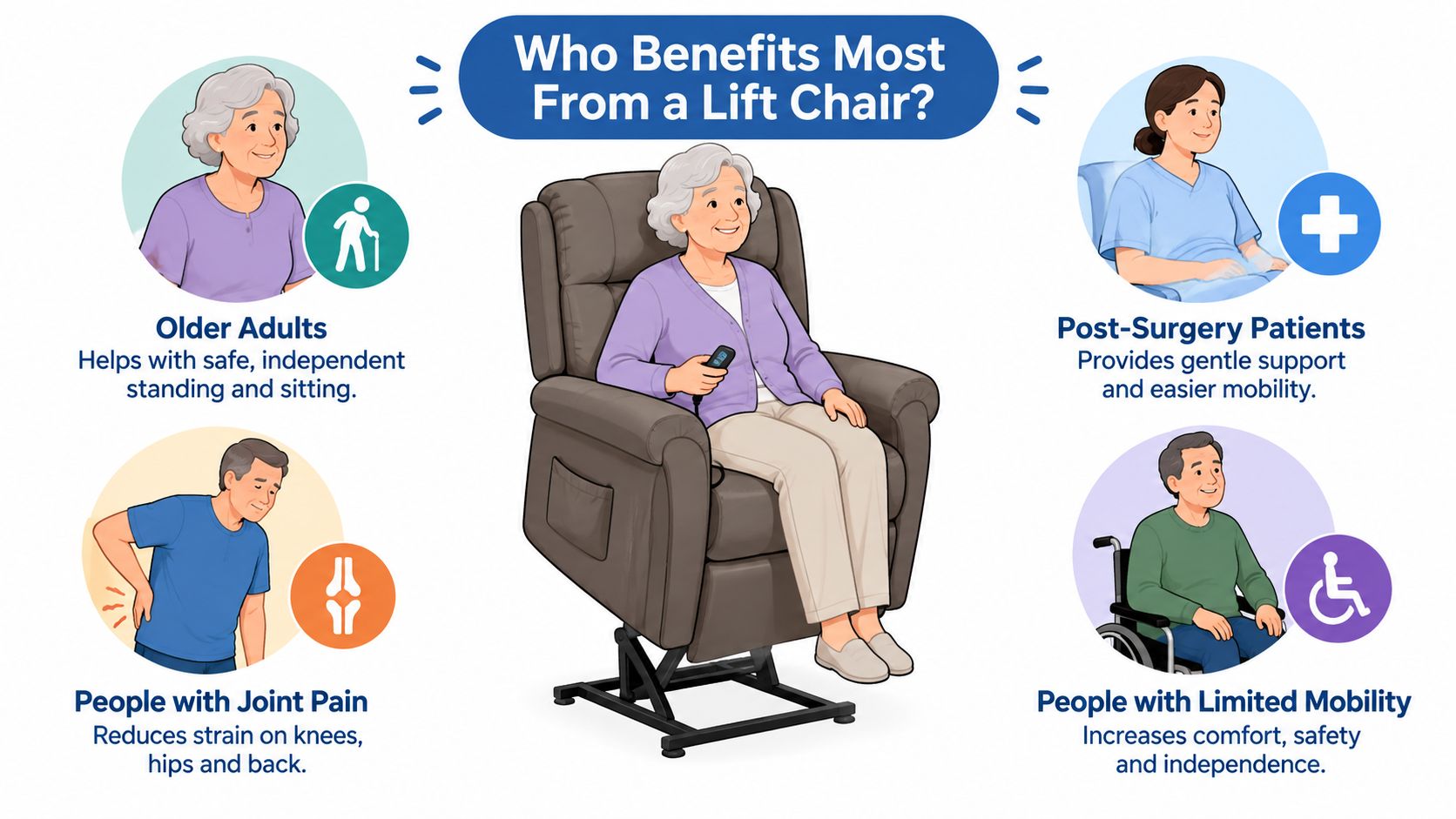
A lift chair helps the right person for the right reason. We see that in the showroom all the time. One customer needs a gentler push up from sitting to standing. Another can stand alone but wants a seat height and arm position that make the motion less tiring. A third person needs full-transfer support, and that calls for medical equipment beyond what a recliner can safely do.
That difference matters.
A power lift chair raises the seat. It does not supply balance, leg strength, or judgment. The user still needs enough control to take part in the transfer, unless a trained caregiver is using a different method that fits the person's needs.
The need is real, but the chair must fit the person
The Administration for Community Living reported that 33% of adults aged 65 and older had at least one disability in 2022, including 21% with serious difficulty walking or climbing stairs (older adult disability and fall data).
Those numbers explain why families pay close attention to transfers, but they do not prove that heat, massage, or even the lift function itself prevents falls. That is where a lot of guides get too rosy. Heat and massage are comfort features. The safety question is simpler and more practical. Can the user get in, get up, and clear the chair without catching a foot, losing balance, or reaching for a shaky table?
Room setup plays a part. A chair parked too near a coffee table can block the lift path. A footrest left out into the walking lane can become a tripping point. Good placement gives the user clear floor space, a straight path forward, and armrests that are easy to press down on during the rise.
Three transfer situations
Assisted standing: The user can bear weight and follow directions but needs help with strength, timing, or confidence. In that case, the chair works best when a caregiver can watch the feet stay flat, check that the knees are in a good position, and make sure the user pushes from the armrests instead of pulling on nearby furniture.
Powered rise with personal balance: The user needs the seat to come up but can organize the body once standing. This is often the sweet spot for a lift chair. A proper sit-to-stand test in the showroom should show whether the seat height feels supportive, whether the armrests meet the forearms naturally, and whether the remote stays within reach without twisting.
Non-ambulatory transfer: The user cannot bear weight or needs full lifting. A lift chair is not a substitute for a medical transfer system or a professional assessment.
A controlled study of 28 older adults found that powered lifting seats reduced knee and hip joint moments during sit-to-stand and stand-to-sit movements, while assistive designs increased ankle joint moments (controlled powered-seat study). In plain language, the chair may take some strain off the knees and hips, but ankles and balance still do real work.
So the safest chair is usually the one that fits the person well. Fit, transfer ability, caregiver access, seat height, armrest position, and clear floor space matter more than extra massage programs or a warmer seat.
Budget Versus Premium Lift Chairs and What Warranties Cover
A budget-friendly lift chair can make sense for a lighter daily user who needs basic powered assistance and occasional reclining. A household with an all-day sitter, a heavier user, or frequent transfers may have stronger reasons to consider sturdier construction, more durable upholstery, and broader mechanism coverage.
The useful comparison isn't just low price versus high price. It's whether the chair's construction and service terms match the work the chair will perform.
Where the tiers may differ
A lower-cost chair may focus on the essential lift and recline functions, with simpler upholstery and fewer adjustments. A mid-range chair may offer a wider intensity range, more flexible heat control, and a more supportive fit. Premium construction may place greater emphasis on heavy-duty frames, motor durability, upholstery resilience, and longer coverage for the lift mechanism.
The warranty deserves close reading. Ask whether the frame, lift mechanism, motors, wiring, remote, and labor have separate coverage terms. Also ask whether service is handled locally, what cycle testing information is available, and which parts are considered wear items.
Wisconsin provides a meaningful pricing advantage: all power lift recliners are exempt from Wisconsin sales tax, making mobility assistance more affordable for shoppers. Families should still compare the full ownership picture, including delivery, setup, service, and the cost of choosing a chair that doesn't fit.
BILTRITE Furniture-Leather-Mattresses offers in-store lift chair guidance through its lift chair cost information. Since the store doesn't sell online, shoppers can sit in the chair and discuss fit rather than making a decision from a product photo.
Spend on the parts that affect daily use
For an occasional sitter, a comfortable mid-range chair may offer enough support without paying for features that won't be used. For someone who transfers often, spends long days in the chair, or needs heavy-duty construction, spending more on fit, upholstery, mechanism durability, and service may be sensible.
Heat and massage should come after those basics. A remote with too many confusing buttons won't help a user who can't operate it. A powerful motor won't solve an unsuitable seat depth. The best budget decision is usually the one that protects daily function first.
Test Before You Buy and Visit Us in Greenfield
A lift chair should be tested with the actual user, not chosen by appearance alone. The showroom trial should begin with the person seated fully back, feet positioned securely, and a caregiver nearby when assistance is needed.

The hands-on checklist
- Watch the sequence: The footrest should retract before lift-off.
- Check the rise: The seat should lift smoothly without forcing the user to pull hard on the armrests.
- Confirm the fit: Check seat-to-floor height, seat width, seat depth, and footwell clearance.
- Test the controls: Operate lift, recline, heat, and massage from the seated position.
- Try the stop function: Make sure the user or caregiver can stop movement and comfort features quickly.
- Ask about service: Review warranty coverage, cycle testing, parts, labor, remote replacement, and local support.
The controlled study of 28 older adults found reduced knee and hip joint moments with powered lifting seats, but increased ankle joint moments in the assistive designs. That's why a supervised sit-to-stand trial tells a family more than a generic “power lift” label.
BILTRITE is a fourth-generation, family-owned business serving the Metro Milwaukee community since 1928. The team includes sales associates with over 400 years of combined experience, and the showroom offers choices ranging from small-scale furniture to heavy-duty pieces, along with a mattress department featuring over 60 models. The store emphasizes affordable, better-quality furniture, including USA-made, Amish-made, and solid-wood options, without pressuring shoppers into a rushed decision.
BILTRITE Furniture-Leather-Mattresses offers hands-on guidance for shoppers comparing lift chairs, comfort features, fit, and everyday support. Visit BILTRITE Furniture-Leather-Mattresses in Greenfield, test a recliner lift chair with heat and massage in person, and bring questions for the family-focused team.