Mattress Protectors: A Complete Buying Guide for 2026


A new mattress arrives at a Greenfield home, the sheets are washed, the pillows are fluffed, and everyone is ready for the first night. Then someone carries a glass of juice into the bedroom, a child climbs aboard with sticky hands, or the family dog shakes off after a rainy walk. The mattress may be brand new, but bedrooms are busy places.
A mattress protector gives that expensive sleep surface a removable layer of defense. It helps manage spills, moisture, allergens, everyday wear, and the stains that can create warranty trouble. The right protector also keeps the mattress feeling comfortable instead of turning the bed into a noisy, hot plastic sheet.
BILTRITE has helped Metro Milwaukee families choose mattresses and bedroom furniture since 1928, so the advice is straightforward. Match the protector to the household, the mattress construction, and the way the bed will be used. A two-sided flip-able mattress needs different coverage from a basic one-sided bed, and a heavy-duty mattress needs a protector with enough depth and strength to stay in place.
Table of Contents
- Why a Mattress Protector Belongs on Every Bed
- What a Mattress Protector Actually Does
- Choosing the Right Type for Your Household
- Fitted vs Encasement and How Materials Feel
- Getting the Right Fit for Standard, Deep, and Heavy-Duty Mattresses
- Care, Cleaning, and Knowing When to Replace
- FAQs and a Friendly Invite to the Greenfield Showroom
Why a Mattress Protector Belongs on Every Bed
A mattress protector is one of the least exciting bedding purchases, right up until a spill reaches the mattress. Cleaning sheets is simple. Cleaning liquid from foam, upholstery, seams, or internal materials is a different problem, and a mattress usually can't be placed in a washing machine.
That's why a protector works like an affordable insurance policy for a sleep investment. It doesn't replace proper mattress care, but it creates a washable barrier between the sleeper and the bed. Families with children, pets, allergies, or frequent overnight guests have especially good reasons to use one from the first night.
Four practical jobs
A quality protector handles several daily challenges:
- Liquid protection: It helps stop drinks, accidents, sweat, and other moisture from reaching the mattress core.
- Allergen control: A suitable barrier can limit the movement and buildup of dust-mite allergens in the mattress environment.
- Surface defense: The layer takes the friction, body oils, and routine soiling that would otherwise reach the mattress cover.
- Warranty support: Stains and liquid damage can create problems with mattress warranty requirements, so a clean, properly used protector matters.
The wider bedding protectors category shows sustained demand. One market projection places the global bedding protectors market at USD 2.2 billion in 2026, with a projection of USD 3.4 billion by 2036 and a 4.5% CAGR over that decade, driven in part by hygiene, durability, and replacement cycles across residential and hospitality use. The bedding protectors market forecast includes mattress protector products, making it a useful signal that shoppers increasingly view protection as regular mattress care rather than an optional extra.
A separate 2024 market report estimated the global bedding protector mattress protector market at USD 3.43 billion, with a projection of USD 6.91 billion by 2035 at about 6.57% CAGR. That category forecast points to a long-term shift toward making mattress protection part of the standard purchase.
Protection has trade-offs
Waterproof protectors offer stronger spill defense, but some designs can feel warmer or make more noise. Breathable constructions usually feel better to hot sleepers, yet shoppers still need to check whether the product offers enough moisture resistance for the household.
Fit matters just as much as fabric. A protector that slips off a thick heavy-duty mattress won't do its job, and a loose cover can bunch beneath the sheets. Two-sided flip-able mattresses need protection on both sleeping surfaces, not just a fitted layer across the top. A guide to why investing in a high-quality mattress matters helps put the protector purchase in perspective. A mattress chosen for long-term comfort deserves practical protection from the start.
What a Mattress Protector Actually Does
A mattress protector is a removable fabric layer that sits between the fitted sheet and the mattress. It normally has little or no cushioning, so its primary job is protection, not changing the firmness or pressure relief of the bed.
That distinction prevents a common shopping mistake. A mattress topper adds meaningful loft or cushioning and changes how the mattress feels. A mattress pad is usually a thinner quilted layer that can add a small amount of softness. A protector may have light padding or quilting, but it shouldn't be chosen as the main tool for changing support.
The four core functions
A useful protector earns its place by doing four jobs:
It blocks spills and moisture. A waterproof membrane or liquid-resistant backing keeps many accidents from reaching the mattress. This matters for children, pets, night sweats, and anyone who enjoys coffee or water beside the bed.
It reduces exposure to allergens. A tightly constructed barrier can limit contact between sleepers and allergen-containing mattress dust. The technical design matters more than a “hypoallergenic” label alone.
It limits wear. Body oils, perspiration, dust, and repeated friction can soil and stress the mattress cover over time. A removable protector takes on much of that routine exposure and can be cleaned separately.
It helps protect warranty eligibility. Mattress warranties commonly exclude damage associated with stains or improper care. A protector won't override the written warranty, but using one and following the care instructions is sensible protection for the purchase.
A fifth benefit applies to full encasements. A zippered encasement covers all six sides of the mattress, creating a sealed barrier that can help with bed-bug prevention and allergen management. It isn't a substitute for professional pest treatment when an infestation exists, but it closes off more of the mattress than a surface protector.
Match protection to the mattress
Even a well-built mattress benefits from a washable outer layer. That becomes especially important with BILTRITE heavy-duty mattresses and two-sided flip-able models designed for long service. A protector should support the mattress's construction, not interfere with it.
A shopper comparing comfort changes can use this mattress topper guide to separate cushioning from protection. The practical rule is simple: choose a topper to change feel, a pad for light quilted softness, and a protector to shield the mattress.
Practical rule: If the product's main promise is extra softness, it isn't a replacement for a true mattress protector.
Choosing the Right Type for Your Household
The right protector depends on what happens in the bedroom. A guest room with occasional use has different needs from a child's bed, a pet-friendly primary bedroom, or a mattress used by someone who wakes up hot.
Mattress protector types compared
| Protector Type | Best For | Key Benefit | Main Trade-Off |
|---|---|---|---|
| Waterproof | Children, pets, spills, moisture concerns | Strong liquid defense | Some designs retain heat or make noise |
| Breathable cotton-blend | Everyday family use and comfort-focused sleepers | Soft hand feel and airflow | May offer less complete liquid protection |
| Allergen-barrier | Dust-mite and allergy concerns | Tighter barrier construction | Dense materials can reduce airflow |
| Cooling | Sleepers who feel warm at night | Smooth, moisture-managing surface | Cooling claims vary by construction and bedding layers |
| Antimicrobial | Households focused on odor and hygiene management | Helps slow odor and bacteria buildup | Treatment performance and durability vary |
Start with the mess, not the label
For children, pets, or frequent spills, waterproof protection comes first. A polyurethane-backed protector usually gives stronger liquid resistance than an unbacked cotton layer, but the membrane, fabric weight, and fit affect whether the bed feels quiet and breathable.
Hot sleepers should look for a breathable membrane or a lightweight fabric construction rather than automatically choosing the thickest waterproof option. Waterproof and breathable aren't mutually exclusive. Recent market coverage shows shoppers are actively seeking that combination. Searches for waterproof mattress covers reached 83 in October 2024 and 75 in July 2025, while the broader waterproof-and-breathable theme rose 19.6% from January to July 2025 and unit sales increased from 26,249 in February to 36,124 in July. The waterproof-and-breathable mattress cover trend reflects a real comfort problem, not just a marketing phrase.
Allergen-focused shoppers should prioritize a measured barrier, sealed seams, and a reliable zipper over a large “hypoallergenic” word on the package. Research on bedding encasements found dust-mite allergens were blocked below detectable limits with woven fabrics having pore sizes under about 10 µm, while cat allergen required pores around 6 µm or less. The bedding allergen fabric research also examined breathability, because denser barriers can restrict airflow.
Antimicrobial treatments can make sense for households concerned about odor and routine hygiene, but they shouldn't replace washing. Demand for antimicrobial and hypoallergenic protectors increased 7% in 2024, with separate forecasts projecting 4.3% CAGR from 2025 to 2035 and 7.5% CAGR from 2025 to 2031. The bedding innovation market coverage indicates that shoppers are considering longevity and hygiene alongside spill resistance.
Fitted vs Encasement and How Materials Feel
Fitted protectors are the easygoing choice for most bedrooms. They stretch over the top and sides like a fitted sheet, usually with an elastic skirt, while leaving the underside of the mattress open. They're quick to remove, simple to wash, and generally provide the least hassle.
An encasement wraps around all six sides and closes with a zipper. That fuller coverage makes it the stronger choice for allergy control, bed-bug protection, and a two-sided mattress that needs protection underneath as well as above.
Construction changes the sleeping experience
Cotton terry feels soft and absorbent, with little noise under the sheets. Polyester knit tends to cost less and can feel smooth or slightly slick. Vinyl and polyurethane laminates provide stronger waterproofing, but heavier versions may feel warmer or create crinkling sounds when the sleeper turns.
Tencel and bamboo blends often feel cool, smooth, and moisture-managing. Wool can help regulate temperature and has a distinctive natural feel, though it usually costs more and needs careful attention to the care label. No material wins every category, so the best selection depends on whether quietness, liquid resistance, airflow, or allergen coverage matters most.
| Style or Material | Coverage | Noise Level | Breathability | Waterproofing | Best For |
|---|---|---|---|---|---|
| Fitted protector | Top and sides | Usually low | Usually good | Varies | Everyday household use |
| Encasement | All six sides | Can be higher at zipper and seams | Varies by fabric | Varies, often strong | Allergy, pest, and two-sided coverage |
| Cotton terry | Surface layer or fitted shell | Low | Good | Limited unless backed | Soft, quiet daily use |
| Polyester knit | Surface layer or fitted shell | Low to moderate | Moderate | Varies | Budget-conscious shoppers |
| Vinyl or polyurethane laminate | Waterproof barrier | Moderate to high in some designs | Lower in dense constructions | Strong | Spills and accidents |
| Tencel or bamboo blend | Surface fabric | Low | Good | Requires backing for full waterproofing | Warm sleepers |
| Wool | Quilted or layered surface | Low | Good | Limited unless specially constructed | Temperature-sensitive sleepers |
The protector should feel like part of the bed, not a separate plastic layer. Fabric selection affects that experience, and BILTRITE's fabric selection guide offers useful background on how materials change feel and performance across home furnishings.
Getting the Right Fit for Standard, Deep, and Heavy-Duty Mattresses
A protector can have excellent fabric and still fail if it doesn't fit the mattress. A loose cover bunches under the sleeper, while a shallow fitted skirt pulls free and leaves the mattress edge exposed.
Measure the mattress itself
Before shopping, record:
- Length and width: Measure the mattress from edge to edge, not the bed frame.
- Deepest sidewall point: Include the full height from the bottom seam to the highest part of the top surface.
- Top construction: Note whether the mattress has a flat top, pillow-top, or Euro-top.
- Sleeping surfaces: Confirm whether the mattress is one-sided or two-sided and flip-able.
- Base details: Check for an adjustable base, split-head design, RV frame, or unusual dimensions.
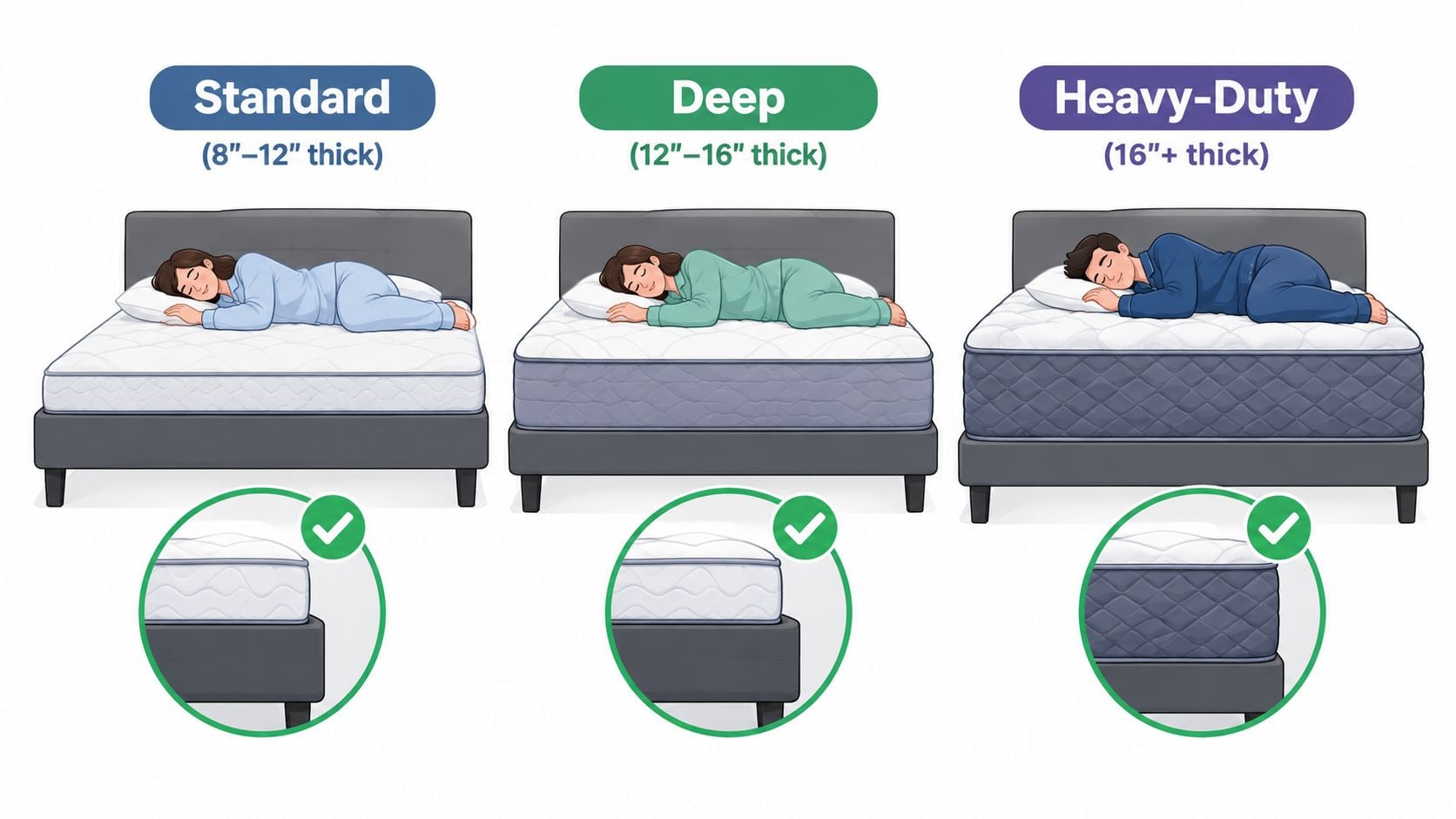
A basic profile may fit a standard protector rated up to 12 inches. Deep-pocket sets commonly cover 13 to 18 inches. Extra-deep BILTRITE heavy-duty mattresses can reach 19 inches or more, so a standard fitted protector may pull loose even when the mattress length and width are correct.
Choose coverage for the mattress design
Deep elastic skirts work well for tall standard or deep-pocket mattresses when the household mainly needs top and side protection. Reinforced corners help keep a heavyweight mattress from stretching the protector out of shape.
A two-sided flip-able mattress deserves more consideration. A full encasement keeps both sleeping surfaces enclosed, while a top-only protector leaves the underside exposed during rotation. Pillow-top and Euro-top mattresses also need extra depth because the raised comfort layer changes the sidewall measurement.
Adjustable bases require a protector with enough flexibility to move with the bed. Split-head bases, RV beds, and other odd-sized frames should be measured individually rather than matched by a general size name.
BILTRITE's guide to how to measure a mattress gives shoppers a useful starting point. Bringing those measurements to the Greenfield showroom removes guesswork, especially when an existing mattress is unusually tall, heavy, or two-sided.
Care, Cleaning, and Knowing When to Replace
A protector only protects the mattress if it remains clean, intact, and correctly fitted. Care instructions vary by construction, so the product label takes priority, especially for waterproof laminates and zippered encasements.
Wash without damaging the barrier
Most fitted protectors can be washed every one to two months in cool or warm water on a gentle cycle with mild detergent. Bleach and fabric softener can weaken waterproof membranes, reduce elasticity, or leave residues that affect the fabric's performance.
Drying requires equal attention:
- Low heat or air-dry: Use this approach for polyurethane or other laminated waterproof styles to reduce the risk of delamination.
- Medium heat: This may suit cotton and polyester when the care label permits it.
- Line-dry: Zippered encasements benefit from gentler drying that helps protect zipper function and seam integrity.
- Spot-clean only: Vinyl-backed styles may need surface cleaning instead of machine washing.
A protector should be fully dry before returning to the bed. Trapping dampness beneath sheets defeats the purpose of a clean sleep surface and can create unpleasant odors.
Know the failure signs
Daily-use protectors eventually wear out. Replacement is generally appropriate every two to three years for daily-use protectors, and sooner when the waterproof layer fails, elastic loses its grip, seams separate, or odors remain after washing.
A simple inspection catches many problems:
- Hold the protector up to a bright area and look for thin spots, cracks, or separated layers.
- Stretch the corners and check whether they still return snugly to shape.
- Examine zipper teeth and seams on encasements.
- Review the mattress warranty and keep the purchase receipt and care information.
UK flammability guidance defines a mattress protector as a product intended to protect a mattress or upholstered bed base from liquid ingress and soiling, designed to be washed in a domestic washing machine. The guidance also says mattress protectors are exempt from UK furniture flammability regulations, while protectors containing foam should still comply with those regulations. The UK mattress protector flammability guidance illustrates why construction and care instructions matter.
Warranty rules differ by mattress, so the written terms should be checked. A waterproof protector, correct washing, and retained receipts give the household a much stronger care record than a stained mattress with no documentation.
FAQs and a Friendly Invite to the Greenfield Showroom
Do waterproof protectors feel hot?
Some do, especially thick, poorly ventilated, or noisy laminate constructions. A lighter waterproof membrane paired with a breathable top fabric usually offers a better balance for warm sleepers, but sheets, room temperature, and mattress materials also affect the final feel.
Do encasements help with allergies?
They can reduce allergen exposure within the mattress environment when the barrier is tightly woven and the seams and zipper are properly closed. A randomized adult asthma study found mattress-dust Der p 1 concentrations were significantly lower after six months in the intervention group, with a geometric mean of 0.58 µg/g versus 1.71 µg/g in controls, but it found no significant improvement in overall respiratory symptoms or sensitization. The randomized asthma study supports exposure reduction, not a promise of symptom relief.
How often should a protector be washed?
Most fitted styles need washing every one to two months, with earlier cleaning after a spill, accident, or heavy sweating. Care labels should guide water temperature, detergent, and drying method.
Can a protector void a mattress warranty?
The protector itself generally isn't the problem. Stains, liquid damage, incorrect care, or failure to follow the mattress warranty terms can create trouble, so the warranty and protector label should both be kept.
Does a two-sided flip-able mattress need a special cover?
Yes, it needs coverage that protects both sleeping surfaces. A six-sided encasement is the practical choice because it stays with the mattress during flipping and rotation, unlike a top-only fitted protector.
Will protectors fit adjustable bases?
Many will, provided the protector has enough stretch and the correct depth. Split-head and other articulated bases need careful fitting so the cover doesn't pull across the hinge area or shift during movement.
BILTRITE's Greenfield showroom gives mattress shoppers a chance to test the bed and discuss the cover at the same time. The Mattress Center carries over 60 models and 500+ mattresses in stock, and staff can help measure an existing mattress, compare protector constructions, and use the mattress testing guide before a decision is made.
The store also offers a complimentary protector with select mattress purchases, layaway, delivery services, and a trade-in program. Qualifying purchases may include free white-glove delivery and old mattress removal when the old mattress is in donatable condition. BILTRITE is a fourth-generation, family-owned business serving Metro Milwaukee since 1928, with sales associates bringing more than 400 years of combined experience to the showroom. The store is closed on Sundays and Mondays for family time, so shoppers should plan a visit on another day.
BILTRITE Furniture-Leather-Mattresses offers in-store mattress protectors, more than 60 mattress models to test, and practical help matching a cover to a standard, two-sided, or heavy-duty bed. Visit BILTRITE Furniture-Leather-Mattresses in Greenfield with the mattress measurements, and the sleep team can help find the right protection without pressure.