Swivel Rocker Accent Chair Guide for Every Room


A Saturday-morning furniture trip can turn into a lesson in room planning. A couple may fall for a handsome swivel rocker accent chair, bring it home, and discover that it rocks only a short distance before the back cushion bumps the drywall. The chair looks right, but the room wasn't ready for its movement.
That little mishap explains why motion seating deserves more than a quick style check. The buyer needs to understand the mechanism, measure the full footprint, consider the intended user, compare upholstery, and plan delivery through doors and hallways. A chair that can turn toward a conversation, face a television, or follow sunlight from a window offers real flexibility, but only when the room gives it enough space.
The basic idea is wonderfully useful. A true swivel rocker combines 360-degree rotation with a back-and-forth rocking motion, so a reader can turn toward a lamp, a nursing parent can face a crib, and a family member can join a conversation without dragging furniture across the floor. Four questions should come before a fabric color: How much clearance is behind the chair? How large is the room? Who'll use it most? Which material can handle that use?
Why This Chair Has Become a Living Room Favorite
Open living spaces ask furniture to work from more than one direction. A chair may need to face the sofa during a visit, turn toward the television during a movie, and angle toward a window during a quiet morning. A swivel rocker accent chair handles those changes without scraping across the floor or asking someone to lift and reposition it.
The appeal also comes from comfort. The swivel lets the sitter change orientation, while the rocking base adds gentle movement for reading, relaxing, feeding a baby, or settling into a conversation. That combination makes the chair useful in living rooms, nurseries, reading corners, and senior-friendly spaces, not just as a decorative extra.
A long history of adaptive seating
The idea isn't new. An illustrated German manuscript documented an early rotating chair prototype in 1505, and Thomas Jefferson modified a Windsor chair with a central iron spindle in 1775, creating one of the best-known early American swivel-chair designs. Peter Ten Eyck later patented a design using wooden construction and steel rockers in 1853, showing that swivel-and-rocker seating was already being refined for durability and motion by the mid-19th century. These milestones place the category in a furniture lineage that extends across at least 350 years. The documented history of swivel chairs shows why this form is better understood as an evolving comfort solution than a passing novelty.
Rocking seating developed alongside it. The term “rocking chair” entered the Oxford English Dictionary in 1787, while Shaker rocking chairs emerged in New York in 1820 and Boston rocking chairs appeared in 1825. The broader comfort market remains substantial, with one 2024 recliner-chair estimate of USD 4.4 billion, projected to reach USD 6.9 billion by 2032, and another estimate placing the 2024 rocker-chair market at USD 3.8 billion, projected to reach USD 5.8 billion by 2030. A history of rocking chairs and motion seating provides that historical and market context.
Practical rule: A beautiful chair isn't a good room choice if its full motion ends at the wall, table, or walking path.
How the Swivel Rocker Mechanism Actually Works
Motion chairs can look similar while behaving very differently. Before choosing upholstery or arm shape, a shopper should identify the movement underneath the seat.
A swivel-only chair turns on a rotating base, much like an office chair or a stationary accent chair with a turning function. It changes direction but doesn't rock. A glider travels forward and backward along a level linkage, creating a smooth, parallel motion with no rotation. Nursery seating often uses this predictable movement.
A true swivel rocker combines both actions. A rotating plate or bearing system allows the seat to turn, while a separate rocking structure permits the body to move back and forth. The sitter gets more freedom, but the added motion also makes base stability, floor conditions, and construction quality more important.
Three motion choices in plain language
The base affects the feel under the body. A ring-and-plate design generally feels planted. A spring mechanism can add bounce and may need occasional tightening. A wooden curved rocker can move smoothly, though it may mark a floor if it isn't protected properly.
The mechanism also affects delivery. Some bases separate, while others arrive as one piece. That detail matters in apartments, older homes, stairwells, and rooms with narrow doorways. Buyers should ask before the chair leaves the showroom, not after it reaches the delivery truck.
| Feature | Swivel Only | Glider | Swivel Rocker |
|---|---|---|---|
| Main movement | Rotation | Forward and back | Rotation plus rocking |
| Feel | Directional and stable | Smooth and predictable | Flexible and gently active |
| Useful for | Conversation and changing views | Nursing and steady soothing | Reading, relaxing, and multi-use rooms |
| Main concern | No rocking comfort | No side-to-side turning | Requires more room and careful base construction |
A senior user may appreciate a controlled movement that returns smoothly, while a nursing parent may prefer a glider's consistent track. Families comparing these options can also review BILTRITE's guide to swivel rocker gliders before testing chairs in person.
Common Sizes and What They Mean for Your Room
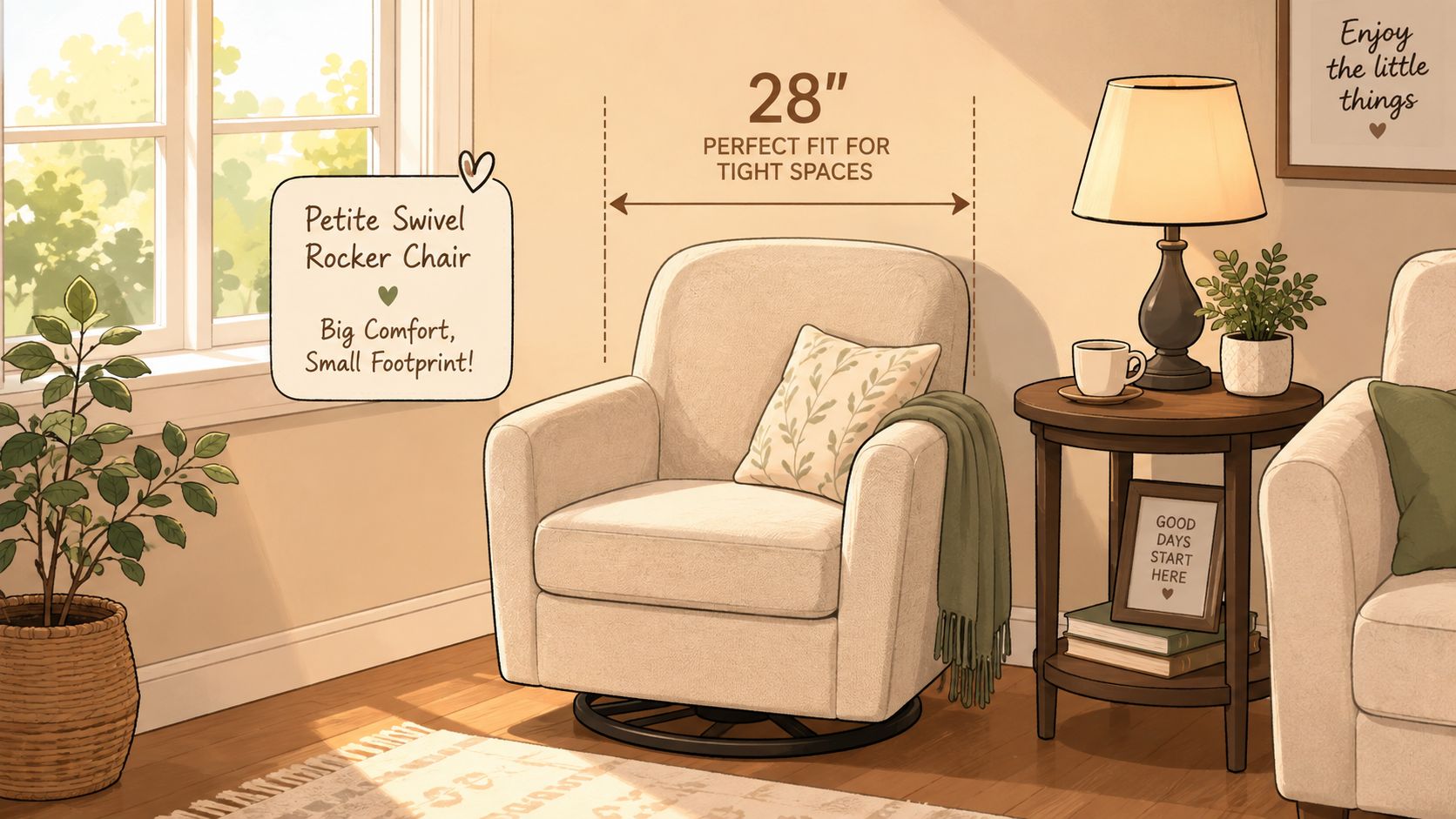
A swivel rocker accent chair is usually a medium-size seating piece, not a tiny side chair. One common profile measures about 33 inches wide, 38.5 inches deep, and 39.75 inches high, with a seat near 21.5 inches wide, 19.75 inches deep, and 20.75 inches high. This listed chair profile shows how much room the chair can occupy once the arms, back, and base are included.
Another listing measures 32 inches wide, 41 inches deep, and 35 inches high, demonstrating that two chairs in the same category can have noticeably different footprints. This second size profile is a useful reminder to measure the actual model rather than rely on the product name.
Read the dimensions as a room plan
A petite frame can suit an apartment, nursery, or tight reading corner. A standard frame often works in a regular living room, while a wider and deeper design gives a family room more relaxed lounging space. Seat depth and back height matter as much as outside width. A shallow seat can feel supportive, while a deeper seat gives taller users more room to settle.
A chair that feels generous in a 14-by-16 family space can feel oversized in a 10-by-10 room. The difference isn't the chair. It's the relationship between the chair, nearby tables, walking paths, and walls. For more guidance on translating outside measurements into a room plan, see BILTRITE's chair-width guide.
Choosing the Right Fabric or Leather
Upholstery should be selected by household use, not just by color. A chair used every evening needs a different surface from one used occasionally in a formal room. Children, pets, food, frequent naps, and direct sunlight all change the practical choice.
Fabric offers a broad range of textures, colors, and patterns. Many fabrics also come with stain-resistant finishes or easier-cleaning instructions, which can help in busy family rooms. A performance fabric may be a sensible direction where the chair receives regular use, but the exact care requirements still need to be checked.
Leather brings a refined appearance and can be wiped clean in many situations. It also develops visible character as it ages, and its surface can show scratches or require more attentive care depending on the finish. Leather isn't one uniform material, so the showroom should provide the care instructions for the specific piece.
Match the surface to the situation
In a nursery, removable or washable covers can simplify everyday cleanup. Near a fireplace, the buyer should ask about applicable flame-retardant requirements. In a bright room, fade resistance deserves attention before a dark or saturated color is chosen.
A showroom swatch under artificial light can mislead the eye. Families should request physical samples, review cleaning instructions, and hold the material near the room's flooring, trim, and window light.
| Material | Strengths | Watch-outs | Best fit |
|---|---|---|---|
| Everyday fabric | Comfortable texture and broad design choice | Care instructions vary | Living rooms and reading areas |
| Performance fabric | Practical for frequent use and household messes | Finish and cleaning rules differ by fabric | Families with children or pets |
| Leather | Wipe-clean surface and polished appearance | Scratches and care needs depend on finish | Rooms seeking a tailored look |
| Removable-cover upholstery | Easier access for cleaning | Covers may affect the chair's finished appearance | Nurseries and flexible family spaces |
For a more informed material decision, families can use BILTRITE's fabric selection guide and then inspect actual samples before committing.
Best Rooms for a Swivel Rocker Accent Chair
The right room depends on what the sitter needs the chair to do. A nursery calls for quiet, controlled movement and a cushion that remains comfortable during long feeding or soothing sessions. A reading corner needs a supportive back, a seat that doesn't collapse under the body, and enough rotation to reach a lamp or side table without leaning awkwardly.

Use the chair to solve a room problem
In a main living room, the chair can connect a sofa grouping with a television or fireplace. Its turning ability helps preserve conversation without forcing the furniture into a straight line. The tradeoff is traffic. A moving chair shouldn't sit where a rotation could interrupt a doorway or narrow walkway.
Senior living spaces benefit from a firm seat, supportive arms, clear contrast around controls if the chair includes them, and a motion that stops comfortably. Stability matters more than an exaggerated rocking arc. A shopper should test standing up, sitting down, and turning at different angles.
Apartments and condos often benefit from smaller frames and careful placement near walls. Family rooms can accommodate deeper cushions and broader seats, provided the chair doesn't crowd a coffee table or block access to another seat. A useful planning question is simple: Does the chair improve access, or does its movement create another obstacle?
Movement should make daily life easier. If the sitter must twist around furniture to use the chair, the room plan needs adjustment.
The category also works in spaces that change throughout the day. A chair can support morning reading, afternoon conversation, and evening television without being dragged from place to place. More ideas for using accent seating appear in BILTRITE's accent-chair guide.
Clearance, Durability, and the In-Showroom Checklist
The empty rectangle where a chair will sit isn't the footprint. The footprint includes the back of the rocking arc, the turning zone, the table beside it, and the space needed to walk around it.
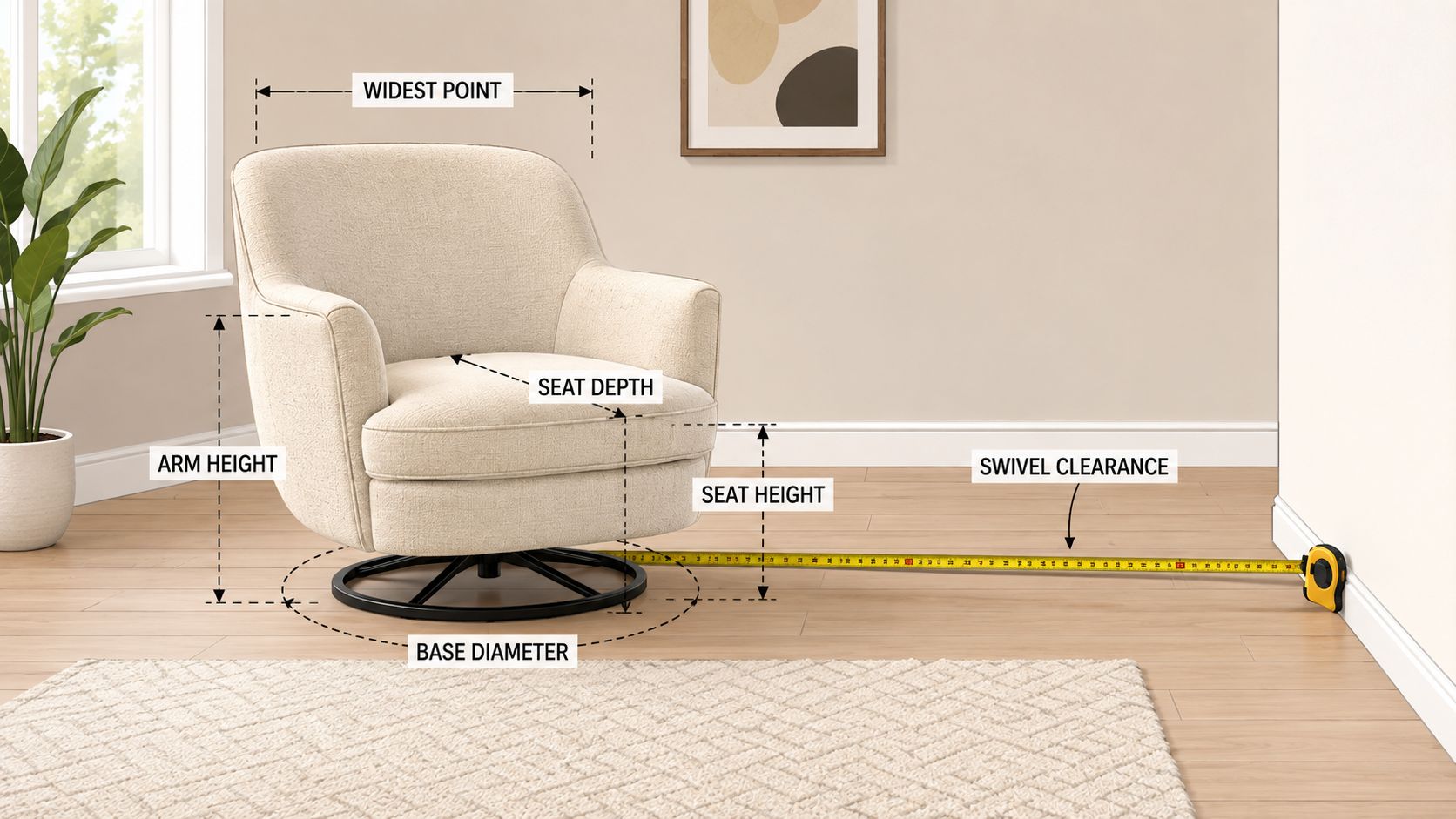
An ergonomics review recommends roughly 42 inches of rear and side clearance for full swivel movement and at least a 30-inch base diameter for stable rocking motion. The independent clearance guidance explains why cramped placement can make a sitter twist the torso instead of turning the seat, which may add postural strain during repeated use.
Measure before the visit
At home, record the chair's widest point, base diameter, seat height, seat depth, arm height, and full movement zone. Painter's tape can mark the proposed footprint so the household can test walking paths, nearby tables, and door swings before choosing a model.
Durability deserves hands-on attention. A swivel mechanism test guide describes testing with a 270-pound load through 60,000 rotation cycles at 5 to 15 rotations per minute, with serviceability expected after 120,000 total cycles for adjustable chairs. The ANSI/BIFMA test guide gives useful context for why the swivel joint, bearing stack, and base attachment deserve close inspection.
In the showroom, the buyer should:
- Test the full turn: Rotate toward a table, sofa, and doorway.
- Check the rocking return: Notice whether the chair moves smoothly or catches.
- Listen closely: Squeaks, grinding, or sudden knocks deserve questions.
- Inspect the structure: Look at seams, cushion recovery, frame joints, and base stability.
- Ask about moving day: Confirm whether the base separates and how the chair will pass through narrow openings.
A replacement mechanism may use a standard-size plate with a 1-inch post, an 8 1/4-inch mounting surface, and 5/16-inch holes with specified spacing. This mechanism-kit listing illustrates why repair work requires exact fitment, not a guess based on appearance.
Before leaving the showroom, the buyer should also ask about the warranty, delivery method, mechanism construction, care instructions, and any available small-scale or heavy-duty options. A practical furniture-buying checklist can be found in BILTRITE's quality-furniture guide.
Come In and Try It for Yourself
A swivel rocker accent chair carries too many practical variables for a photograph to settle the decision. The sitter needs to feel the seat height, test the return motion, notice the arm position, and check whether the back supports the body without forcing the shoulders forward.
At BILTRITE's Greenfield showroom, a shopper can turn a floor model toward different directions, sit normally, rock gently, and try standing up without rushing. The sales associates bring over 400 years of combined experience, so families can ask direct questions about motion, scale, upholstery, delivery access, and everyday comfort.
A neighborly furniture visit
Room measurements help the conversation. A shopper can bring the width of the doorway, the available wall space, the location of a table, and the people who'll use the chair most often. The team can then compare small-scale seating for apartments, condos, and senior living spaces with broader options for family rooms.
BILTRITE is a fourth-generation, family-owned business serving the Metro Milwaukee community since 1928. The showroom focuses on affordable, better-quality furniture, including USA-made, Amish-made, solid-wood, small-scale, and heavy-duty pieces. Families can also explore custom choices in fabric, leather, wood, finish, and hardware, along with a mattress department offering over 60 models. The store closes on Sundays and Mondays to support family time, a choice that reflects its local, family-first approach.
There's no need to make a motion chair decision from a screen. The hands-on visit can reveal whether a model feels lively or controlled, whether its arms help with standing, and whether the footprint works before delivery is scheduled. That kind of testing is especially valuable for a chair intended for daily use, nursery routines, reading, or senior-friendly comfort.
BILTRITE Furniture-Leather-Mattresses offers USA-made, Amish-made, solid-wood, small-scale, heavy-duty, and motion furniture for Metro Milwaukee homes, along with a mattress department featuring over 60 models. Visit BILTRITE Furniture-Leather-Mattresses at the Greenfield showroom, bring room measurements, and call ahead if personal help with a swivel rocker accent chair would be useful.