Custom Solid Wood Furniture: A Buyer’s Guide


You sit down at the table for dinner, and one chair has a wobble again. The dresser drawer sticks. The coffee table corner has chipped, and nobody in the house is even surprised. That’s the frustrating part. Furniture is supposed to support daily life, not become one more thing on your weekend fix-it list.
Around Metro Milwaukee, we meet a lot of families in that exact spot. They’re tired of buying something that looks nice at first but doesn’t hold up to kids, guests, pets, moves, or just normal living. They want furniture that feels solid when you touch it, works in a real home, and still looks good years from now.
That’s where custom solid wood furniture starts to make a lot of sense. Not in a fancy, untouchable way. In a practical way. A better-built dining table. A bedroom set that can be refinished instead of replaced. A bookcase that fits the wall you have, not the wall some factory guessed you might have.
We’ve been part of the Milwaukee area since 1928, and as a fourth-generation family business, we’ve had a front-row seat to the difference between furniture that gets by and furniture that lasts. If you’ve been curious about custom solid wood but aren’t sure where to begin, this guide will help you sort through the terms, the options, and the tradeoffs in plain English.
Tired of Furniture That Doesn't Last?
A lot of people don’t start by saying, “I want custom solid wood furniture.” They start by saying, “I don’t want to buy this again.”
That’s a smart place to begin.
Maybe it was a bed that started squeaking too soon. Maybe it was a dining set that looked sharp in the photo, but the top scratched easily and the chairs loosened up fast. Maybe it was a TV stand that survived exactly one move. Those stories are common because a lot of modern furniture is built to hit a price point first.
Why disposable furniture gets expensive
Cheap furniture can feel like a bargain until you replace it. Then replace it again.
A stronger way to shop is to ask how long a piece will serve your family. If you’re weighing that question right now, our guide on how long furniture should last is a helpful place to compare expectations by category.
Furniture should earn its floor space. If it can’t handle everyday life, the low sticker price stops looking low.
What lasting furniture feels like
Good solid wood furniture has a different feel right away. The drawer closes with confidence. The table doesn’t shimmy when someone leans on it. The chair feels planted.
It also ages differently. A scratch on real wood is often part of a finish story, not the end of the piece. Years from now, many solid wood pieces can still be touched up, refinished, and kept in service.
That matters for busy homes in Milwaukee. Dinner tables host homework and holidays. Bedroom furniture gets opened and closed every day. Living room pieces need to survive movie nights, sleepovers, and the occasional “don’t jump on that” moment.
The shift that makes shopping easier
Once you stop asking, “What’s cheapest today?” and start asking, “What will still be working well years from now?” the whole furniture search gets clearer.
That doesn’t mean every piece has to be formal or expensive. It means choosing materials and construction that match real life. That’s the heart of this guide, and it’s why so many families eventually land on custom solid wood when they want something dependable, personal, and built with staying power.
What Exactly Is Custom Solid Wood Furniture
The phrase sounds simple, but furniture terms get muddy fast. “Wood furniture” can mean a lot of things. “Solid wood” is more specific. “Custom solid wood furniture” adds another layer.
Here’s the plain-language version. Solid wood furniture is made from actual lumber throughout the visible structural parts of the piece, not a thin decorative skin over a lower-cost core.
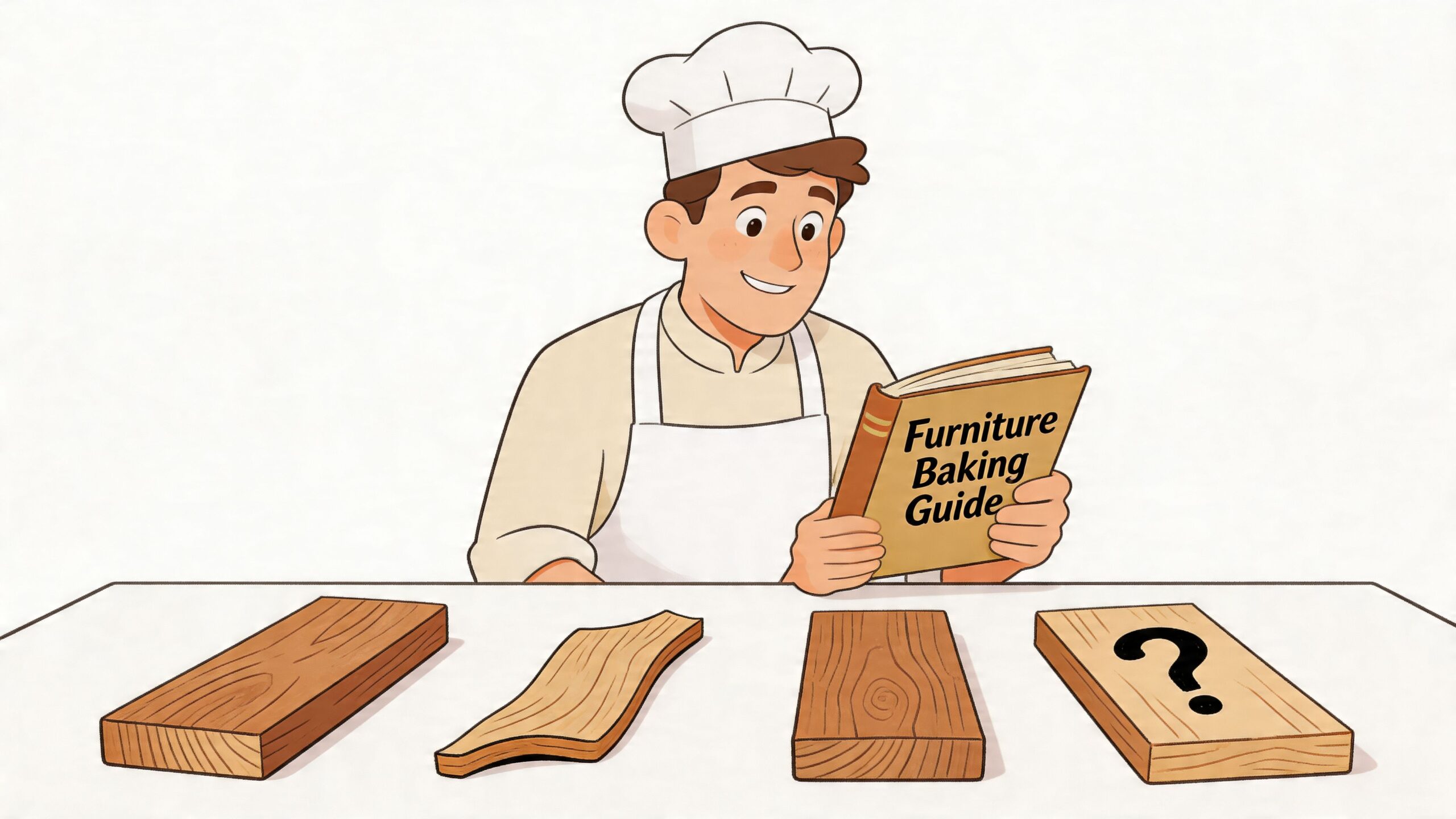
Think from-scratch cake versus box mix
This is the easiest analogy we know.
Solid wood is like a cake baked from scratch. The ingredients are genuine from top to bottom. Veneer furniture is more like a box mix with a pretty frosting layer. It can look nice from the outside, but what’s underneath matters.
A veneer is a thin slice of real wood attached to another material, often MDF, particleboard, or plywood. That approach has its place in some furniture categories, but it doesn’t behave the same way over time as real solid wood.
What custom means in everyday terms
“Custom” doesn’t have to mean starting with a blank sketch on a napkin.
Often, it means you begin with a proven design and make choices that fit your home better. You might change:
- The size so a table fits your dining area without crowding traffic flow
- The wood species if you like a smoother maple look or a more textured oak grain
- The stain or paint finish to match flooring, trim, or other furniture
- The hardware such as knobs or pulls
- The layout details like leaves, shelving, drawer banks, or door style
That’s why custom solid wood furniture often lands in a sweet spot between artisan one-off pieces and mass-produced big-box furniture. You get flexibility without needing to reinvent the wheel.
How to spot the difference in person
If you’re shopping in a showroom, use your hands and eyes.
Look for these clues:
- Check the edges: Solid wood usually shows natural grain continuation rather than a surface layer wrapping a different core.
- Open the drawers: Better-built wood furniture often feels heavier and more stable.
- Inspect wear points: Corners, drawer fronts, and table edges tell you a lot.
- Ask direct questions: Is this real solid wood? Which parts are solid wood? What is the drawer box made from?
Simple test: If a scratch would expose the same wood underneath, you’re dealing with something very different than a thin applied surface.
Why people get confused
Marketing language often blurs categories. A piece might be called “wood,” “hardwood solids,” or “wood veneer” without making the construction obvious.
That’s why it helps to slow down and ask what the furniture is made of. When the answer is clear, your buying decision gets easier. You’re not just paying for how a piece looks on day one. You’re paying for how it holds up, how it can be repaired, and whether it still belongs in your home years from now.
Understanding Wood Species and Construction
A table can look great on a showroom floor and still be the wrong fit for a busy Milwaukee home.
The ultimate test begins later. Kids slide cereal bowls across the top. Someone drops a backpack on the corner. A leaf goes in and out every holiday. In a condo or bungalow where every piece has to earn its keep, the wood species and the way the piece is built matter just as much as the style.
Why wood species matters
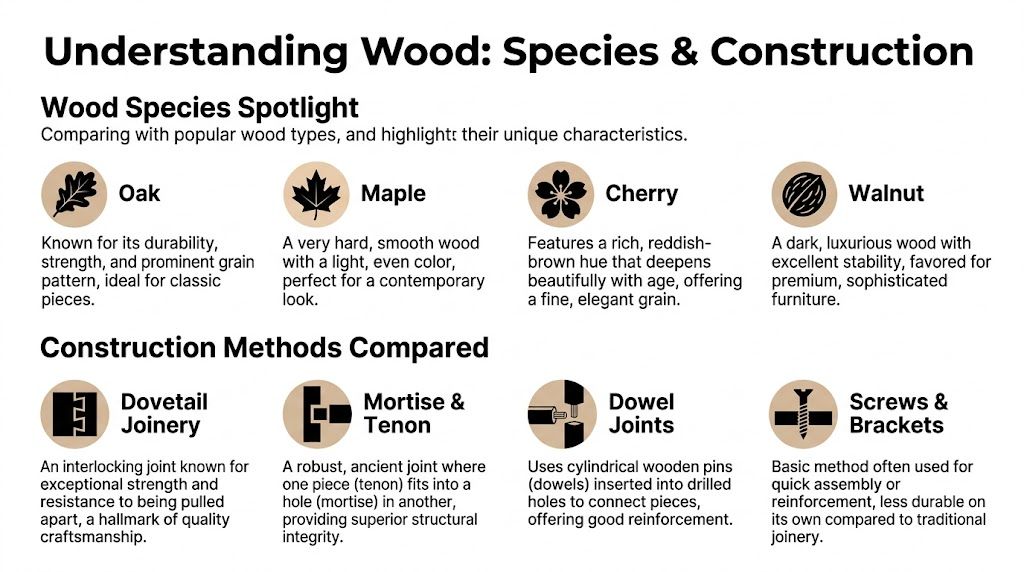
Wood species affects three everyday things. How the furniture looks, how easily it dents, and how it ages with use.
If you have young kids, pets, heavy serving dishes, or a dining table that gets used for homework and craft projects, hardness matters. Millwest’s wood fundamentals guide notes that white oak rates at 1,360 on the Janka scale, hard maple at 1,450, black walnut at 1,010, and many pines fall around 400 to 500. In plain English, maple and oak generally resist dents better than pine, while walnut offers a rich look with moderate hardness.
That does not make pine a poor choice. It makes pine a better fit for the right job. A relaxed farmhouse bench may look even better with a few marks over time. A hard-working kitchen table usually benefits from a tougher species.
Common solid wood species comparison
| Wood Type | Hardness (Janka) | Grain Pattern | Best For |
|---|---|---|---|
| White Oak | 1,360 lbf | Prominent, classic grain | Dining tables, bedrooms, family-use pieces |
| Hard Maple | 1,450 lbf | Smooth, subtle, even look | Contemporary styles, desks, dressers |
| Black Walnut | 1,010 lbf | Rich, elegant, darker grain | Statement pieces, offices, refined dining |
| Pine | Around 400-500 lbf | Softer, often rustic look | Casual styles where dents are less of a concern |
If you want a clearer side-by-side explanation before you shop, our guide on the best wood for furniture breaks down durability, appearance, and everyday practicality.
Matching the species to the room
White oak is a favorite for good reason. It has visible grain, solid durability, and a familiar look that works in colonials, ranch homes, condos, and updated older Milwaukee houses.
Maple is quieter visually. If you like cleaner lines, lighter finishes, or a less busy grain pattern, maple often feels calmer in the room.
Walnut has more drama. It brings warmth and depth, so families often choose it for a desk, bed, or dining piece they want to notice every day.
The best choice depends on use, not prestige. A family with a narrow eat-in kitchen, frequent guests, and rough daily wear may need oak. A condo owner furnishing a smaller bedroom may prefer maple because it keeps the room feeling lighter.
Construction is the hidden half of quality
Good lumber alone does not make a piece last. The joints do the heavy lifting.
Furniture joints work like the framing inside a house. You do not stare at them every day, but they decide whether the structure stays tight and steady. If the joinery is weak, even attractive solid wood can loosen, wobble, or rack over time.
A few terms are worth knowing before you walk into a showroom:
- Dovetail joints are common in better drawer boxes because the interlocking shape helps resist being pulled apart.
- Mortise-and-tenon joints are widely used in chairs, table bases, and frames because they create a strong mechanical connection between parts.
- Dowel joints can perform well when they are accurately fitted and reinforced.
- Screws, staples, and metal brackets have their place, but they should not be the whole plan on a piece meant for decades of daily use.
One quick clue. Open a drawer and look at the corners. If you see carefully fitted joinery instead of thin panels held together by staples, you are usually looking at a better-built piece.
Why Amish-built pieces get so much respect
Many Milwaukee shoppers who want practical custom furniture end up looking at Amish-built options because the construction tends to be straightforward and time-tested. You are often getting solid wood, proven joinery, standard sizes that can still be customized, and delivery options that do not require full designer-level budgets.
That matters if you need a table built for real family life, a bedroom set that has to make it up a stairwell, or a storage piece sized for an older home with tighter rooms.
Woodworkers have trusted mortise-and-tenon joinery for centuries, and the Encyclopaedia Britannica entry on mortise-and-tenon joints explains why the method has lasted so long in furniture and building. The takeaway is simple. A well-fitted joint locks parts together in a way that handles weight and movement better than shortcut construction.
Quick questions to ask in the showroom
Ask these before you buy:
- What wood species is used on the top, sides, drawer fronts, and drawer boxes?
- How are the drawers joined?
- Is the base built with mortise-and-tenon, dowels, or simpler fasteners?
- Will this finish and wood choice hold up to heavy daily use?
- Can the piece be delivered into a smaller space without damage or awkward disassembly?
Those questions help you compare a locally available custom piece with both high-end artisan furniture and big-box options. You get past the sales tag and into what really matters. How it is built, how it will live in your home, and whether it still makes sense ten or twenty years from now.
Making It Your Own With Customization
This is the part people tend to overcomplicate. They hear “custom” and assume it means expensive, slow, or hard to manage.
Usually, it just means making sensible choices so the furniture fits your home instead of forcing your home to fit the furniture.
Start with the problem you need solved
A custom order goes smoother when you begin with the actual issue.
Maybe your dining room is narrow. Maybe your condo elevator is small. Maybe your mom is moving into a senior living apartment and needs something sturdy, supportive, and scaled right. Maybe you love a certain bed but need different wood and a warmer finish.
That’s all customization.
The choices that matter most
Most shoppers don’t need endless options. They need the right options.
Focus on these first:
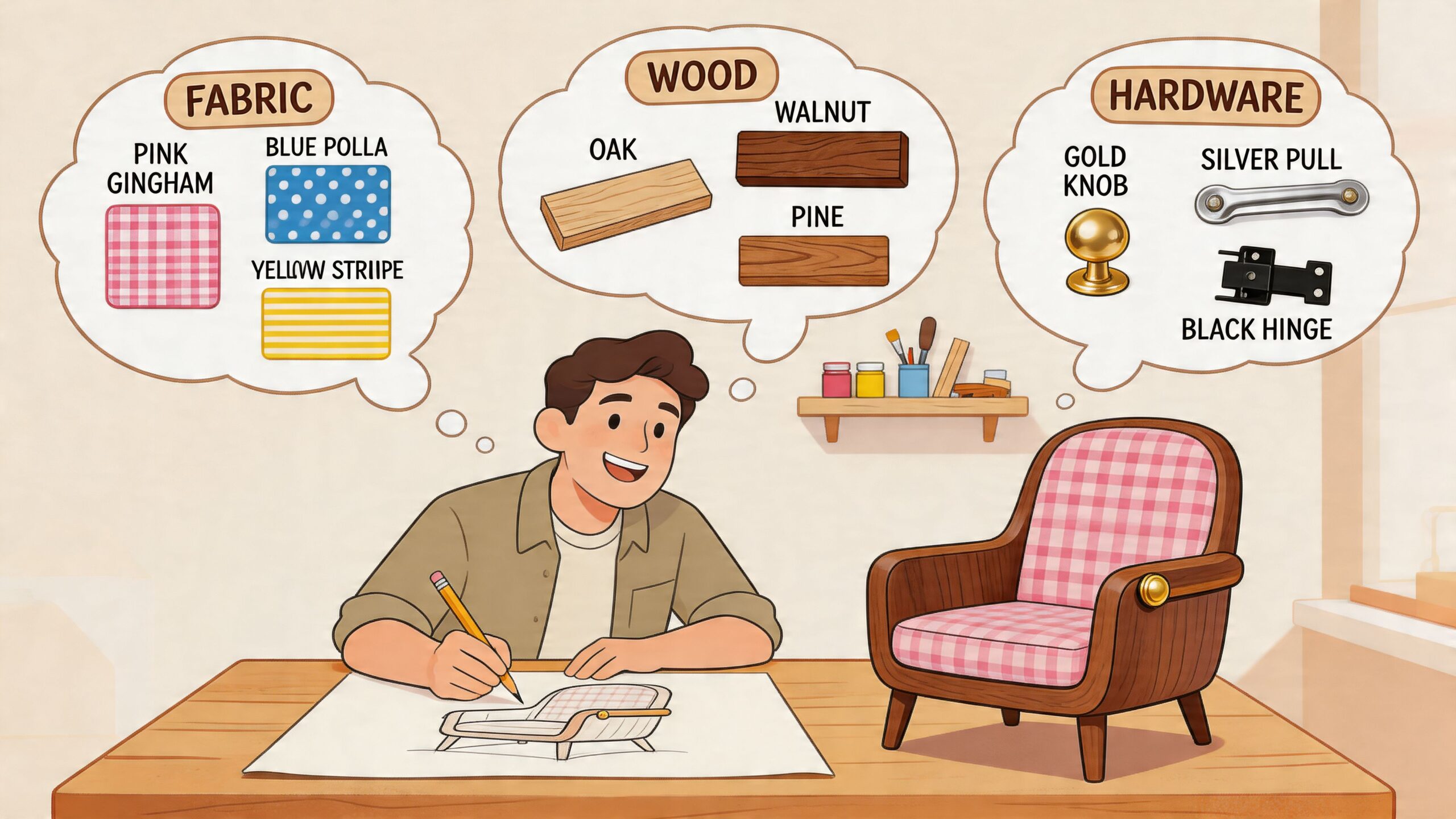
- Size and scale: Width, depth, height, extension leaves, and overall visual weight
- Wood type: Oak, maple, walnut, cherry, and other species each change the look
- Finish: Light, medium, dark, painted, or natural
- Hardware: Pulls and knobs can shift a piece from classic to more current
- Function details: Extra storage, shelving, height changes, or delivery-friendly design
A practical guide like custom furniture made simple can help you organize those decisions before you visit a showroom.
Small spaces need smarter furniture, not less furniture
This is one area where the market often misses regular families. Many artisan sites highlight giant live-edge tables and oversized statement pieces. Big-box stores, on the other hand, often lean toward standard sizes and quick-turn inventory.
But a lot of people around Milwaukee need something more practical.
They need a solid wood dining set for a condo. A small-scale dresser for a bungalow bedroom. A sectional that can get through a tight stair turn. A supportive chair that doesn’t overpower a smaller room.
That need is growing. Recent trends show rising demand for modular, come-apart solid wood sofas and sectionals amid 15% urban housing shrinkage in major U.S. markets, according to Sentient Furniture’s custom furniture trend discussion.
Custom can solve delivery headaches too
This is one of those details people think about too late.
A beautiful piece isn’t helpful if it can’t get into the room where it belongs. For city homes, older Milwaukee stairways, condos, and senior living settings, modular or come-apart construction can make all the difference.
That’s one reason some local shoppers look at practical showroom options such as BILTRITE Furniture-Leather-Mattresses, which carries categories like small-scale furniture, real solid wood pieces, and come-apart sofas and sectionals for tighter delivery situations.
Measure the room, then measure the path to the room. Hallways, stair turns, elevator doors, and entry landings matter just as much as floor space.
A simple way to narrow your options
If you feel stuck, use this order:
- Pick the function first.
- Lock in the size second.
- Choose the wood look third.
- Finish with the details like stain and hardware.
That order keeps you from falling in love with a look that won’t fit your home or your daily routine. Good customization feels less like adding complexity and more like removing compromise.
The Custom Order Process And Value
A lot of shoppers worry that custom ordering will feel mysterious. It doesn’t have to.
The process is usually straightforward when you work with a showroom team that knows the product lines, knows the builders, and knows which questions to ask before an order is placed.
What the process usually looks like
Most custom solid wood orders follow a path like this:
You try the furniture in person
Sit in the chair. Open the drawers. Look at the finish under normal light.You choose the base design
This might be a dining table, bed, dresser, bookcase, or entertainment piece.You make your selections
Wood species, finish, hardware, size, and any layout details.The order is submitted to the maker
That could be an Amish shop or another American manufacturer.The piece is built, finished, and delivered
This is the waiting part, but it’s also where the value is created.
If you want a shopper-friendly walkthrough, getting started with custom order lays out the early steps clearly.
Why lead times are longer
Custom furniture takes longer because it isn’t pulled from a giant pile of identical cartons. The wood needs to be selected, milled, assembled, sanded, finished, cured, inspected, and shipped.
That requires patience.
It’s also normal. Amish solid wood tables can average 30% to 50% higher upfront than veneered imports, they can last up to 5x longer according to lifecycle analyses, and lead times often stretch to 3 months amid artisan backlogs, according to Vermont Woods Studios.
That statement captures the tradeoff well. You’re paying more at the start and waiting longer, but you’re often buying less often.
Cost versus value
A great deal of confusion resides here.
Custom solid wood furniture is not the lowest-ticket option in the room. But “value” and “lowest price” are not the same thing.
A veneered import may cost less today. If it loosens, peels, or doesn’t survive your next move, the replacement clock starts quickly. A solid wood piece often stays in service much longer and can age with the household instead of aging out of it.
Value test: Ask yourself whether you want to furnish this room for now, or furnish it for the next chapter of your life.
Where custom feels worth it fastest
Some categories show the value sooner than others.
- Dining tables get hard daily use and benefit from stronger tops and bases.
- Bedroom case pieces like dressers and chests are used constantly, so drawer quality matters.
- Desks and bookcases often need exact dimensions.
- Beds benefit from better frame stability and stronger side rail construction.
How to stay on budget without losing quality
You don’t have to order the most elaborate version of everything.
Practical budget strategies include:
- Choose a simpler silhouette instead of extra ornament
- Put money into construction first and cosmetic extras second
- Customize the size carefully so you don’t overbuy
- Ask about in-stock or quick-ship variations if timing matters
- Prioritize one anchor piece now and add matching pieces later
That approach helps many families land on furniture that feels meaningful and durable without drifting into luxury-for-luxury’s-sake territory.
The BILTRITE Difference Why Buying Local Matters
Big furniture shopping can feel anonymous. Bright lights, quick scripts, and tags that tell you almost nothing about what’s under the finish.
Buying local feels different because it is different.
We’ve been serving Metro Milwaukee since 1928, and being family-owned isn’t a slogan for us. It shapes how we buy, how we talk with customers, and how we think about value. We want people to end up with furniture that fits their homes and holds up, not furniture that creates regret.

Why local sourcing and regional knowledge matter
The Midwest has real strength in furniture production. The U.S. furniture manufacturing sector has 5,649 manufacturers, and the Midwest accounts for 28%, according to World Coppersmith’s custom furniture market overview.
That matters because regional access to wood resources and long-standing maker relationships can support strong custom solid wood options.
For shoppers, the practical benefit is simpler. A knowledgeable local showroom can help you compare woods, finishes, sizes, and makers without guessing from photos.
What a neighborhood showroom does better
A good local store gives you things a product grid can’t.
- You can compare build quality in person instead of trying to decode listings.
- You can ask blunt questions about origin, wood species, and construction.
- You can get advice for Milwaukee homes including bungalows, condos, apartments, and senior living settings.
- You can plan delivery realistically with help from people who know local logistics.
We’re also proud of some choices that say a lot about who we are. We don’t sell online, because this category is better experienced in person. We’re closed on Sundays and Mondays so our team can spend time with family. That’s not corporate strategy. That’s just how we believe a family business should operate.
Buying local supports more than one family
When you choose USA-made and Amish-made furniture, you’re supporting craftspeople, workshops, finishers, drivers, and showroom teams here in the country.
That doesn’t make every decision simple. Price still matters. Delivery still matters. Budget still matters. But local buying gives you a better chance of getting clear answers and long-term support.
Buying local doesn’t only change where your money goes. It changes who you can call when you have a question six months later.
That ongoing relationship is a big deal with custom furniture. You’re not buying a mystery box. You’re working with people who can help you get the details right from the start.
Caring For Your New Family Heirloom
Saturday breakfast is over, somebody sets down a sweaty orange juice glass without a coaster, and the dog bumps the chair on the way to the back door. That is real family life in Milwaukee. Good solid wood furniture is built for living, but it will look better and age more gracefully if you give it a little steady care.
The good news is that the routine is simple.
Start with the finish, because that is the part you interact with every day. Dust with a soft cloth so tiny bits of grit do not act like sandpaper. If you need to wipe up a spill or sticky spot, use a slightly damp cloth, then dry the surface right after. Coasters under cold drinks and trivets under hot dishes help prevent the kinds of rings and heat marks that are hard to reverse later.
Harsh spray cleaners cause a lot of trouble here. Many leave residue, dull the sheen, or slowly wear at the protective top layer. If you want a plain-English refresher, our guide on how to clean wood furniture walks through the basics.
Your room matters too.
Wood works a little like hardwood flooring. It is made from a natural material that reacts to the air around it. In a very dry winter house, boards can shrink a bit. In a muggy stretch, they can expand. That does not mean something is wrong. It means the piece is alive to its environment, so steady indoor conditions are easier on it than sharp swings in humidity or temperature.
Construction helps here as well, just in a quieter way. Well-made joinery keeps a table, bed, or chair working as one unit instead of loosening under daily stress. As noted earlier, strong joinery such as mortise-and-tenon is one reason many Amish-made and USA-made pieces stay dependable for decades with basic upkeep.
One more insider tip. Small marks are not always a failure. A softened edge on a dining chair arm or a light patina on a tabletop often becomes part of the piece’s character. Families with kids, pets, smaller dining spaces, or heavy day-to-day use usually appreciate solid wood for this exact reason. It can be maintained, touched up, and kept in service, rather than tossed out when life leaves a trace.
Your Forever Furniture Awaits at BILTRITE
Furniture shopping gets a lot easier when you know what to look for. Real solid wood. Smart construction. Practical customization. A size that fits your room. A style that still feels like you years from now.
That’s why custom solid wood furniture appeals to so many Milwaukee families. It fills the gap between pricey artisan one-offs and disposable furniture that doesn’t stay useful for long. It gives you something personal, durable, and grounded in real materials.
If you’re furnishing a condo, updating a family dining room, helping a parent with a senior living move, or just replacing pieces that never held up the way they should have, this category is worth a close look. You don’t have to know every wood species or joinery term before you walk in. You just need a place to ask questions and compare actual pieces.
We’d love to meet you in Greenfield, hear what you’re working on, and help you sort through the options in a friendly, no-pressure way. After all these years in the Milwaukee area, that’s still our favorite part of the job. Helping neighbors make smart choices for their homes.
If you’re ready to explore custom solid wood furniture, come visit BILTRITE Furniture-Leather-Mattresses in Greenfield. You can see real solid wood up close, compare USA-made and Amish-made options, talk with an experienced team, and find practical choices for small spaces, heavy-duty use, and everyday family life.