


RV Adjustable Bed: A Practical Guide for Owners


An RV bedroom can feel like a puzzle designed around everything except sleep. The mattress may sit close to a slide wall, overhead cabinets can hover above the pillow, and a fixed platform can make reading, watching television, or reaching storage awkward. After a long day on the road, those small frustrations add up.
An RV adjustable bed can bring back some of the comfort people enjoy at home, but it can't be treated as a regular residential base squeezed into a smaller room. The frame must respect tight clearances, unusual mattress footprints, vehicle vibration, and the electrical setup inside the coach. The right choice starts with room geometry, then moves to frame height, mattress flexibility, power, installation, and support.
Table of Contents
- Why an RV Bedroom Deserves a Better Bed
- What an RV Adjustable Bed Actually Is
- Low-Profile Frames and the Clearance Problem
- Common RV Bed Sizes and Adjustable Options
- Power, Wiring, and Installation Considerations
- Choosing a Mattress That Bends With the Frame
- Where to Buy an RV Adjustable Bed
- Bringing It All Together for Your Rig
Why an RV Bedroom Deserves a Better Bed
A typical Class A or Class C bedroom has very little spare space. A mattress may sit only inches from a slide wall, with overhead cabinets, reading lights, or a low ceiling competing for the same vertical room needed by a raised head section. The result is a sleeping area that may work when everything stays flat, but feels cramped when someone wants to sit up with a book or reach the storage beneath the platform.
A fixed mattress also limits everyday comfort. The sleeper may roll toward the center, climb across the bed to reach a cabinet, or brace against the wall when getting up. At home, a person can recline to watch television, raise the upper body while using a laptop, or lift the feet after a long day. Those simple adjustments often disappear in an RV because a residential base is too tall, too wide, or poorly matched to the room.

Start with the room, not the feature list
The first question isn't whether the bed has massage, lighting, or multiple presets. It's whether the moving deck can raise without touching the slide, cabinetry, wall trim, or ceiling. A comfortable mattress still becomes a poor fit if the head section stops halfway or the finished bed height makes sitting up harder.
A useful mattress foundation also matters. Readers comparing support and construction can review this guide to why investing in a high-quality mattress is essential for long-term health, then apply the same thinking to the RV's tighter dimensions.
The broader adjustable-bed category has moved well beyond hospital-style equipment. One market summary estimated the global adjustable beds and mattress market at USD 6.24 billion in 2021, with a projection of USD 13.34 billion by 2030 and a projected 8.8% compound annual growth rate from 2022 to 2030. A separate report estimated USD 8.68 billion in 2025 and projected USD 14.50 billion by 2032, as reported in this adjustable-bed market summary. For RV owners, the important point is qualitative: the technology has matured enough to be adapted for mobile rooms instead of remaining a home-only feature.
What an RV Adjustable Bed Actually Is
An RV adjustable bed is a motorized frame with a hinged deck. The deck raises the head, the feet, or both through a remote or switch, allowing the sleeper to change position without stacking pillows or leaning against a wall. The frame is designed around an RV mattress footprint and the physical limits of a vehicle bedroom.
That distinction separates it from a typical residential adjustable base. A home base may assume a spacious bedroom, a standard mattress size, a tall ceiling, and a stable floor. An RV version must account for short queens, RV kings, twin XL footprints, narrow slide-outs, nearby cabinetry, and movement during travel.
The engineering differences matter
An RV-focused frame may use a lower deck, a lighter structure, or motors selected for the available electrical setup. It may also use isolation points or travel restraints so the frame doesn't shift or transmit unnecessary noise through the platform while the coach is moving. Buyers should confirm these details rather than assume that a residential base will translate safely to the road.
Control systems vary. A wired remote keeps the signal dependable and stays easy to locate, while a radio-frequency remote avoids a cable across the mattress. A wall-mounted switch can work well when the bed has a dedicated bedside location. Head and foot articulation are the core functions. Lumbar adjustment, massage, and under-bed lighting are trim-level features, not automatic parts of every frame.
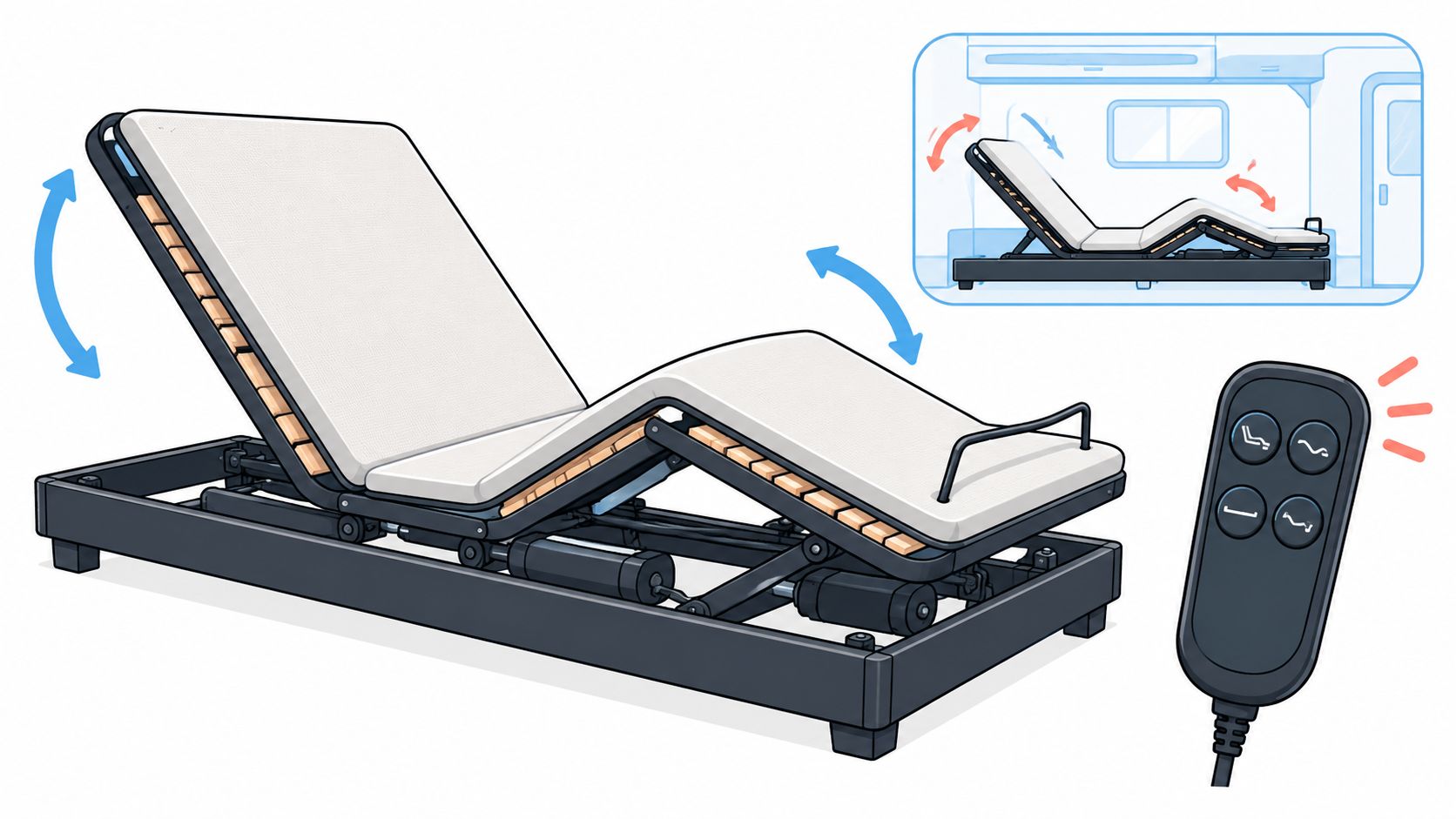
The category exists because the frame, motor, deck, and mattress must work as one system. A helpful overview of the health benefits of using an adjustable base bed can explain the comfort side, but RV shoppers also need to ask whether the hardware suits their particular coach.
Practical rule: An RV adjustable bed isn't a shrunken home base. It's a purpose-built mechanical system that must fit the mattress, platform, power source, and surrounding room at the same time.
Low-Profile Frames and the Clearance Problem
In an RV, stack height is often the make-or-break specification. Stack height means the distance from the existing platform or floor to the top of the mattress after the frame is installed. A base that feels low in a house can become too tall once it sits beneath a mattress and approaches a slide ceiling or cabinet door.
Independent RV-focused guidance describes adjustable systems in the 4 to 5 inch range, while another source discusses frames around 5 inches maximum so the motorized structure can sit on a standard wooden platform without interfering with nearby furniture. Those measurements are discussed in this RV adjustable-bed clearance guide and the BILTRITE RV adjustable-bed guide. The frame height alone doesn't tell the full story, but it explains why low-profile construction matters.
Measure the worst obstruction
A raised head section can approach a cabinet, slide wall, reading light, or ceiling edge as it moves. The tightest point matters more than the most generous point. A few inches of extra mattress height can reduce the usable movement range, even when the frame itself fits the platform.
A careful inspection includes:
- Bare platform height: Measure from the existing bed platform to the lowest overhead obstruction.
- Head-section path: Check the space above the pillow area, not only the center of the mattress.
- Side clearance: Look for trim, walls, cabinet doors, and slide edges that could catch the moving deck.
- Access height: Consider whether the finished bed will still allow comfortable sitting and getting up.
The frame may use recessed linkages or shallower actuators to preserve room, but every low-profile design involves choices. A thinner mattress can leave more headroom, yet it may feel different at the edge or provide less motion separation than a thicker construction. The mattress and base should be selected together.
An owner should measure the platform before shopping, write down the lowest clearance, and compare the complete installed height rather than the frame measurement alone. The adjustable-bed height guide provides another useful reference for thinking about the finished profile.
Common RV Bed Sizes and Adjustable Options
RV mattress labels can be confusing because the name doesn't always tell the whole story. A short queen, for example, isn't automatically the same footprint as a residential queen, and an RV king can use a different width or length from the king in a house. The frame must match the actual platform, not just the label printed on the old mattress.
Independent RV-bedding guidance lists several common footprints, including three-quarter at 48 by 75 inches, RV full at 53 by 75 inches, short queen at 60 by 74 inches, RV queen at 60 by 80 inches, Olympic queen at 66 by 80 inches, RV king at 72 by 75 inches, twin at 38 by 75 inches, and twin XL at 38 by 80 inches. The same guidance identifies adjustable options for queen at 60 by 80 inches, twin at 38 by 75 inches, twin XL at 38 by 80 inches, and full at 53 by 75 inches, as shown in this RV adjustable-bed size guide.
| RV Size | Dimensions in inches | Typical Location | Adjustable Frame Availability |
|---|---|---|---|
| Short queen | 60 x 74 | Compact slide-out bedroom | Available in RV-focused options, verify exact length |
| RV king | 72 x 75 | Wider rear bedroom | Available in selected RV configurations |
| RV full | 53 x 75 | Compact bedroom or bunk-area conversion | Available in selected adjustable formats |
| Twin XL | 38 x 80 | Split or narrow sleeping arrangement | Commonly available, but confirm platform fit |
Measure both ends of the platform
The platform may not be perfectly open from wall to wall. Trim, rounded corners, slide edges, and a headboard can reduce the usable envelope. Measure inside wall to inside wall at the head and foot, then measure the length along both sides if the platform has an unusual shape.
A frame can match the mattress and still foul the slide. That's why the owner should confirm the actual frame footprint, the clearance around its moving parts, and the mattress dimensions before ordering. The existing mattress tag is a useful starting point, not the final measurement.
The RV bed mattress guide can help shoppers think through RV-specific mattress fitting. The showroom conversation should include a drawing or written measurement of the platform, especially when the bedroom has a slide or a cut corner.
Power, Wiring, and Installation Considerations
Power planning deserves attention before the frame arrives. An RV adjustable bed may use low-voltage direct-current motors supplied through a power adapter, while another design may connect to a household-style alternating-current outlet. The owner should read the installation information for the exact frame instead of assuming that the coach's available outlets will work.
An outlet near the head of the bed is usually easier to manage than a cord stretched across the room. The cable should stay clear of hinges, moving deck sections, walkways, and storage doors. If the outlet depends on an inverter, the bed may only operate when that system is enabled, so the owner should test the arrangement before travel.
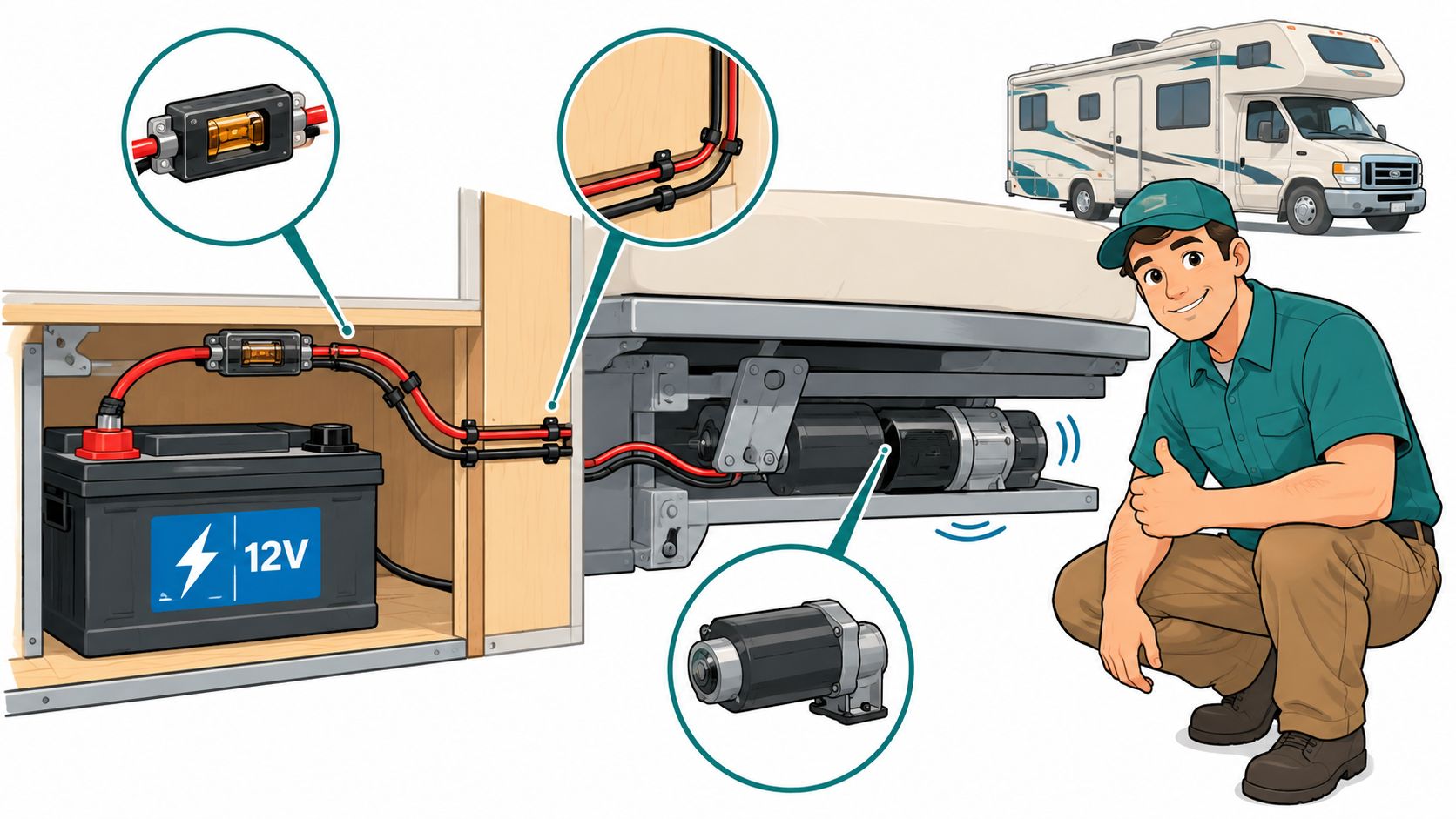
Check the platform before attaching anything
Many installations use a platform-style bracket system. The frame may bolt through the existing base or rest on top of it, depending on the design. The platform needs to support the frame, mattress, and sleepers without flexing, and the fasteners need to suit the platform material.
A product manual provides the right place to verify safety information. One adjustable-base manual identifies UL 962 fourth-edition compliance and conformity with CSA C22.2 No. 68, 16 CFR 1632, 16 CFR 1633, and California TB 129. The same category of manual guidance states a recommended maximum load of 900 pounds including the mattress, with weight distributed evenly, as documented in this adjustable-base user manual.
Before installation, the owner should confirm:
- Electrical route: The cord won't cross a walking path or moving joint.
- Platform strength: The base can carry the complete occupied load.
- Travel security: Isolation feet, retaining hardware, or locking pins keep the frame from shifting.
- Service access: The motor and control connections remain reachable if troubleshooting becomes necessary.
A battery or power-pack discussion, such as this battery power pack for a power recliner, can help explain the difference between cord management and stored power. The exact RV bed connection still needs to follow the frame's instructions.
Choosing a Mattress That Bends With the Frame
The mattress has to follow the deck as it rises. A rigid mattress can resist the hinge points, bow at the foot, or pull against the frame. That creates an uncomfortable sleeping surface and may place unnecessary stress on the mechanism.
Foam and flexible hybrid constructions generally adapt more readily than traditional designs with rigid edges. Memory foam and latex can bend through the head and knee sections, while a pocketed-coil hybrid may provide a more familiar spring feel with enough flexibility for articulation. The important question isn't only what the mattress is made from. It's how the entire mattress responds when the base moves.
Thickness changes the room
A tall mattress raises the finished sleeping surface and reduces the open space above the bed. In an RV, that can make the head section approach a cabinet or slide sooner than expected. A lower-profile mattress may preserve more room for movement, but the shopper still needs to assess edge support, pressure relief, and how easily the mattress changes shape.
Stiff perimeter rails deserve particular attention. A reinforced edge can be useful on a stationary bed, yet it may fight the bend at the head or knee break. The mattress should flex without forming a hard crease or pushing the deck away from its intended position.
A practical test is simple:
- Place the mattress on the frame while the deck is flat.
- Raise the head section slowly.
- Watch the side edges, foot area, and corners.
- Lower the deck and check whether the mattress settles back without a permanent fold.
- Repeat with the foot section if the frame offers that movement.
The owner should also confirm the mattress warranty allows use on an adjustable base. An RV mattress made for a tight platform can be a better match than a residential mattress selected only by feel in a showroom.
Where to Buy an RV Adjustable Bed
There are three practical purchasing paths, and each suits a different kind of owner. The right choice depends on the coach's measurements, the complexity of the installation, and how much hands-on help the buyer wants.
An RV specialty supplier usually focuses on unusual footprints, low-clearance rooms, and travel-related installation details. That kind of source may offer a narrower range of styles, but the staff and product information are more likely to address slide-outs, platform bases, and coach-specific constraints.
A furniture showroom offers a different advantage. Shoppers can test mattress feel, compare control layouts, and discuss how the frame works beneath different mattress constructions. The available inventory may assume a conventional room and household power, so RV owners need to bring measurements and ask direct questions about height, footprint, and installation.
A custom fabricator can create a frame around an unusual platform. That path offers control over dimensions and finish, but it also places more responsibility on the owner. Wiring, fabrication tolerances, motor compatibility, travel restraints, and warranty service all need to be settled before work begins.
| Channel | Selection Fit for RV | Service and Support | Installation Effort |
|---|---|---|---|
| RV specialty supplier | Strong focus on unusual footprints and low-clearance rooms | Focused guidance for vehicle interiors | Usually requires careful owner or installer coordination |
| Furniture showroom | Broad mattress and comfort testing, with fit requiring verification | In-person discussion and product comparison | Moderate, depending on the selected frame and platform |
| Custom fabrication | Highest control over unusual dimensions | Support depends on the fabricator and component suppliers | Greatest owner responsibility for fit, wiring, and service |
Ask the same questions everywhere
A useful purchasing conversation should cover the complete system:
- Will the frame fit the measured platform?
- What is the complete installed height with the intended mattress?
- How does the frame stay secure during travel?
- What power arrangement does the motor require?
- Who handles installation questions or warranty service?
BILTRITE Furniture-Leather-Mattresses offers adjustable-base guidance and mattress options through its Greenfield showroom, where shoppers can discuss fit and setup in person. The store is a fourth-generation, family-owned business serving the Metro Milwaukee community since 1928, with a focus on affordable, better-quality furniture, mattresses, USA-made pieces, Amish-made furniture, and solid wood options.
Bringing It All Together for Your Rig
The purchase becomes much easier when the room gets measured before the shopping begins. The owner should record the platform length and width, the lowest overhead obstruction, the space beside the bed, and the doorway route for bringing the frame into the RV. A written sketch can prevent a costly mismatch caused by relying on a mattress label alone.
The frame then needs to match three conditions: footprint, clearance, and power. A low-profile design is often the sensible starting point for a compact bedroom, and a motor compatible with the coach's available electrical arrangement avoids surprises during travel. The mattress should flex with the deck and remain low enough to preserve headroom.
A practical buying checklist
- Measure the platform: Record the usable dimensions at the head and foot, including trim and rounded corners.
- Find the lowest obstruction: Check cabinets, slide ceilings, lights, walls, and any surface the raised head section could reach.
- Confirm the complete height: Add the frame, mechanism, and intended mattress rather than evaluating the frame by itself.
- Match the actual footprint: Choose among short queen, RV king, RV full, twin, or twin XL based on measured space.
- Check the power plan: Identify the outlet, adapter, cord path, and inverter limitations before installation.
- Review load guidance: Confirm that the platform and frame can support the mattress and occupants with weight distributed as required.
- Choose the support path: Decide whether specialty RV guidance, showroom assistance, or custom fabrication best matches the owner's skills and needs.
A confident purchase starts with measurements on paper. Comfort comes after the frame, mattress, room, and power source agree with one another.
The goal isn't to find a residential bed that happens to fit inside an RV. It's to select a coordinated system that clears the room, supports the sleepers, articulates smoothly, and stays secure when the coach moves. A showroom visit can make those choices less abstract, especially when the owner brings platform measurements and photos of the bedroom.
The Greenfield team can help walk through mattress feel, adjustable-base options, and the fit questions that are easy to overlook from a catalog. That kind of conversation is especially useful for owners who want better quality without giving up practical guidance or local service.
The BILTRITE Furniture-Leather-Mattresses showroom offers adjustable bases, a mattress center with over 60 models, and sales associates with over 400 years of combined experience to help RV owners compare comfort and fit. Visit the Greenfield showroom with the RV platform measurements, and the team can help sort through the options in person.