Recliners Made in USA: A Friendly Buyer’s Guide


You're comparing recliner listings after a long day, and every description seems to promise something different. One chair says Made in USA, another says American-built, a third says Amish-crafted, and a fourth says Assembled in USA. They may look similar on a screen, but those labels can describe very different materials, manufacturing steps, and service expectations.
A thoughtful purchase starts with more than patriotic wording. The frame, reclining mechanism, foam, suspension, upholstery, warranty, and repair process all matter. The guide below helps shoppers understand what recliners made in USA mean, identify the construction details inside the chair, and ask useful questions before bringing one home.
Why the Label on Your Recliner Matters
A shopper named Maria might begin with a simple goal, a comfortable recliner for movie nights that can handle everyday family use. After opening several listings, she finds phrases such as American-made, built in America, assembled domestically, and Amish-made. None of those phrases automatically tells her where the frame, mechanism, motor, cushions, or upholstery originated.
That confusion is understandable. Furniture descriptions often emphasize the finished chair while leaving the component story unclear. A recliner can receive final assembly in the United States while still containing imported parts, whereas an unqualified Made in USA claim has a more demanding standard. A buyer who understands the wording can compare chairs based on construction instead of assuming every American-sounding label means the same thing.
Three questions worth asking
Before choosing among recliners made in USA, shoppers should ask:
- What does the origin label mean? Is the chair fully made domestically, assembled domestically from global components, or handcrafted in a U.S. workshop?
- What's inside the chair? Which materials support the body, carry the motion, and protect the upholstery from daily wear?
- How can the claim be confirmed? Can the seller identify the frame, mechanism, motor, upholstery, and final assembly locations?
The United States has a meaningful recliner manufacturing history. In 1927, Monroe, Michigan cousins Edwin Shoemaker and Edward Knabusch designed the first La-Z-Boy recliner, then upholstered the design for indoor year-round use by 1929, according to the documented history of La-Z-Boy recliners. That history shows that the American recliner story is more than a modern marketing theme. It grew from domestic design and manufacturing.
Practical rule: A country-of-origin label is a starting point, not a substitute for construction questions.
Recliners have also held a broad place in American homes. An industry estimate reported that about $2.6 billion of roughly $30 billion spent on furniture in 1990 went toward recliners, while one university household-furniture study found ownership rates as high as 63.1% in a U.S. region. The same study reported that recliners reached 30% of urban residents as active purchases, with ownership rising in smaller places, as described in the household-furniture research. The takeaway is simple: this is a mainstream piece of household furniture, so buyers deserve clear information about what they're getting.
What Made in USA Really Means for Recliners
The most useful starting point is the Federal Trade Commission standard. An unqualified Made in USA claim means a product must be made in the United States with all or virtually all significant parts and processing originating domestically. For a recliner, that raises practical questions about the frame, mechanism, motor, springs, foam, upholstery, and final construction.
Read the label like an ingredient list
Food packaging gives shoppers an easy comparison. A product can be prepared in one location while containing ingredients sourced from several others. Recliner labels work in a similar way.
Made in USA suggests that the significant materials and manufacturing steps are domestic. Assembled in USA focuses on the final assembly location, so imported components may still make up a substantial part of the chair. American-built can sound reassuring, but shoppers should ask the manufacturer how the phrase is defined rather than treating it as identical to an unqualified Made in USA claim.
This guide to furniture made in the USA can help shoppers become more familiar with the distinctions before visiting a showroom.
Amish-made describes a different kind of promise
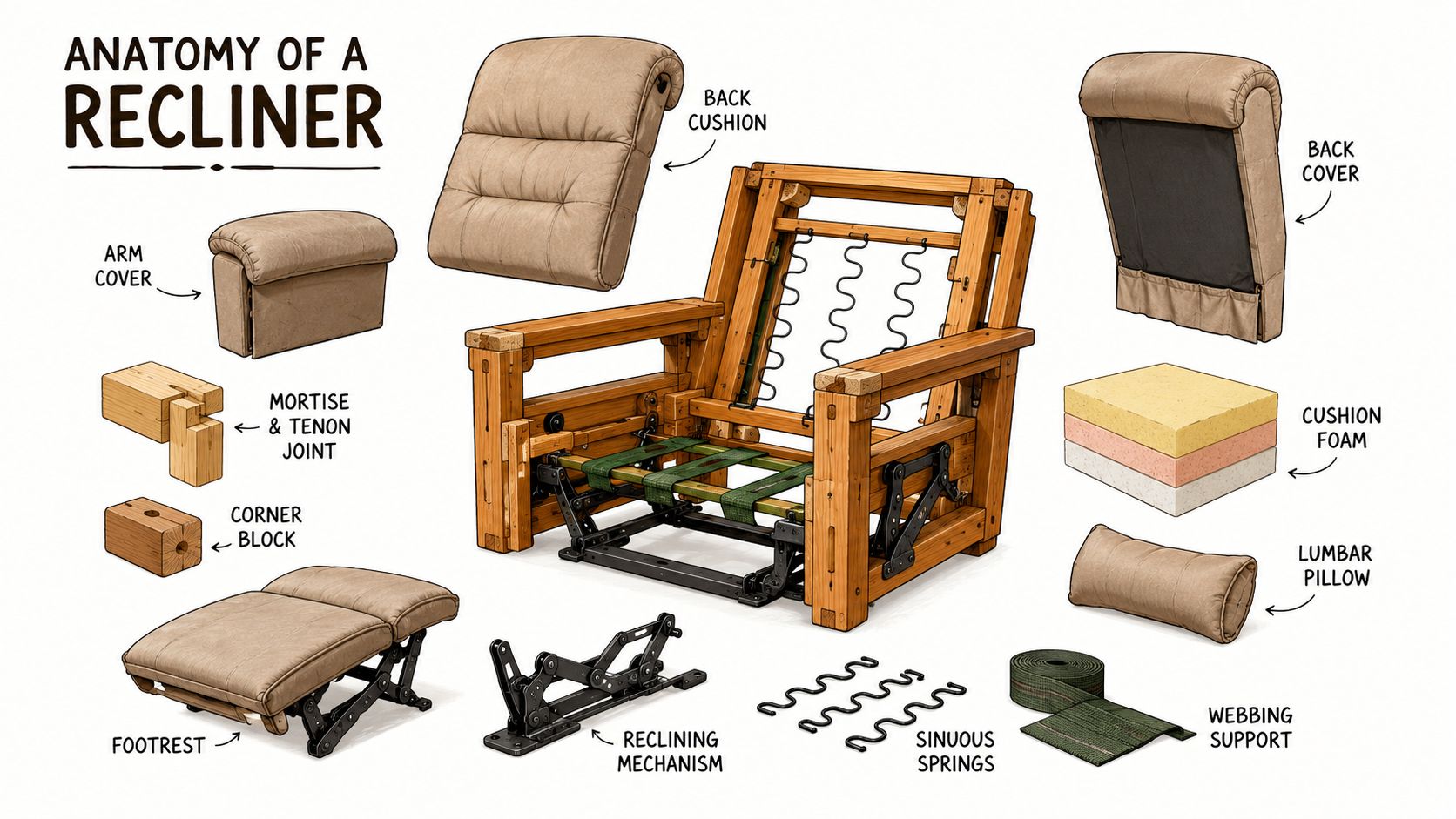
Amish-made generally points toward handcrafted construction in domestic workshops, often using traditional woodworking methods. Product descriptions for Amish recliners identify kiln-dried North American hardwoods such as oak, maple, cherry, quarter-sawn white oak, rustic cherry, and hickory. They also identify mortise-and-tenon frame construction, a traditional joint that connects shaped wood components rather than relying only on basic fasteners.
One Amish recliner description identifies a webrider coil spring bottom and states that Amish builders in Ohio and Indiana handcraft the furniture. Those details are more useful than a broad “handmade” phrase because they identify the wood, joinery, support system, and workshop locations. A separate premium Amish-made recliner description states that the chair is handcrafted in America, has a 20-year limited warranty, and uses a metal base for its swivel glider function, as shown in the detailed Amish recliner listing.
The best approach is to ask for component-level information. A clear seller should be able to explain what the label covers and where the major parts come from.
Inside an American-Made Recliner
A recliner's comfort comes from several systems working together. The chair may look like a simple upholstered box, but the frame carries the load, the mechanism manages movement, the suspension supports the seat, and the cushion determines how the body settles.
The frame carries the structure
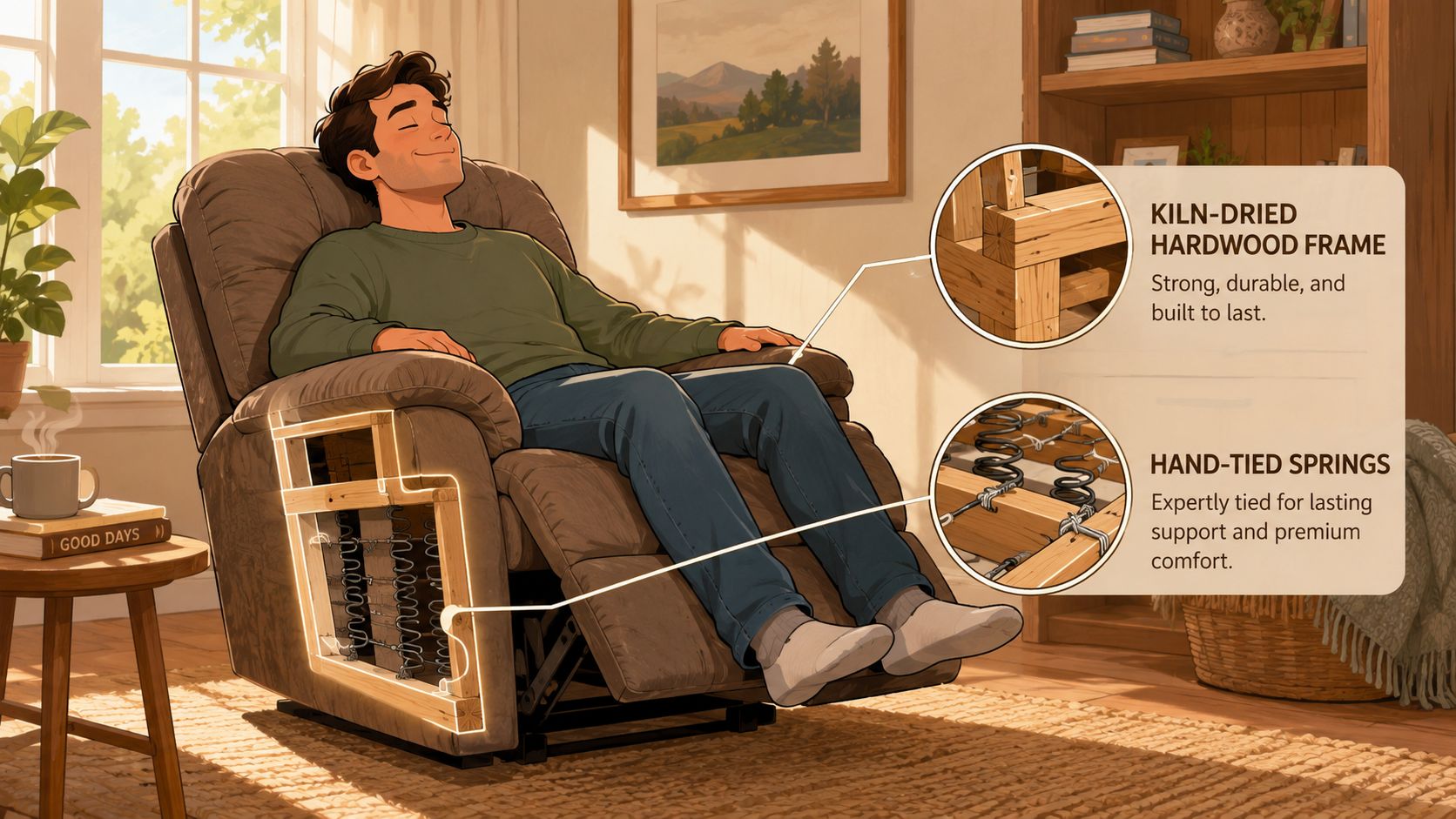
A quality domestic recliner may use kiln-dried hardwood, corner blocks, and traditional joinery. Kiln drying removes excess moisture before construction, which helps the wood remain more stable as indoor conditions change. Mortise-and-tenon joinery, used in many Amish-made recliners, connects wooden members through fitted joints and gives the frame a more deliberate structural foundation.
Not every imported or composite frame fails, and not every domestic frame has the same specification. The useful question is whether the manufacturer identifies the frame material and construction method. A shopper should also ask whether the frame is designed for the chair's intended load and motion, particularly for heavy-duty or lift seating.
The mechanism controls daily movement
The reclining mechanism deserves close attention because it moves under load every time the footrest opens or the back changes position. Guidance for recliner hardware recommends an all-metal mechanism, with steel components better suited to repeated load cycles than plastic parts. The same buyer guidance points to cycle-testing targets of at least 25,000 cycles, as explained in this recliner mechanism durability guide.
A wall-hugger mechanism, rocker mechanism, or lift mechanism can each serve a different room and mobility need. The important details include metal construction, smooth movement, stable footrest operation, and access to replacement parts. Powered chairs also need a motor and electrical components that the seller can identify.
Cushions and suspension shape the sit
Seat foam has a major effect on how a recliner feels after regular use. Expert buyer guidance recommends at least 1.8 lb/ft³ high-resilience foam in the seat, while higher-end construction may pair hardwood frames with sinuous spring suspension and upholstery rated at 30,000+ double rubs, according to this professional recliner buyer guide.
Suspension may use sinuous wire, webbing, or eight-way hand-tied coils. No single system automatically suits every sitter, but the combination of suspension, foam, cushion shape, and frame determines whether the chair feels supportive or overly soft. Upholstery adds another layer. Top-grain leather from an American tannery differs from an imported split, and careful hand-tailoring shows through aligned seams, matched patterns, and even stitching. Shoppers can learn more about these choices through this upholstery materials guide.
Why USA-Made Recliners Offer Lasting Value
A well-built recliner earns its place in a home through daily use. It should feel steady when someone sits down, move without awkward strain, and continue supporting changing routines. The country-of-origin label can point to useful information, but the lasting value comes from examining the chair component by component.
A kiln-dried hardwood frame provides a stable base. Sinuous springs or eight-way hand-tied coils support the seat beneath the foam. High-resilience foam helps the cushion hold its shape, while a steel reclining mechanism is designed for repeated movement. A recliner combines furniture and machinery, so both sides deserve attention.
Service can shape long-term value
Repairability becomes especially important after years of use. If a motor, mechanism, cushion, or upholstery needs attention, a reachable manufacturer and local dealer may make diagnosis and service more practical. Confirm the warranty terms, parts availability, labor coverage, and service process before assuming repairs will be simple.
Powered and lift recliners deserve extra care because they contain more working components than basic manual chairs. Import costs also form part of the buying context. A report on furniture tariffs states that U.S. policy held a 25% tariff on upholstered furniture in 2026, while planned increases to 30% were delayed until at least January 1, 2027, as described in the tariff coverage. Policy details can change, yet they show why the purchase price should be considered alongside future parts and service support.
A lower sticker price matters less if the chair becomes difficult to repair, recover, or match with replacement components.
Domestic value includes the buying experience
Domestic production can support American manufacturing jobs and shorten parts of the supply chain. Those benefits do not guarantee flawless quality. Clear specifications, appropriate sizing, a usable warranty, and a responsive seller still matter. A nearby showroom can add practical value by letting you test the fit, compare movement, and ask detailed questions before ordering.
USA-made and Amish-made recliners may cost more upfront because of materials, labor, customization, and smaller-scale production. That cost may suit a household looking for a chair over many years, but the label alone should not decide the purchase. Compare the frame, mechanism, cushion, upholstery, warranty, and service details. For a deeper look, read this guide to the advantages of buying furniture made in the USA.
How to Verify a Recliner Is Truly Made in the USA
A showroom visit gives shoppers a chance to turn a vague origin claim into a useful conversation. The goal isn't to challenge a salesperson. It's to understand exactly what the chair includes and what support will be available later.
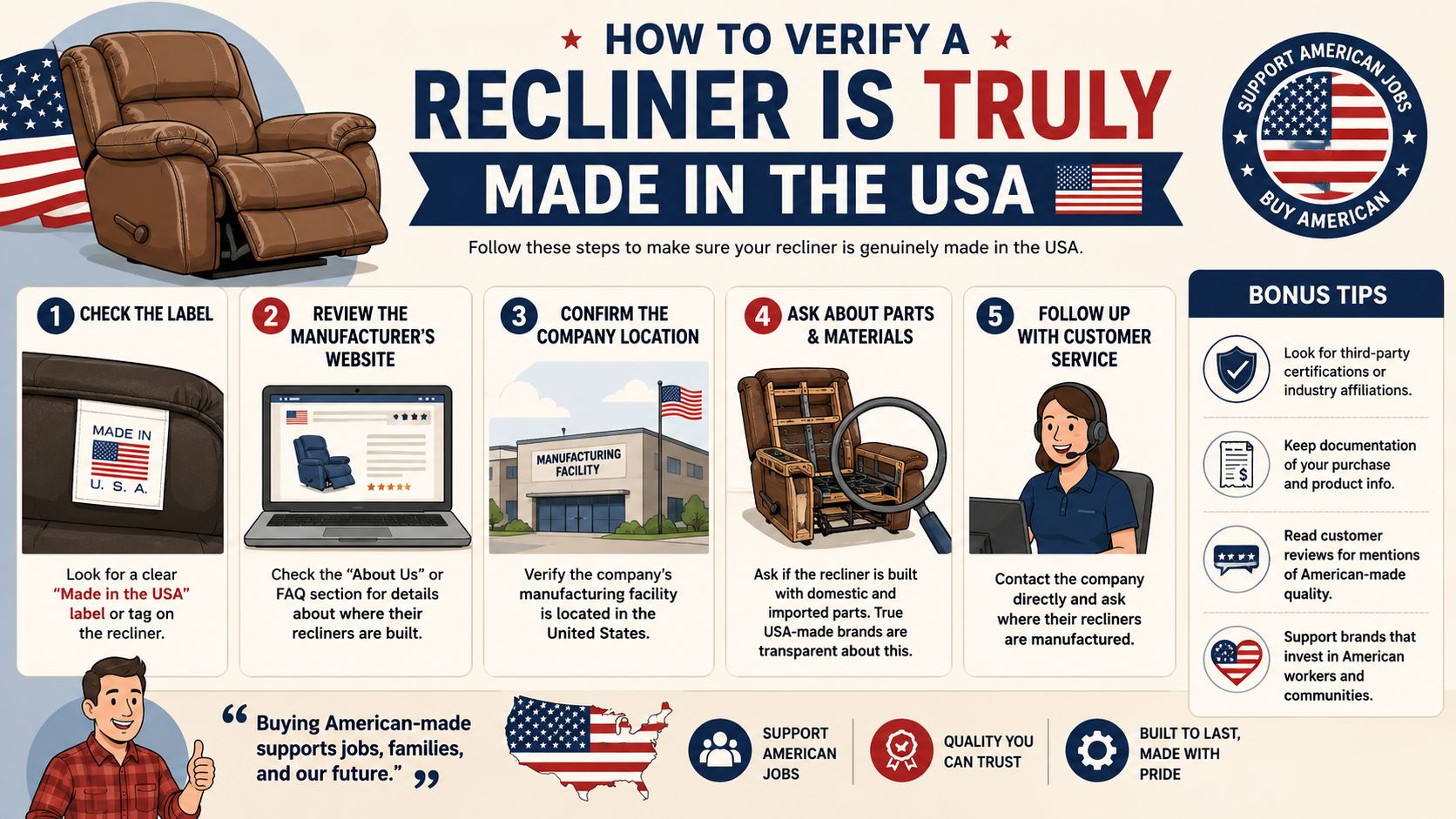
Use a five-point showroom checklist
-
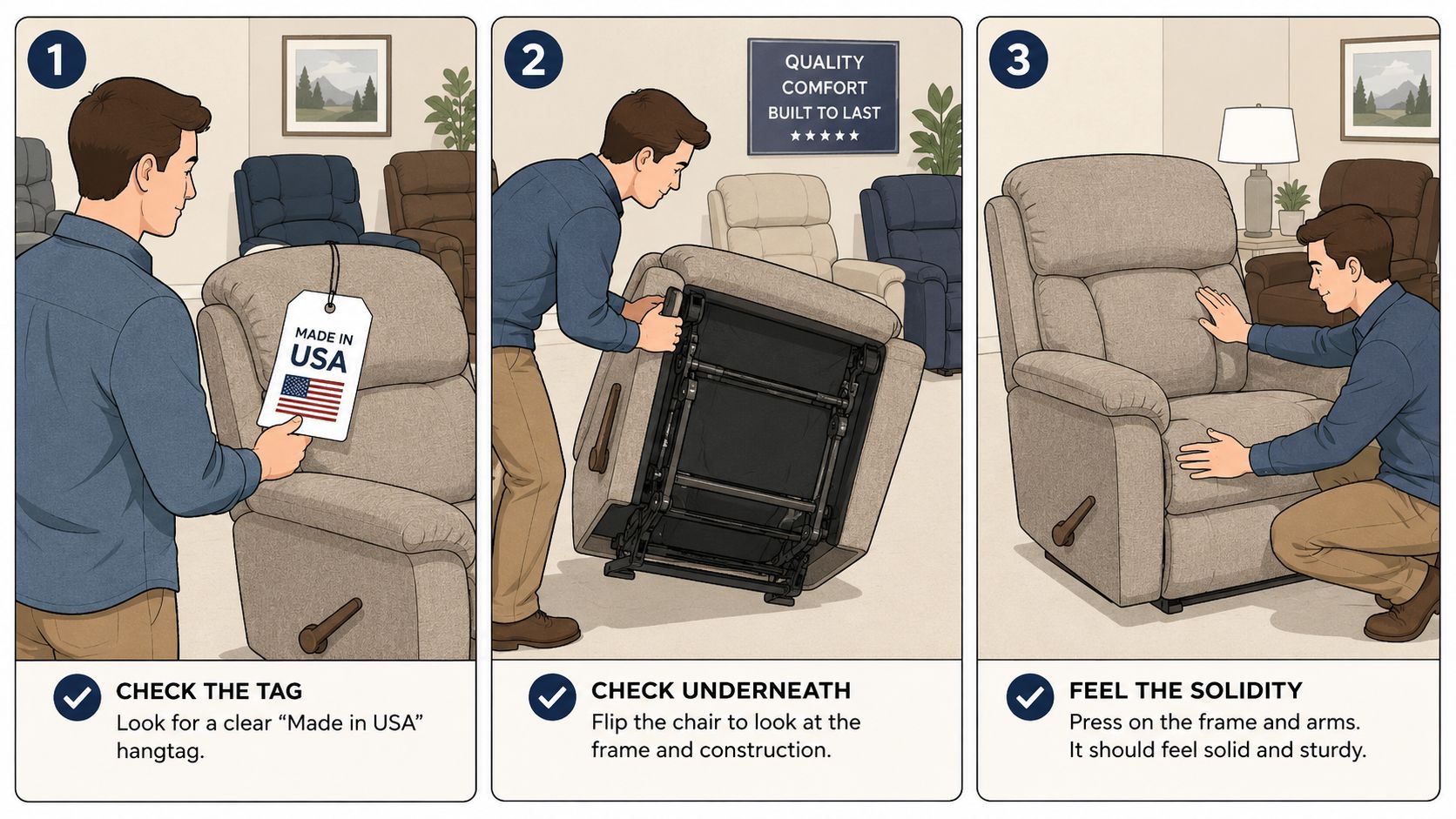
Read the hangtag carefully. Look for the exact country-of-origin wording. “Made in USA” and “assembled in USA” carry different implications, so the distinction should appear in writing.
-
Inspect the chair for maker information. Ask whether the recliner has a frame stamp, manufacturer label, or product identification tag. A clear identifier helps connect the chair on the floor to its specifications and warranty.
-
Ask which components are imported. The useful questions include the origin of the frame, reclining mechanism, motor, foam, springs, leather, fabric, and final assembly. A seller who can answer specifically gives the buyer more confidence than one who repeats a general slogan.
-
Request a specification sheet. The document should identify the frame wood, suspension, mechanism type, upholstery category, and available service information. If the chair is customized, shoppers should ask whether the origin details apply to every configuration.
-
Confirm where warranty service occurs. A domestic manufacturing claim doesn't automatically mean every repair happens locally. Ask who diagnoses problems, where parts ship from, and whether the retailer coordinates service.
Some labels name an importer rather than the furniture maker. Others describe a chair as assembled domestically from global parts. Those statements may be accurate when properly presented, but they aren't interchangeable with an unqualified Made in USA claim under the FTC's all or virtually all standard.
A retailer should welcome reasonable questions about origin and service. Shoppers can also use this guide to American furniture manufacturers as a starting point for understanding domestic production before comparing individual chairs.
Finding USA-Made Recliners Close to Home
Online listings are useful for narrowing a search, but a recliner is a body-fit purchase. A chair that looks generous in a photograph may place the head too far forward, leave the feet unsupported, or create pressure behind the knees. A local showroom lets shoppers test those details before making a decision.
A Metro Milwaukee shopper might begin by calling ahead and asking which floor models are made domestically, which are Amish-made, and which offer custom fabric or leather choices. That small conversation can save time and help the store prepare meaningful comparisons. Comfortable clothing also helps, since a proper test means sitting upright, extending the footrest, reclining fully, and returning to a standing position.
What a family-owned showroom adds
BILTRITE is a fourth-generation, family-owned business serving the Metro Milwaukee community since 1928. Its selection emphasizes affordable, better-quality furniture, including USA-made, Amish-made, and solid-wood pieces. The showroom also carries small-scale options for apartments and condos, heavy-duty furniture for households needing extra support, and a large mattress department with over 60 models.
The local experience is less about a quick transaction and more about comparing how chairs behave. Shoppers can test manual and powered motion, evaluate lumbar support, check footrest extension, and discuss whether a wall-hugger or lift chair fits the room and the sitter. BILTRITE's sales associates bring over 400 years of combined experience, giving families a resource for questions without requiring them to make a rushed choice.
Questions to ask before the visit
- Domestic selection: Which recliners are made in the United States, and which are Amish-made?
- Customization: Can the buyer choose fabric, leather, wood, finish, or hardware?
- Delivery: Does the store coordinate delivery and setup for the selected chair?
- Space planning: Will the recliner fit through the doorway and leave enough room to operate?
- Service: Who handles warranty questions if the mechanism, motor, or upholstery needs attention?
Shoppers can learn more about local options through this guide to USA-made furniture stores. A showroom visit also gives families a chance to compare domestic construction with other options without relying on a photograph or a short product description.
Your Next Step Toward the Right Recliner
The right recliner starts with clear language. Made in USA should be understood through the FTC's all or virtually all standard, while assembled in USA may describe a chair finished domestically with imported components. Amish-made adds a craftsmanship story that can include named hardwoods, mortise-and-tenon joinery, and traditional workshop construction.
The label is only one part of the decision. A careful buyer also examines the frame, mechanism, suspension, foam, upholstery, warranty, and repair process. Steel reclining hardware, resilient seat foam, durable upholstery, and a serviceable design can matter more to daily comfort than a patriotic phrase printed on a hangtag.
Match the chair to real life
A family with narrow doorways may need a chair that comes apart for delivery. Someone furnishing a smaller apartment may need compact proportions or a wall-hugger design. A senior or caregiver may need a lift recliner with accessible controls, while a tall or heavy user may need a chair designed for a larger body. The showroom conversation should include room dimensions, sitting habits, mobility needs, preferred firmness, and budget.
BILTRITE's team can help shoppers compare USA-made and Amish-made recliners in person, talk through fabric and mechanism choices, and test how each chair supports the body. The store is located at 5430 West Layton Avenue in Greenfield, Wisconsin, and it's closed on Sundays and Mondays to support family time.
The most suitable recliner isn't the one with the strongest label. It's the one that fits the sitter, the room, the daily routine, and the household's expectations for care over time. A relaxed showroom visit can reveal those details far better than scrolling through listings.
BILTRITE Furniture-Leather-Mattresses offers USA-made and Amish-made recliners, solid-wood furniture, custom upholstery choices, lift chairs, and a broad in-stock selection for Metro Milwaukee homes. Visit BILTRITE Furniture-Leather-Mattresses in Greenfield to sit in the recliners, ask about construction and service, and find a chair that feels right before bringing it home.