Twin Beds Iron Buyer’s Guide: Sizes, Styles and Safety

A spare room is getting a grandkid for weekends, a teen has outgrown a childhood bed, or a small apartment bedroom only leaves room for one narrow frame. In each case, twin beds iron frames look like an easy answer because they're compact, sturdy looking, and simple to dress. The catch is that the label tells shoppers very little. Two frames can both be called iron, both be called twin, and still differ in the three things that decide daily comfort: interior size, support geometry, and finished height. A tape measure, a close look at rails and joints, and a sit test on the actual mattress reveal far more than a finish name. That's the practical way to shop, and it prevents the most common surprise, a handsome frame paired with a mattress that doesn't quite fit or a bed that sits too low for the person using it.
Table of Contents
- Twin Iron Bed Sizes at a Glance
- What Makes an Iron Twin Bed Last
- Iron Twin Bed Styles and Where Each Fits
- Bed Height and Easy Access for Older Adults
- Bunk and Loft Iron Twin Beds Need Extra Checks
- Getting Your Iron Twin Bed Home and Set Up
- Styling Your Iron Twin Bed in Any Room
- Test Iron Twin Beds in Person in Greenfield
Twin Iron Bed Sizes at a Glance
A standard twin mattress measures about 38 by 75 inches, and most modern iron twin frames are built around that footprint. That size suits one child, teen, or adult sleeper and leaves more floor space than wider beds. Twin XL keeps the same width but adds length for taller sleepers, and that extra length matters because a Twin XL mattress won't fit a frame built only for a standard twin.
The table below puts common sizes side by side. Dimensions are given in inches, with centimeters in parentheses, so shoppers can check a listing quickly before measuring the actual frame.
| Mattress size | Dimensions | Fits a standard twin frame? |
|---|---|---|
| Twin | 38 x 75 in (97 x 191 cm) | Yes |
| Twin XL | 38 x 80 in (97 x 203 cm) | Only if the frame is built for Twin XL |
| Full | 54 x 75 in (137 x 191 cm) | No |
| Full XL | 54 x 80 in (137 x 203 cm) | No |
| Queen | 60 x 80 in (152 x 203 cm) | No |
| King | 76 x 80 in (193 x 203 cm) | No |
| California King | 72 x 84 in (183 x 213 cm) | No |
Why older frames deserve a tape measure
Standard twin size feels timeless, but it isn't. The Sizes.com mattress history notes that a 1922 U.S. Bureau of Standards conference addressed mattresses ranging from 6 feet to 6 feet 5 inches long and 3 feet to 4 feet 6 inches wide, and manufacturers agreed to standardize four widths around a 73-inch length, with the approximately 37-inch-wide option identified as the "twin" size. Later conventions settled near 38 to 39 inches wide and 75 inches long. That history explains why an older iron frame, or a reproduction based on one, can be close to modern size without matching it exactly.
Practical rule: Measure the frame itself, not the label, before ordering a mattress, sheets, or a mattress protector.
Three measurements that settle fit
- Inside length: Measure inside the rails from head to foot, at the level where the mattress will sit.
- Inside width: Measure between the side rails near the head, middle, and foot because decorative posts can narrow one end.
- Support surface: Check slat spacing, slat width, and whether a center support reaches the floor.
Those numbers can be compared with measurements of a twin size bed before bedding enters the picture. A mattress squeezed between posts can bunch at the corners, while one that is too short slides and leaves a gap at the foot. Neither problem shows up in a product photo.
Slats on many iron frames act as the support surface, but that doesn't automatically replace every foundation. The mattress maker should confirm whether a box spring, low profile foundation, or no extra foundation is required for warranty and comfort. Foam, hybrid, and innerspring models don't all tolerate the same slat spacing. Bringing the frame measurements and the mattress requirement to the same conversation saves a return trip and keeps a too tall foundation from changing the bed height later.
What Makes an Iron Twin Bed Last
The word iron is more of a style label than a durability guarantee. Many modern frames sold under that name use steel tubing, steel rails, and cast look details in different combinations. Longevity depends on section shape, joint design, finish, and foundation support. A light frame with well shaped rails and tight joints can outlast a heavier looking frame with thin tubing and loose slats.
For background on structural standards, the U.S. Consumer Product Safety Commission bunk bed standards page reflects a useful principle for any metal frame: federal and ASTM materials emphasize structural integrity requirements rather than prescribing a universal consumer weight rating. That means any stated maximum load should be treated as model specific. Shoppers should ask whether the rating includes the mattress, bedding, and movement during sleep, not only a sleeper's still body weight.
Where strength actually comes from
Hollow steel rails can feel stiff for their weight because the material sits away from the center of the tube. The trade off is that thin walls dent more easily, and fasteners can strip or loosen where rails meet posts. A firm hand shake at the headboard, footboard, and side rail reveals movement that a weight figure won't. Welded joints should look smooth and continuous, while bolted joints should pull parts together squarely without a visible gap.
Support underneath matters just as much. Continuous perimeter rails carry the mattress edge, a center support that reaches the floor carries the middle, and slats held positively in place don't migrate when bedding gets changed. Shoppers comparing frame construction can review what makes the strongest bed frame and then apply the same checks to a narrow twin.
| Part | What good looks like | Warning sign |
|---|---|---|
| Side rails | Continuous support around the perimeter and sturdy tubing | Thin tubing that dents easily |
| Center support | Reaches the floor and carries the slats | Slats resting on small tabs with no center support |
| Slats | Positively retained and evenly spaced | Slats that slide, shift, or rattle |
| Joints | Smooth, fully coated welds or secure bolts | Chipped paint, cracks, or wobble at joints |
| Finish | Powder coated or otherwise protected | Bare or flaking metal, especially under the mattress |
| Feet and glides | Replaceable or easy to reach, off damp floors | Feet that trap moisture or rust quickly |
Rust starts in small, hidden places
Corrosion usually begins at a chip, scratch, weld, or foot where bare steel stays damp. Condensation can collect under a mattress, and floor level parts pick up moisture from mopping, basement air, or a lakeside home's humidity. A powder coated or otherwise protected finish, smooth fully coated welds, and accessible glides make inspection easier. Glides also lift metal slightly away from a damp floor and reduce scraping.
A simple routine keeps small damage from becoming structural damage.
- Wipe monthly: Use a dry or slightly damp cloth, then dry joints and feet so moisture doesn't sit in seams.
- Touch up chips promptly: Cover exposed metal with a compatible touch up product after cleaning the spot.
- Check bolts seasonally: Tighten loose hardware by hand tools, without forcing a bolt that feels stripped.
- Lift, don't drag: Dragging bends glides, scrapes finish, and racks bolted joints out of square.
In humid rooms, ventilation under and around the bed matters. Bedding shouldn't trap damp air against rails for months, and a frame stored in a basement needs a dry spot off concrete. Indoor location and moisture exposure often predict service life better than scrollwork or a heavy sounding name.
Iron Twin Bed Styles and Where Each Fits
Iron bedsteads have a long American history, so today's styles range from faithful vintage looks to plain utility frames. The Collectors Weekly history of American cast iron furniture notes that decorative cast iron examples were especially prominent from about 1840 to 1860, historical examples included French pattern and spool turned designs, and manufacturers offered beds in three widths. Later, public health concerns during outbreaks of influenza, tuberculosis, and pneumonia helped make separate twin bed arrangements more established in American homes.
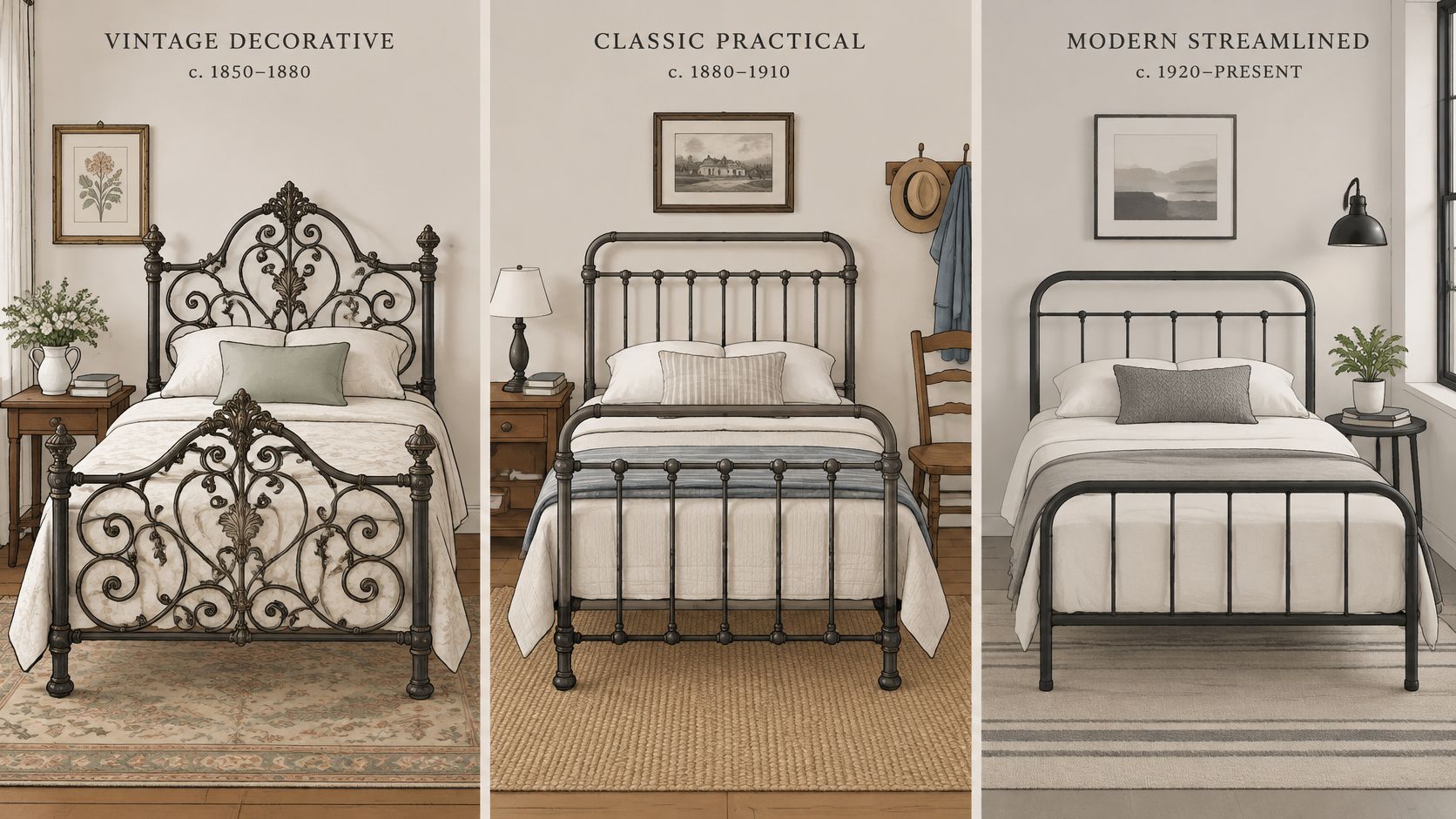
Shoppers curious about period details can compare those shapes with antique bed frame styles, then judge modern versions by how each style behaves in a real room.
Traditional spool and scroll frames
Spool turned posts, curved top rails, and scrolled panels bring warmth to a guest room, farmhouse bedroom, or cottage style space. Openwork keeps a small room from feeling blocked in, and light passes through the headboard. The checks are practical. Decorative curls should feel firmly attached, tight curves shouldn't have rough welds, and closely spaced details will collect dust. A soft brush makes cleaning easier than trying to force a cloth through every loop.
Simple tubular frames
Straight rails and plain spindles suit apartments, studios, kids' rooms, and spare rooms that also hold a desk. Nothing projects far beyond the mattress, so walking space stays usable. With fewer decorative elements, tubing thickness and rail connections carry the whole impression of quality. A frame that twists when the footboard gets a gentle push will likely creak once bedding and a sleeper add movement. Simple styling also makes mismatched bedding easier to pull together.
Panel headboard and footboard frames
A solid or mostly solid metal panel feels more substantial and can anchor a room where a spindly frame might disappear. Panels can keep pillows from slipping through spindles, which some readers appreciate. The hidden question is support. A handsome panel doesn't prove that slats are strong, retained, or carried by a center support, so the underside still needs inspection. Panels also add weight and can make a narrow room feel heavier if the finish is very dark.
One styling decision links any of these looks to the room. Match the metal tone to one other visible element, such as black iron with a black lamp base or aged brass with drawer hardware. Repeating the tone once is enough, and it keeps the bed from looking like an isolated purchase. Which room is being furnished, a guest room that needs charm, a child's room that needs easy cleaning, or a compact apartment bedroom that needs visual lightness? The answer usually points to the right family of frames faster than a finish chart.
Bed Height and Easy Access for Older Adults
A twin saves floor space, but smaller doesn't automatically mean easier to use. Safe access depends on the total assembled height, meaning frame height plus any foundation plus mattress thickness. Decorative platform styling can place the sleeping surface very low, while a tall mattress on a standard foundation can turn an ordinary iron frame into a climb.
The National Council on Aging bedroom safety guide recommends that the mattress top generally sit about 20 to 23 inches above the floor, with the user able to sit on the edge with both feet flat and knees near a 90 degree angle. That range is a starting point, not a substitute for the actual sit test, because leg length, mattress compression, and footwear change the result.
A five step height worksheet
- Measure finished height: Tape from the floor to the top of the uncompressed mattress, with the intended foundation in place.
- Run the sit test: Sit on the edge in usual indoor footwear and check for flat feet, stable knees, and an easy stand without pulling on the frame.
- Map the bedside zone: Leave room for a stable table, reachable lighting, glasses, and any grab handle that must clamp or attach securely.
- Protect walking space: Keep the open side clear of storage bins, loose rugs, and cords.
- Inspect edges: Run a hand along rails, posts, and decorative edges that might catch clothing, bedding, or skin during a transfer.
Those results can be compared while reviewing adjustable bed height options and mattress thicknesses. Changing only the foundation height often corrects a near miss without replacing the frame. Removing an unneeded foundation lowers the bed, while a low profile foundation can raise a decorative frame, provided the mattress maker approves the support arrangement.
Sit, stand, and turn toward the bedside table on the actual mattress. A showroom number cannot reproduce how foam compresses under hips and hands.
Caregiver access deserves equal attention. A bed pushed tightly into a corner saves space, but it makes sheet changes and nighttime help harder from the wall side. Where room allows, access from both sides helps with bedding, repositioning, and cleaning. Casters can make a frame easier to move for cleaning, yet locking casters only help when they're locked every time and the floor doesn't let the bed drift. Fixed glides are often the steadier choice for daily transfers.
The person who will sleep in the bed should try the height in person whenever possible. A frame bought for looks can still work well, as long as mattress and foundation choices bring the finished surface into a comfortable range.
Bunk and Loft Iron Twin Beds Need Extra Checks
A conventional low profile iron twin bed may not fall under bunk bed rules. A bunk or loft version is different because height changes the risks. The rules are triggered by construction and foundation height, not by whether the frame is metal.
The U.S. Consumer Product Safety Commission bunk bed business guidance states that U.S. regulations and ASTM F1427 apply when the underside of the upper foundation is more than 30 inches (762 mm) above the floor, at which point the frame must incorporate two upper guardrails, with at least one on each side, and the wall side rail must be continuous between the end structures. The same guidance states that the top of each guardrail must extend at least 5 inches above the thickest mattress recommended by the manufacturer.
Rules worth checking on the label and frame
| Requirement | Rule | Why it matters |
|---|---|---|
| Guardrails needed | Underside of upper foundation more than 30 in (762 mm) above the floor | Prevents rolling out of the upper bunk |
| Upper guardrails | Two, one on each side | Covers both sides of the sleeper |
| Guardrail height | Top at least 5 in above the thickest recommended mattress | Reduces roll over risk |
| Wall side rail | Continuous from one end to the other | Leaves no gap for a child to slip through |
| Wall side end gap | No more than 0.22 in (about 0.558 cm) if the rail does not attach directly to an end structure | Limits entrapment |
| Away side rail ends | No more than 15 in from the nearest bed end | Limits gaps on the open side |
| Headboard and footboard openings | Upper bunk openings must not let the test wedge pass freely | Helps prevent heads or limbs getting stuck |
| Labels | Manufacturer, model number, and date of manufacture | Lets shoppers check the model and its instructions |
| Age warning | Children under 6 should not use the upper bunk | Sets safe use from the start |
Gap size matters in places adults may not notice. Openings below guardrails, between rails and end structures, between mattress and foundation, and between bed and wall can create entrapment hazards. Decorative iron headboards deserve special attention because scroll openings that look harmless on a low bed become part of the safety geometry on an upper bunk. Upper bunk openings must not allow the specified wedge block to pass freely, and a mattress that's too thick can reduce effective guardrail height even when the frame itself was built correctly.
Shoppers comparing raised layouts for tight rooms can look at loft beds for apartments while keeping those federal checks separate from style preferences. A loft that frees desk space still needs the correct rail geometry and mattress thickness.
Three checks before assembly
- Bunk or loft labeling: Confirm the frame is explicitly labeled for that use, with permanent manufacturer and model identification.
- Mattress match: Confirm length, width, and maximum thickness against the instructions, not against a mattress already on hand.
- Fasteners and fit: Tighten every structural fastener as instructed, then recheck rails, ladder connections, and end structures for movement.
Those rules also offer a useful benchmark for ordinary iron twin frames. Secure joints, controlled openings, and a mattress matched to the support are good engineering habits at any height.
Getting Your Iron Twin Bed Home and Set Up
Iron and steel frames can be awkward as well as heavy. Long side rails catch on stair turns, one piece ends swing into door trim, and a bundle of slats becomes hard to grip. Bolted frames that separate into rails, ends, and slats are usually easiest to move. Before purchase, it's worth asking which pieces come off, whether hardware is standard, and whether instructions show the order of assembly.
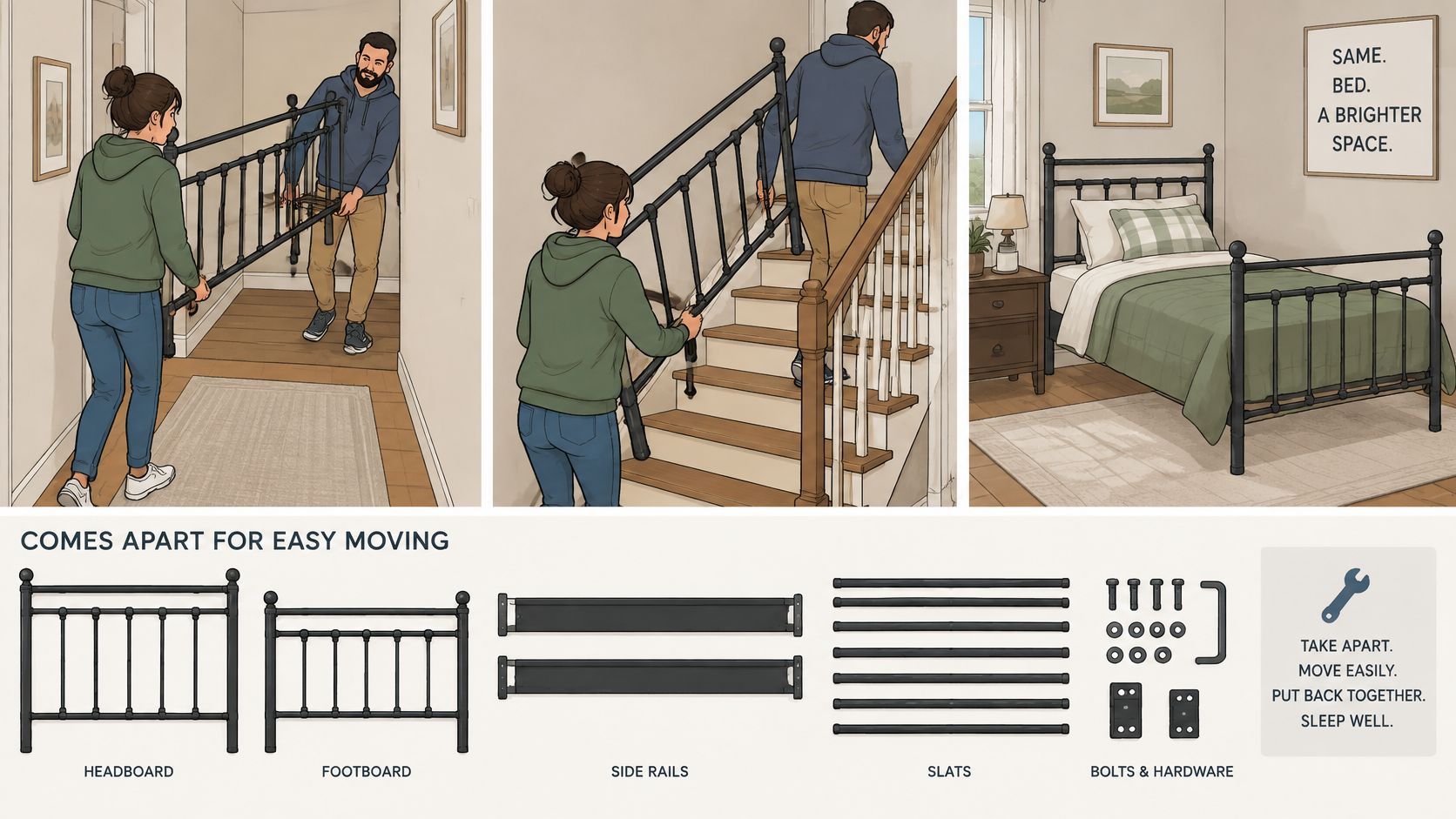
Move and assembly sequence
- Measure the path: Check doorways, hallway turns, stairwells, landings, and the final wall space before carrying anything upstairs.
- Strip the bed: Remove bedding, mattress, foundation if present, and slats so the frame pieces carry no extra load.
- Bag the hardware: Put bolts, washers, and caps for each joint in a labeled bag and tape the bag to the matching rail.
- Carry with control: Carry long rails flat and ends upright, with two people on heavy pieces and a moving blanket protecting walls and floors.
- Assemble loosely first: Hand tighten all connections, set the frame square on a level surface, then tighten in a balanced order.
- Recheck after settling: Tighten structural bolts again after the first week because joints can seat themselves with use.
Gloves help with grip and protect hands from burrs or cold metal edges. Cardboard on a stair landing gives rails a resting spot without scraping paint. Photographs taken at each disassembly step make reassembly much easier, especially where left and right rails look alike but have holes in different positions.
Photograph each joint before loosening it. A phone picture is faster than sorting identical looking bolts on the bedroom floor.
Once assembled, the frame should sit without rocking. A short wobble often means one glide isn't seated, the floor is uneven, or opposite corners were tightened in the wrong order. Loosening slightly, squaring the frame, and retightening usually works better than forcing one bolt harder. Persistent creaks point to a loose joint, a slat shifting in its holder, or metal parts rubbing where a washer or cap went missing.
A quick hardware check every few months keeps movement from enlarging bolt holes. Spare bolts and glides should stay in a labeled envelope with the instructions. That small habit turns a future move, room swap, or mattress change into a routine job rather than a hardware hunt.
Styling Your Iron Twin Bed in Any Room
An iron twin can look intentional with very few pieces. The frame already supplies line and pattern through spindles, scrolls, or panels, so bedding works best when it adds softness without competing for attention. A crisp neutral base, such as white or oatmeal sheets, gives the metal a clean background and makes laundry sorting simple in a guest room.
Layer from the mattress outward. A fitted sheet and flat layer create the base, a washable duvet or coverlet adds the main body, and one textured throw near the foot adds contrast. Two coordinating pillows are enough for most twins. Extra pillows look generous in photos, but they need somewhere to go at night and can overwhelm a narrow sleeping surface. Folding the top layer back slightly shows the sheet, softens the edge of the metal headboard, and makes the bed feel ready rather than sealed shut.
Layers around the bed
A wood nightstand adds warmth against cool metal and gives the eye a solid block beside open spindles. A wall sconce or swing arm lamp frees the small tabletop for a book, water glass, and phone. Lighting should be reachable from a lying position, with the switch easy to find without sitting up fully. A rug under the foot and open side anchors the bed, quiets footsteps, and gives bare feet a softer landing than a cold floor.
In a tight room, place the long side against a wall and leave about 24 inches of walking space on the open side where layout allows. That gap is enough for making the bed and carrying a laundry basket without turning sideways. Keep pattern discipline simple by choosing one patterned textile, perhaps a quilt or pillow sham, and keeping sheets, throw, and rug mostly solid. Iron scrollwork already counts as visual texture.
For a pair of twin beds, one shared nightstand between them keeps the arrangement calm and leaves the outside edges open. Matching frames create order, while bedding can differ slightly by sleeper through a throw color or pillow pattern. In a child's room, that small difference helps each bed feel personal without buying two unrelated sets.
A phone photo of the room, the wall length, window position, and outlet locations makes showroom decisions easier. Those details determine whether a sconce can be plugged in, whether a rug will clear a door swing, and whether a tall headboard will block trim. Which kind of room is taking shape, a quiet guest corner, a shared kids' room, or a compact studio sleep zone? The styling layers should answer that use first and decorate second.
Test Iron Twin Beds in Person in Greenfield
Measurements on paper can narrow the field, but comfort and sturdiness need hands and weight. Sitting on the edge, lying down, changing position, and giving the footboard a gentle shake show whether a frame and mattress work together. That in person test is especially useful for twin beds because a small difference in mattress thickness can change both finished height and how secure the sleeping surface feels.
BILTRITE Furniture-Leather-Mattresses is a fourth generation, family owned business serving Metro Milwaukee since 1928. The showroom is known for affordable, better quality furniture, with a strong focus on USA made and Amish made pieces and real solid wood furniture in many categories. BILTRITE Furniture-Leather-Mattresses isn't the cheapest option, and that positioning is stated plainly. The value case rests on better quality for the price, durable construction, and help matching pieces to the room rather than pressure to leave with the first frame that fits.
What to bring and what to test
- Room numbers: Wall length, doorway path, and the intended walking space on the open side.
- Frame measurements: Inside length and width if an existing iron frame will stay in use.
- Height target: Current floor to mattress top measurement and notes from the sit test.
- Use case: Child, teen, guest, older adult, bunk, loft, or everyday apartment bed.
The mattress department at BILTRITE Furniture-Leather-Mattresses has over 60 models, and mattresses are available in Twin, Twin XL, Full, Full XL, Queen, King, California King, King 2PC, and California King 2PC sizes. That range helps shoppers pair a measured frame with the right length instead of forcing a Twin XL need into a standard twin footprint. Small scale furniture for apartments and senior living, plus heavy duty options for families who need extra sturdiness, can also be compared in the same visit.
Sales associates at BILTRITE Furniture-Leather-Mattresses have over 400 years of combined experience, and the stated approach is help without pressure. Shoppers can measure frames, sit on mattresses, ask about slat support and foundation requirements, and take notes home. Because BILTRITE Furniture-Leather-Mattresses doesn't sell online, the showroom visit is the main way to judge finish quality, joint tightness, and mattress feel.
The Greenfield showroom is located at 5430 West Layton Avenue in Greenfield, WI, and BILTRITE Furniture-Leather-Mattresses can be reached by phone at 414-238-2020. Hours should be checked before a trip because the store is closed on Sundays for family time, a long standing part of its local, family first identity. Metro Milwaukee shoppers who prefer buying local can see scale in person, compare USA made and Amish made solid wood companion pieces such as nightstands, and confirm that a narrow bed still feels substantial.
Come on down to the showroom and see for yourself. Bring the tape numbers, try the sit test, and let the frame, mattress, and room plan line up before anything goes home.
Bring frame measurements, a room photo, and a height target to BILTRITE Furniture-Leather-Mattresses, where shoppers can test twin and Twin XL mattress pairings, inspect frame support up close, and ask experienced associates about foundations and finished height. A visit to the Greenfield showroom turns twin bed shopping from guessing at labels into measuring, sitting, and choosing with confidence.