2 DAY MEGA STOREWIDE SALE! TUESDAY & WEDNESDAY!
98TH ANNIVERSARY SALE-A-BRATION ENDS SATURDAY, NOVEMBER 7TH AT 5PM!
NO CREDIT CARD FEES!
1000's of Items IN-STOCK + 500 Mattresses!
Largest selection of USA Made Furniture & Mattresses + Amish Made!
FREE In-Store Design Services!
BUY LOCAL & LOVE YOUR HOME!
Tuesday-Thursday 10am to 6pm | Friday 10am to 7pm | Saturday 10am to 5pm | Sunday Closed To Be With Family & Friends | Monday Showroom Closed
5430 West Layton Ave, Greenfield - Metro Milwaukee
What good is beautiful leather if the person sitting on it can't reach the controls, stand up comfortably, or get the sectional through the front door? A power reclining leather sectional deserves a closer look than its color and seat count.
For Metro Milwaukee households comparing power reclining sectional leather options, the useful questions are practical: Does each powered seat fit its user? Can occupants adjust independently? Can worn parts be replaced? And will the furniture fit both the delivery route and the room when it's open?
A documented cycle test, including whether the complete seat was tested
A heavy-duty claim does not prove the motor, frame, and switch
Leather construction
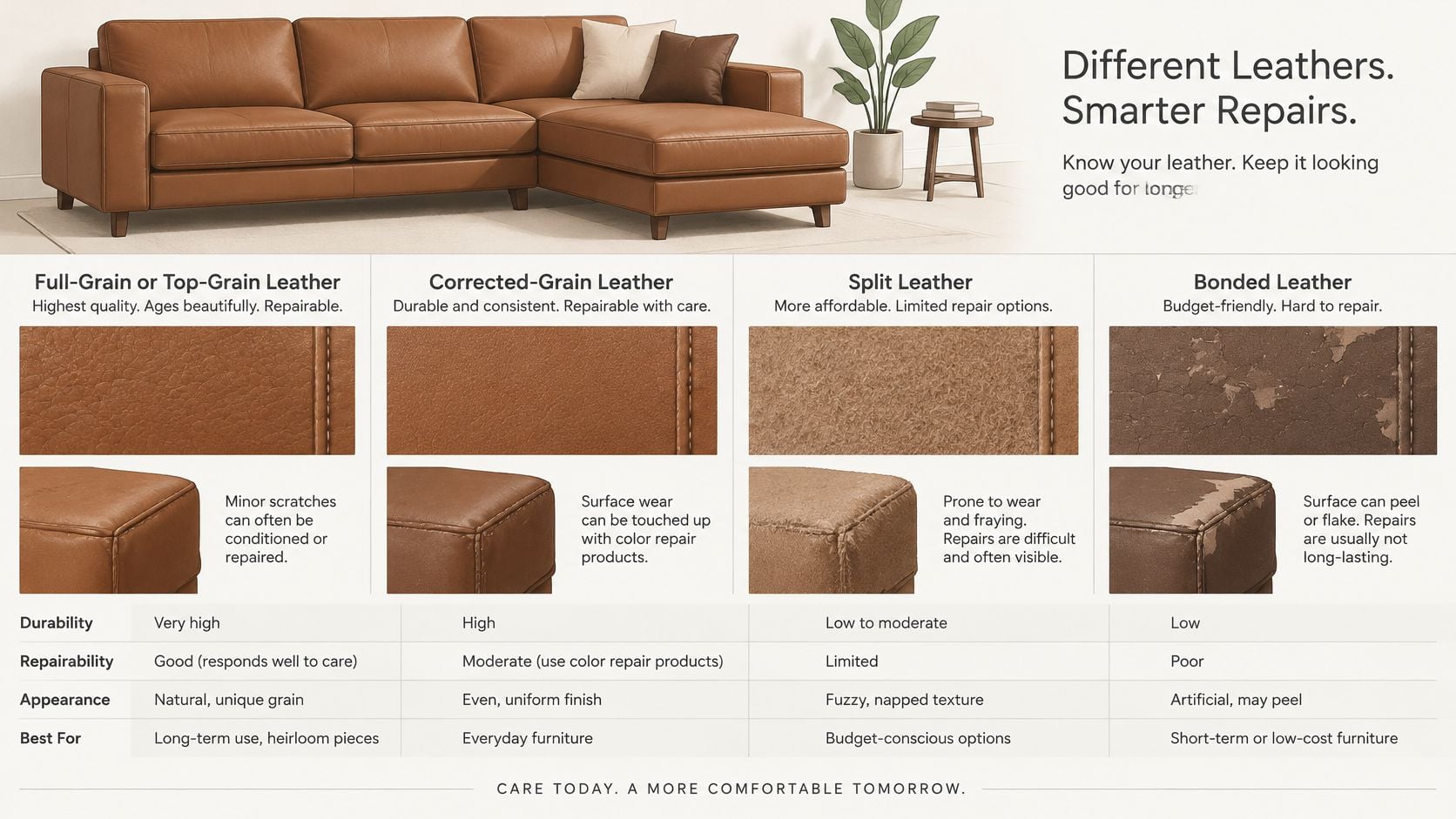
Full-grain, top-grain, corrected-grain, split, or bonded
Ask for care and durability information for the specific leather
The cheapest leather can cost more over time
Hide strength and finish
Category, coating, and tear result
Ask for the applicable category and test results
Soft feel alone misses seam and seat-edge failure
Use the mechanism, leather, and hide-strength rows to ask for specifications, not just a salesperson's assurance. These are screening questions, not promises that a particular sectional will last for a set number of years.
A motor moves the seat, but fit creates comfort
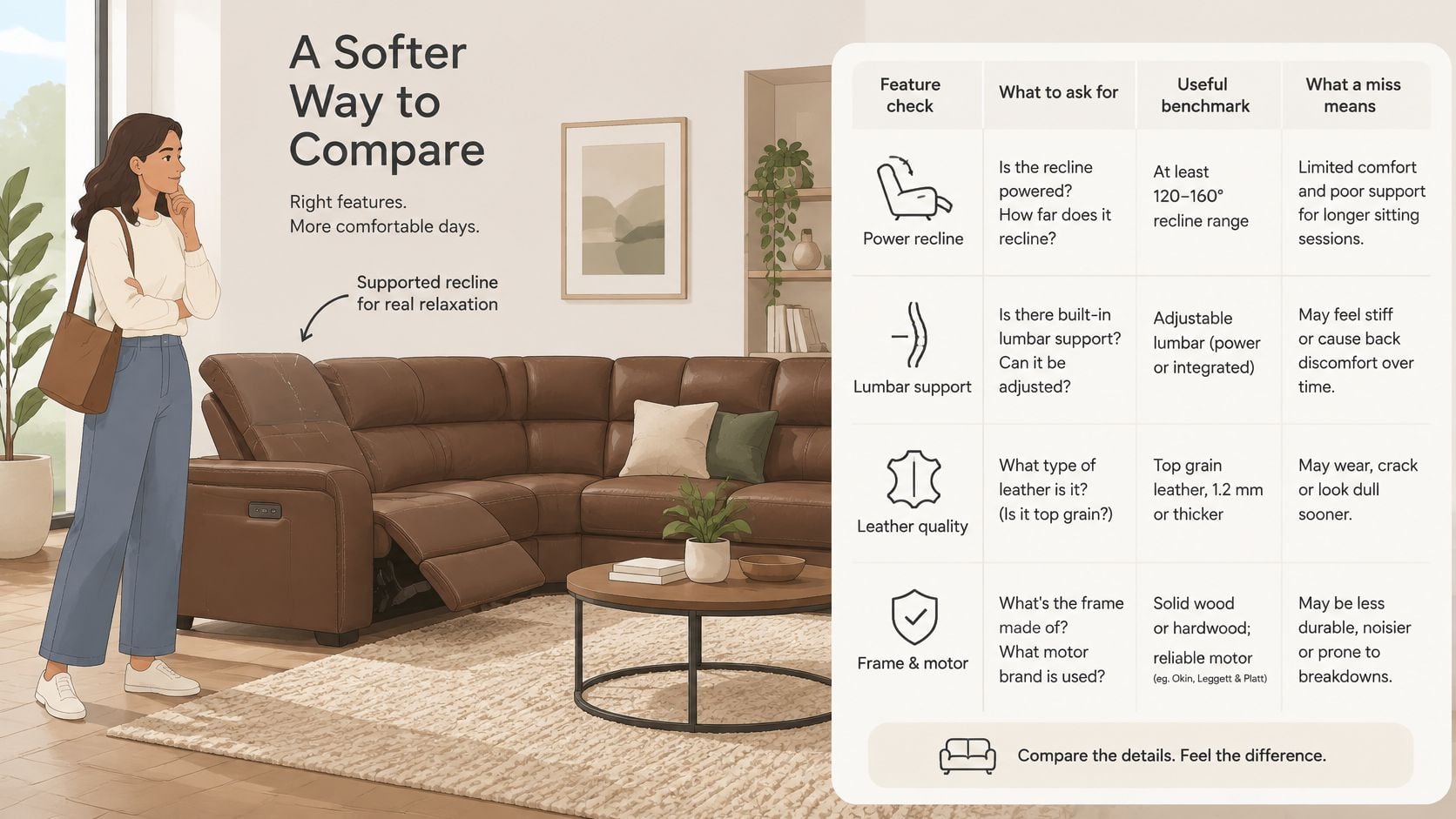
Supported recline means more than leaning backward. Your lower back should feel supported, your head shouldn't reach forward, and your pelvis shouldn't slide toward the cushion's front edge as the footrest rises.
The Cornell material offers a useful showroom reference, not a medical prescription or a promise of comfort. Seat depth, cushion firmness, body height, and footrest shape can make seats with similar recline angles feel quite different.
Check each powered seat separately. Separate controls don't necessarily mean the back, headrest, lumbar support, and footrest all adjust independently. Try the actual controls to see which movements the selected configuration allows.
Turn the comparison into a sit test
A useful showroom visit includes ordinary movements, not just a quick lean against a soft back cushion. Take the table along, and check the seat as the person who will use it would.
Sit fully back. Check whether the lower spine meets the back support without a loose cushion filling a large gap.
Operate every control. Buttons should be reachable without leaning forward, twisting, or searching between cushions.
Watch the hips. Leg elevation shouldn't push the pelvis forward or leave the lower back unsupported.
Return the seat to closed. The user should be able to place both feet securely and rise without fighting the cushion.
Check the arms. Arm support should feel useful during standing, rather than too low, too far away, or overly soft.
For example, a taller adult may prefer a deep seat while a shorter family member needs more support closer to the front. This is a fit problem, and a stronger motor won't solve it. Check whether each person can sit back, reach the controls, and rise comfortably in the seat they'll use.
Shopping rule: Mark any failed row for the person who will use that seat. A beautiful finish shouldn't erase a daily-use problem.
If a specification is missing, ask for clarification. If a control is hard to reach, getting up feels awkward, or the footrest shifts the user's hips, try another seat or configuration.
How Power Mechanisms Hold Up
A power recliner may run smoothly in a showroom, but that brief demonstration reveals little about how it will hold up over time. Documented endurance testing and replaceable parts give you more useful questions to ask about ownership.
The U.S. General Services Administration upholstered-furniture test method defines a recliner cycle as moving from closed to TV position, then to full recline and back to closed. Its durability requirement is 25,000 cycles or failure, whichever occurs first. The test measures protocol performance, not years of family-room use.
Test conditions matter, too. Load, pauses, and the components included can all affect what a result means. Ask whether the test covered the complete upholstered seat or only its mechanism, and whether it applies to the powered seats and configuration you are considering.
Ask what the rating covers
A mechanism tested on its own may perform differently from a finished seat supporting its intended user. Ask for specifics:
Complete-seat testing. Was the finished seat tested under its intended load, or only the metal mechanism?
Configuration coverage. Were the powered seats at both ends evaluated, and does the information apply to your selected arrangement?
Component coverage. Does the rating include the motor, actuator, frame, wiring, transformer, and switch, or only one part?
Service access. Can a technician reach a failed component without dismantling unrelated upholstery?
Failure isolation. If one seat stops working, can the other powered seats still operate?
Every powered position adds electrical connections and moving parts. That can make individual adjustment convenient, while also making service access more important. Check how the seats operate independently and whether a single failure could affect other positions.
Read the written warranty terms closely. Coverage for material defects, motors, controls, labor, and service visits may differ, so ask which terms apply to each.
Buttons should be visible, easy to understand, and reachable from a supported sitting position. The specification should also state the user-weight limit, required rear clearance, power-source location, and any obstruction protection or reset procedure. Keep children and pets clear while the mechanism moves.
Power interruptions deserve a practical question: How does this exact seat return to a usable position without household electricity? A compatible battery arrangement, backup feature, and rechargeable power pack may serve different purposes. Confirm what works with the selected furniture, where charging can be done, and which operating instructions apply.
The guide to battery power packs for power recliners can help you prepare questions about battery options. Confirm compatibility and charging access for the specific model before relying on one.
Choose a mechanism you can operate, understand, and get serviced, not just one that moves smoothly in a demonstration.
Leather Grades and What You Can Repair
Leather type and finish affect how a power reclining sectional looks, wears, and can be repaired. The practical choice is whether each powered seat remains comfortable, operates independently, can be serviced, and suits the home. For the leather itself, compare the surface and construction, then ask whether a damaged panel can be replaced.
Leather types on a reclining sectional
Leather type
Daily-use outlook
Surface and care
Repair outlook
Full-grain or top-grain
Wear depends on construction and care
Grain appearance and finish differ; use gentle, approved cleaning
Panels may be replaceable if matching hides are available
Corrected-grain, pigmented
Evaluate the coating and expected family wear
More even color; finish can wear at edges
Ask whether finish failure is covered and panels can be matched
Split, including suede or coated split
Assess the specific finish and construction
Napped and coated surfaces respond differently to rubbing and flexing
Inspect edge and seam performance, not showroom sheen
Bonded
May peel, crack, or delaminate with daily use
Uniform surface made from scraps plus polyurethane
Often a poor candidate for a lasting surface repair
HOMEiA's furniture-material comparison estimates that professional high-end leather-sofa repair may cost $800 to $2,500, with successful work sometimes preserving functionality for another 5 to 8 years. Treat these as general comparison estimates, not a warranty or a local repair quote.
Separate leather construction from finish
Full-grain, corrected-grain, split, and bonded describe differences in the material. Aniline, semi-aniline, nubuck, suede, pigmented, and coated describe surface characteristics that affect appearance and care. The labels can overlap, so ask which leather and finish cover the seats, arms, and other high-contact panels.
The explanation of top-grain and full-grain leather clarifies what those labels mean. Neither label alone confirms cushion quality, whether panels can be replaced, or how well the reclining mechanism can be serviced.
European furniture guidance based on EN 13336 specifies a pH of at least 3.5 and an average tear load greater than 20 newtons for listed leather categories. Tear performance matters where force concentrates, such as seams, the seat nose, arm caps, and upholstery beside moving edges.
Judge repairability alongside surface wear
Repairable leather is only one part of a serviceable sectional. Before buying, ask about replacement switches, motors, transformers, cushions, and panels. Find out whether sections separate for service and whether matching upholstery may remain available.
Abrasion test results also need context. Wyzenbeek and Martindale use different methods, so their counts are not directly interchangeable or complete predictions of everyday wear. With permission, gently rub and flex a sample, then inspect its finish and edges. Use approved cleaners, since aggressive cleaning or excessive conditioning can change the protective surface.
A higher purchase price makes sense when construction, coverage, and repair options justify it. A costly sectional with inaccessible electronics can still be difficult to maintain.
Layouts, Doorways, and Reclined Depth
Will every powered seat recline comfortably, operate independently, remain serviceable, and fit through the route into your home? Check each point with measurements in hand. A sectional must pass two separate tests: getting into the house and fitting the room. Clearing the front door alone does not confirm that it can make a turn or leave enough usable floor space.
Clearances for a power reclining sectional
Measurement
Planning figure
What to verify
Walking corridor
At least 36 inches around seating edges
Daily traffic, including a walker if someone uses one
Standard doorway
About 32 to 34 inches with feet removed
Narrowest clear width, not the door's catalog size
Tight opening
Under 32 inches
Modular design, removable legs, or detachable backs
Turn
Tightest 90-degree turn and diagonal of the largest piece
Space before and after the opening
Upright piece
Manufacturer width, depth, and height
Whether the back or legs come off for delivery
Fully reclined
Manufacturer's open depth with footrest and back extended
That the extended footrest or a separate ottoman won't block the walkway
The sectional-sofa measuring guide helps organize the route and room measurements. Use the figures in the table as planning references, and compare them with the manufacturer's delivery dimensions. Actual fit depends on the sectional's largest component, the openings, and the turns along the way.
Measure the route with doors open
Start outside and follow the full carrying route. A tape measure and a simple sketch can capture details a room photograph misses.
Openings. Measure clear space around hinges, trim, handles, and the open door itself.
Turns and landings. Record the room available to rotate the largest component before and after each opening.
Stairs. Include railings, ceiling clearance, and fixtures that intrude into the carrying path.
Removable components. Confirm which backs or legs detach, and get the resulting delivery dimensions.
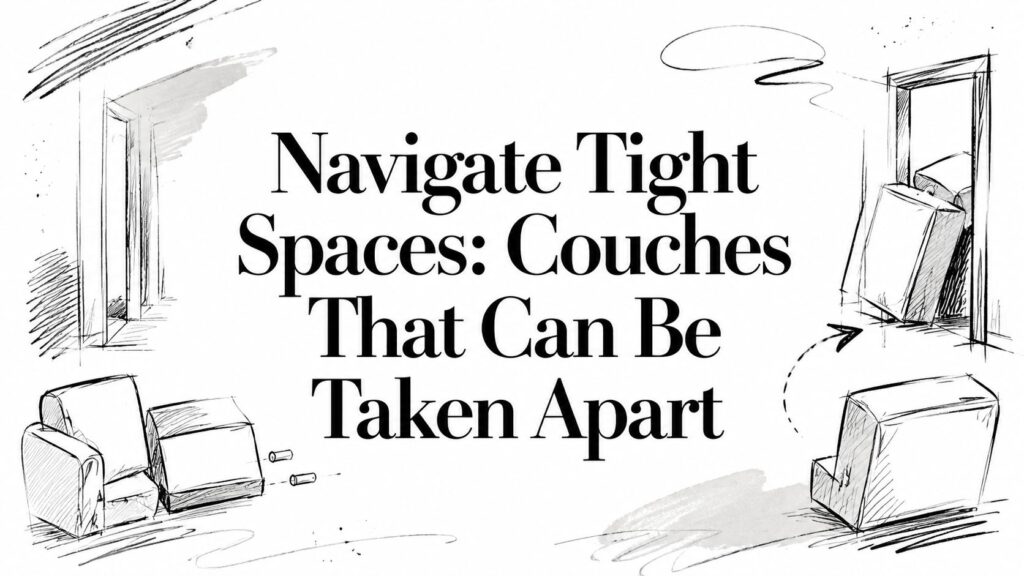
Don't assume a come-apart design means every piece will be easy to maneuver. Check the actual dimensions of each piece after removable parts are taken off, then compare them with the narrowest opening and tightest turn on the route.
Tape out the open furniture
In a Greenfield home with a roomy front door, a narrow hallway turn, and a family room shared with someone using a walker, the largest module might clear the entrance but fail at the turn. A smaller layout could get inside yet block the kitchen route when reclined.
Use painter's tape to mark both the upright footprint and the fully extended position. Check each powered seat separately: one may recline into a walkway while another has room to open. Make sure cords or battery placement won't occupy the everyday route, and ask how the power controls and moving parts can be serviced.
Straight and L-shaped arrangements should be measured against the actual room. Add a console or wedge to the plan only if that piece is offered in the furniture collection.
Keep the everyday walking route open with the seats reclined, not just with everything closed for company.
Matching a Sectional to Real Family Life
Which powered seats will each person use, and can everyone operate them comfortably in the room they share? Daily routines should decide the layout, not just the largest arrangement that fits on paper.
A busy family room
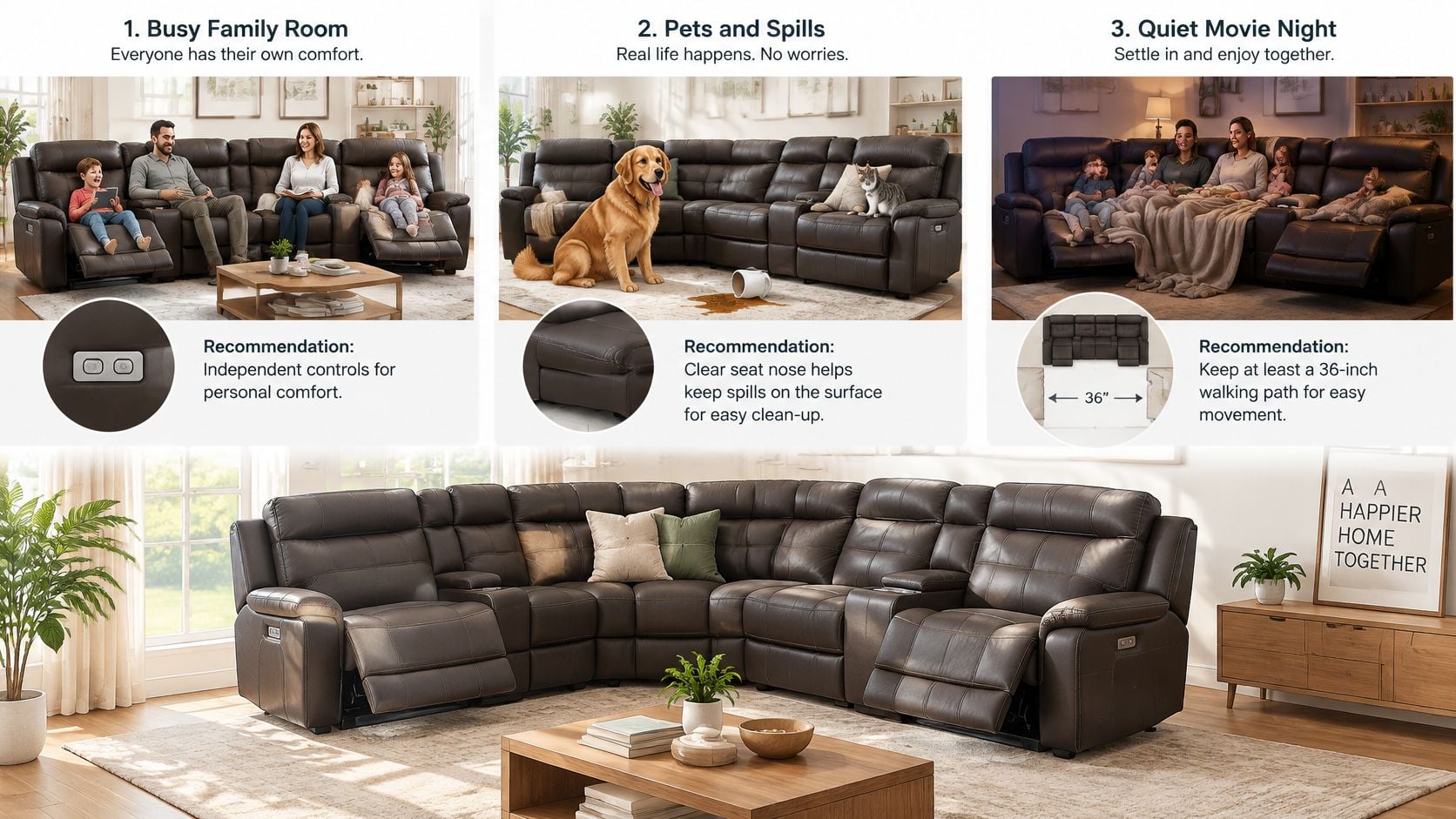
For movie nights, prioritize a well-made seat with independent controls over extras. Cupholders can be handy, but they matter less than upholstery construction, mechanism documentation, and whether replacement parts can be obtained.
Notice where people sit and how they use the sofa. The seat nose takes friction from clothing and pressure when someone pushes up to stand. A console may also divide a parent from a child or make a preferred seat harder to reach.
Recommended priority. Choose a layout that keeps the route to the kitchen usable while regular users recline.
Household habit. Before operating a seat, check around and beneath it. Keep children, pets, toys, and blankets clear of moving parts.
A surface that looks easy to wipe is not automatically scratch-proof. Compare material samples and care instructions rather than assuming leather suits every household with pets.
An apartment, condo, or smaller home
A smaller household may need fewer powered seats, and a sectional that separates can be easier to move. That flexibility can preserve useful circulation without filling the room with motion seating.
Choose the smallest arrangement that comfortably supports the household's routines. An oversized run of seats wastes space if people must squeeze past it whenever the footrests are open. Mark where household members read, watch television, talk, or use a mobility aid, then place powered seats where they will be used most.
An older adult or caregiver household
For someone who has trouble standing, assess the transfer itself. Have the regular user try the controls, feel how the seat supports their legs, check whether the arms are easy to reach, and see how much effort it takes to rise from the closed seat.
A caregiver can help assess whether those steps feel manageable for the person who will use the seat. For example, if someone needs the armrests to push up from sitting, check that they can reach and hold them securely before choosing the configuration.
Make the decision person-first: choose the setup that the least mobile regular user can operate comfortably every day. A control that is difficult to see or reach can make a powered seat inconvenient, even if other household members find it easy to use.
Sit With Us in the Greenfield Showroom
How can you tell whether a power reclining sectional will work for its regular user? Try each powered seat in person: operate its controls, settle into a supported recline, close the footrest, and stand up again. Check that each seat reclines comfortably and independently, ask how service is handled, and confirm the configuration can get through the home's entry route.
BILTRITE has served customers since 1928 as a fourth-generation, family-owned business in the Metro Milwaukee area. At the Greenfield showroom, hands-on testing can reveal details a photograph cannot, such as whether the buttons are easy to reach and the seat feels supportive when reclined.
Bring the regular user and a short checklist
A room sketch and notes on the intended adjustments help keep comparisons focused. Bring the person who will use the seat most often, especially if comfort, reach, or mobility affects the choice. For doorway widths, stairs, landings, and turns, use the route guidance in the section on layouts and reclined depth.
Check the room fit. Compare traffic paths, nearby furniture, outlets, and the space needed with the footrest open.
Test each powered seat. Make sure each user can operate their seat independently and comfortably.
Ask about ownership. Clarify material identification, component warranties, service access, and operation during a power interruption.
BILTRITE offers come-apart sofas and sectionals, small-scale and heavy-duty options, and custom choices in leather, fabric, wood, finish, and hardware. The showroom also carries USA-made, Amish-made, and solid-wood furniture.
A local visit without the rush
A showroom visit lets you compare the feel and operation of different seats at your own pace. Take notes on which controls are easiest to use and whether each regular user can recline and return upright comfortably. Those details make it easier to weigh comfort, independent controls, service questions, and delivery access together.
Plan a visit to the Greenfield showroom Tuesday through Thursday 10am to 6pm, Friday 10am to 7pm, or Saturday 10am to 5pm. The store is closed Sundays and Mondays. For questions before the drive, call 414-238-2020.