2 DAY MEGA STOREWIDE SALE! TUESDAY & WEDNESDAY!
98TH ANNIVERSARY SALE-A-BRATION ENDS SATURDAY, NOVEMBER 7TH AT 5PM!
NO CREDIT CARD FEES!
1000's of Items IN-STOCK + 500 Mattresses!
Largest selection of USA Made Furniture & Mattresses + Amish Made!
FREE In-Store Design Services!
BUY LOCAL & LOVE YOUR HOME!
Tuesday-Thursday 10am to 6pm | Friday 10am to 7pm | Saturday 10am to 5pm | Sunday Closed To Be With Family & Friends | Monday Showroom Closed
5430 West Layton Ave, Greenfield - Metro Milwaukee
A couch under $400 can provide a useful seat, but its price alone cannot promise how long it will last. The better question is what it costs for each year your household can use it.
A sofa near $399 is under 40 percent of the 2023 average stationary fabric sofa price of $1,027, according to Home Furnishings Business. That puts it in the entry tier, not the typical range. Like a low-cost tool, it may be a good buy if it keeps doing its job. Include delivery, repairs, replacement, and disposal when judging the overall cost.
A couch under $400 sits in the entry tier, but household furniture spending figures need careful reading. They describe different groups and time periods, so neither can be used as a direct estimate of what a family should spend on one sofa.
Benchmark
Amount
What it tells you
All U.S. households, furniture, 2024
$648.24 for the year
Includes homes that bought nothing
Households that bought furniture
$1,103.20 in a quarter
Covers buyers whose purchases may involve several pieces
Annual spending across all U.S. consumer units includes households that made no furniture purchases. The quarterly figure, by contrast, covers households that did buy furniture. Read them as broad household spending measures, not as competing couch prices.
Families also buy furniture irregularly. One purchase may cover several pieces, while another household may go a long stretch without buying anything. Those patterns make average spending a poor shortcut for setting a sofa budget.
What an entry sofa can reasonably do
A basic sofa can furnish a first apartment, serve in a lightly used spare room, or bridge the gap while a family saves. Those are practical jobs, and choosing within a firm budget is a sensible way to manage household spending.
A low tag shows what a household can pay today. Construction, comfort, warranty coverage, and delivery costs help show what the purchase includes and how it may fit the household's needs. A good comparison starts with the intended use, then checks what comes with the sofa and what costs extra.
Our family business, BILTRITE Furniture-Leather-Mattresses, has served Metro Milwaukee since 1928. We keep the advice plain: match the sofa to the room, the budget, and how often it will be used. A couch for a spare room has a different job from the one the whole family uses every day.
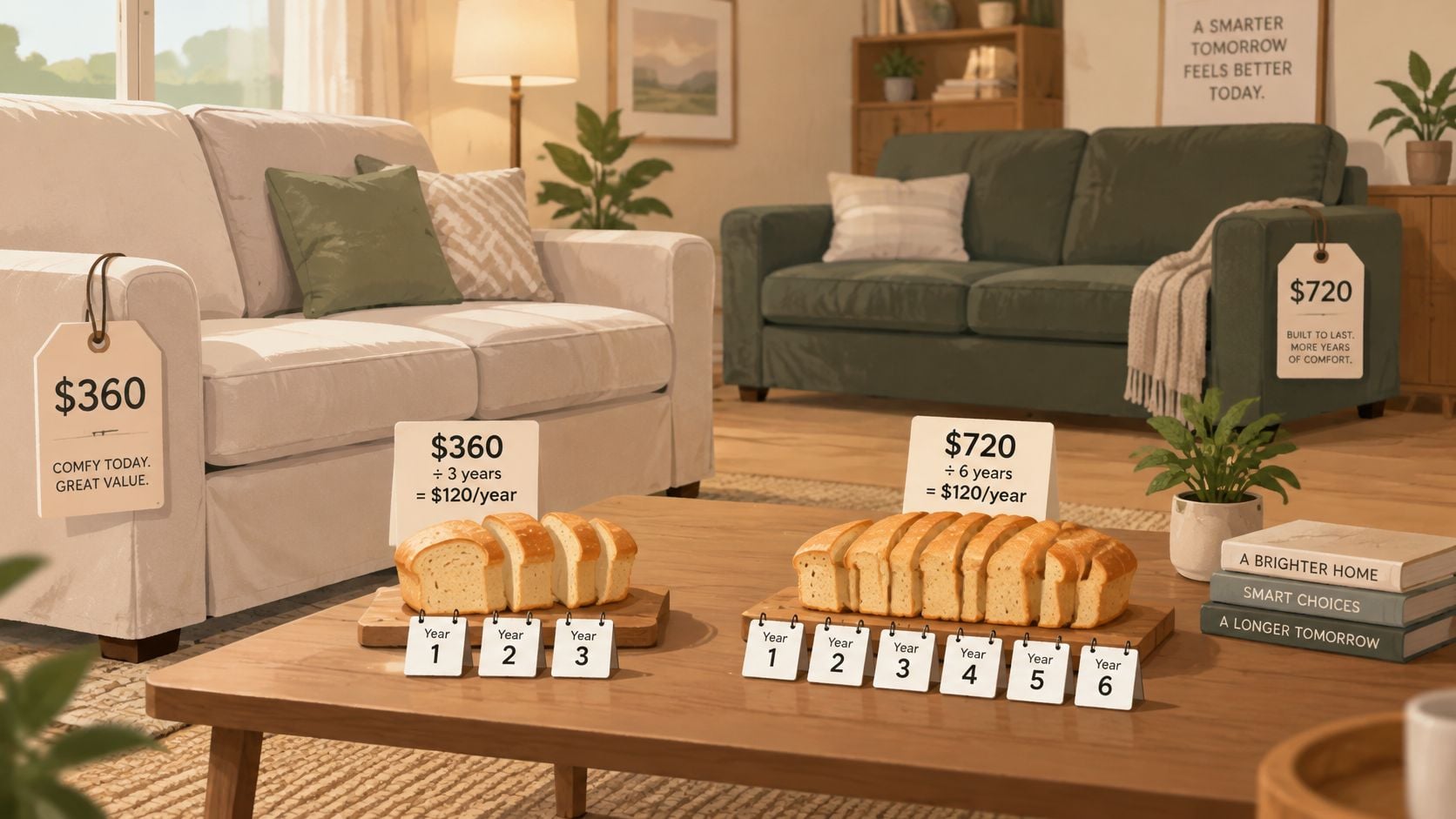
Cost Per Year Beats the Sticker Price
Cost Per Year at Two Price Points
The following is a hypothetical worked example, not a prediction of how long either price category will last.
Couch
Years before replacement
Cost per year
$360 couch replaced every two years
2
About $180
$720 couch comfortable for eight years
8
About $90
The calculation is simple: purchase price divided by usable years. In this example, the more expensive couch costs less per year because the household keeps using it longer.
That doesn't mean doubling the budget automatically doubles durability. It means that expected life deserves a place beside price, with delivery, assembly, repairs, and eventual removal added before making the comparison.
Why the low-price tradition needs context
WUNC's reporting on sofa construction and pricing places a new sofa at approximately $300 in 1964 and describes the industry's long-running promotion of sofas near $399. Maintaining that affordability has involved changes in sourcing, production scale, and materials, not just selling the same construction for less.
Replacement also has a cost beyond the household budget. King County's sustainable furniture purchasing guide notes that U.S. furniture and furnishings waste reached 12.1 million tons in 2018, with 80.1 percent landfilled and 0.3 percent recycled.
Budget rule: Count the years of useful sitting, not just the dollars needed to get the couch home.
The right answer changes with the household
A renter expecting another move soon may reasonably choose a basic couch. Portability, immediate comfort, and avoiding unnecessary spending may matter more than long-term upholstery options.
A family sharing the same cushions with children and a pet every evening has a different assignment. Repeated use makes structural strength, serviceable cushions, and repair access more important.
A first-home buyer planning to keep the living room settled should consider whether a second purchase could erase the initial savings. A hypothetical $350 couch bought twice isn't automatically cheaper than a sturdier alternative bought once.
BILTRITE's guide to how long furniture should last offers additional context for thinking about useful life. The goal isn't to stretch a budget past its limit. It's to avoid paying repeatedly for the same seating need.
Check the Frame Before the Fabric
A couch can feel soft and look inviting on the showroom floor. Its frame and support determine whether that comfort holds up, so inspect the hidden structure before judging the upholstery.
Start with what would be difficult to replace. Cushion covers may be accessible, but a failing structural rail can make the whole couch unusable. A lower sticker price only saves money if the couch gives you useful years of sitting.
Six checks worth making in person
Identify the frame and corners. Ask what the frame is made from, rather than accepting “sturdy wood” as a specification. Engineered hardwood or plywood with reinforced joints can be reasonable choices. Ask whether corner blocks are glued and screwed.
Request construction or performance paperwork. The General Services Administration's upholstered-seating test requirements identify ANSI/BIFMA X5.4 as a minimum lounge-seating safety and performance standard. The requirements call for documentation of frame materials, member dimensions, joinery, seat and back supports, spring spacing and gauge, and leg attachment. Treat compliance as a claim that needs documentation, not an assumption.
Name the suspension. Sinuous springs, coils, and webbing support a seat in different ways. Ask which system is used. A specific answer helps you compare construction; “supportive seating” does not.
Check leg attachment. Look for legs secured to the frame structure. A leg attached only to a thin base is a reason to ask more questions.
Sit, then gently check rigidity. With permission, apply light opposing pressure at the back and an arm. A little give is different from excessive twisting, wobbling, or creaking. Investigate those signs without forcing the couch.
Ask about cushion fill and access. Find out what the cushions contain, whether replacement inserts are available, and whether the covers unzip. A zipper gives access to the cushion, but does not by itself mean the cover is washable.
Use the answers to judge likely service life
The checks above describe construction. Fabric ratings help you judge a separate question: whether the upholstery suits the amount of use the couch will get.
Fabric Abrasion Ratings by Use
Use
Typical rating to look for
Decision threshold
Lower-traffic private space
About 15,000 Wyzenbeek double rubs or 20,000 Martindale cycles
A stated result near this range may suit lighter use
Higher-traffic space
About 30,000 double rubs or 40,000 Martindale cycles
Look for the higher range when the couch will see frequent use
Homestyler's small-space sofa guide summarizes these abrasion guidelines, distinguishing lower-traffic private spaces from higher-traffic public use. These are laboratory measures, not promises of a set number of years at home. Compare ratings only when the test method and pressure are stated, and confirm the result applies to the exact fabric being considered.
A clear construction answer is more useful than an attractive adjective. Our guide to things to look for in a new sofa or chair offers another way to organize questions before you decide whether the couch's likely years of use justify its price.
Measure the Path Into the Room
A couch can fit its wall and still fail at the stairwell turn. Before comparing prices, check both the room and the route the delivery must take. A tape measure, notepad, and simple floor sketch help catch problems before they become costly.
Measure in the order the couch will be used
Mark the intended wall and walking space. Use painter's tape to outline the couch on the floor. Check doors, drawers, and everyday paths, not just the empty wall.
Check overall depth and usable seat depth. Measure the sitting area from the front of the back cushion to the seat edge. Overall depth also includes parts that do not provide sitting room.
Record the delivery route from start to finish. Measure doorway openings, hallway turns, stair diagonals, ceiling clearance, elevator openings, and elevator interiors. Note railings, light fixtures, and other fixed obstacles.
Compare assembled and packaged dimensions. Ask which parts detach and which must pass through an opening intact. Removable cushions do not make a rigid frame smaller.
Use size labels as starting points
Sofa Sizes and the Path They Must Clear
Check
Target
Why it matters
Usable seat depth
Compare the actual seat with your comfort needs
Overall depth includes areas you cannot sit on
Compact overall width
Compare the couch with the wall and walking space
A shorter couch can still crowd a room
Small-couch cutoff
72 inches wide or less
A general small-couch definition
Small living room
Under 80 inches wide
May help avoid crowding
Larger room
Over 90 inches wide
Only if the wall and route allow
Door, stair, and elevator
Measure every turn and the package
Wall fit does not guarantee entry
Cosmopolitan's small-space sofa review uses 72 inches wide or less as a general small-couch definition. Consumer Reports' couch-buying guidance suggests considering sofas under 80 inches wide for small living rooms, while larger rooms may accommodate designs over 90 inches wide. Treat these as starting points, then compare the actual footprint and try the seat for comfort.
A short couch is not always small-scale. Thick arms or a deep body can take up valuable floor space even when the overall width seems modest.
In apartments, condos, older Milwaukee houses, and senior living residences, route measurements deserve the same care as room measurements. Use a guide to furniture for narrow doorways to check delivery questions before buying. Confirm which parts can be removed, what must pass through each opening, and whether the packaged piece can make the turns.
For active daily use, also consider whether the cushions are accessible and the upholstery suits the household. A failed delivery, return trip, or restocking charge can use up the savings on a couch under 400. Get delivery conditions in writing so you know the full cost before committing.
Clearance Floor Models and Sturdier Options
A markdown can lower the entry price, but it does not tell you how many years the couch will serve your household. Ask what caused the markdown and what condition is documented. Then weigh the likely years of use against the cost of replacement, repairs, and waste.
Compare the compromise, not just the discount
Alternative
What makes it worth considering
Plain-language verdict
Clearance piece
A discontinued color or fabric may reduce the price
Consider it if the construction and terms check out
Floor model
You can inspect the actual piece
Test its condition before buying
Refurbished sofa
A sound frame may be worth reupholstering
Get the full repair estimate first
Sturdier new seating
Repair access or delivery design may support longer use
Compare the frame, filling, warranty terms, and expected ownership cost
The label gives you a reason to inspect, not a verdict. Check the actual couch for visible wear, then ask whether delivery, returns, or warranty coverage differ from the terms for a regular-priced item. A floor model's condition is specific to that piece, so inspect the one you would take home.
For a refurbished sofa, start with the frame, then add up foam, fabric, labor, and transport. An itemized estimate shows whether the work fits your budget. A low purchase price can lose its advantage if repairs and replacement arrive sooner than expected.
Browse BILTRITE's clearance information to see what may be available, and confirm availability before making plans around a particular couch or price.
Read origin claims carefully
The Federal Trade Commission's Made in USA rule says an unqualified Made in USA claim requires a product to be all or virtually all made domestically, with final assembly or processing in the United States. Qualified wording can describe a narrower claim, such as domestic assembly using imported parts.
Assembled in USA describes a different claim from Made in USA. Ask what the wording covers, including the frame, filling, upholstery, hardware, and final assembly. Amish-made describes a craftsmanship category; construction details still deserve attention.
Budget and quality can both matter. The 2025 AlixPartners consumer sentiment survey found that 31 percent of consumers planned to spend less on furniture, while 67 percent of furniture shoppers said they were willing to pay more for quality.
For a couch under 400, compare what the price buys: the frame, filling, and warranty terms. A higher tag is useful only if those details support the household's needs. Judge the choice by its likely years of real use, not by the discount alone.
Covers Cushions and Small Repairs That Add Years
Once a structurally sound couch is home, care should target the part that's wearing out. Faded fabric, flattened foam, and a broken support aren't interchangeable problems.
A cover can hide tired upholstery. It can't restore a frame that shifts under ordinary sitting.
Protect what's still working
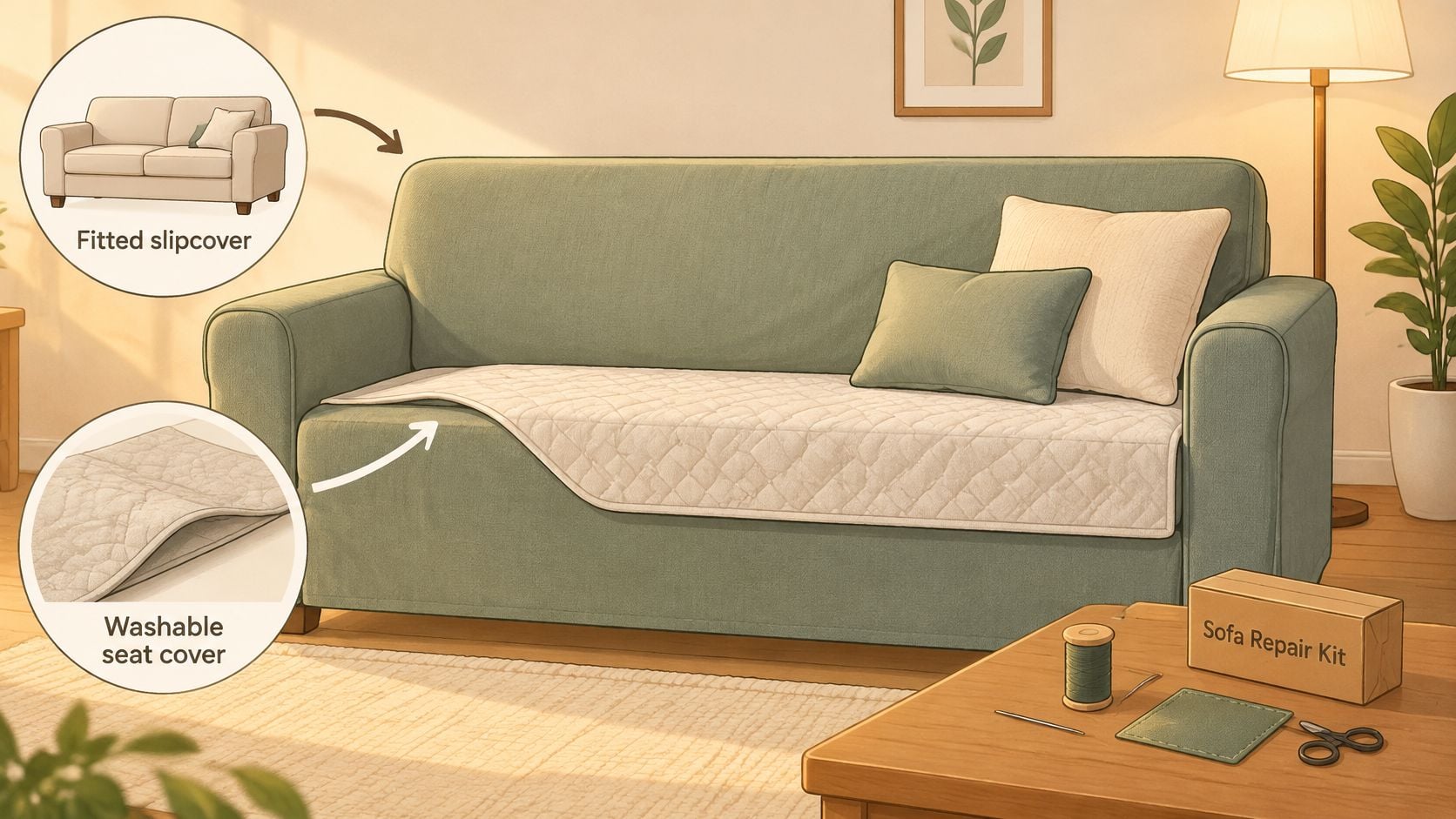
Cover worn cloth thoughtfully. A fitted slipcover or washable seat protector can keep a usable couch presentable. Follow the original upholstery instructions, and don't assume a removable factory cover can go in the washer.
Share cushion wear. Rotate loose cushions during routine cleaning and flip only cushions designed for use on both sides. Keep their orientation consistent with the cushion construction.
Vacuum seams and creases. Use an upholstery attachment to remove grit and crumbs. Blot spills promptly rather than rubbing them deeper into the fabric.
If a cushion feels flat but the support deck remains firm, an appropriately fitted replacement insert may be more sensible than replacing the couch. BILTRITE's guide to fixing sagging couch cushions helps distinguish cushion problems from support problems.
Repair the cause, not the appearance
Tighten legs only where the attachment is designed to be tightened. Stop if the fastener spins, the mounting plate moves, or the surrounding material crumbles; repeated tightening won't restore a stripped connection.
A corner block may help a repairable wood joint, but only when sound material can hold the fasteners. Don't drive screws blindly through upholstery or treat a damaged particleboard rail like solid lumber.
A local upholstery repairer may be able to renew webbing or springs on a sound frame. Request a diagnosis and estimate before authorizing work, particularly when several parts are worn at once.
Keep-or-replace test: Spend on the worn component only when the structure beneath it remains dependable.
Read warranty exclusions before expecting a free repair. Pet damage, stains, and the type of use may affect coverage, and repair authorization may be required before work begins.
The final test is physical. If the frame racks during ordinary shared sitting, stop masking the problem with covers and seek an assessment; if the frame stays stable and only the cloth looks tired, cosmetic care may still be worthwhile.
Come Sit With Us in Greenfield
A couch's price tag tells only part of its story. Sitting in person can help you judge whether it fits your comfort needs, your room, and your budget before you decide.
Bring the measurements and the questions
Start with a room sketch, doorway measurements, and a clear spending limit. Sit upright, lean back, and stand again. The right sofa should suit the person using it, not just the available wall.
Bring the delivery route. Include stair turns and elevator measurements, not just the front door opening.
Describe daily use. Mention children, pets, frequent guests, or difficulty getting up from low seating.
Name the budget boundary. Include delivery and any other necessary charges in the amount available.
Our associates can help answer questions and compare choices without rushing your decision.
Leave with a clearer comparison
Our showroom includes USA-made, Amish-made, solid-wood, small-scale, and heavy-duty furniture, along with come-apart sofas and sectionals. The living room selection includes sofas, sectionals, loveseats, chairs, recliners, lift chairs, and sleeper sofas. Small-scale pieces can suit apartments, condos, smaller homes, and senior living residences.
The mattress department has over 60 models on sale and over 500 mattresses in stock. If you are also considering seating that helps with standing, ask about lift chairs and try them for comfort and support.
There is no need to arrive ready to purchase. A hands-on visit can help you decide whether an entry-level couch meets the immediate need or whether saving for a sturdier seat makes more sense. The lowest tag is not always the lowest cost over years of use.
Visit BILTRITE Furniture-Leather-Mattresses in Greenfield with your room measurements and spending limit. You can test comfort, compare options, and ask questions in person.