Full Size Bookshelf Headboards: Sizes, Storage and Safety

Most advice about full size bookshelf headboards starts and stops with width. Match the headboard to a full mattress, pick a finish, and call it done. That's the advice to challenge!
Width matters, but it isn't the whole decision. A bookshelf headboard also holds weight above a sleeper, pushes the bed farther into the room, and has to connect to a specific frame, base, and wall. A unit can measure right on paper and still block an outlet, crowd a nightstand, sag under hardcovers, or shift every time someone sits up to read.
The smarter order is fit, load, and anchoring first, then style. Measure the complete sleep setup. Check how much the shelves will carry. Decide how the piece will be secured. Only then compare pine, oak, paint, and stain.
Table of Contents
- Full Size Bookshelf Headboard Dimensions at a Glance
- Checking Your Bed and Room Before You Buy
- Shelf Weight and Anchoring the Headboard
- Choosing Solid Wood, Amish-Made and Engineered Materials
- Styling Your Bookshelf Headboard in the Bedroom
- Confirm the Fit and Visit Our Greenfield Showroom
Full Size Bookshelf Headboard Dimensions at a Glance
A bookshelf headboard can match a full mattress and still be the wrong fit for the room. Start with the unit's outside measurements, then account for how its height, depth, and shelf layout affect the bed and walkway.
For a standard full mattress, the sleeping surface measures 54 inches wide by 75 inches long, or about 137 by 191 centimeters, according to a guide to full size bed dimensions. Use that as a reference, not the finished footprint: the frame and headboard add width and depth.
Full-size bookshelf headboards commonly measure about 56 to 62 inches wide, 35 to 40 inches high, and 9 to 11 inches deep, according to sizing guidance for full-size bookcase headboards. A little extra width can hide the mattress edges, but too much may crowd a nightstand or overlap trim and outlets.
The Numbers Worth Comparing
| Measurement | Typical value | What it means for you |
|---|---|---|
| Mattress width | 54 inches (137 cm) | Compare against the headboard's outside width |
| Mattress length | 75 inches (191 cm) | The frame and headboard add to the bed's total length |
| Headboard width | 56–62 inches | Check clearance beside nightstands and at the wall |
| Headboard height | 35–40 inches | Taller models may need wall anchoring |
| Headboard depth | 9–11 inches | Include this projection when checking the walkway |
| Shelf depth | 8–12 inches | Check that the shelf suits the items you plan to store |
Dimensions vary by design, even within the full-size category. One pine model measures 58 inches wide, 48 inches high, and 11 inches deep, according to the pine bookcase headboard dimensions. An oak model measures 59 inches wide, 43 inches high, and 9 inches deep, as listed in the oak bookcase headboard specifications.
That difference matters in daily use. The taller, deeper pine unit takes up more wall and floor space, while the lower, slimmer oak model may suit a tighter layout. Shelf depth also affects what fits: check the usable shelf space against the books or other items you intend to keep there.
Before comparing finishes, check the exterior width, depth, and shelf height on each specification sheet. Then measure the complete setup, including the frame and mattress, so the chosen headboard fits the bed and leaves a clear path through the room.
Checking Your Bed and Room Before You Buy
A bookshelf headboard has to work with the whole sleep setup: mattress, frame, base, and the space around the bed. Check those together before choosing a model. A frame without compatible headboard brackets, an adjustable base, or a thick pillow-top can create fit problems, even when the headboard itself is the right width.
Seven Checks With the Tape Measure
- Measure the sleep setup: Record the mattress and frame at their widest points, then measure from the wall to the foot of the bed. Include any frame parts that extend beyond the mattress.
- Check both sides: Aim for 18 to 24 inches beside a twin or full bed, with 18 inches as the minimum for basic movement, based on bedroom clearance and spacing guidance.
- Check the foot: Leave 24 to 30 inches for easier walking, following the bedroom clearance and spacing guidance.
- Check nearby seating: Allow 24 to 36 inches between the bed and bedroom seating as a planning suggestion, then test the route by walking through it.
- Mark the wall: Note outlets, windows, doors, baseboards, switches, and heat vents. Check that the headboard will not cover them or interfere with access.
- Walk the delivery path: Measure doorways, hallways, and stairs, especially if the headboard arrives as one tall piece. Record the narrowest point along the route.
- Compare the hardware: Match the headboard bracket holes with the frame's mounting slots before delivery day. If they do not line up, ask whether the frame or headboard needs compatible hardware.
A quick sketch helps. Mark the bed outline and headboard depth, then add nightstands, dresser drawers, and closet doors in their open positions. This shows where furniture and doors may overlap before the headboard is in place.
Check the walkway at the side and foot of the bed with the setup drawn in. A nightstand drawer that hits the bedding or a closet door that cannot open fully can make the room awkward to use. A narrow passage may also be harder to manage for someone who needs steady footing at night.
Shelf depth affects both storage and clearance. Shallow shelves suit paperbacks and small décor, while large hardcovers and binders may not sit securely. Deeper shelves provide more room, but bring the headboard closer to the bed and can become a bump hazard when someone sits up. Check the lowest shelf against the mattress height, too, particularly with a thick pillow-top.
A narrower, lower model secured to the wall may suit a small apartment or senior living room better than a deeper unit with more storage. For help recording the bed, frame, and room dimensions, use a step-by-step guide to measuring furniture.
Shelf Weight and Anchoring the Headboard
A bookshelf headboard is a storage unit above a bed, so check its shelf span and anchoring before judging it by width alone. A long shelf bends more under the same load than a short one. Books add weight quickly because they are dense and often fill a shelf from end to end.
Books weigh roughly 20 to 30 pounds per linear foot. A 54-inch shelf could therefore carry about 90 to 135 pounds before accounting for the shelf board, hardware, or uneven loading, according to the CPSC release on anchoring bookcases and shelving. The same release cites the L/360 deflection criterion: a 36-inch shelf should deflect no more than about 0.10 inch under design load.
What Shelf Span Changes
The table uses the book-weight range above and the L/360 calculation, where the deflection limit is shelf span divided by 360. These are illustrative figures, not a load rating for a particular headboard. Check the manufacturer's stated capacity before loading shelves.
| Shelf span | Approximate book load | Deflection limit (L/360) | Practical note |
|---|---|---|---|
| 24-inch shelf | 40–60 lb | About 0.07 inch | Suits paperbacks and décor |
| 36-inch shelf | 60–90 lb | About 0.10 inch | Fine for a mixed bookcase with a center divider |
| 48-inch shelf | 80–120 lb | About 0.13 inch | Add a center support for heavy hardcovers |
| 54-inch shelf (full width) | 90–135 lb | About 0.15 inch | Use side panels and a center divider |
Hardcovers and cookbooks put a shelf to the test. A shelf that stays straight with paperbacks may bow under reference books, photo albums, or heavy novels. The diving-board comparison is useful here: the longer the unsupported span, the more it bends. Uneven loading increases the strain when the heaviest books sit in the middle.
A stronger design shortens the span. Look for substantial side panels, a center divider, and mechanically secured shelf supports rather than friction pegs alone. Put the heaviest books low, away from upper compartments above the sleeper.
Anchoring Is Part of the Purchase
Secure a tall bookshelf headboard to the wall according to the manufacturer's instructions. A gentle push in a store does not show how the unit will respond if a child climbs it, someone pulls on a shelf, or an older adult grabs it for balance.
The furniture and décor tip-over statistics report an average of six fatalities per year involving chests, bureaus, or dressers, with children younger than 10 representing most reported fatalities. Bookcases and other furniture can tip regardless of price or material, so solid wood does not remove the need to anchor a tall unit.
Two connection methods are common. With a bolt-on design, the metal bed frame's mounting slots need to align with the headboard's predrilled holes. With a wall-supported design, a cleat should transfer the load through fasteners secured into wall studs.
- Find the studs: Mark their centers before moving the headboard into place.
- Dry-fit the hardware: Check that the headboard holes line up with the frame slots. Do not force a mismatch.
- Fasten into structure: Secure the cleat or anti-tip bracket through structural material into studs using supplied or appropriately rated screws.
- Install the kit promptly: Anchor It safety education guidance advises installing supplied anti-tip devices immediately and notes that existing furniture can be anchored with brackets.
- Recheck the connections: Inspect after the first week, after a move, and every few months thereafter.
Older adults also need protection. Furniture may be used for balance, which creates a tip-over risk if a unit is unsecured.
Wall material affects the fasteners. Plaster and brick need anchors and screws rated for that material. Drywall anchors alone are not enough for a tall, loaded unit. Renters should check their lease and use approved hardware, or choose a lower model with a manufacturer-approved attachment method that meets rental rules.
The mattress or bed frame does not replace wall anchoring. A frame connection helps keep the headboard aligned; wall anchoring addresses tip-over risk. Before buying, compare bed frames with hooks for a headboard and footboard with the headboard's mounting method, then confirm the frame, base, and mattress will work together.
Choosing Solid Wood, Amish-Made and Engineered Materials
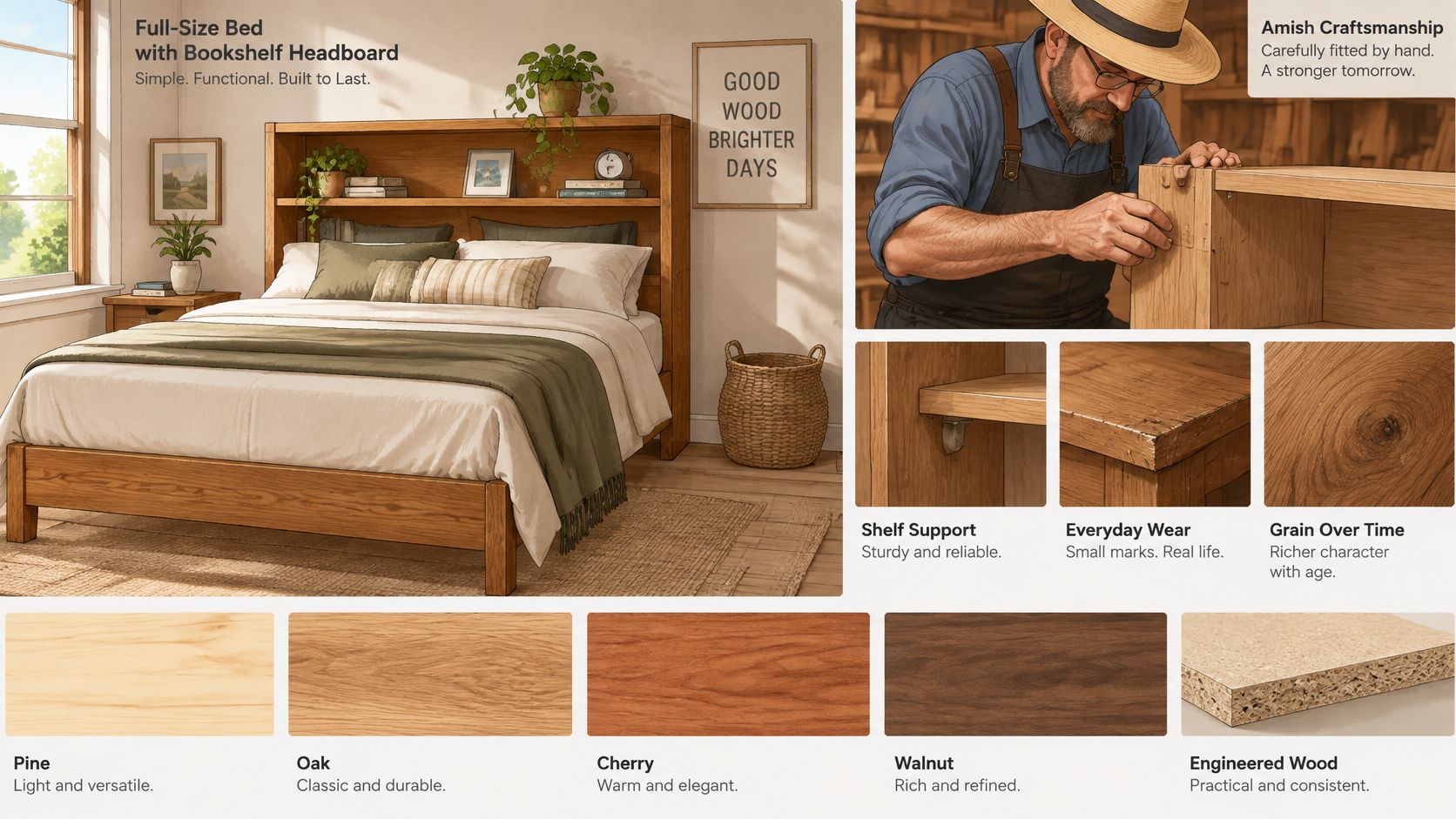
The right material depends on the shelf span, expected load, and the bumps and spills a bedroom brings. Solid wood can often be sanded or touched up after small dents. Engineered boards have smooth, flat faces and can cost less, but long spans may sag under heavy books, and moisture can damage them. Keep shelves within their recommended load and span, whichever material you choose.
Materials Side by Side
These are general material characteristics, not a guarantee of how a particular headboard will perform. Construction, shelf dimensions, and finish all matter.
| Material | General characteristics | Check before buying | May suit |
|---|---|---|---|
| Solid pine | Light and takes paint or stain; softer wood can dent and scratch | Shelf span, finish, and joinery | Painted or rustic bedrooms, including kids' rooms |
| Solid oak | Distinctive grain; the finished piece may be heavy | Overall weight and shelf support | Buyers looking for a solid-wood option |
| Solid cherry or walnut | Distinctive color and grain | Finish, availability, and shelf dimensions | Bedrooms where the wood appearance is a priority |
| Amish-made or USA-made solid wood | Describes how or where a piece is made, not a specific wood species | Ask which species is used and how the shelves and joints are constructed | Buyers seeking American-made furniture |
| Engineered wood, such as MDF or veneered board | Flat surfaces; performance varies by construction | Shelf span, edge finish, and care instructions around moisture | Lighter book and décor loads |
| Metal frame with wood shelves | Open frame with wood shelving | Shelf support and how the frame connects to the headboard | Rooms where an open profile suits the space |
At BILTRITE, the furniture selection includes USA-made and Amish-made solid wood furniture.
What to Check on the Tag
Look for the wood species and the stated material for the shelves, side panels, and back. A solid-wood label alone may not mean every part is solid wood. If the tag does not explain how the shelves join the frame, ask the salesperson. A close look at the joints and shelf supports can help clarify what is holding each span.
For a broader overview of how construction differs, see this guide to solid wood and engineered wood furniture.
Finish Choices in Plain Terms
- Stain: Shows the grain and the wood's natural color.
- Paint: Covers the grain and offers a painted look for bedrooms, including kids' rooms.
- Clear topcoat: Adds a protective surface against everyday scuffs from books and other items.
A solid-wood headboard can still tip if it is not attached as directed. Follow the manufacturer's instructions for the approved wall attachment, and choose shelves suited to the weight you plan to store.
Styling Your Bookshelf Headboard in the Bedroom
Styling a bookshelf headboard is a safety task wearing a décor hat. The prettiest arrangement won't work if the heaviest books sit up high or a lamp cord dangles where a child can pull it.
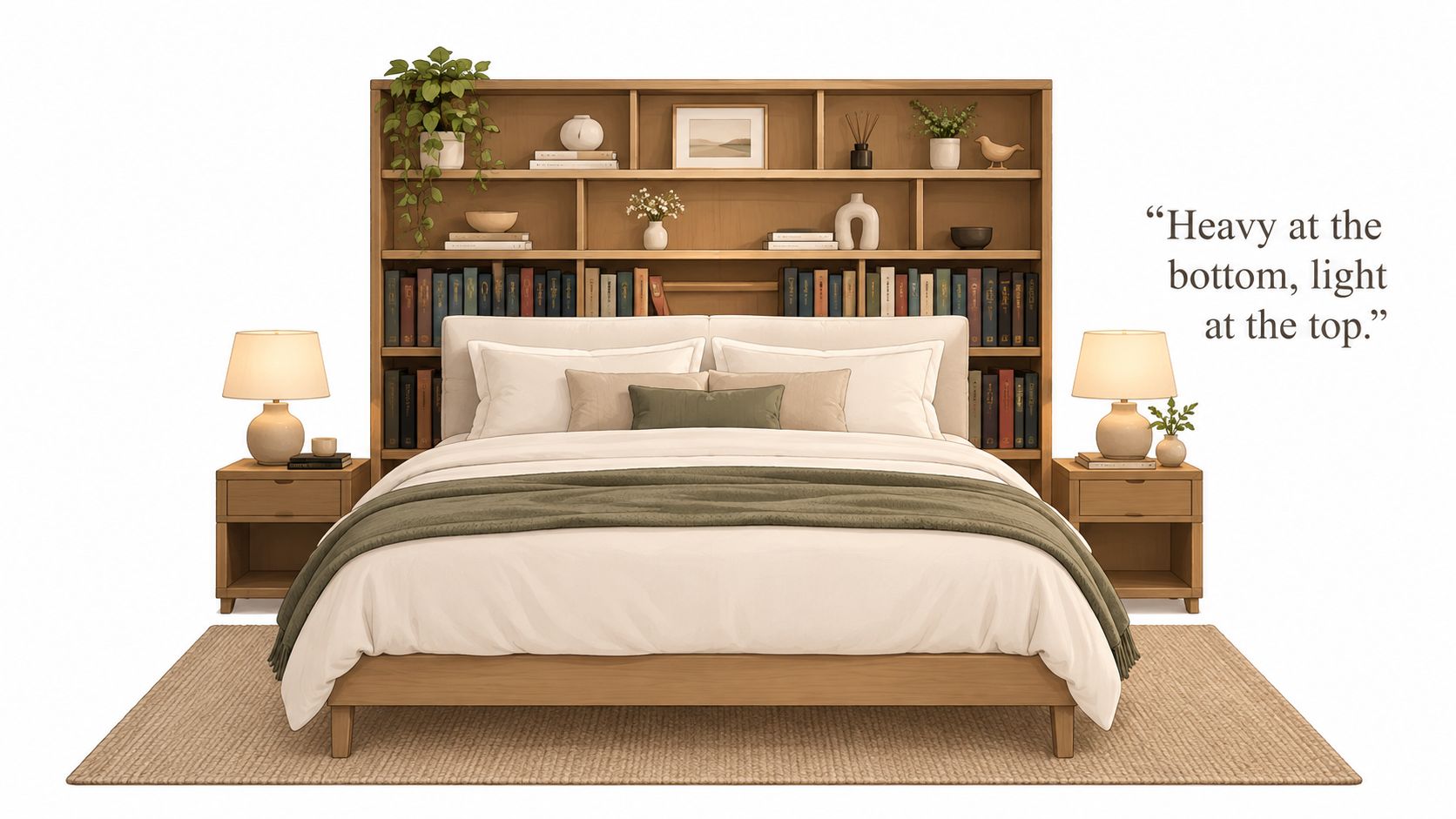
Heavy at the bottom, light at the top, and nothing climbable within reach of small hands.
That one rule settles most shelf decisions. Put hardcovers, albums, and storage baskets on the lowest shelves. Save the upper shelves for paperbacks, a small plant, a framed photo, or lightweight décor that won't hurt anyone if it gets knocked loose.
Simple Ways to Make It Look Finished
Match the wood tone to the nightstands, or keep the nightstands painted so the headboard becomes the warm wood feature. Group books by height for a calmer line, then break up one row with a horizontal stack. A few woven baskets can hide remotes, chargers, tissues, and reading glasses without turning the shelf into a junk drawer.
Leave a little breathing room. One open section with a plant or photo keeps the wall from feeling packed, especially in a small bedroom. In tight spaces, a shallower shelf and a lighter finish help the wall feel open rather than heavy.
Kids' rooms and teen reading nooks need extra thought. Route lamp and charger cords so they can't be pulled from the shelving. Keep stools, storage cubes, and step-like objects away from the headboard so shelves don't become a ladder.
Lighting deserves the same caution. A plug-in reading lamp on a low, stable shelf works well for most readers. Wiring a fixture into the headboard is a job for a licensed electrician, not a weekend shortcut.
One more check matters for families. Anchor It resources note that, beginning September 1, 2023, new furniture safety standards cover dressers, armoires, and other clothing-storage furniture, including stability requirements and anchor kits, in the Anchor It resources on furniture safety standards. A bookshelf headboard may not fall into every covered category, so shoppers should verify the product instructions rather than assume the rule applies.
For more shelf-arranging ideas that keep rooms balanced and uncluttered, tips for decorating shelves in any room can help readers plan the look after the safety basics are set.
Confirm the Fit and Visit Our Greenfield Showroom
A full-size headboard can fit the mattress and still fail the room. Check the complete setup: frame, base, mattress thickness, headboard height, outlets, nightstands, and the walkway. Also confirm that the piece can get through the delivery route and that you have a plan to anchor it before it arrives.
Take a tape measure to the bed and wall, and note the frame's attachment points and baseboard depth. Photos of the setup can help resolve details that are hard to remember at the showroom. If the fit or anchoring plan is uncertain, pause before ordering.
We're BILTRITE, a 4th generation, family-owned and operated furniture store serving Greenfield and the Metro Milwaukee community since 1928. At our Greenfield showroom, you can inspect the finish and shelf edges in person, compare headboard heights with your mattress setup, and ask questions without pressure.
For a bookshelf headboard, check more than appearance. Press gently on the shelves to assess their feel, and ask how the piece attaches to your frame or wall. If you're comparing solid wood, Amish-made, or smaller-scale options, seeing them in person can help you judge the trade-offs in finish, footprint, and storage.
During the visit, sit against the headboard as you would while reading. Check whether the shelf is easy to reach, whether items would sit safely within it, and whether the headboard leaves enough room to walk beside the bed. A few minutes spent checking these details can help prevent a poor fit at home.
For help matching a full-size bookshelf headboard to your bed and room, visit BILTRITE Furniture-Leather-Mattresses in Greenfield. Bring your measurements and frame details, then check the shelf construction, attachment method, and walkway clearance before choosing.