45 Inch Round Dining Table: Sizing, Seating, and Style

You've measured the breakfast nook twice, moved the chairs around, and still can't tell whether a round table will leave enough room to walk past. That's a common Metro Milwaukee furniture puzzle, especially in a condo, apartment, senior living space, or smaller dining room. A 45 inch round dining table can be a smart answer, but the tabletop diameter is only the beginning. The chairs, base, and surrounding traffic lane decide whether four people dine comfortably or bump elbows all evening.
A round table removes corners and makes conversation easier, but it doesn't magically create more room. The most useful question isn't how many chairs fit. It's whether the chosen chairs, table base, and room layout work together for everyday meals, homework, holiday serving dishes, and the occasional extra guest.
Table of Contents
- Why a 45 Inch Round Dining Table Is a Sweet Spot
- How Much Tabletop Space a 45-Inch Round Gives You
- Pedestal Base Versus Four Legs
- Matching Chairs to a Compact Round Top
- Sizing the Room Around the Table
- Where a 45 Inch Round Table Fits in the BILTRITE Lineup
- An Accessibility and Aging-in-Place Checklist
Why a 45 Inch Round Dining Table Is a Sweet Spot
In a Wauwatosa breakfast nook, a rectangular table can block the kitchen path. In a Greenfield senior living space, the same table may make daily movement feel cramped. A round top solves part of both problems by removing the sharp corner, but comfort still depends on the chairs and base you pair with it.
A 45-inch diameter equals approximately 114 centimeters. That places the table between compact four-person designs and larger tops made for more generous entertaining. Interior space-planning guides such as Homestyler's round-table space planning guidance place round tables of roughly 38 to 42 inches in the compact range for four diners, while 48 to 54 inches is more typical for six.
The 45-inch size earns its appeal from that middle ground. It gives four adults more breathing room than the smallest four-seat tables, while taking less space than a larger entertaining table. The top alone does not determine comfort. Chair width, armrests, the base footprint, and the room's traffic path matter just as much.
Four adults should be the everyday expectation. Choose narrower or armless chairs if the tabletop must also hold serving bowls, a pitcher, or a centerpiece. A pedestal base usually makes it easier to place four chairs evenly, while four legs can restrict where each chair sits.
Where this size makes sense
This shape works well beside an awkward corner, near an open kitchen connection, or along a walkway that a rectangular end would interrupt. Every diner also faces the center, which keeps conversation natural during family meals.
BILTRITE has served the Metro Milwaukee community since 1928 as a fourth-generation, family-owned furniture business. Before visiting, compare your room measurements with this dining table size guide, then bring those measurements to the showroom for a hands-on discussion.
Choose 45 inches when four people are the normal household group, the room is compact, and the table must work without dominating it. Select a different size for frequent entertaining, very wide chairs, or large serving pieces.
How Much Tabletop Space a 45-Inch Round Gives You
A 45-inch round tabletop offers approximately 1,590 square inches of surface and about 141.4 inches of circumference. As a planning example, allowing roughly 24 inches of table edge per adult gives four diners a combined need of about 96 inches. The circle leaves useful room beyond that allowance, but chair design and the table base decide how comfortable those inches feel.
Four adults fit comfortably with the right setup. The full perimeter is not equally available, since chair backs, armrests, aprons, pedestal feet, place settings, and access points take up space. A fifth or sixth person may fit temporarily with narrow chairs, child-sized seating, or a casual breakfast arrangement. For regular adult meals, four is the sensible capacity.
Round table sizes at a glance
| Diameter | Comfortable Seating | Typical Best Fit |
|---|---|---|
| 38 to 42 inches | Four diners with compact chairs | Apartments, breakfast nooks, smaller dining rooms |
| 45 inches | Four adults for everyday meals | Compact family dining and open-plan corners |
| 48 to 54 inches | Six diners more comfortably | Larger dining rooms and frequent entertaining |
The practical distinction is physical capacity versus comfortable capacity. A tabletop may hold several chairs around its edge yet feel crowded once every diner has a plate, drink, and serving dish. Round construction improves access around the perimeter, but it cannot provide unlimited elbow room.
Surface area versus usable dining space
The center of the table works well for shared food, while each diner still needs personal space at the edge. A 45-inch top suits a family meal for four without overwhelming a smaller room, especially when the chairs remain visually light and the surface shape stays practical.
For a solid-wood option, review BILTRITE's solid wood table top options before visiting the showroom. Inspect the edge profile, apron, finish, and underside in person. Those details affect the room left for knees, dishes, and chair movement more than a seat-count label does. A compact top feels generous when those parts work together, and cramped when they do not.
Pedestal Base Versus Four Legs
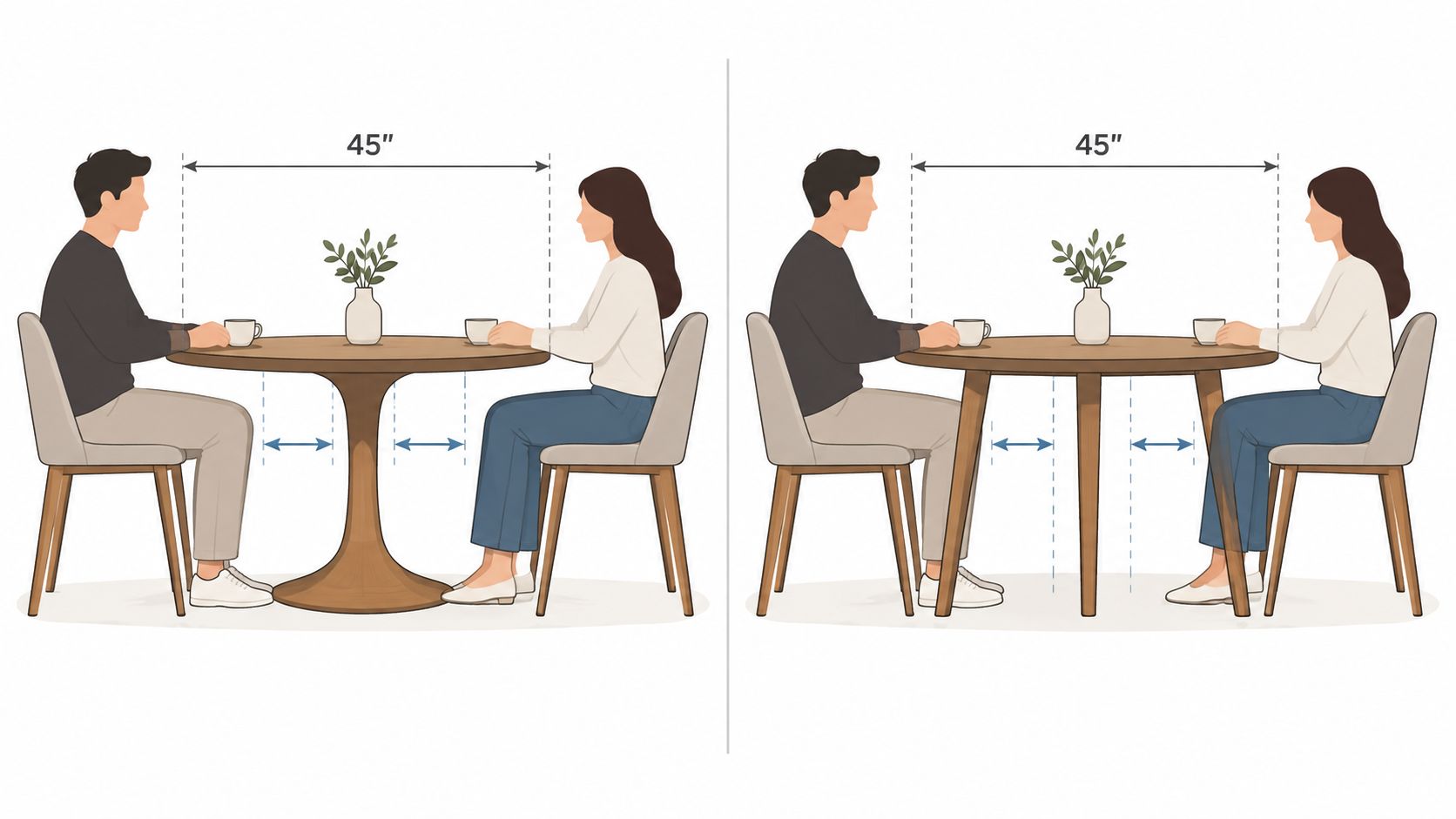
The base often determines whether a 45-inch round table feels relaxed or fussy. Four legs can look familiar and stable, but they may sit exactly where a diner wants to place a foot or pull in a chair. A pedestal usually gives chairs more freedom around the perimeter, although a poorly proportioned central base can create its own obstruction.
Knee clearance and chair placement
A pedestal generally wins for flexible chair placement. Each chair can move slightly around the circle without encountering a corner leg, which is useful when one diner needs more room or when the table is used for homework during the day.
A four-leg design can still work well, especially when its legs are positioned thoughtfully. The customer should sit in the actual chair, check where the knees land, and confirm whether the chair can slide in without striking a support. A double-pedestal design may provide more open space than four corner legs, but its cross supports and feet still need inspection.
Practical rule: The strongest base is the one that leaves the most useful knee and toe space for the people who will actually sit there.
Accessibility requires more than a round top
ADA-aligned dining-surface guidance specifies at least 27 inches of vertical knee clearance and 30 inches of unobstructed width at an accessible position. A pedestal can make wheelchair approach easier by removing corner legs, but its central column and feet must still leave the required knee envelope clear. (ADA dining-surface criteria)
That makes a wide pedestal foot a possible problem. It may look open from across the room while blocking the front wheels or preventing a close approach. Four legs can create the same difficulty in a different way, especially if none of the seating positions offers a clear forward approach.
For senior households, caregivers, and multigenerational families, the showroom test should include more than sitting down. A shopper should approach the table with the mobility device or walker used at home, check whether a chair can move away easily, and examine the underside rather than judging only the tabletop.
Which base should a buyer choose?
A pedestal is usually the stronger choice for four chairs, flexible positioning, and conversation around a compact round top. A four-leg base may suit shoppers who prefer a traditional look and find a design with clear knee positions. Neither option should be selected without checking the actual base spread, apron height, and chair placement.
Matching Chairs to a Compact Round Top
A 45-inch round dining table can seat four, but the chairs determine whether dinner feels comfortable or cramped. The top offers about 141 inches of perimeter, or roughly 35 inches per seat for four diners, before chair spacing, aprons, supports, placemats, and serving dishes take room. (round-table perimeter guidance)
That gives each diner more than the commonly used 24-inch edge allowance. Wide frames and thick upholstery can consume that advantage quickly, so chair shape matters as much as the seat count.
Three chair choices
An armless side chair is the safest match for four daily seats. Its narrower profile leaves room for diners to shift around the circle, and it usually slides closer to the tabletop without armrests catching on the edge.
A standard dining chair works when its overall width remains moderate and its legs do not interfere with neighboring chairs. Set all four chairs around the table before buying. Check the gaps between chair backs, the space beside each diner, and how the group looks in the actual room.
A small upholstered armchair adds comfort but uses more of the available perimeter. Armrests may prevent the chair from tucking under the tabletop, while extra width can make four positions feel crowded even when every chair technically fits. For a compact Milwaukee-area dining nook, reserve armchairs for selected positions rather than assuming four will work.
Seat height also affects comfort. Dining-chair seats commonly measure about 17 to 19 inches high, a range that pairs with ordinary dining-table height and supports a natural seated posture. (dining-table and chair ergonomics)
The BILTRITE showroom test
A showroom test gives better information than a floor plan. Place four chairs around the table, sit in every position, reach toward the center, and check whether knees contact a leg, pedestal, or apron. Add a plate and glass to one place setting. An empty tabletop can feel generous until serving pieces and elbows occupy it.
Customers comparing profiles can use this guide to choose dining chairs before discussing the preferred style with BILTRITE. Solid-wood tables pair naturally with USA-made chairs in smaller-scale silhouettes when the household wants durable construction without visually filling the room.
Choose armless or modestly scaled side chairs for daily use. Two small armchairs can work at opposing positions. Four large armchairs usually make the wrong pairing for this tabletop size unless the room and serving habits leave generous spare space.
Sizing the Room Around the Table
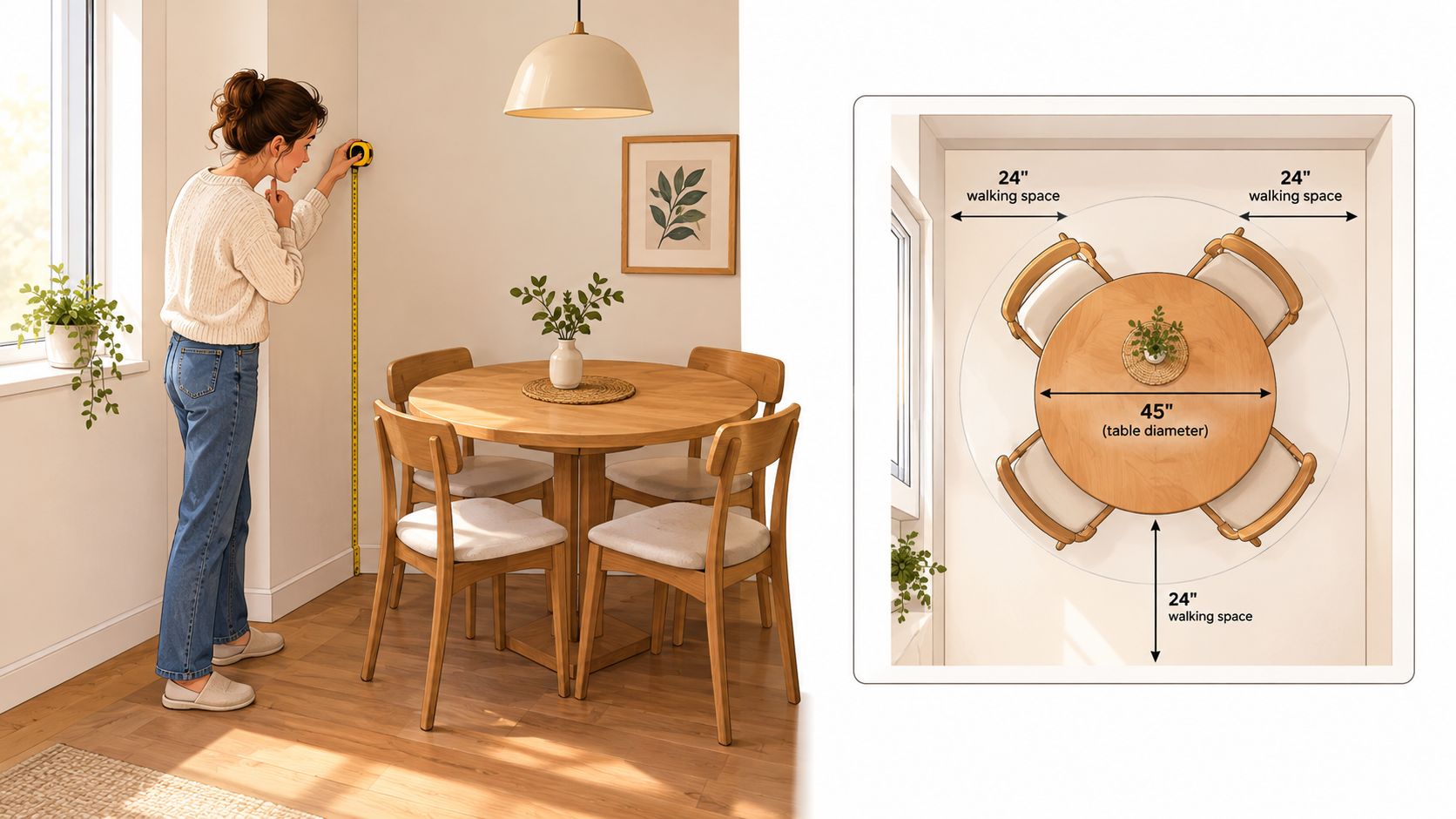
A Milwaukee-area dining nook can fit a 45-inch round table and still feel cramped once chairs, serving paths, and door swings enter the picture. The top measures only 3.75 feet across, so plan the full dining zone, not just the tabletop. Standard dining-room planning calls for 30 to 36 inches of clear space, with 36 inches the stronger everyday target. Applied around a 45-inch tabletop, that produces an overall planning diameter of approximately 105 to 117 inches, or 8 feet 9 inches to 9 feet 9 inches.
Use more room beside a kitchen route, sideboard, doorway, or frequently used cabinet. 42 to 48 inches gives diners space to stand, serve food, and pass behind a pulled-out chair without turning the meal into a hallway obstacle. That extra clearance matters more than a tight fit that works only when nobody is moving.
A tape-measure checklist
Mark the tabletop diameter. Use painter's tape to create a 45-inch circle on the floor. The outline shows the footprint more clearly than measuring from wall to wall.
Add the chair envelope. Extend the marked zone to include chair backs when the chairs are pulled out. Use the exact chair style under consideration, not a generic chair symbol. A broad armchair can change the room's working size quickly.
Protect the traffic side. Allow at least 36 inches around seating and walking sides. Use the roomier range beside a sideboard, kitchen passage, or other busy route.
Test door swings and drawers. Open nearby doors, drawers, and windows. A table that fits with everything closed may block daily access.
Check the kitchen path. Walk from the cooking area to the table while carrying a serving dish. If the route forces someone behind every chair, give the layout more breathing room.
A paper or tape template costs nothing and can expose a bad layout before furniture arrives.
For more ways to compare footprints, review BILTRITE's guide to maximizing dining space with table shapes and seating arrangements. The same method works in a Milwaukee condo, a Waukesha dining nook, or a compact home in Greenfield. Measure the complete chair-and-traffic envelope, not merely the tabletop.
Where a 45 Inch Round Table Fits in the BILTRITE Lineup
A 45-inch round dining table makes sense for shoppers who need compact scale without giving up a family dining surface. BILTRITE's showroom includes options for apartments, condos, smaller homes, and senior living spaces, along with heavier-duty furniture for households that need more substantial construction.

The most useful showroom markers are simple:
- Small-scale furniture helps shoppers compare pieces intended for tighter rooms and narrower circulation paths.
- Solid-wood furniture gives customers a chance to inspect real grain, edge construction, finish, and underside details.
- USA-made and Amish-made furniture supports households looking for American craftsmanship and durable materials.
- Heavy-duty options serve families and senior shoppers who need furniture selected for demanding everyday use.
A round table can also be part of a larger delivery plan. The same households that need a compact dining set may need come-apart sofas or sectionals for narrow hallways and tight entryways. BILTRITE also operates a large mattress department with over 60 models, giving shoppers another reason to handle several household decisions during a local showroom visit.
BILTRITE is a fourth-generation, family-owned business serving Greenfield and the broader Metro Milwaukee area, including New Berlin, Franklin, Waukesha, and Racine. The store doesn't sell online, so the useful advantage is physical comparison. Customers can sit in the chairs, inspect the base, and discuss room measurements with sales associates who have over 400 years of combined experience.
The store is also closed on Sundays so the family can spend time together. That buy-local, family-first approach fits a purchase where comfort and fit deserve a real conversation rather than a rushed online guess.
An Accessibility and Aging-in-Place Checklist
A senior-friendly dining setup starts underneath the tabletop. ADA-aligned guidance specifies a tabletop height between 28 and 34 inches, at least 27 inches of knee clearance, 30 inches of clear width, and 19 inches of clear depth for a forward approach. (accessible dining-surface guidance)
Before choosing a 45-inch round dining table, shoppers should check:
- Tabletop height: Confirm that the surface falls between 28 and 34 inches.
- Underside clearance: Measure the actual knee space, not just the overall table height.
- Approach width: Verify that at least one position provides 30 inches of unobstructed width.
- Forward depth: Check for 19 inches of clear depth at the accessible position.
- Chair height: Look for a seat height between 17 and 19 inches when that range suits the diner.
- Base footprint: Make sure the pedestal column or legs don't obstruct a wheelchair, walker, or caregiver.
- Traffic space: Keep the surrounding chair-and-walking zone open enough for safe sitting and standing.
A round top may improve conversation and remove corners, but accessibility depends on the complete table-and-chair combination. Shoppers planning for aging in place can review BILTRITE's wheelchair-accessible furniture resources, then test the actual pieces side by side at the Greenfield showroom on Layton Avenue.
BILTRITE Furniture-Leather-Mattresses offers small-scale, solid-wood, USA-made, and Amish-made furniture for Metro Milwaukee homes, along with senior-friendly and heavy-duty options. Visit BILTRITE Furniture-Leather-Mattresses in Greenfield for a no-pressure, hands-on chance to test a 45-inch round dining table, compare chair styles, and ask the team about comfort, clearance, and room fit in person.