Storage Platform Bed Guide for Small Spaces


A bedroom can feel crowded even when it contains only the essentials. Clothing spills from an overfilled closet, extra blankets occupy a chair, and storage bins under a conventional bed turn into a forgotten jumble. A storage platform bed addresses that everyday problem by giving the bed a second job, keeping sleeping and organizing in one carefully planned footprint.
The right choice depends on more than appearance. Room clearance, storage habits, mattress support, construction, and weight capacity all matter. A family furniture showroom such as BILTRITE, a fourth-generation business serving Metro Milwaukee since 1928, helps shoppers consider those details before bringing a bed home.
Table of Contents
- Reclaiming Your Bedroom Space With Smart Design
- Choosing Between Drawers And Lift-Up Mechanisms
- Evaluating Materials And Weight Capacity
- Sizing Footprints And Mattress Compatibility
- Maximizing Organization In Small Spaces
- Maintenance Tips For Long-Lasting Functionality
- Finding Your Ideal Bed At Our Greenfield Showroom
Reclaiming Your Bedroom Space With Smart Design
A small bedroom often reveals the same problem in a dozen ways. The closet holds daily clothing but not spare quilts, a dresser takes up valuable walking space, and seasonal items migrate from one corner to another. A storage platform bed turns the unused area beneath the mattress into an organized part of the room instead of leaving it to dust and forgotten boxes.
That idea is far from new. A furniture history source records storage beds appearing around 1420, while raised pedestal-like bed bases created room for bedding and household goods during the Gothic period. The box-like base became more established at the beginning of the Renaissance, roughly 200 years later, showing that furniture makers have long used the bed's footprint to solve storage problems in compact homes. The modern version replaces older chests and box structures with drawers or lift-up platforms. (Furniture history of storage beds)
A familiar bedroom problem
Consider a household with a modest bedroom and limited closet space. A conventional bed leaves a broad area underneath, but shallow containers may be difficult to reach and can make cleaning awkward. A drawer-based storage platform bed gives that household designated places for folded bedding or clothing, while a lift-up design creates one larger cavity for items that don't need daily access.
The visual benefit matters, too. Built-in storage keeps the room calmer because fewer freestanding pieces compete for attention. A lower-profile platform can also create a cleaner outline than a taller bed and separate storage pieces, although the final height depends on the frame and mattress combination.
Practical rule: A storage bed works best when it replaces clutter, not when it becomes another place to hide unsorted belongings.
Families furnishing apartments, condos, and smaller homes can explore small-space furniture solutions with the same measurement-first mindset. The useful question isn't just whether a bed has storage. It's whether the storage can be opened comfortably, whether the room still has a clear path, and whether the construction suits the household's long-term needs.
That's why this furniture category deserves more thought than a quick style decision. A storage platform bed is a modern expression of an old space-saving principle, but its success depends on matching the mechanism to real daily behavior.
Choosing Between Drawers And Lift-Up Mechanisms
A drawer bed and a lift-up bed may occupy a similar footprint, yet they behave very differently. One offers quick, compartmentalized access. The other offers a broad hidden cavity that can hold larger items but may require more effort each time it's opened.
Side drawers need clear space along the bed's long edges. They suit bedrooms where a person can stand beside the bed and pull a drawer fully open without striking a dresser, wall, or nightstand. Foot-of-bed drawers need a comfortable path at the end of the mattress, so they're useful when the room has open clearance near the footboard.
Lift-up storage changes the layout calculation. Because the platform rises rather than sliding outward, it can work well in a tight room where side or end clearance is limited. It's less convenient for daily clothing, though, because accessing the full cavity usually means lifting the mattress platform rather than pulling one small drawer.
Storage Mechanism Decision Guide
| Storage Type | Best Room Layout | Ideal For Storing |
|---|---|---|
| Side drawers | Open floor space along one or both sides | Daily clothing, sheets, and smaller folded items |
| Foot-of-bed drawers | Clear space between the footboard and the opposite wall or furniture | Towels, throws, shoes, and items accessed from the end |
| Lift-up platform | Tight side clearances with room to raise the platform | Bulky comforters, pillows, seasonal bedding, and larger soft goods |
A practical example makes the difference clear. Someone who reaches for socks and pajamas every morning may prefer drawers because each category can have its own compartment. Someone storing guest bedding or bulky winter comforters may favor lift-up storage because one wide cavity avoids compressing large items into narrow drawers. A reviewed storage bed example includes a lift-up cavity 7.7 inches high that spans almost the full width and length of the bed, a configuration suited to those larger pieces.
There's also a household-safety consideration. Drawers should open smoothly without forcing the user to pull at an angle. Lift-up platforms should have dependable hardware and should be operated as directed, with hands clear of hinges and moving joints.
For shoppers comparing queen options, queen storage beds can be evaluated by mechanism, access side, and room clearance rather than by drawer count alone. The best fit is the design that makes the most frequently stored items easiest to reach.
Evaluating Materials And Weight Capacity
Storage introduces engineering demands that a simple bed frame may not face. Drawers add rails, lift-up designs add hinges and lifting hardware, and the cavity beneath the mattress can concentrate stress around the frame. A strong-looking exterior doesn't automatically tell a shopper how well those parts will perform over years of use.
Solid wood offers a repairable, substantial construction approach. Veneered composite materials can provide a finished wood appearance with a manufactured core, while metal frames often rely on steel components and a different support structure. Each category can be made for different budgets and uses, so the important questions are how the joints are assembled, how the slats are supported, and whether the hardware feels stable during operation.
BILTRITE emphasizes USA-made, Amish-made, and solid-wood furniture because careful craftsmanship and serviceability matter in pieces used every night. Shoppers interested in the construction difference can review solid wood furniture versus particle board before comparing finishes and storage layouts.
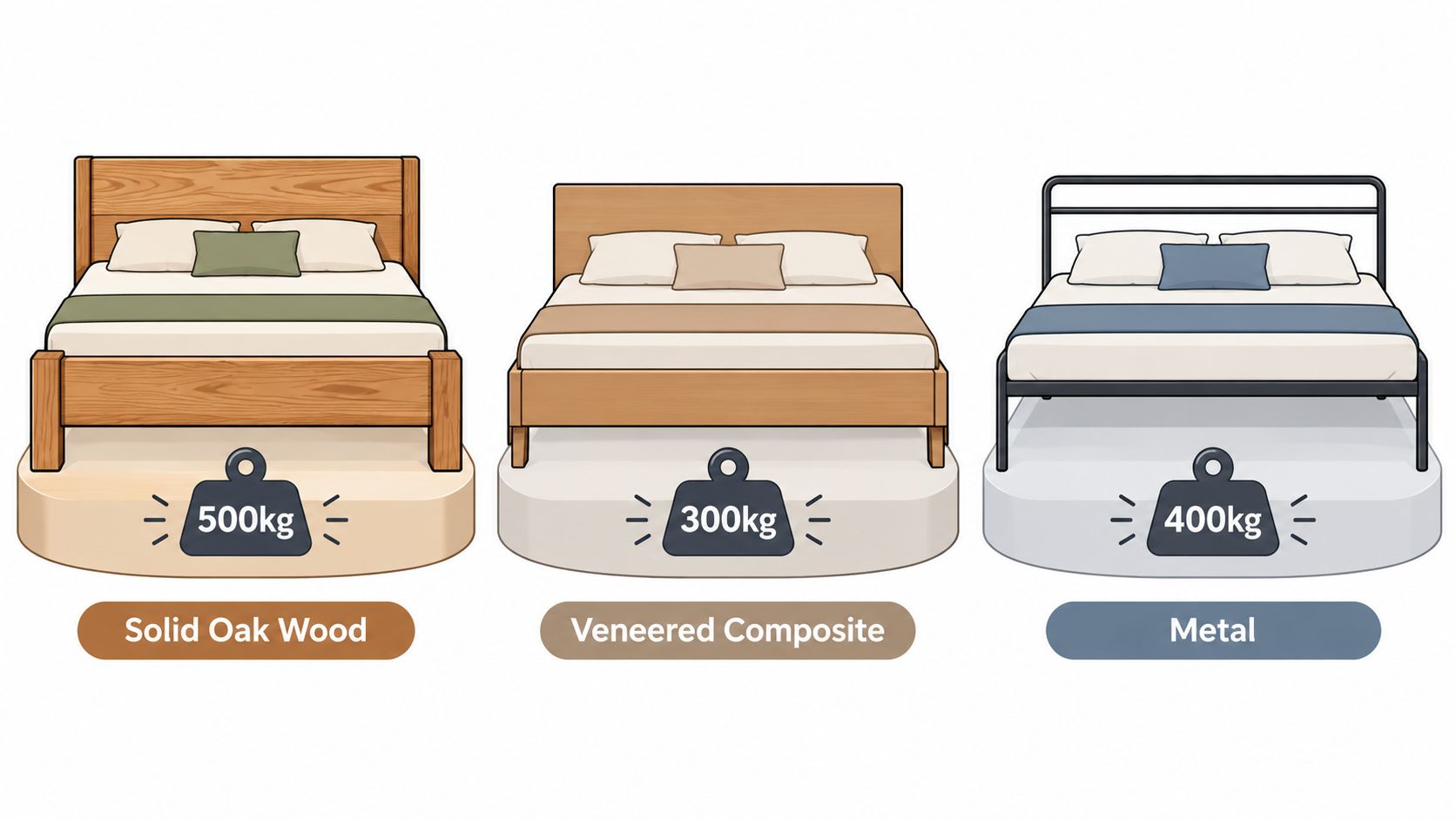
Read the capacity label carefully
Reported storage-bed capacities commonly range from about 500 pounds to 1,500 pounds for evenly distributed loads. Higher ratings are generally associated with steel or heavy-duty wood frames, additional support legs, and reinforced slat systems.
The household load should include more than the sleepers. Add the mattress, the foundation components, and the combined weight of the people using the bed. A lower-rated frame may be pushed beyond its intended limit when a heavy mattress and two adults are combined, especially if the load isn't distributed as the manufacturer expects.
Material comparisons offer another useful reference point. One expert guide reports typical wood platform capacities of 400 to 600 pounds, metal-frame capacities of 800 to 1,200 pounds, and heavy-duty models reaching 3,500+ pounds. Those figures describe broad categories, not a promise for every frame, so the product's own rating should take priority.
Construction deserves a close look
A careful in-store inspection can reveal details that photographs miss:
- Frame joints: Solid connections should feel firm, without noticeable rocking.
- Slat support: The center structure and legs should appear designed to carry the mattress load across the span.
- Drawer hardware: Rails should stay aligned when a drawer is opened and closed.
- Lift mechanism: The platform should move in a controlled way, without sudden drops or excessive side-to-side motion.
Quality isn't only about a number on a label. It's also about how the frame handles repeated movement, how easily hardware can be serviced, and whether the materials suit the household's expectations for long-term use. That's where a solid wood, USA-made or Amish-crafted option can offer meaningful value over disposable flat-pack furniture.
Sizing Footprints And Mattress Compatibility
Room planning starts with the outside dimensions, not the mattress alone. A storage bed can extend beyond the mattress on several sides, and its drawers need additional room to open. Measuring the wall, walking paths, nightstands, and nearby furniture before shopping prevents a frustrating surprise on delivery day.
One neutral product example lists a queen storage bed at 72 inches wide, 9.5 inches high, and 91 inches deep, with drawers measuring 23 inches deep, 21 inches wide, and 6 inches high. Its king version measures 84 inches wide, 9.5 inches high, and 93 inches deep, with drawers measuring 24 inches deep, 21.5 inches wide, and 6 inches high. (Queen and king storage-bed dimensions)
Those dimensions illustrate why room measurements need to include operating space. A drawer that fits inside the frame still needs a clear path to slide outward. A lift-up platform needs overhead and side freedom for movement, plus enough room for a person to stand safely while opening it.
Match the foundation to the mattress
Most storage platform beds use slats instead of a box spring. The critical detail is the distance between those slats. Foam and latex mattresses generally need gaps no wider than about 2.75 to 3 inches, hybrids commonly require gaps of roughly 3 inches, and innerspring mattresses can often tolerate gaps up to about 4 inches. (Mattress slat-spacing guidance)
Wider openings can leave portions of the mattress without continuous support. Foam may press into the gaps, localized sagging can develop, and the mattress warranty may be affected if the foundation doesn't meet its requirements.
Before choosing a frame, a shopper should:
- Identify the mattress type. Foam, latex, hybrid, and innerspring designs can have different support needs.
- Ask for the slat spacing. Don't assume every platform bed uses the same layout.
- Check the mattress warranty. Follow the manufacturer's foundation requirements.
- Measure the complete bed footprint. Include drawer extension or lift-up access in the room plan.
A mattress size chart can help organize the basic size comparison, but the frame's outer dimensions still control the final fit. A comfortable mattress on an incompatible foundation won't deliver dependable support, so both purchases should be considered together.
Maximizing Organization In Small Spaces
The hidden space beneath a bed becomes more useful when every section has a clear purpose. Without a plan, drawers fill with unrelated items and the household eventually forgets what's inside. With a simple category system, the bed can take pressure off the closet and keep the room easier to maintain.
Storage capacity often scales with bed size. A step-by-step bed-building guide states that twin and full beds use two drawers, while queen and king beds use four drawers, showing how the available storage configuration can expand with the mattress footprint.
That doesn't mean a larger bed automatically suits every bedroom. It means the size can influence how much organization is built into the frame, which may help a household decide whether the room can benefit from a larger footprint or whether a smaller bed with disciplined storage is more practical.
Assign categories before filling drawers
A drawer system works best when categories reflect how often items are needed. Daily-use pieces belong in the easiest-to-reach drawers, while seasonal goods can occupy less convenient storage.
- Daily clothing: Keep frequently worn basics in a side drawer that opens beside the dressing area.
- Bed linens: Store sheet sets together, with pillowcases folded inside one matching sheet.
- Seasonal bedding: Use deeper or less frequently opened storage for quilts and winter blankets.
- Children's items: Reserve one clearly labeled area for spare clothing, books, or comfort items.
- Guest supplies: Keep rarely used bedding together so it can be retrieved without disturbing daily storage.
A lift-up cavity is particularly practical for soft, bulky goods that don't fold neatly into narrow drawers. Drawers, on the other hand, make it easier to separate clothing and smaller items so the contents stay visible and manageable.
Keep the room breathable
The best storage plan leaves enough open space for cleaning, dressing, and moving around the bed. A room may feel larger when the bed replaces a separate storage unit, but overcrowding the bed with surrounding furniture can cancel that benefit.
Households seeking more ideas can explore five bedroom clutter solutions and then choose categories that fit their own routines. A storage platform bed won't organize a room by itself, but it gives residents a useful structure for keeping the most troublesome items in one consistent place.
Maintenance Tips For Long-Lasting Functionality
Moving parts reward small, regular habits. Dust, lint, and loose hardware can make drawer tracks feel rough, while careless operation can place unnecessary strain on lift mechanisms. A few minutes of attention helps the bed remain quiet, aligned, and easier to use.
Keep drawers moving cleanly
Inspect drawer tracks when the drawers are empty. Remove dust with a soft, dry cloth or a vacuum attachment, and avoid overloading the drawer beyond its intended use. If a track needs lubrication, the owner should follow the manufacturer's instructions rather than applying a random household product that could collect more debris.
Check that each drawer sits squarely in its opening. A drawer that rubs on one side may indicate uneven loading, a shifted guide, or hardware that needs adjustment.
Inspect the frame and hardware
At reasonable intervals, household members should check accessible screws, bolts, legs, slat supports, and drawer fasteners. Hardware can loosen through normal movement, particularly when a bed is moved or assembled on an uneven floor. Tightening should be firm but controlled, since overtightening can damage wood or strip a fastener.
Lift-up beds need extra care. Keep hands away from hinges and closing points, open the platform with a controlled motion, and never allow children to play with the mechanism. The platform should remain supported as directed while someone retrieves items from the cavity.
The category has strong commercial momentum. One market report estimates that storage platform beds represented about 18.4% of global platform-bed product-type revenue in 2025 and projects a 7.1% CAGR through 2034. The same report values the overall platform-bed market at $14.8 billion in 2025 and projects $24.6 billion by 2034, an increase of about 66% over that period. (Platform-bed market reporting) Those projections describe a market outlook, not a guarantee about any individual frame, so construction and maintenance still deserve close attention.
Finding Your Ideal Bed At Our Greenfield Showroom
A bed is a tactile purchase. Shoppers need to feel whether a drawer glides smoothly, see how high the mattress will sit, inspect the joinery, and understand how the storage mechanism works before deciding. A screen can show a finish, but it can't reveal the balance of a lift platform or the feel of a solid wood frame under the hand.
BILTRITE Furniture-Leather-Mattresses is a fourth-generation, family-owned showroom at 5430 West Layton Avenue in Greenfield, Wisconsin, serving the Metro Milwaukee community since 1928. The store carries affordable, better-quality furniture, including USA-made and Amish-made solid wood pieces, with options for smaller apartments as well as households seeking heavy-duty construction.
Bring the room details along
A useful showroom visit starts with practical information:
- Room measurements: Bring wall lengths, doorway widths, and the locations of windows, vents, and existing furniture.
- Mattress information: Note the mattress type and its foundation requirements.
- Access habits: Explain whether the bed will store daily clothes, children's items, seasonal bedding, or bulky comforters.
- Household load: Include the mattress and the combined weight of the people who will use the frame.
BILTRITE's sales associates bring over 400 years of combined experience, giving shoppers a knowledgeable resource without a high-pressure approach. The store also has a large mattress department with over 60 models, so the frame and mattress can be considered as connected parts of the sleep setup rather than separate decisions.
The showroom is closed on Sundays and Mondays so the family can spend time with their own families. That schedule reflects the store's local, family-first character, while the in-person experience gives Metro Milwaukee shoppers a chance to compare materials, storage access, and comfort at their own pace.
BILTRITE Furniture-Leather-Mattresses offers affordable, better-quality furniture, USA-made and Amish-made solid wood pieces, and a mattress department with over 60 models to help households build a storage setup that fits both the room and daily routines. Visit BILTRITE Furniture-Leather-Mattresses in Greenfield, bring the room measurements, and let the family team help find a storage platform bed that feels right in person.