6 Drawer Chest Oak: The Complete Buyer’s Guide


You know the feeling. A bedroom refresh starts with good intentions, then clothing piles up, the old dresser wobbles, and every available wall seems just a little too short. A 6 drawer chest oak piece can bring order back to the room while adding the warmth and substance of real wood.
The smart choice isn't based on appearance alone. Drawer construction, dimensions, hardware, wood movement, and finish all affect how the chest will serve a household over time. This guide breaks down what to examine, using the practical furniture knowledge that helps shoppers make confident decisions in a Metro Milwaukee showroom.
Table of Contents
- Finding Your Dream Oak Dresser
- Understanding Oak Wood and Construction Quality
- Checking Joinery and Hardware for Longevity
- Choosing the Right Size for Your Space
- Creating a Cohesive Bedroom Look
- Simple Care for Lasting Beauty
Finding Your Dream Oak Dresser
A bedroom can change character when the right chest arrives. Consider a homeowner who has measured a bedroom wall, cleared a spot near the closet, and wants one piece to handle folded shirts, linens, and everyday clothing. The chest needs to fit without crowding the walking path, but it also needs enough presence to make the room feel finished rather than patched together.
That balance is where an oak chest earns its place. Six drawers provide organized storage, while the natural grain gives the room a grounded, welcoming look. Oak has remained important in furniture because it combines a familiar appearance with the strength expected from a working piece of case furniture. It isn't merely decorative, and it shouldn't feel fragile when a household uses it every morning and evening.
More than a place for clothing
A well-chosen chest can support several routines. One drawer might hold sleepwear, another workout clothing, and another extra linens. In a guest room, the same layout gives visitors a comfortable place to unpack instead of leaving everything in a suitcase.
The form itself has a long history. The chest of drawers emerged as a distinct furniture form in Europe during the 17th century, as drawers gradually replaced plain chests because clothing and textiles became easier to reach. Early examples were often made from oak, and references place the wider shift toward drawers in the mid-to-late 1600s in this antiques reference.
Practical rule: A chest should make daily storage easier first, then add beauty to the room.
Choosing quality that can stay
A solid oak chest can move from a first home to a larger family bedroom without looking out of place. Oak works with traditional rooms, relaxed country interiors, and cleaner modern spaces because its grain adds character without demanding one narrow decorating style.
Shoppers should also separate affordable better-quality furniture from furniture priced only to look appealing for a short time. A lower price doesn't automatically mean poor construction, but the piece should still have sturdy drawer boxes, a stable carcass, and hardware that feels dependable. Solid-wood furniture is associated with long service, with one durability-focused furniture source describing solid-wood dressers as commonly lasting 15 to 30+ years when properly maintained.
The best choice is the one that fits the room, supports the household's storage habits, and feels substantial without becoming impractical to move. A showroom visit helps because shoppers can open every drawer, inspect the finish, and see whether the scale feels right in person.
Understanding Oak Wood and Construction Quality
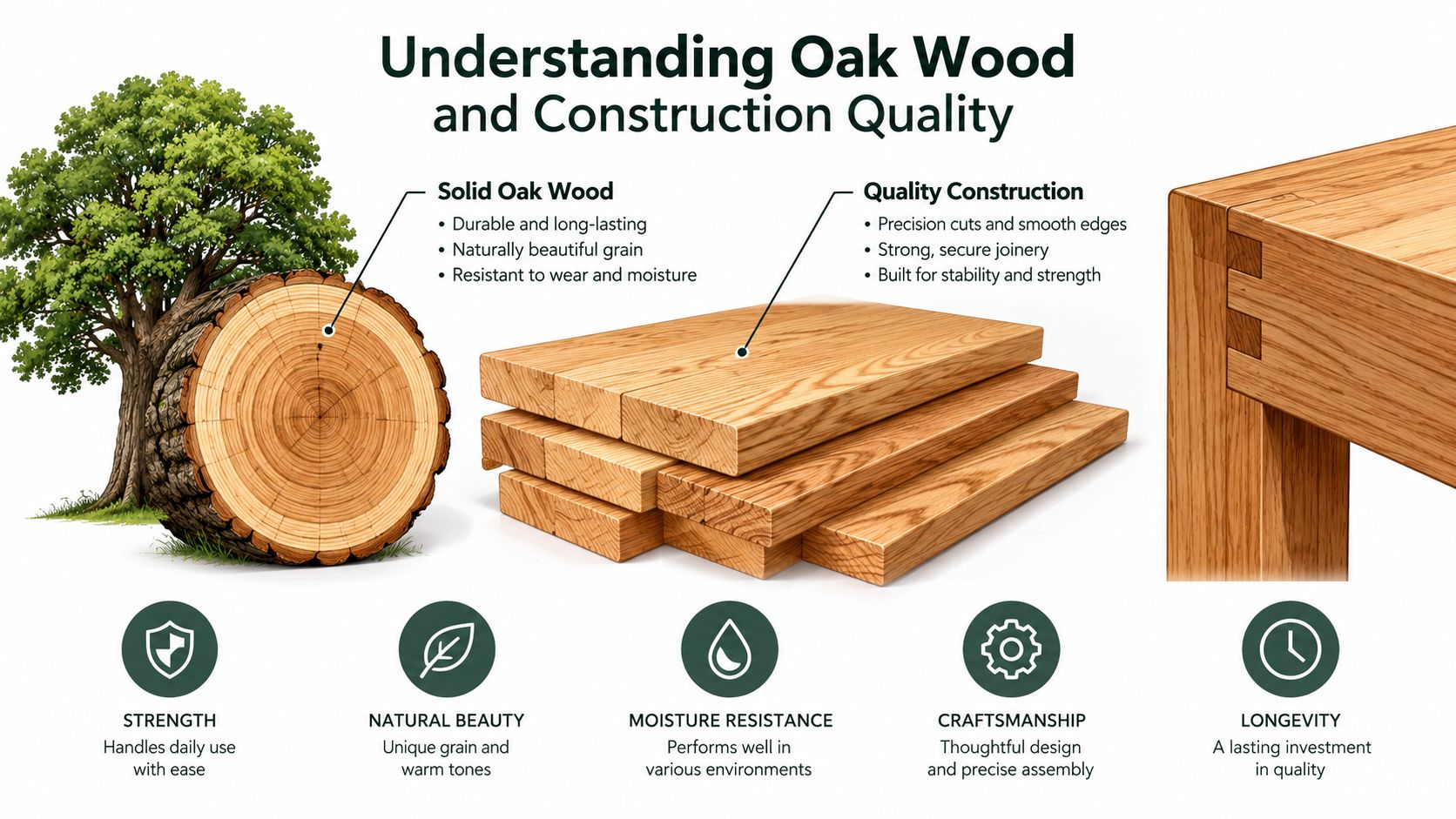
A chest labeled “oak” can be built in more than one way, and the label alone does not tell you how much of the piece is doing the work. Some chests use solid oak throughout, while others use oak veneer over a stable core, or a mix of solid parts and engineered components. The right choice depends on which parts need strength, which parts only need a clean finish, and how the chest will be used day to day.
Solid oak gives you visible grain, a solid feel when you lift a drawer front, and the option to refinish the piece later if the finish wears down. Per furniture wood standards, oak is commonly reported at about 0.75 g/cm³ density, with 1,200 to 1,300 lbf Janka hardness, roughly 14,000 psi bending strength, and radial and tangential shrinkage near 4% and 9% respectively. Those traits help explain why oak shows up so often in casegoods that need to hold up under regular use.
Solid wood, veneer, and mixed construction
Solid oak is usually most useful where the chest takes the most wear, such as drawer fronts, legs, rails, and structural framing. Veneer is a real oak surface layered over another material, and that can be a smart choice when the builder wants a stable panel with the look of wood. A veneered surface is not a shortcut by itself. In the right place, it can help the chest stay flatter and more predictable as seasons change.
BILTRITE's guide to choosing hardwood for longevity and style is useful here because it helps shoppers see how wood choice and construction work together. A chest with solid front rails, sound drawer boxes, and a stable case can outlast a piece that looks heavier but was built without much thought for movement or support.
Why wood movement matters
Oak is strong, but wide panels still move with humidity. That is where many shoppers get tripped up. A broad solid-wood front behaves a little like a wooden floorboard. It can expand and contract across the grain, so a good builder has to leave room for that movement instead of forcing every part to stay fixed. The result should be a chest that feels tight and well made, not one that fights the seasons.
A quick inspection helps:
- Look at broad panels: Grain should run naturally, without splitting, lifting edges, or stress marks.
- Study the finish: It should look even and feel smooth, not thick in some spots and rough in others.
- Ask what is solid: A helpful salesperson should be able to point out which parts are solid oak and which parts use veneer or another stable material.
- Check the back and underside: These areas often show whether the maker paid attention where buyers do not usually look.
Oak also stays easy to live with because it is familiar in durable furniture. That matters for a family choosing one chest that needs to fit a bedroom now and still make sense after a move, a remodel, or a change in style.
Checking Joinery and Hardware for Longevity
A chest can have a lovely finish and still disappoint if the drawers are poorly built. The most useful inspection happens with the drawers open, the chest gently tested for movement, and the hardware examined rather than admired from across the room.
Start with the carcass. Place both hands on opposite upper corners and apply gentle pressure. A well-assembled chest should feel stable, not twist noticeably from side to side. Next, open each drawer slowly. Watch for uneven gaps, scraping, sudden drops, or a drawer that needs to be lifted before it closes.
Inspect the drawer boxes
Look inside the drawer rather than stopping at the front. Dovetail joints at the front and back show that the builder designed the box to resist pulling forces. A strong drawer bottom should sit securely and shouldn't feel loose when the drawer is moved.
Corner blocks and reinforced rails also deserve attention. These parts help keep the case square and distribute stress as drawers are loaded and opened. Mortise-and-tenon construction is another useful term to understand, and BILTRITE's explanation of mortise-and-tenon joints gives shoppers a clear look at why interlocking wood joints matter.
Test the slides
Full-extension metal slides let the drawer travel farther out, making it easier to reach clothing at the back. They should move smoothly and without excessive side-to-side play. A loaded drawer puts more demand on the slides, so hardware that already feels loose when empty deserves caution.
Use this quick showroom check:
- Pull every drawer fully open.
- Place a hand on each side and test for excessive wobble.
- Close the drawer slowly and listen for grinding or slamming.
- Look for consistent spacing between drawer fronts.
- Check whether the chest includes an anti-tip design or requires drawers to be opened one at a time.
A useful test: If a drawer feels awkward when empty, clothing won't make it feel better.
Solid wood naturally responds to changes in household humidity. The best construction doesn't try to prevent all movement. It gives the wood room to move while keeping the joints strong and the drawers aligned. That distinction separates thoughtful furniture making from a simple box with hardware attached.
Choosing the Right Size for Your Space
A six-drawer chest should fit the wall, the walking path, and the people using it. Measure the wall, but don't stop there. Doorways, stair turns, hallways, and the clearance needed to open drawers all affect whether the piece will work once it reaches the bedroom.
A useful benchmark for a chest in the 120 to 135 cm width class is approximately 78 to 86.5 cm high and 36 to 47.3 cm deep based on these oak chest dimensions. A shallower case helps circulation in a narrow room, while a deeper case can accommodate larger drawer boxes and offer more stability when loaded.
| Width | Depth | Height | Room Fit |
|---|---|---|---|
| 120 cm | 36 cm | 78 cm | Helpful for a narrower bedroom or tighter circulation |
| 135 cm | 47.3 cm | 86.5 cm | Better for a larger wall and deeper storage needs |
Compare the trade-offs
The narrower example keeps the visual mass lighter and leaves more room for movement around the bed. The deeper option offers more room inside each drawer, but it takes more floor space and may create a heavier delivery and placement challenge.
Before visiting a showroom, shoppers can mark the proposed footprint with painter's tape. That simple outline shows whether the chest interferes with a closet door, blocks an outlet, or leaves too little room to stand comfortably while dressing.
BILTRITE also serves shoppers who need small-scale furniture for apartments, condos, smaller homes, and senior living spaces. The furniture measuring guide can help households record the dimensions that matter before they start comparing pieces.
Don't forget vertical clearance. A mirror, artwork, television, or window trim may limit the chest's usable height. Measuring the delivery route is just as important as measuring the bedroom wall, particularly for a dense oak case that may be difficult to reposition after delivery.
Creating a Cohesive Bedroom Look
Oak gives a bedroom a natural starting point, but the chest shouldn't have to match every other piece exactly. A coordinated room usually feels more comfortable when the furniture shares a few visible qualities, such as wood tone, hardware finish, leg shape, or overall scale.
A warm oak chest can sit comfortably beside matching nightstands, a taller chest, or a bed with a related finish. In a traditional bedroom, visible grain and substantial rails can reinforce a settled, classic feeling. In a modern farmhouse room, simpler hardware and cleaner lines can make the same wood feel relaxed and current.
Build around the room's anchor
The chest may be the first new piece, or it may need to join furniture already in place. If the existing bed has a strong finish, shoppers can look for an oak tone that complements it rather than trying to create an identical match. A small difference in wood tone often looks intentional when the shapes and hardware connect.
For a nursery or guest room, a six-drawer chest can provide useful storage without requiring a complete suite immediately. In a primary bedroom, it can balance a longer dresser or supply a separate clothing zone for another household member.
Coordinate without overmatching
A cohesive arrangement might use:
- Related wood tones: Warm finishes can sit together even when the grain patterns differ.
- Shared hardware details: Similar metal tones connect pieces across the room.
- Balanced proportions: A broad chest looks more natural beside a substantial bed than a very delicate frame.
- One contrasting element: A different nightstand style can add personality without making the room feel scattered.
The aim is a room that feels collected, not copied. BILTRITE's guide to mixing furniture styles can help shoppers combine pieces while keeping the overall look intentional.
A showroom makes these decisions easier because wood finishes can look different under indoor lighting than they do on a screen. Bringing a finish sample, room photo, or measurements can help the sales team suggest combinations without taking over the decision. BILTRITE's associates bring more than 400 years of combined experience, so shoppers can ask practical questions about scale, storage, and coordinating bedroom pieces.
Simple Care for Lasting Beauty
Oak furniture doesn't need a complicated routine. Dust, spills, sunlight, and moisture are the main everyday concerns, and simple habits protect the finish before small problems become frustrating repairs.
Begin with a soft, dry cloth. Dust gently with the grain, and pay attention to drawer pulls, upper edges, and the corners where buildup collects. If a spill occurs, wipe it promptly with a lightly damp cloth, then dry the area rather than allowing moisture to sit on the finish.
A low-effort care routine
- Dust regularly: A soft cloth keeps grit from rubbing against the finish during ordinary use.
- Use water sparingly: Excess moisture can dull or damage some finishes.
- Avoid harsh cleaners: Strong chemicals may affect the finish or leave a cloudy surface.
- Protect the top: Coasters, trays, or fabric-lined organizers can help prevent scratches and marks.
- Open drawers evenly: Distributing clothing across the six drawers reduces unnecessary strain on one area.
- Keep the room stable: Oak responds to humidity changes, so avoid placing the chest beside a heat source or in a damp location.
Direct sunlight deserves special attention. Strong, repeated exposure can gradually alter warm wood tones, so positioning the chest away from intense sun helps preserve its appearance. Curtains or blinds can add protection when the room receives bright afternoon light.
Know when to ask for help
A sticky drawer shouldn't be forced. Remove some contents, inspect for an obstruction, and check whether the drawer is sitting correctly on its slides. Repeated binding may signal alignment or seasonal movement that deserves professional attention.
For a finish-specific routine, BILTRITE's wood furniture cleaning guide offers additional practical direction. Care instructions can vary by finish, so the manufacturer's guidance should take priority over improvised cleaning products.
BILTRITE Furniture-Leather-Mattresses offers solid-wood, USA-made, and Amish-made furniture, along with bedroom pieces for smaller spaces and heavier household use. Visit BILTRITE Furniture-Leather-Mattresses in Greenfield to open the drawers, compare oak finishes, and talk with the local team about a chest that fits the room and daily routine.