




Lift Chair Dimensions: A Complete Sizing Guide

A family may already have a lift chair picked out by color and upholstery, only to discover that the user's feet don't rest on the floor or that the chair can't clear the hallway. Those surprises are avoidable. The right lift chair dimensions start with the person's body, then account for the chair's movement and the home's delivery path.
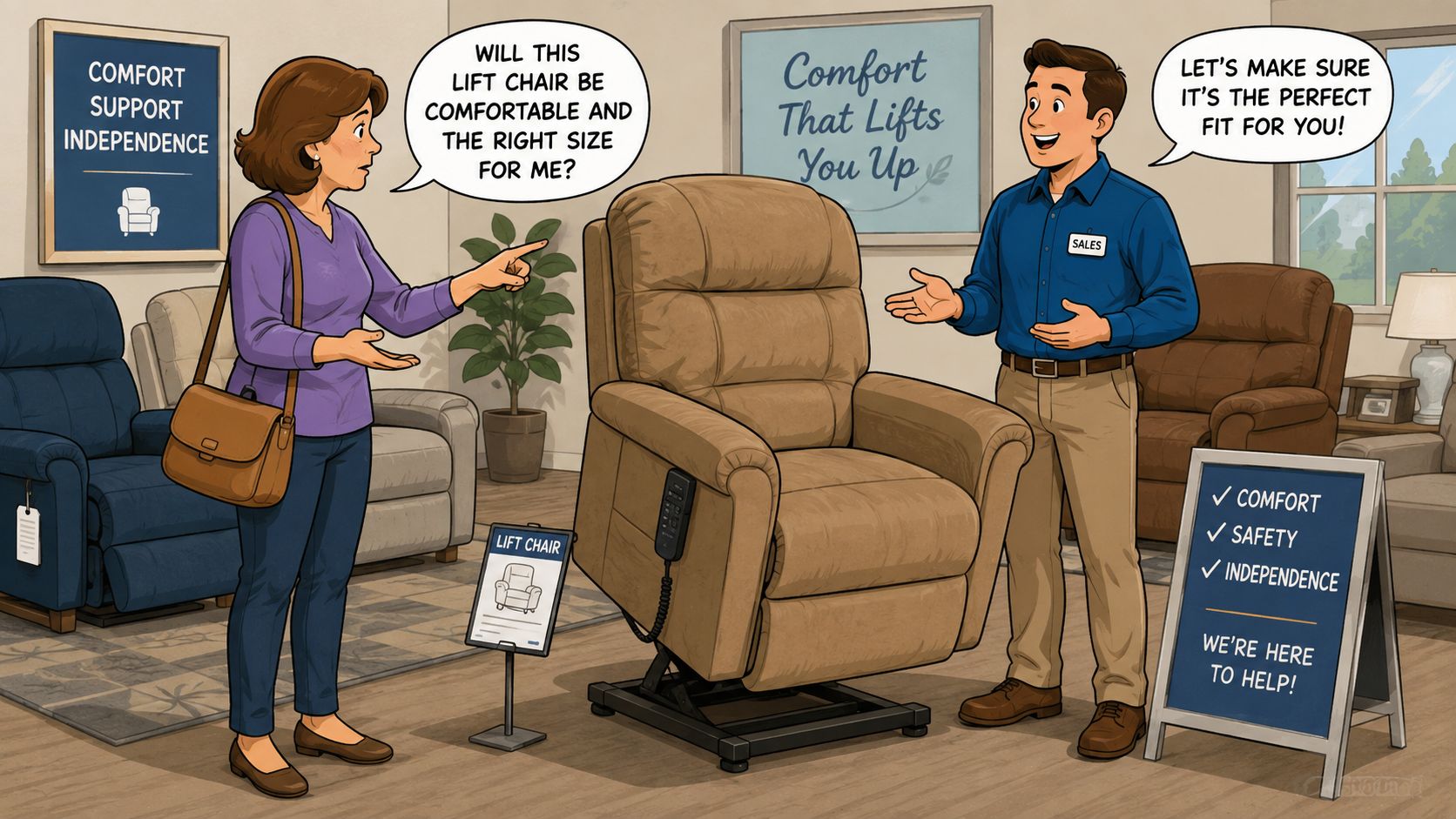
At BILTRITE, a fourth-generation, family-owned furniture store serving Metro Milwaukee since 1928, associates help shoppers test the fit in person instead of guessing from a specification sheet. A chair can look generously sized and still be too deep, too tall, or too wide for safe transfers. The goal is comfortable support, steady foot placement, and enough room for the chair to operate properly.
What Lift Chair Dimensions Mean
A shopper may sit in a chair that feels comfortable, then discover that its arms crowd the hips or its seat leaves the feet unsupported. Fit starts with the user's body and the room's available space. Manufacturers describe that fit through seat-to-floor height, seat depth, seat width, and backrest height. Pride Mobility's lift chair sizing guidance explains why these measurements should match the user rather than serve as universal standards.
The four measurements that shape comfort
- Seat width is the usable space between the arms. It should center the hips without side pressure. Excess width can also place the armrests too far away during transfers.
- Seat depth extends from the front of the cushion toward the backrest. It supports the thighs, while excessive depth can prevent the user from sitting fully back.
- Seat-to-floor height measures from the top of the cushion to the floor. It affects whether the feet rest firmly before the lift function begins.
- Backrest height runs from the seat surface to the top of the back. It indicates where the chair supports the lower back, shoulders, neck, and head.
Use the outside width for delivery and room planning, not as a shortcut for sitting space. One healthcare lift chair specification lists an overall width of 33 inches and an arm-to-arm seat width of 21 inches. The difference shows why this guide to standard chair width is useful context when planning furniture placement.
Manufacturers also group chairs by size categories, and those categories can differ substantially. Small models may measure 18 to 19 inches in seat-to-floor height, 18 to 19 inches in seat depth, and 18 to 20 inches in seat width. Large-tall models may reach 20.5 to 21.5 inches in seat height. XXL models can provide a 30-inch seat width and 22-inch seat depth, with overall widths reaching 43 inches. These figures describe a starting category, not a guaranteed personal fit. The user's measurements and the home's clearance still decide whether the chair works.
How to Measure Yourself for the Right Fit
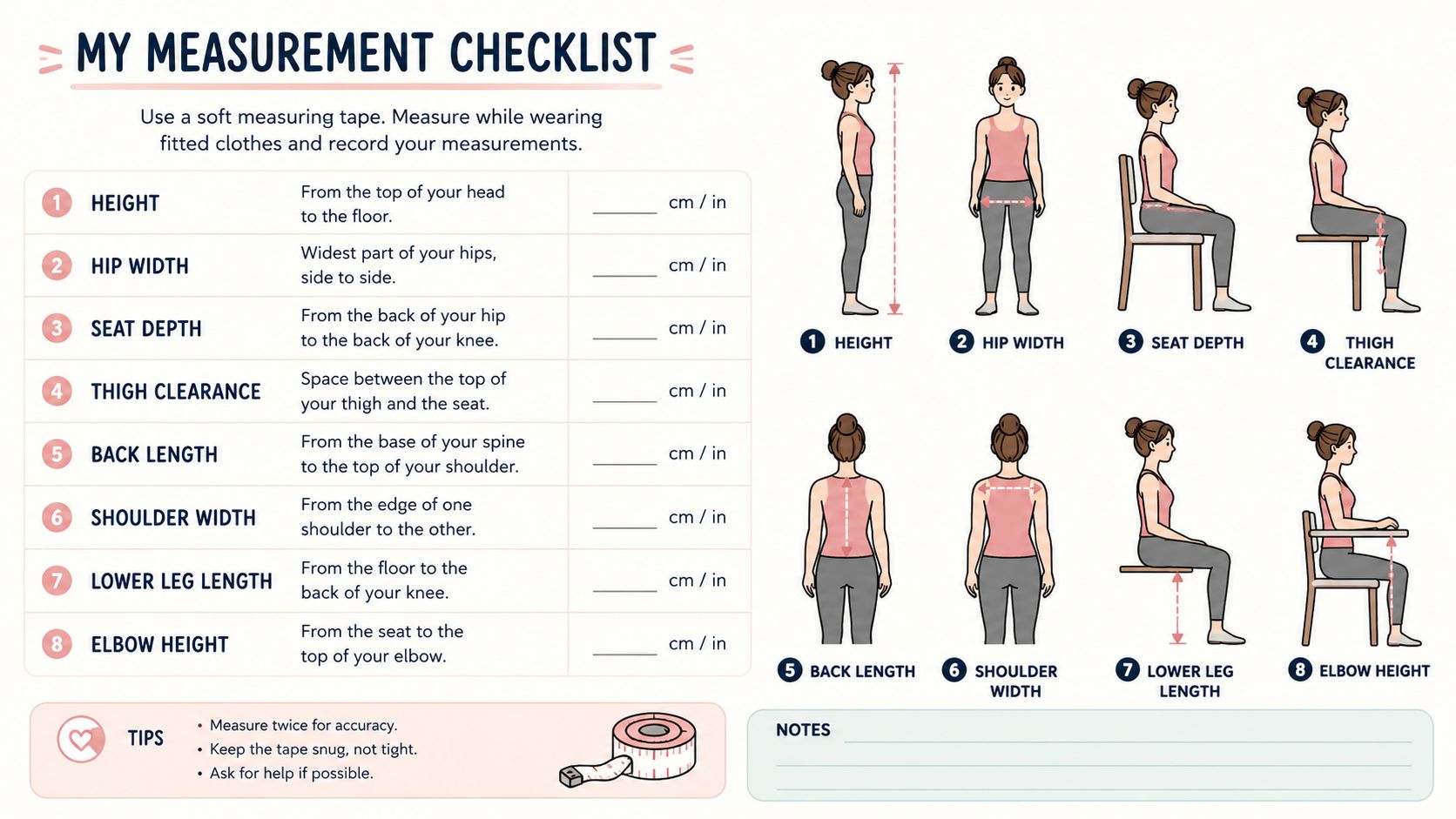
A few careful measurements can make a showroom visit much more productive. The person who'll use the chair should be measured while seated in a supportive, firm chair, not while standing in loose clothing or estimating from height alone.
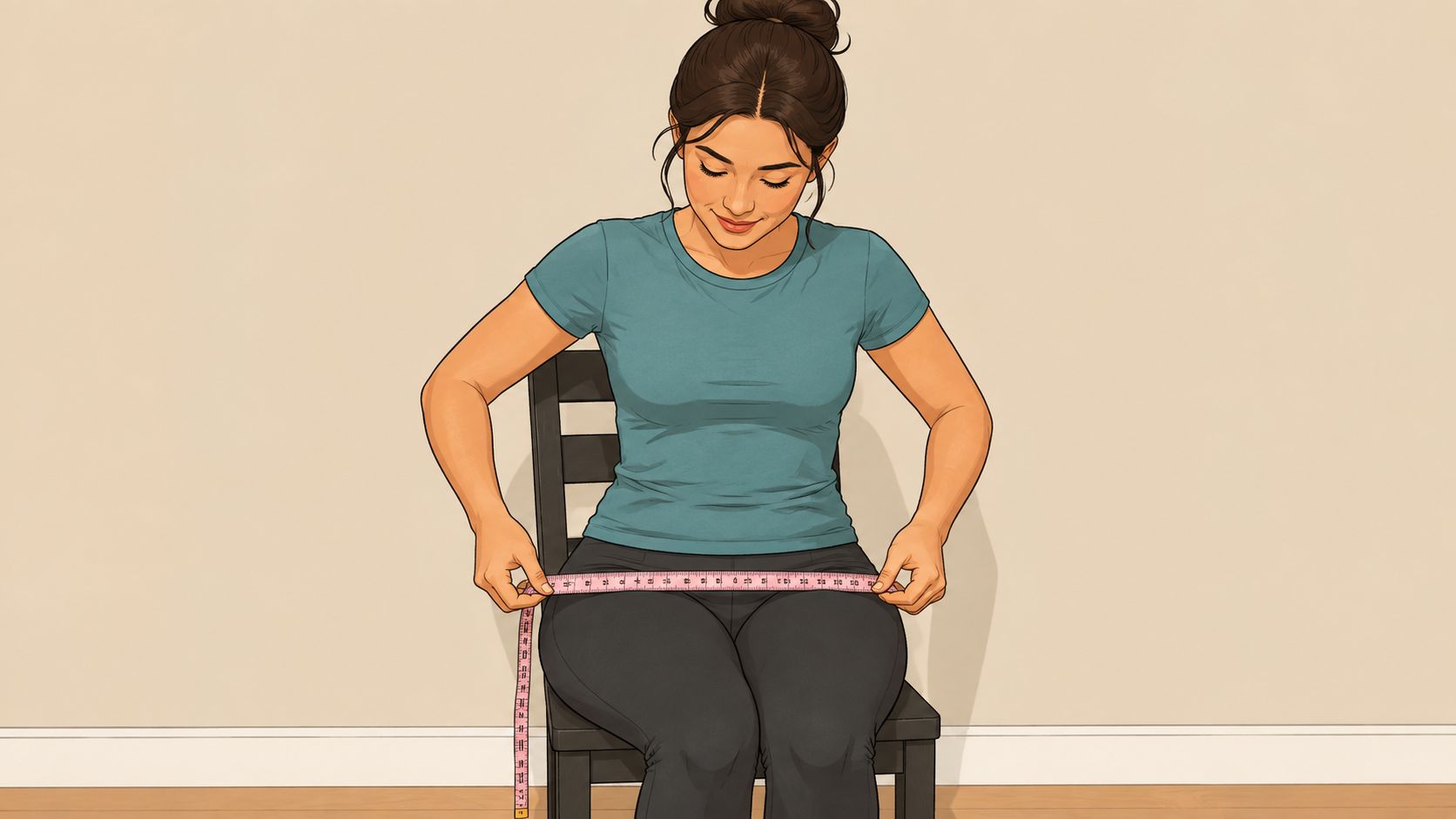
Start with the seat width
Have the user sit upright with both feet supported. Measure across the widest part of the hips or thighs, keeping the tape horizontal. Add comfortable room rather than choosing a seat that matches the body exactly.
The measurement should be compared with the chair's usable seat width, not its outside arm-to-arm width. Arms, padding, and side bolsters can reduce the space that's available for sitting. A little room helps the user sit naturally, but excessive width can make the armrests harder to reach during transfers.
Find the useful seat depth
With the user's back against a flat wall and knees bent comfortably, measure from the back of the buttocks to the back of the knee. The chair's seat should support much of the thigh without pushing into the area behind the knees.
A practical showroom test is simple. The user should sit all the way back, then check whether there's a small gap between the cushion edge and the back of the knees. If the knees are pressed forward by the cushion, the seat may be too deep. If a large portion of the thighs hangs unsupported, it may be too shallow.
Set the seat height target
Measure from the floor to the crease behind the knee while the user stands barefoot, or use a seated position with the feet flat and knees comfortably bent. This gives the associate a useful starting point for comparing seat-to-floor heights.
The correct height should allow the feet to make firm contact before standing. Feet that dangle can reduce stability, while an overly low seat can make the user work harder to rise. For more furniture measuring help, families can use BILTRITE's furniture measuring guide.
Record back length
While seated upright, measure from the seat surface to the top of the shoulders and note whether the user needs head and neck support. Back height varies with chair design, so a tall person may need a taller back even when the seat width looks suitable.
Write all four measurements on paper or in a phone note. That small step prevents repeated guesswork when several chairs look similar.
Standard Lift Chair Sizes by Category
A “small” lift chair can fit one person well and feel cramped for another. Manufacturers use labels such as petite, small, medium, large, and XL or tall to organize collections, but the labels are not standardized. Treat them as a first filter. Your body measurements and the room's available space make the final decision.
The chart below shows common patterns from published sizing information. Use the ranges to narrow your search, then compare each model's actual seat width, seat depth, seat-to-floor height, and back height.
Standard lift chair size categories and typical dimensions
| Size Category | User Height Range | Seat Width | Seat Depth | Seat-to-Floor Height | Back Height |
|---|---|---|---|---|---|
| Petite | Under 5 feet | 18 to 20 inches | 18 to 19 inches | 18 to 19 inches | Shorter back |
| Small | About 5 feet to 5 feet 3 inches | 18 to 21 inches | 18 to 20 inches | 18 to 20 inches | Short to medium back |
| Medium | About 5 feet 2 inches to 5 feet 6 inches | 20 to 22 inches | 19 to 21 inches | 19 to 20 inches | Medium back |
| Large | About 5 feet 4 inches to 5 feet 10 inches | 21 to 24 inches | 20 to 22 inches | 20 to 21 inches | Taller back |
| XL or tall | Up to 6 feet 8 inches | 24 inches and wider | 22 inches | 20.5 to 21.5 inches | Extended back |
Published charts show smaller models with seat widths from 18 to 20 inches, while XXL models can reach 30 inches. Seat depth commonly runs from 18 to 19 inches in smaller chairs to 22 inches in XL and XXL models. Seat-to-floor heights range from 18 to 19 inches up to 20.5 to 21.5 inches. Overall width may also increase from 33 to 37 inches in small chairs to 43 inches in XXL chairs, so the category affects room planning as well as seating comfort.
A petite chair is not a large chair made narrower. Its cushion proportions, seat height, and back support are adjusted together. For compact users or smaller rooms, BILTRITE's small lift chair guide offers a useful way to review those design considerations.
Heavy-duty categories add a separate fitting question. They may include broader seat pans and stronger construction, but their larger outside footprint still needs to fit the room and delivery path. Start with the user's measurements, then check the category and the complete specification sheet. The label should confirm the fit, not decide it.
Reading a Lift Chair Specification Sheet
A specification sheet can look like a collection of disconnected numbers. The easiest way to read it is to translate each line into a question about the user, the room, or the delivery route.
One representative healthcare lift chair lists 33 inches of overall width, 43 inches of overall height, 64 inches of reclined length, 30 inches of back width, 21 inches of seat width between the armrests, 19 inches from the seat to the floor, 20 inches of seat depth, 7 inches of armrest height above the seat, and 29 inches from the seat to the top of the back. The manufacturer specification sheet demonstrates why shoppers need more than one dimension.
Decoded lift chair specification sheet
| Spec Line | What It Means | Why It Matters |
|---|---|---|
| Overall width | Outside measurement from arm to arm | Determines room fit and doorway clearance |
| Overall height | Floor to the top of the chair | Helps plan visual scale and overhead surroundings |
| Overall length reclined | Front-to-back space when fully open | Determines wall distance and room clearance |
| Seat width | Usable space between the arms | Must accommodate the hips without excessive looseness |
| Seat depth | Front edge of cushion to back support | Affects thigh support and knee pressure |
| Seat-to-floor height | Cushion surface to floor | Influences foot placement and standing transfers |
| Back height | Seat surface to top of backrest | Supports the user's torso, shoulders, neck, or head |
| Armrest height | Seat surface to top of the arm | Affects reach, pushing support, and transfer control |
The reclined length deserves special attention. In the example above, the chair extends to 64 inches, which is more than 5 feet of front-to-back space. A chair can fit upright beside a wall and still block a walkway when fully reclined.
Cushion firmness also changes how the dimensions feel. Two chairs with identical listed measurements may support the body differently if one cushion compresses more under the user's weight. Comparing several models side by side, then testing the lift and recline positions, gives a more reliable answer than relying on marketing language.
Doorway Hallway and Room Clearance
A lift chair can fit the planned room and still stop at the front door. Treat delivery like tracing a route on a floor plan, starting outside and checking every point where the chair must pass, turn, or rest.
Begin with the narrowest clear opening, rather than the door slab's stated size. If the door swings into the route, measure with it removed from the usable width. Include trim, railings, corners, stair landings, elevators, and ramps. Compare that tightest opening with the chair's packaged or upright width, and allow room for the delivery team to handle it safely.
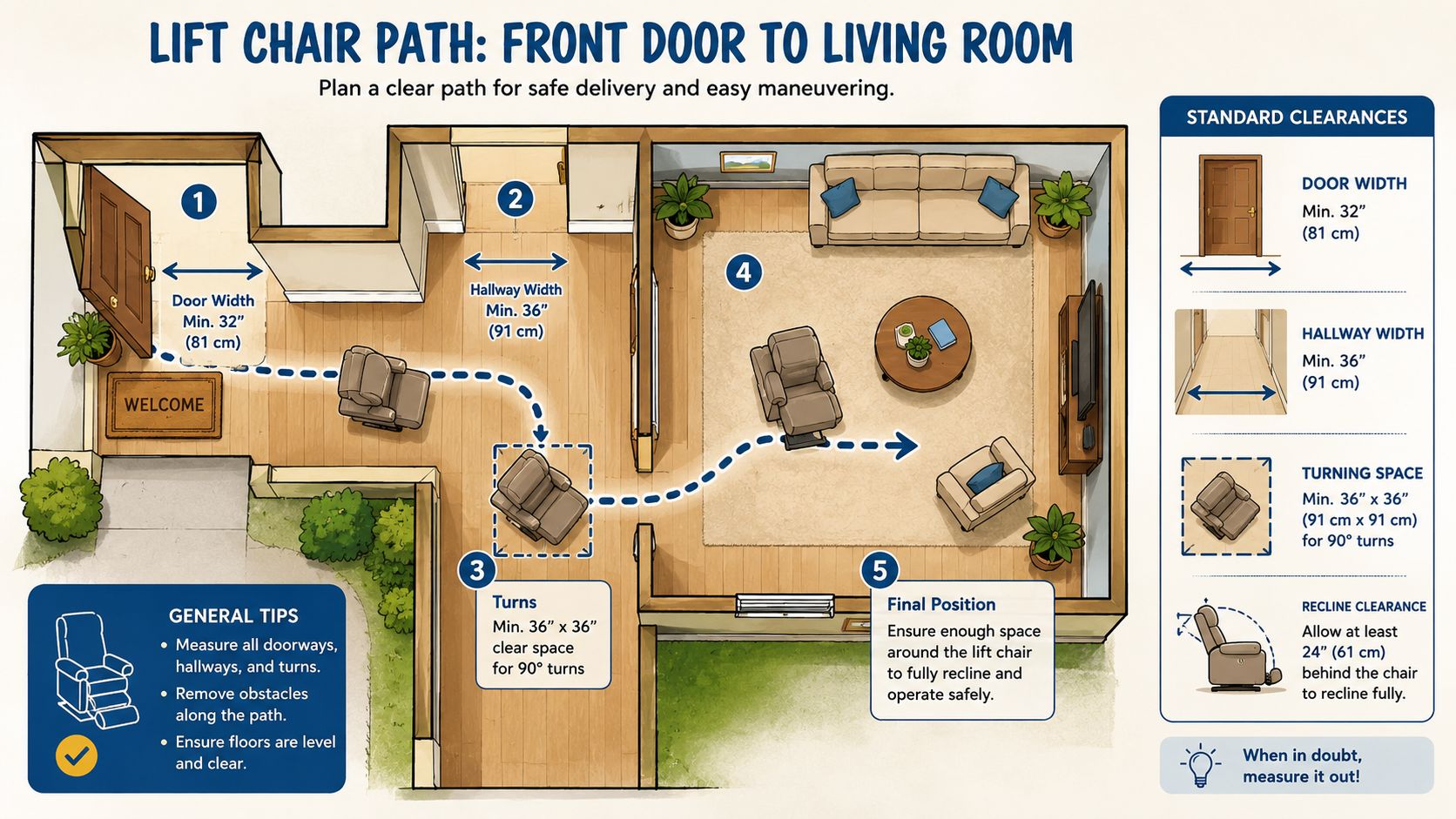
Walk the route in sequence:
- Front entry: Check the clear width with the door fully open. Record the threshold height and any tight turn just inside.
- Hallway: Look for pinch points between walls, furniture, and handrails. One narrow corner can matter more than a long, open corridor.
- Stairs and landings: Measure landing depth and turning space. A straight stair run requires a different plan from a turn at either end.
- Final room: Mark the chair's upright footprint, then trace the space needed for the footrest and reclined back. Include tables, lamps, vents, and walking paths.
- Special access: Check elevator doors, narrow ramps, and shared building corridors before delivery is scheduled.
Use painter's tape to make the measurements visible. Mark the outside footprint on the floor, extend the tape toward the expected footrest and reclined back, and preserve room for transfers, cleaning, and circulation.
Width and reclined length must be reviewed together. A chair may pass through the entry and fit beside the wall, yet occupy the main walkway when opened. For difficult entrances, BILTRITE's furniture for narrow doorways offers a useful starting point for reviewing delivery-friendly furniture options.
Matching User Height to Seat Dimensions
Height helps narrow the field, but it isn't the final measurement. Two people of the same height can have different leg, torso, and thigh proportions. The best match combines height guidance with seat depth, seat-to-floor height, and back support.
Published sizing guidance maps seat heights to user height bands. One independent guide lists a seat height of about 47 centimeters for people under 160 centimeters tall, 48 centimeters for users from 160 to 172 centimeters, and 51 centimeters for users from 175 to 188 centimeters. The buyer's sizing guide provides those reference points.
How the match affects daily movement
Shorter users often need a shorter seat depth and lower seat height. If the cushion extends too far forward, the user may slide forward instead of keeping the back against the support. If the seat sits too high, the feet may lose firm contact with the floor.
Taller users generally need more room under the thighs and a taller back. A deep seat can provide useful thigh support when it matches leg length, while a short seat may leave the knees bent sharply and unsupported. Published sizing information also lists common seat heights around 47 to 51 centimeters and seat depths around 69 to 74 centimeters across lift chair size ranges. The lift chair history and sizing account shows how manufacturers use body proportions, not just general furniture labels, to organize models.
User height to recommended seat dimensions
| User Height | Seat-to-Floor Height | Seat Depth | Back Height |
|---|---|---|---|
| Under 5 feet | About 18 to 19 inches | About 18 to 19 inches | Shorter support |
| 5 feet to 5 feet 3 inches | About 18 to 20 inches | About 18 to 20 inches | Short to medium support |
| 5 feet 2 inches to 5 feet 6 inches | About 19 to 20 inches | About 19 to 21 inches | Medium support |
| 5 feet 4 inches to 5 feet 10 inches | About 20 to 21 inches | About 20 to 22 inches | Medium to taller support |
| Taller users | About 20.5 to 21.5 inches | About 22 inches | Taller or extended support |
These ranges overlap because body shape varies. The chair should be tested with the user's back against the backrest, heels supported, and hands able to reach the armrests or remote without stretching.
Weight Capacity and Heavy Duty Options
Weight capacity is part of fit, not a separate detail. The frame, lift mechanism, motor, seat springs, and arms all need to support the intended user safely and repeatedly.
A standard chair's rating should be treated as a firm limit. Choosing a chair with a rating that comfortably accommodates the user helps avoid unnecessary strain on the mechanism. Families should also ask whether the published rating describes a static load, a moving load, or another testing condition, because the label alone doesn't explain every use situation.
Compare the full group of dimensions
| Capacity Tier | Weight Rating | Typical Seat Width | Typical Seat Depth | Best For |
|---|---|---|---|---|
| Standard | Confirm the manufacturer's rating | Standard category width | Standard category depth | Users who fit conventional proportions |
| Wide | Confirm the manufacturer's rating | Wider than standard | Standard to deeper | Users needing additional hip room |
| Heavy duty | Confirm the manufacturer's rating | Broad seat pan | Deeper, model-dependent | Users needing stronger construction and more space |
Exact capacity ratings vary by model, so the product specification must supply the number. The same rule applies to seat width and depth. A chair can carry the required load and still be a poor fit if the user cannot reach the arms or keep the feet supported.
BILTRITE's lift chair weight capacity guide offers a practical place to review the questions that belong together. Families should verify the maximum user weight, usable seat width, seat depth, overall width, and motor design before selecting a heavy-duty option.
Reinforced arms matter during transfers, but they shouldn't replace proper technique or clinical guidance. Anyone with significant mobility limitations should involve a healthcare professional in the decision, especially when the chair will be used for extended periods.
When Standard Sizes Are Not the Answer
A larger chair does not automatically create a better fit. Start with the user's body and transfer needs, then check whether the chair leaves enough room to operate safely in the home. The seat should support the hips and thighs while keeping the lower legs positioned comfortably.
A chair that is too wide may place the armrests beyond an easy hand position. During lifting, the user could reach or lean farther than intended. Excessive seat depth can keep the back from meeting the backrest, encourage sliding, and press behind the knees. These issues can make the movement feel less controlled.
Fit problems often appear in small details:
- Too tall: The feet may not rest securely on the floor, reducing stability before lifting begins.
- Too short: The knees may sit higher than the hips, creating pressure and a cramped rise.
- Too deep: The user may slide forward or slouch to relieve pressure behind the knees.
- Too shallow: The thighs lose support, and the back may not stay in steady contact.
- Too wide: The user may have difficulty reaching the arms while preparing to stand.
- Too narrow: The hips and thighs may press against the arms during longer sitting.
Practical rule: Bigger should mean more usable room for the individual, not just more inches everywhere.
The lift mechanism also depends on positioning. With suitable proportions, the chair can guide the body forward and upward in a controlled motion. With unsuitable proportions, the movement may feel as if it tips the user forward instead of supporting a steady transfer.
Standard categories do not fit every body. A compact model, another size class, or a custom option may better match unusual proportions, limited knee flexion, edema, or difficulty reaching the armrests. In those situations, test the chair with the user seated fully back, feet positioned naturally, and hands placed where they would support a transfer. That practical check connects the specification sheet to the person who will use the chair.
Custom Orders and the Showroom Experience
A showroom visit makes measurements easier to judge. A shopper who feels comfortable at home may still need to test how a particular chair supports sitting, lifting, and reclining. An associate can guide the user into the intended position, then check whether the chair's proportions and controls work naturally.
Custom ordering helps when a standard category leaves one fit detail unresolved. Depending on the chair line, available choices may include adjusted seat width, longer or shorter seat depth, a taller backrest, or reinforced construction. Remote placement, upholstery, and other comfort features may also be configurable.
Bring the whole household into the decision. Fabric or leather samples let family members consider texture, cleaning needs, and the room's style. Some chairs can be ordered with fabric, leather, wood, finish, or hardware choices, while other models are available from stock.
A useful showroom visit includes these checks:
- Transfer test: The user tries the lift motion with feet positioned naturally and hands resting where they can provide support.
- Recline test: The chair opens fully while staff check the available room and the position of the user's head, back, and legs.
- Reach test: The remote is placed where the user can operate it without twisting or leaning.
- Delivery review: The route from the entrance to the final location is discussed before an order is placed.
BILTRITE Furniture-Leather-Mattresses offers lift chairs alongside small-scale, heavy-duty, USA-made, Amish-made, and solid-wood furniture, plus a mattress department with over 60 models. The store's associates bring over 400 years of combined experience. Families can compare chairs in person, ask practical questions, and decide whether a stock model or custom order better suits the user and the room.
Quick Reference Checklist for Lift Chair Sizing
Use this list before leaving home or visiting a showroom:
- Measure height: Use it as a starting point for the chair category.
- Measure hip width: Compare it with usable seat width, not outside width.
- Measure seat depth: Match thigh length while keeping pressure off the knees.
- Measure back length: Check that the backrest supports the torso and head as needed.
- Verify seat height: Confirm that both feet can rest firmly on the floor.
- Measure the delivery route: Check every doorway, hallway, corner, stair landing, and elevator.
- Mark the room footprint: Tape the upright and reclined positions on the floor.
- Verify weight rating: Match the manufacturer's capacity with the intended user.
- Test the chair: Sit for at least five minutes, operate the lift, and try the recline.
BILTRITE Furniture-Leather-Mattresses offers lift chairs, small-scale and heavy-duty furniture, USA-made and Amish-made pieces, and a large mattress selection for Metro Milwaukee families. Visit BILTRITE Furniture-Leather-Mattresses in Greenfield to test lift chair dimensions in person, review the delivery path, and talk with an experienced associate about what fits the user and the home.