Luxury Mattress Toppers: Upgrade Your Sleep in 2026


You know the feeling. A mattress that used to feel fine now leaves shoulders sore, hips cranky, or your lower back stiff by breakfast. A luxury mattress topper can look like the easy fix, and sometimes it is, but the smart question is simpler than most shoppers expect, does it improve the bed you already own, or is the mattress itself too far gone?
For Milwaukee shoppers trying to stretch a bedding budget without giving up comfort, that question matters. A topper can add softness, pressure relief, and a little more life to a mattress that's still sound, but it can't rebuild support that's already broken down. That's why luxury toppers deserve a careful look, not a rushed purchase.
What Makes a Mattress Topper Truly Luxury
A mattress can feel “okay” for years, then one morning it starts to feel a little too firm, a little too flat, or just worn out in the wrong spots. That's usually where a topper enters the conversation. In the sleep world, a topper is a separate comfort layer, usually 1 to 4 inches thick according to Consumer Reports' buying guide, and it's meant to change feel, not replace the mattress underneath.
Luxury is where the details start to matter. The global mattress topper market is being treated as a real growth category, not a tiny accessory niche, with one independent estimate valuing it at USD 1.85 billion in 2025 and projecting USD 3.15 billion by 2035 at a 5.6% CAGR over 2026 to 2035, while another forecast puts it at USD 2.8 billion in 2024 rising to USD 4.7 billion by 2033 at 5.9% CAGR. That growth tells a simple story, more shoppers are treating sleep comfort as an upgrade worth paying attention to.
What separates a premium topper
The jump from basic to luxury usually comes down to material quality, construction, and verification. Premium toppers tend to use better foam systems, latex, wool, down, feather, or blended builds, and the nicer ones are more likely to show meaningful certification, not just marketing language on the tag. For safety-minded buyers, OEKO-TEX STANDARD 100 Class I is the strictest consumer-grade textile certification mentioned in the sources, and buyers should check whether certification covers the whole product or only one layer (PureTree certification overview).
Practical rule: a luxury topper should feel intentional, not vague. If the label doesn't clearly explain the fill, thickness, and certification coverage, the product is probably selling the idea of comfort more than the comfort itself.
For a simple primer on what toppers do, BILTRITE's guide on what a mattress topper does is a helpful starting point for shoppers who want the basics before comparing materials.
Comparing Premium Materials and Their Benefits
A luxury topper isn't one thing. It's a category with very different sleep feelings inside it. Some toppers hug the body closely, some spring back quickly, and some feel fluffy and airy, which is why the right choice depends on what bothers someone most at night.
Memory foam, latex, down, wool, and feather
Memory foam is usually the go-to for pressure relief because it contours around shoulders, hips, and joints. In the topper market, memory foam held nearly 42% of global revenue in 2025 in one report, and that lines up with how often shoppers reach for it when they want a softer landing without giving up too much support. It can feel comforting, though warmer sleepers may want a cooling build.
Latex behaves differently. It offers responsive support with a little bounce, and its open-cell or pincore structure improves airflow and responsiveness compared with conventional memory foam. That makes latex a good fit for people who want pressure relief without sinking in too far.
Down and feather toppers lean plush and airy. They make sense for people who want a softer surface and a more traditional, hotel-style feel, but they won't contour the body the way foam does. Wool brings a different kind of comfort, with natural loft and temperature moderation, which can help sleepers who dislike the trapped feeling some foam layers create.
A simple way to think about trade-offs
| Material | Best For | Cooling | Durability | Price Range |
|---|---|---|---|---|
| Memory Foam | Pressure relief, body contouring | Moderate to lower, depending on build | Strong if density and construction are good | Usually higher |
| Latex | Responsive support, airflow | Better than conventional memory foam | Strong | Usually higher |
| Down | Plush softness, cloud-like feel | Good breathability | Moderate with proper care | Varies |
| Wool | Temperature balance, natural comfort | Strong | Good with proper care | Varies |
| Feather | Soft loft, traditional feel | Good breathability | Moderate | More affordable than premium foam or latex |
A nice shortcut is to think about what the sleeper wants to change. Softness, bounce, cooling, or pressure relief. A topper can do one of those things very well, but usually not all of them at once.
For shoppers comparing foam options, BILTRITE's gel mattress vs. memory foam page can help clarify how foam-based comfort layers differ before anyone decides on a topper style.
Understanding Thickness Density and Temperature Regulation
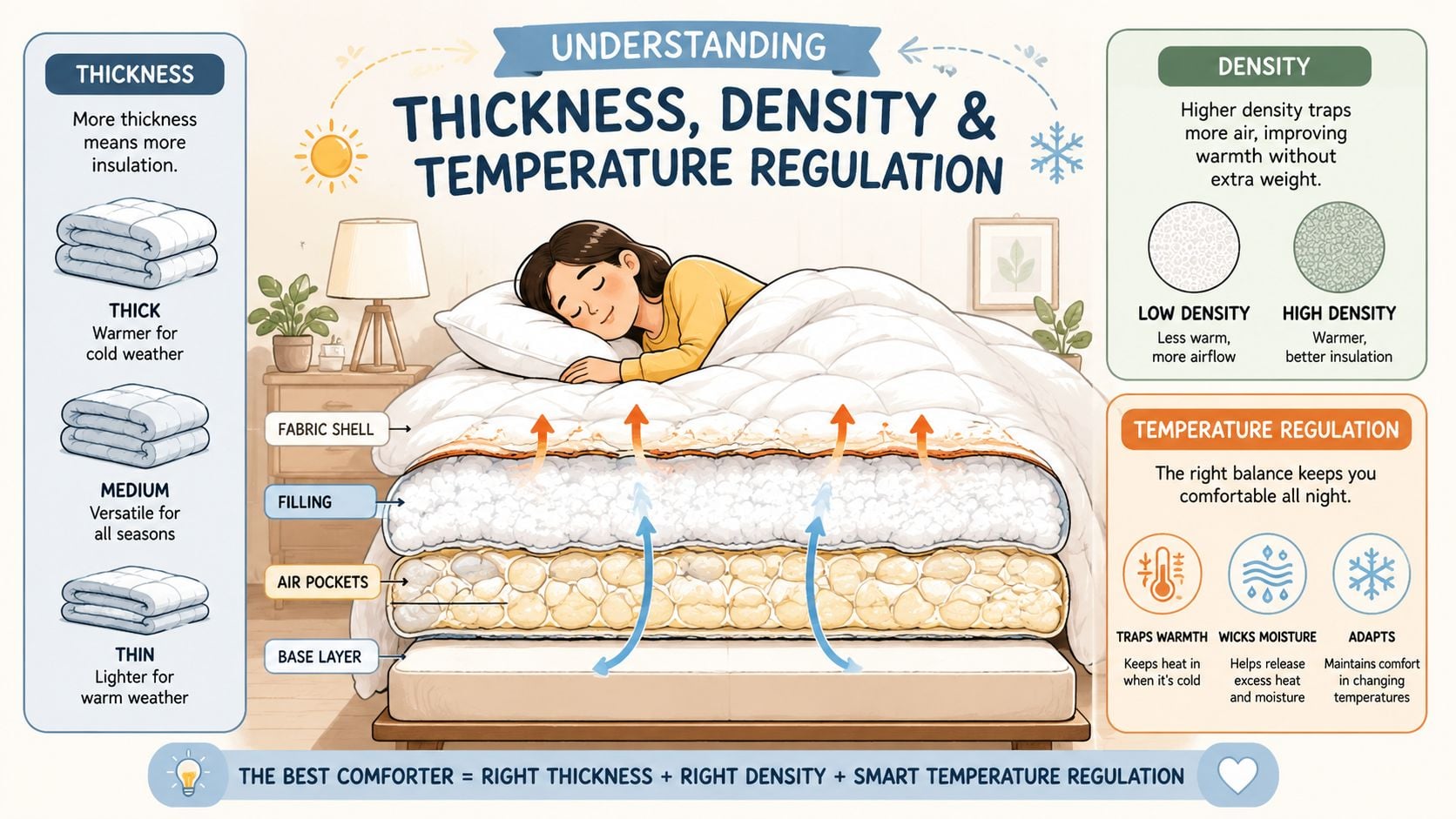
Specs sound technical until they are tied to sleep comfort. Thickness changes how much a topper alters the bed. Density affects how the topper holds up after months of use. Temperature regulation affects whether the bed still feels good at 2 a.m., not just when it first arrives in the home.
Thickness changes the feel first
A helpful starting point is the thickness range Consumer Reports gives, 1 to 4 inches. Thin toppers usually make a small adjustment to a bed that is only slightly off. Thicker toppers create a more noticeable comfort shift, almost like adding a new top layer over the mattress. A firmer mattress may need more thickness to feel meaningfully softer, while a mattress that already has some give may only need a lighter comfort layer.
Density is about staying power, not just softness
Density matters because it shapes how quickly a topper breaks down and how much support it keeps over time. A low-density foam topper can feel soft at first, then lose its shape too soon. A better-built topper keeps its loft longer, which is why shoppers should ask how the core is constructed, not just how plush it feels in the showroom. For a clearer way to read those numbers, BILTRITE's foam density ratings page is a useful guide.
Good comfort at bedtime means little if the topper collapses by the middle of the night or flattens out after a short stretch of regular use.
Cooling depends on the whole design
Temperature regulation is not about one magic feature. Latex usually sleeps cooler than traditional memory foam because of its open structure, while natural fills like wool and down breathe differently from foam. A hot sleeper should look for airflow, breathable covers, and materials that do not trap body heat. A cold sleeper may prefer foam or a loftier fill that holds warmth a little more.
For shoppers who want a clearer picture of what thickness, density, and heat control do together, this descriptive infographic on mattress topper thickness, density, and temperature regulation lays out the relationship in a simple visual.
When a Topper Can and Cannot Save Your Mattress
A topper can make a tired mattress feel better. It can soften a too-firm surface, add cushioning at pressure points, and help a decent mattress stay usable longer. That part is real, and it's why toppers are so appealing when a full replacement feels too expensive right now.
The line between comfort and repair
The hard truth is that a topper only changes the top feel. It does not rebuild the support core, fix broken springs, or erase deep body impressions. Independent guidance from AARP notes that toppers mainly change feel and can extend lifespan rather than solve structural support problems, and it specifically warns that they can't fully correct a mattress with deep body impressions, edge collapse, or support failure.
That's the key decision point. If the mattress is still structurally sound but feels a touch too firm, a topper may be a smart buy. If the bed sags in the middle, has obvious edge breakdown, or leaves the sleeper rolling into a dip, the topper is only masking the problem.
A quick decision check
- Use a topper when: the mattress feels hard, the surface is slightly uneven, or you want more pressure relief without changing the whole bed.
- Choose replacement when: the mattress has deep impressions, obvious sagging, or spring and support problems.
- Pause and compare both options when: the bed is old enough that comfort and support problems are showing up together.
Luxury toppers can still make financial sense in the right situation. But a comfort layer on top of a failing mattress is a temporary patch, not a fix.
BILTRITE's are mattress toppers worth it page fits this exact question, especially for shoppers trying to decide whether to upgrade the surface or start over with a new mattress.
Matching Toppers to Sleep Positions and Special Needs
Different sleepers need different kinds of help. That sounds obvious, but plenty of people buy a topper for “comfort” and end up with the wrong kind of comfort. A side sleeper, for example, usually needs pressure relief at the shoulders and hips, while a stomach sleeper usually needs a firmer feel so the midsection doesn't sink too far.
Match the topper to the sleeping position
Side sleepers usually do best with a topper that eases pressure without bottoming out. Memory foam often fits that goal because it cushions the body where it presses hardest. Back sleepers often need a blend of softness and support so the lower back doesn't sag, while stomach sleepers generally need less plushness and a flatter surface.
Couples should think about motion transfer too. Foam usually dampens movement better than more buoyant fills, which can matter a lot if one partner turns over often. Hot sleepers may want latex or a breathable natural fill, while sleepers who get cold easily may prefer a topper with more enveloping feel.
Special cases deserve special attention
Seniors often care about two things at once, comfort and mobility. A topper that is too soft can make getting out of bed harder, while one that is too firm can feel punishing on joints. The right balance depends on the mattress underneath and how much assistance the sleeper needs getting in and out of bed.
Good fit beats fancy material. The best topper for a sleeper is the one that corrects the actual discomfort, not the one with the loudest marketing language.
For readers comparing side-sleeper comfort layers, BILTRITE's best mattress topper for side sleepers page is a natural reference point.
Smart Shopping and Care for Long-Lasting Comfort
A good topper can still disappoint if it doesn't fit the bed, doesn't match the sleeper's needs, or wears out too quickly. That's why the practical steps matter just as much as the feel test. Measure first, ask questions second, and only then compare price.
A simple buying checklist
- Measure the mattress first: fit matters more than brand language, especially with oversized or deep mattresses.
- Check certification carefully: look for whether the claim covers the cover, core, and accessories, not just one piece.
- Compare the price band: NCOA reports queen-size toppers in its tested roundup at $235 to $532, which is a useful baseline for luxury shopping.
- Ask about lifespan: Consumer Reports says high-quality toppers generally last 3 to 5 years.
- Look for warranty coverage: Ideal Home recommends a 5 to 10 year warranty or guarantee because it lines up with the replacement window many experts expect for toppers and mattresses.
Care habits that help a topper last
Rotation helps even out wear when the design allows it. A protector can keep sweat and spills from reaching the fill, and regular airing helps many materials stay fresher. Care instructions matter more than shoppers think, especially with natural fills and higher-end foam systems.
If a topper is being tested in person, the sleeper should lie down long enough to notice whether shoulders sink too far, whether the lower back feels supported, and whether heat builds up too quickly. Those three checks usually reveal more than a quick hand press ever will.
Experience the BILTRITE Difference in Greenfield
Shopping a topper in person changes the decision. At BILTRITE Furniture-Leather-Mattresses in Greenfield, shoppers can compare sleep surfaces alongside a Mattress Center with over 60 models and 500+ mattresses in stock, then talk through comfort needs with a team that knows how to match a topper to the bed underneath. That matters when the question is not just “What feels nice?” but “What solves the problem?”
BILTRITE has served Metro Milwaukee since 1928, and that family-first approach shows up in the way the store stays closed on Sundays and Mondays to spend time with family. The showroom also offers value extras on qualifying purchases, including white-glove delivery, old mattress removal in donatable condition, and select-set bonuses like a protector or heavy-duty frame.
If a topper sounds like the right next step, or if the mattress might be too far gone, visiting the showroom gives the clearest answer. For shoppers who want real guidance instead of guesswork, BILTRITE Furniture-Leather-Mattresses is ready in Greenfield, and the team's job is to help customers sleep better, not push a quick sale.
Ready to sort out whether a luxury topper can save your mattress, or whether it's time to replace the whole bed? Visit BILTRITE Furniture-Leather-Mattresses in Greenfield and test real options with a team that knows sleep comfort inside and out. We'd love to help you find the right fit for your home and your nights.