Milwaukee’s Best Family Owned Furniture Stores Near Me

Typing “family owned furniture stores near me” into a search bar sounds simple. Then the results pop up, and suddenly everything looks the same. One store says “quality.” Another says “local.” A third promises big selection. That doesn’t tell you much when you’re trying to find a dining set that won’t wobble in a year or a sofa that can handle real family life.
That’s where a little insider know-how helps.
We’ve been around furniture long enough to know that shoppers usually aren’t just looking for a store. They’re looking for confidence. They want to know who will answer questions truthfully, who carries furniture built with care, and who still remembers that a home is personal. In Milwaukee, that matters.
Welcome to the Family Your Guide to Finding Great Furniture
You search for a family owned furniture store near you, tap through a few websites, and within ten minutes every showroom starts to blur together. The photos are polished. The promises sound similar. Meanwhile, you are still trying to answer the only question that really matters. Which place will help you bring home furniture that holds up in real life?
That question gets easier once you know what to look for.
In Milwaukee, a family furniture store should feel less like a random stop on a map and more like a place with roots. You want to know who picked the brands, who understands how a frame is built, and who will still be there if you need help after delivery. That is part of what makes BILTRITE’s local legacy in Milwaukee a useful benchmark. The business has served Greenfield and Metro Milwaukee since 1928, and that kind of staying power usually comes from repeat customers, honest guidance, and pieces that earn their spot in the home.
A good local store works a lot like a good mechanic or family doctor. The value is not only in what they sell. It is in knowing what to recommend, what to steer you away from, and what questions to ask before you spend your money.
Where shoppers usually get stuck
Shoppers around Milwaukee often run into the same three roadblocks:
- Who can I trust when every store says its furniture is high quality?
- What does quality look like if I do not know construction details?
- How can I compare stores wisely without spending every Saturday driving from showroom to showroom?
Those questions are reasonable. Furniture is one of those purchases where surface beauty can fool you. A sofa can look neatly upholstered and sturdy under bright lights, then start sagging because the support system underneath was the weak link all along.
That is why the first job is not picking a color. It is finding a store that explains what sits beneath the fabric, leather, or finish.
What a helpful family store should make clear
A strong showroom should help you answer a few practical questions early:
- What materials does the store stand behind over time?
- Are there solid wood, USA-made, or Amish-made options if that matters to you?
- Can the staff talk through room size, traffic flow, delivery access, and everyday use?
- Does the business show signs of real community commitment and long-term accountability?
That last point can sound a little abstract, so here is the plain version. A store that has deep ties to Milwaukee usually acts like it plans to be here for the next generation too. You can often feel that in the way people answer questions. They are less interested in rushing you to a quick decision and more interested in helping you avoid a bad one.
That is the mindset you want before you compare brands, wood species, cushion cores, or mattress types.
Why Shopping Family Owned Makes a Real Difference
You walk into one store and hear, "This one is popular." You walk into another and hear, "Who uses the sofa every day, and do you want the cushions to feel supportive or sink-in soft?" That second conversation usually tells you a lot about the store before you ever look at a price tag.
Family-owned furniture stores often work that way because the sale is only part of the relationship. In Milwaukee, a local family name means something. If a dresser starts failing, if a delivery goes poorly, or if the fabric was the wrong choice for a house full of kids and dogs, that story travels fast. Stores with deep roots in the area know that, so they tend to choose product lines and train staff with the long view in mind.
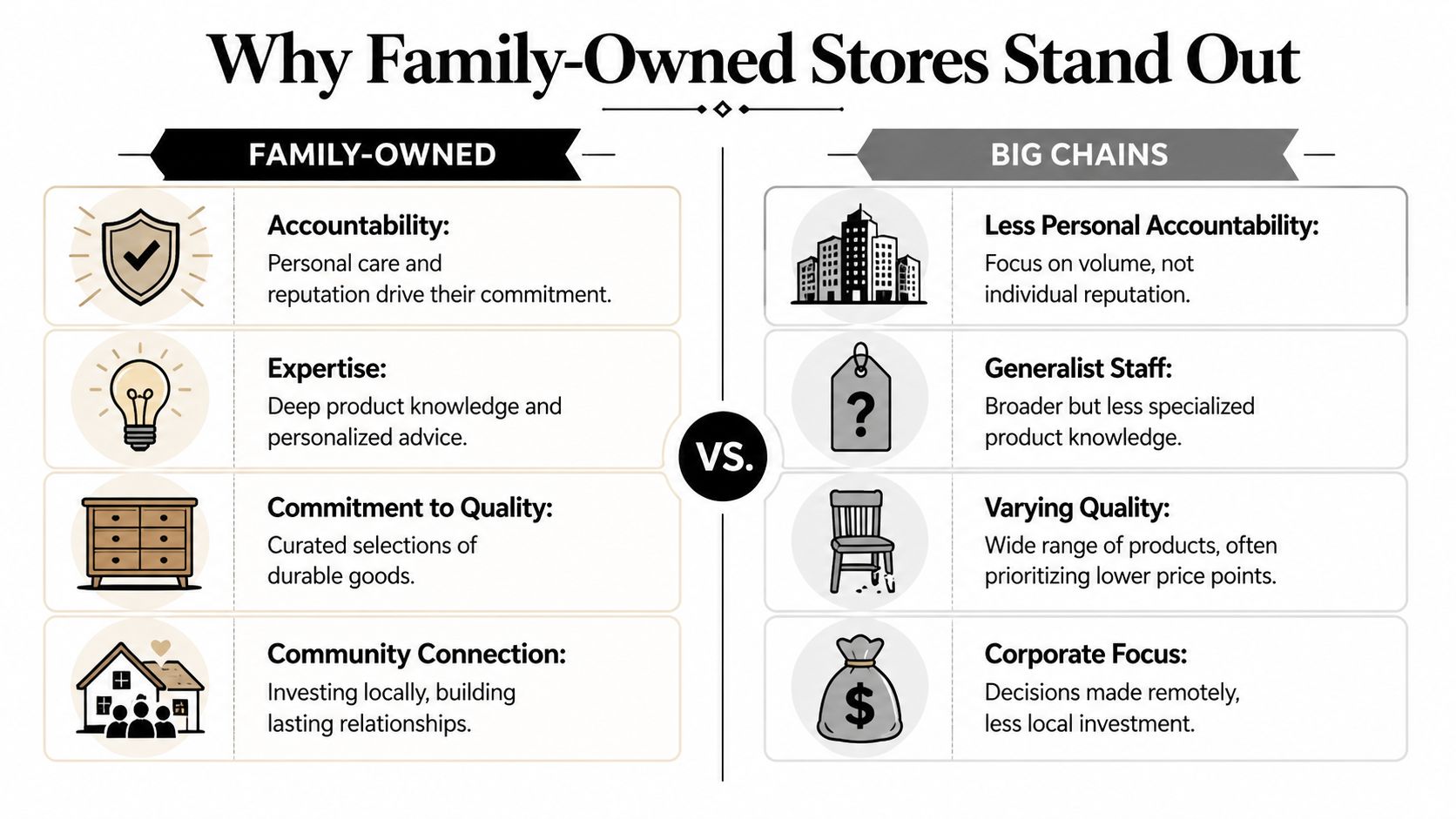
Why local accountability changes the shopping experience
Here is the plainest way to put it. A family-owned store has to live with its decisions in the same community where it makes them.
That affects what shows up on the floor. It also affects how questions get answered. You are more likely to hear honest guidance about what fits your room, what will wear well, and what is worth repairing versus replacing later. A good local store is not trying to win one transaction and disappear. It is trying to become the place you return to for the next room, then the guest room, then the mattress your teenager suddenly needs after a growth spurt.
That does not mean every chain gives poor service, and it does not mean every local store deserves trust automatically. It means you should listen for the store's priorities. If the staff can explain construction, materials, and expected wear in simple language, you are usually in a better place than a showroom that talks only about color, trend, and this week's special.
A quick side-by-side view
| Store trait | Family-owned focus | Big-chain tendency |
|---|---|---|
| Product selection | Chosen with repeat customers and durability in mind | Broader mix, often shaped by volume and price points |
| Advice | More tied to your room, use, and long-term satisfaction | More standardized from shopper to shopper |
| Reputation | Built person to person in the Milwaukee area | Spread across many markets |
| Furniture story | Clearer explanation of materials and build quality | More attention on style, speed, and promotions |
One local example is BILTRITE's family tradition and quality approach, which shows how a family store can treat furniture as a purchase you live with for years, not a quick item to get out the door.
Good furniture shopping is really about fewer regrets. You want a piece that still makes sense after the first excitement wears off and everyday life takes over.
Why this matters for your wallet too
Lower prices can look good in the moment. Then real life starts. Drawer bottoms bow, cushions flatten, finishes scratch too easily, and the bargain piece needs replacing long before you expected.
That is why family-owned stores often put so much attention on categories like USA-made upholstery, Amish-made furniture, and solid wood pieces. The point is not to make everything sound expensive. The point is to help you buy once, buy better, and understand what you are paying for.
If you are trying to vet Milwaukee stores like a pro, use BILTRITE as a benchmark. Look for a showroom where people can explain why one frame is stronger than another, why one wood species suits daily use better, and why the right piece for your home is not always the one with the lowest sticker price. That is where family ownership makes a real difference.
Your Smart Search for Milwaukee's Best Furniture Stores
If you only search “family owned furniture stores near me,” you’ll get a mixed bag. Some results will be useful. Some will be paid placements. Some will be stores that are local in name but not especially helpful for what you need.
A smarter search starts by getting specific about the furniture, not just the store.
Search for the product, the build, and the neighborhood
Try searches that sound more like what you need:
- “Amish furniture Waukesha” if you want handcrafted wood pieces
- “solid wood dining table Greenfield” if you want to skip particleboard
- “USA made sofas Franklin” if domestic manufacturing matters to you
- “small scale furniture Milwaukee” if your rooms are tighter
- “white glove furniture delivery Milwaukee” if access is tricky
That last one matters a lot more than people expect. A store’s delivery support can make a huge difference when you’re dealing with stairs, condos, narrow halls, or older homes. For that reason, it helps to review options that discuss furniture stores with white-glove delivery.
Don’t stop at the first page
Search results are only part of the story. You’ll learn more if you check what real local shoppers mention in neighborhood groups, community forums, and everyday conversation.
Look for comments about things like:
- How the store handled questions
- Whether the furniture matched the description
- If delivery went smoothly
- How the staff treated people who were “just looking”
- Whether shoppers felt guided or pressured
To clear up a lot of confusion: shoppers often assume the biggest showroom or loudest ad must mean the strongest choice. In practice, the better sign is usually consistency. If people keep describing a store as helpful, knowledgeable, and honest, that tells you a lot.
Use a simple filter when comparing stores
When you narrow your list, ask each store the same few questions:
- What are the frames made of?
- Do you carry solid wood?
- Which pieces are USA-made or Amish-made?
- Do you have options for small rooms or tricky delivery spots?
- Can I see the product in person before deciding?
Those five questions quickly separate stores that know their inventory from stores that mostly rely on broad sales language.
How to Spot Quality Furniture Like a Pro
You walk into a showroom in Milwaukee, spot a dining set that looks perfect under the lights, and then wonder what you are really paying for. That question separates a quick purchase from a smart one.
Families in this business learn early that furniture has two lives. One is the showroom life, where everything looks polished. The other is real home life, where drawers get opened every day, chairs get scooted across the floor, and tabletops handle homework, holidays, and spilled coffee. Quality shows up in that second life.

Start with wood and joinery
Begin with the frame and the joints. Those parts do the heavy lifting long after the finish catches your eye.
Solid wood and engineered materials both have a place, but they are not the same purchase. Solid wood can often be repaired, refinished, and kept in service for many years. Lower-cost engineered materials can work well in certain categories, though they usually do not offer the same long-term feel or repair options.
If you want a strong benchmark, study Amish-made solid wood furniture options near Milwaukee. Amish builders are widely respected for careful joinery, steady construction, and wood selection that is meant to hold up in everyday use. At BILTRITE, that standard helps shoppers compare one piece against another with a clearer eye.
A simple test helps here. Ask the salesperson to explain the wood species, how the corners are joined, and whether the piece can be repaired down the road. Clear answers usually point to a store that knows its inventory well.
If the answer stays vague, that tells you something too.
What to physically check in the showroom
Use the piece the way you would at home. Good furniture should feel settled, balanced, and consistent.
- Drawers should open smoothly, close evenly, and feel secure in the track.
- Tabletops should feel solid, with seams and edges that look clean rather than rushed.
- Chairs should sit flat on the floor and feel steady when you shift your weight.
- Sofas should support you without a hollow, saggy, or springy feel.
- Back panels and undersides often reveal build quality faster than the front view.
The underside is like looking under the hood of a car. Fancy styling can hide a lot. Construction usually cannot.
Learn the language stores use
Furniture labels can help, but only if you know their true meaning.
“Solid wood” refers to the material itself. “Wood finish” only describes the surface appearance. “Handcrafted look” speaks to style. It does not explain how the frame was built. “Farmhouse” and “modern” tell you about design, not durability.
Some showrooms make this easier by marking key features clearly. BILTRITE Furniture-Leather-Mattresses uses icons to identify pieces such as USA Made, Amish Made, Real Solid Wood, and Heavy Duty. That kind of labeling gives shoppers a practical shortcut, especially when you are comparing several pieces in one visit.
Questions worth asking before you buy
A knowledgeable team should be comfortable with specific questions, not just style talk.
| Ask this | Why it helps |
|---|---|
| Is this solid wood, veneer, or another material? | You learn how the piece is built and what kind of wear it may handle |
| How are the joints constructed? | Joinery affects strength, stability, and repair potential |
| Where is it made? | Origin often gives helpful context about craftsmanship and materials |
| Is this available in a heavier-duty build? | Useful for busy households, daily use, or longer-term plans |
| Can I customize the size, wood, or finish? | Helps the furniture fit your room and your routine better |
One small habit that saves headaches
Shop with your household in mind, not just your eyes.
Say if the sofa will get daily use from kids, pets, or overnight guests. Mention strong sunlight, narrow spaces, or a room that serves three jobs at once. A beautiful piece that fights your daily routine will not feel like a good buy for long.
That is the insider way to shop in Milwaukee. Search results can show you who sells furniture. A careful quality check shows you who understands it.
Finding Furniture That Fits Your Unique Home and Needs
You find a sofa you love online. The color is right, the price feels fair, and the measurements look close enough. Then delivery day comes, and the piece will not clear the apartment turn, the basement door, or the stair landing. Families around Milwaukee run into this every week, which is why a good furniture search needs to go beyond style and price.
Milwaukee homes have their own quirks. A Bay View duplex, a Brookfield condo, and a New Berlin family room can ask for three very different solutions, even if each shopper starts by typing "family owned furniture stores near me."
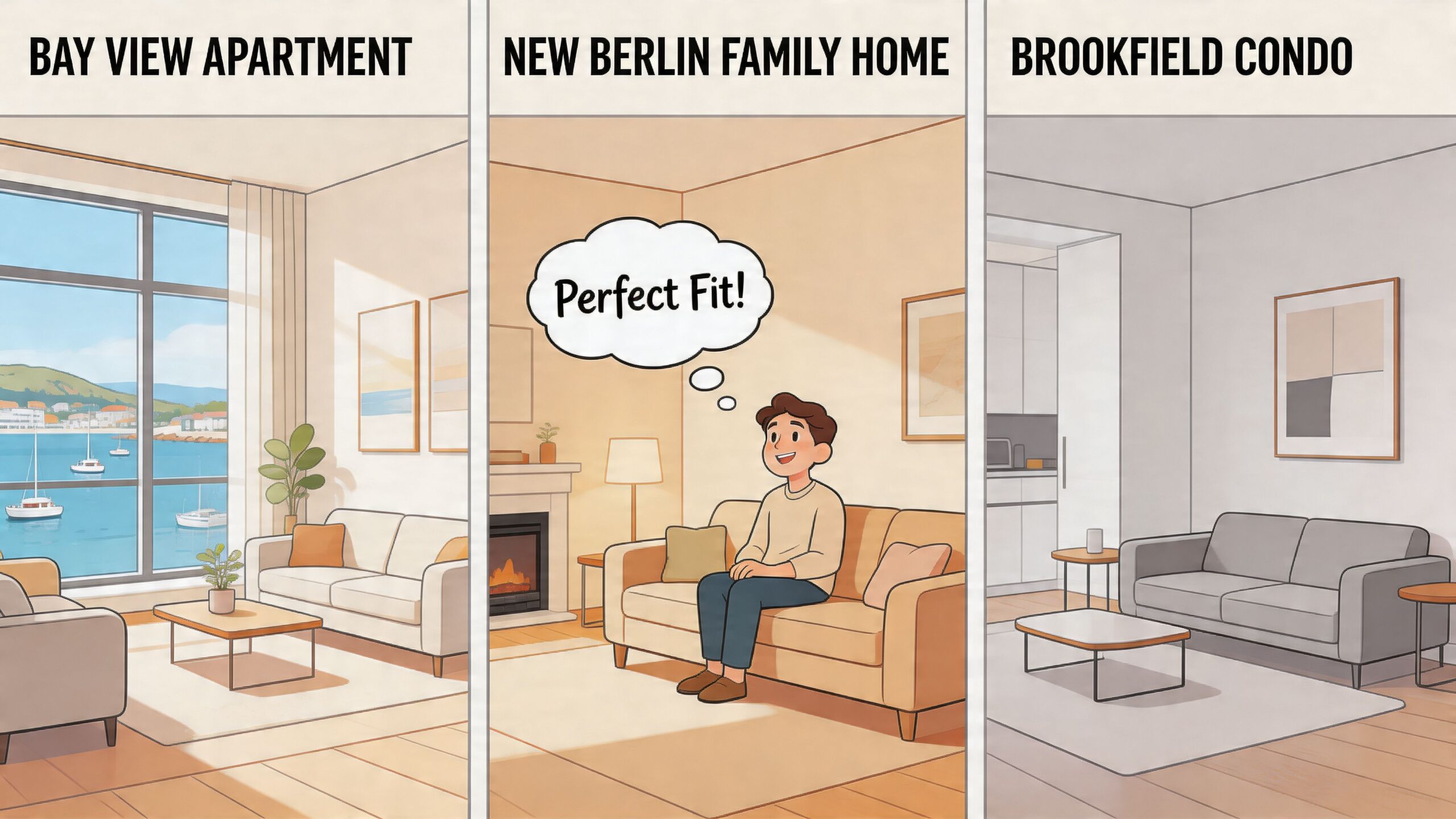
Three common Milwaukee shopping situations
Apartment and condo shoppers usually need furniture with a lighter footprint. That can mean narrower arms, shallower seat depths, smaller dining tables, or pieces that fit elevators and tighter entryways without eating up the whole room once they are inside.
Busy family homes have a different checklist. The room may need to handle homework, movie night, spills, pets, and guests all in the same week. In that case, the right piece often comes down to scale, cushion support, and construction that holds up to everyday use.
Senior living and caregiving bring another set of needs. Seat height matters more. Bed height matters more. Ease of getting in and out matters more. Good furniture for this stage should feel comfortable and supportive without making the room look medical or cold.
Delivery shape matters as much as room size
A tape measure tells only part of the story.
A significant test is the path into the house. Hallways, stair turns, older door frames, low basement ceilings, and condo elevators can rule out a piece that technically fits the room. Come-apart sofas and sectionals help solve that problem because they can be carried in smaller sections and reassembled inside.
The simplest rule I learned from my family in the furniture business is this: measure the room, then measure the route. A sofa that fits the wall but not the front entry is still the wrong sofa.
Match the piece to the way you live
Good stores help you shop by use, not just by department label. BILTRITE is a strong benchmark for this in Milwaukee because the conversation can start with your home and your routine, then work toward the right size, build, and options.
Here are a few examples of what that looks like in practice:
- Apartment dwellers often do better with cleaner silhouettes, tighter depths, and pieces that leave walking space around them.
- Growing families usually benefit from sturdier seating, forgiving fabrics, and dining furniture that can take daily wear.
- Seniors and caregivers may want supportive chairs, practical bed heights, and layouts that make movement easier.
- Decorators and remodelers often look for custom choices in wood species, finish, fabric, or hardware so the piece fits the home instead of forcing the home to fit the piece.
For shoppers who want handcrafted wood furniture in sizes and styles that feel more personal, browsing Amish furniture near Milwaukee can be a useful way to compare options.
That is how experienced shoppers separate a generic search result from a store that actually knows how people live.
The Secret to a Great Night's Sleep Is in Our Mattress Center
You get to the mattress department after a long day, lie down for a few minutes, and suddenly every label starts to blur together. Foam. Coils. Hybrid. Plush. Firm. Pillow top. Euro top. It can feel like trying to judge a whole winter coat by touching the sleeve.
That confusion is normal. A mattress is one of the few things in your home that has to do real work for eight hours at a time, every night. The goal is not to find the one that feels softest for thirty seconds. The goal is to find the one that keeps your body supported month after month.
One construction detail our family has respected for years is the flip-able, 2-sided mattress. It wears more like a pair of well-made work boots than a fashion shoe. When both sides are built to be slept on, you can rotate use and spread out the pressure that builds up in the same spots night after night.

Why two-sided construction still matters
Sagging usually starts long before a mattress looks worn out from across the room. Hips and shoulders press into the same areas, the surface starts to settle unevenly, and support gets less consistent. A two-sided mattress helps slow that process because the wear is shared instead of concentrated on one sleeping surface.
If you want a practical walkthrough, BILTRITE's guide on how to test a mattress before you buy explains what to look for in support, pressure relief, and overall comfort. That kind of testing matters more than marketing terms on a tag.
Why in-person testing still helps
Reviews are useful, but they cannot feel your shoulder pressure, your lower back curve, or the way you sleep at 2 a.m. Side sleepers, back sleepers, lighter bodies, and heavier bodies can have very different experiences on the same mattress.
That is why a real mattress center still matters. At BILTRITE, shoppers can compare a large selection in person and talk with people who do this every day. You can spend enough time on a mattress to notice whether your spine feels level, whether your hips dip too far, and whether the comfort layer is cushioning you or just swallowing you up.
A good mattress test is simple. Lie down in your normal sleep position. Stay there longer than a quick showroom flop. Pay attention to alignment, pressure points, and how easy it is to change positions. Those little details usually tell the truth faster than the product name does.
A mattress should support your body in the position you actually sleep in, not just feel soft or firm for a few seconds in the showroom.
Come On Down and Say Hi We'd Love to Meet You
Furniture is one of those things that still makes more sense in person. You want to feel the seat cushion. Open the drawer. Check the scale. Look at the wood tone in real light. That’s hard to replace with a search result.
For many Milwaukee shoppers, the aim goes beyond finding “family owned furniture stores near me.” It’s finding a place where the advice feels honest, the quality is visible, and the people helping you understand what matters. That’s what turns a store visit into a good decision.
We’re proud to be part of that tradition in Greenfield. We’ve served Metro Milwaukee since 1928, and we still believe a furniture store should feel welcoming, knowledgeable, and neighborly. You’ll find us at 5430 West Layton Avenue, Greenfield, WI, with furniture for living rooms, dining rooms, bedrooms, home offices, senior living, tighter spaces, and a large mattress selection, all grounded in the family-first values described earlier.
We’re closed on Sundays and Mondays so our team can spend time with family. The rest of the week, we’d love to meet you, hear about your space, and help you sort through the choices in a down-to-earth way.
If you’d like to see solid wood, Amish-made, USA-made, small-scale, heavy-duty, and mattress options in person, visit BILTRITE Furniture-Leather-Mattresses. Come say hi in Greenfield and let our team help you find furniture that fits your home and your everyday life.