Queen Size Mattress Size: Dimensions and Room Fit

A standard U.S. queen mattress measures 60 by 80 inches, about 152 by 203 centimeters, with a sleeping surface of about 33.3 square feet. But does a mattress that fits on a bedroom floor necessarily leave enough room for the people who sleep there?
Not always! A comfortable bedroom also needs space for the frame, bedding, opening drawers, and everyday movement. For Metro Milwaukee families comparing a queen size mattress size, the smartest approach is to measure the whole sleep setup, not just the soft part.
Table of Contents
- Queen Mattress Size at a Glance
- Why Queen Size Changes from Country to Country
- Mattress Thickness and Fitted Sheet Fit
- Matching Mattress Types to Frames and Foundations
- Room Sizes That Work for a Queen Bed
- How to Measure Bed Clearance Step by Step
- Queen Beds for Accessibility and Caregiving
- Choose Your Queen and Visit Our Greenfield Showroom
Queen Mattress Size at a Glance
Width runs across the bed, and length runs from the head toward the foot. That orientation trips up more shoppers than any dimension itself: a tall sleeper who upgrades for "more room" often buys width, while the shortage is length, and a couple who buys extra length gains nothing for the crowding that bothers them.
Standard U.S. mattress sizes compared
The table below lists the standard U.S. sizes, with sleeping areas calculated from width multiplied by length and converted to square feet. Areas are rounded, so use them for comparison rather than precision furniture planning.
| Size | Width x Length (inches) | Sleeping area (sq ft) |
|---|---|---|
| Twin | 38 x 75 | 19.8 |
| Twin XL | 38 x 80 | 21.1 |
| Full | 54 x 75 | 28.1 |
| Queen | 60 x 80 | 33.3 |
| King | 76 x 80 | 42.2 |
| California King | 72 x 84 | 42.0 |
A queen adds 750 square inches, roughly 18.5% more sleeping surface, over a full; measured against an eastern king, it runs 16 inches narrower and gives up about 21.1% of the surface area, per the queen mattress dimensions reference. Read the length column closely and a second pattern appears: queen, Twin XL, and standard king all stop at 80 inches, so moving up in width does nothing for a sleeper whose feet already reach the edge. Only the California king adds length in this lineup.
What that means for sleepers
Split a queen between two adults and each gets 30 inches of nominal width, before bedding, movement, and personal-space preferences enter the picture. The 30 inches is a planning figure; comfort depends on sleep habits.
A sleeper who curls up uses the surface differently from one who stretches out or changes positions all night. Pets and children climbing in change how roomy the bed feels, even though the dimensions never change.
Practical rule: A queen is the middle choice when sleepers need more room than a full provides, but the bedroom can't comfortably fit a king.
One more caution before the numbers get treated as the whole answer. The table compares sleeping surfaces, not furnished bedrooms. A substantial headboard, projecting footboard, or wide side rails can turn a modest mattress into a much larger bed, and the mattress itself is only the first layer of a sleep system that also includes the foundation, the fitted sheets, and the walking clearance around all of it.
Why Queen Size Changes from Country to Country
Queen is a regional label. Its meaning changes by country. The U.S. reference is approximately 152 by 203 centimeters, equivalent to 60 by 80 inches, as listed in the U.S. queen size reference.
A bed frame or sheet set bought abroad can carry the same queen name while following a different local standard. Two products that share the word can still disagree by several centimeters, which is enough to matter once the mattress has to sit inside rails and under fitted corners.
Queen mattress dimensions by market
The following regional measurements are listed in the international queen-size comparison; centimeter dimensions are approximate where converted from inches.
| Market | Queen size (cm) | What to know |
|---|---|---|
| United States, Canada, Australia and New Zealand | 152 x 203 | Standard reference size |
| Europe | 160 x 200 | About 8 cm wider and 3 cm shorter than a U.S. queen |
| Japan | 152 x 195 | Width matches the U.S. queen while length runs shorter; confirm the model's finished dimensions |
| China | 152 x 200 | Width matches the U.S. queen while length runs shorter; confirm the model's finished dimensions |
| Thailand | 152 x 198 | Width matches the U.S. queen while length runs slightly shorter; confirm the model's finished dimensions |
| South Africa | 152 x 188 | Same width, clearly shorter length; confirm before pairing with U.S. bedding |
| UK-style queen | 152 x 198 | Verify measurements; UK retailers more often use double, king or super king |
Europe makes the mismatch easy to see. A mattress that is wider and shorter than the U.S. version can overhang a U.S. support surface side to side while leaving a gap near the head or foot, so a footprint that looks close on paper behaves differently on the frame.
That small shift travels through the whole sleep system. The sheet corners, the usable space inside the rails, and the walking room left around the bed all inherit the same few centimeters.
Match the system to the finished dimensions
Three pieces have to agree before an imported queen works in a U.S. bedroom:
- The mattress itself: the finished width and length of that exact model.
- The support: the usable opening inside the frame rails, which is smaller than the frame's outside dimensions.
- The bedding: the standard the fitted sheet was sewn to, since a package labeled queen may follow another market's sizing.
The regional table is a starting reference. The number that matters on delivery day is the finished width and length printed for that specific model, because the frame, foundation and sheets are all sized from it.
Mattress Thickness and Fitted Sheet Fit
Two queen mattresses can share the same footprint and look completely different in a bedroom. A low-profile model sits close to the bed rails, while a tall pillow-top build can cover a good portion of the headboard. Construction, cushioning, and the finished sleep surface decide how thick a particular model will be.
Queen mattresses vary from slim, low-profile designs to thick, plush-topped builds. That spread matters because a fitted sheet needs enough fabric to wrap the sides and tuck underneath, much like a tablecloth has to hang past the table edge to stay in place.
Check the pocket, not just the package name
Pocket depth describes the fitted sheet's capacity around the mattress edge. A sheet labeled queen can still be too shallow for a thick queen mattress, so its corners pop loose during the night.
Toppers count too. A mattress pad or topper that will sit under the fitted sheet belongs in the measurement. Sizing the sheet to the bare mattress and then adding a substantial topper leaves an otherwise sensible purchase feeling frustratingly snug.
Three checks make the choice easier:
- Measure the height: Use a tape measure from the mattress's bottom surface to its top edge, without compressing the cushioning.
- Compare the sheet label: Match the complete covered height with the fitted sheet's stated pocket capacity.
- Check nearby furniture: Consider where the finished mattress top will sit relative to the bed rails, headboard, and nightstands.
The mattress measurement guide walks through a reliable measuring routine before bedding shopping.
Account for the complete bed height
A thicker mattress can hide more of a decorative headboard and leave a formerly convenient nightstand feeling low. A platform, foundation, or adjustable base also changes the final floor-to-top height, so the whole stack deserves a measurement before anything else gets chosen.
Standard queen bedding generally corresponds to the usual footprint. Olympic queen, split queen, and RV or short queen formats break that assumption, and each needs specifically matched bedding and support components.
The simplest habit is also the most useful: measure the mattress being purchased before choosing its sheets.
Matching Mattress Types to Frames and Foundations
Every mattress needs a frame opening that accommodates its finished dimensions and a support system approved for its construction. A familiar size label doesn't establish whether an existing foundation is suitable.
The frame holds the bed together. The foundation or platform supports the mattress underneath, and those jobs shouldn't be confused.
Match support to construction
Different mattress categories call for different checks. The support requirement should come first, followed by appearance, storage, and decorative details.
- Memory foam and latex: A solid platform or appropriately firm foundation helps support these often-heavy mattresses without unsupported areas.
- Innerspring: A compatible box spring, foundation, or platform may be suitable, depending on the mattress maker's instructions.
- Hybrid: A supportive platform or approved foundation must carry both the coil system and the cushioning layers.
- Adjustable-base setups: Both the mattress and base must be approved to work together, with room for movement and the base's installed footprint.
- Flip-able and two-sided: Consistent support and enough handling space allow the mattress to be flipped and rotated according to its care instructions.
- Heavy-duty and semi-heavy-duty: A sturdier frame with suitable rails, center support, and load capacity should match the mattress's requirements.
The platform bed frame guide helps distinguish a platform's supporting surface from a decorative frame surrounding a separate foundation.
Look underneath before deciding
A frame can look sturdy while lacking the support a mattress requires. Shoppers should inspect the center rail, supporting legs, slats, and the points where those components connect.
Existing furniture deserves the same attention as new furniture. Loose hardware, bowed support pieces, or missing legs shouldn't be overlooked just because the mattress still sits level when nobody is on it.
A mattress and its foundation should be chosen as a working pair, not as unrelated purchases.
For an adjustable setup, check clearance through the full range of motion. Bedding, nearby furniture, and decorative rails shouldn't interfere with the moving components.
The final check is the written support requirement for the specific mattress. Warranty terms differ, so an attractive frame or familiar foundation shouldn't be assumed compatible without reviewing those requirements before purchase.
Room Sizes That Work for a Queen Bed
Think of a bedroom like a parking space. A queen mattress fits into far more rooms than it lives comfortably in, so the key question is what remains once the bed is parked. As a general planning guide, a 10-by-10-foot bedroom works as a starting point for a queen, 10 by 12 feet allows more comfortable furniture placement, and 12 by 12 feet gives you real layout freedom. Treat these as categories, not guarantees, since two rooms with identical dimensions can behave very differently.
Room sizes for a queen bed
| Room size (feet) | Fit for a queen | What it leaves you |
|---|---|---|
| Under 10 x 10 | Usually tight | Consider a full, or cut frame bulk and furniture |
| 10 x 10 | Minimum practical | Room for the mattress and basic walkway, little room for extra furniture |
| 10 x 12 | Comfortable | More room for nightstands, a dresser and easier movement |
| 12 x 12 | Flexible | Space for nightstands, a dresser or bench and wider walkways |
Shape and openings matter as much as total floor area. A closet that projects into the room, a door that swings inward, or a radiator on the wrong wall can make a generous-looking layout awkward in practice. Before trusting the numbers on a floor plan, note where every door, window, and fixed feature sits.
Furniture changes the answer
Take a bedroom at the smallest practical size in the table. Add a dresser against the foot wall and the remaining walkway shrinks fast, especially once the drawers stand open. The mattress may fit perfectly while the room still fails.
A longer room offers more options. Pushing the bed against one wall preserves a clear route along the open side, which can work well in a guest room, though it makes bed-making harder and leaves the wall side awkward to climb out of. Caregivers should weigh that trade-off carefully, since a bed reachable from only one side complicates helping someone in and out of it.
A small room can still suit a queen. The whole-bedroom queen planning guide recommends judging the complete furniture layout rather than treating mattress dimensions as the only deciding factor.
Useful adjustments include:
- Reduce frame bulk: Slim side rails and a less-projecting footboard preserve floor space.
- Choose narrow nightstands: Keep the bedside surface useful without filling the whole passage.
- Consider sliding storage doors: These avoid the swing space needed by hinged doors.
- Use wall placement thoughtfully: Preserve the route people use, while acknowledging any loss of bedside access.
One mistake catches many shoppers here. A lower-profile frame makes a small room feel airier because it sits lower in your sightline, yet it frees zero floor area. Only a smaller outside footprint, meaning a slimmer frame or a shorter headboard and footboard, actually widens the walkway. Mattress thickness plays a similar trick: a taller mattress raises the bed visually and physically without changing what you can walk around.
The bedroom furniture arrangement guide can help with placement decisions. Sketch the room to scale with the bed, every other piece of furniture, and every opening before you commit, since the drawing costs nothing and a misplaced bed costs real space every day.
How to Measure Bed Clearance Step by Step
Can the queen leave a path you can walk after the frame is in the room? A catalog photo will not answer that. A tape measure, graph paper, a pencil, and painter's tape will. Measure the room the way it is used, with doors and drawers open.
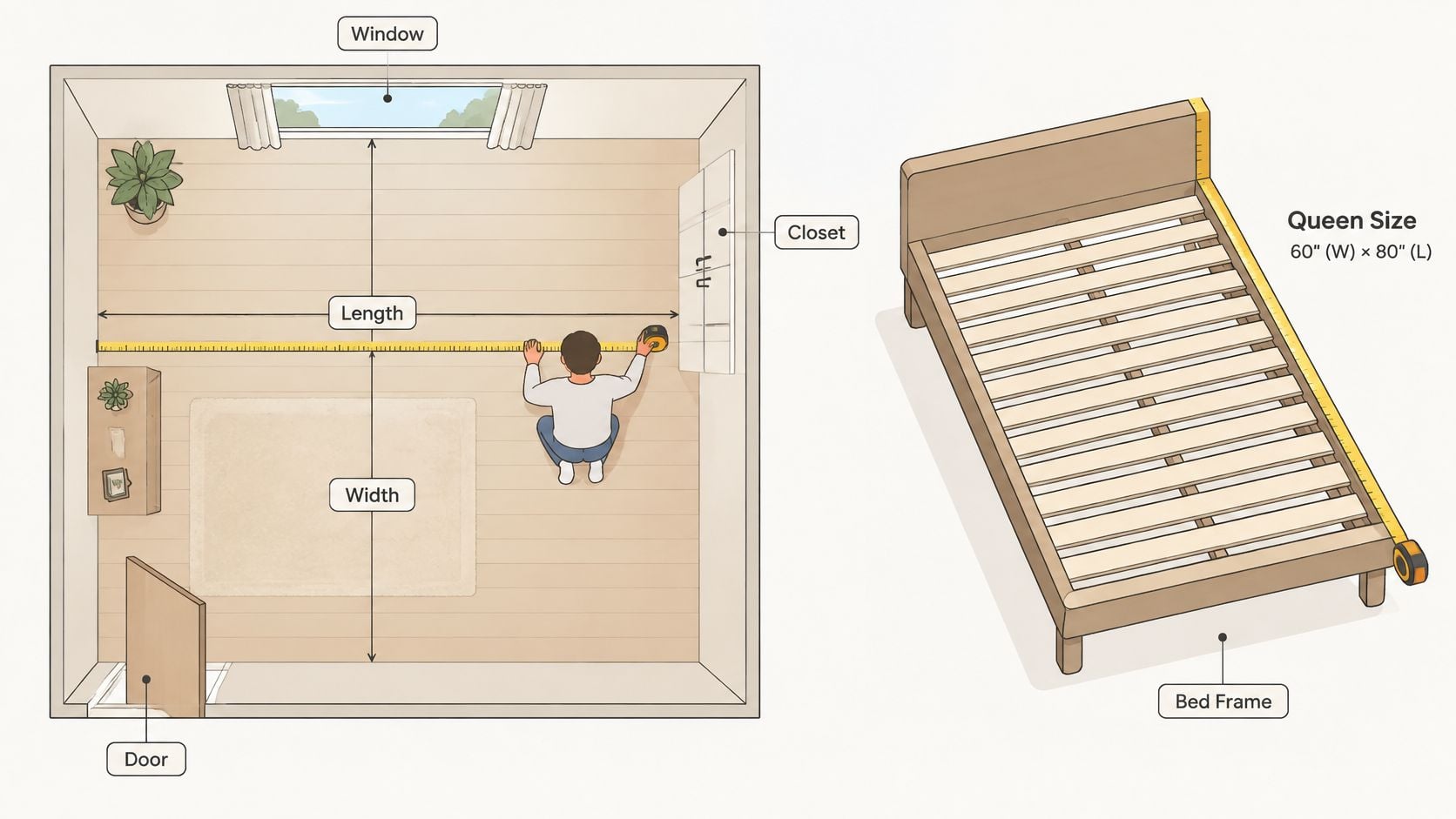
Build the measurement worksheet
The worksheet works like a subtraction problem. Start with the whole room, remove the finished bed, then see what floor is left to walk on.
Measure wall to wall. Record the room's length and width. Mark windows, doors, closets, and fixed obstructions. Include baseboards or any projection that changes where furniture can sit.
Measure the assembled bed. Record the actual outside width and length, including the headboard, footboard, and projecting trim. The mattress label only describes the sleep surface. The finished piece takes more floor.
Subtract the footprint. Subtract the bed's outside dimensions from the matching room dimensions. That leftover is the total remaining space. Split it by where the bed will sit, rather than assuming a centered placement.
Reserve walking space. Plan approximately 24 inches of open space along each side people use. Treat that as a starting target for walking beside the bed and pulling the covers straight.
Confirm the floor left after other furniture. Draw nightstands and any dresser on the same sketch you already used for the room plan. Measure the open strip that remains with a drawer fully extended and a person standing in front of it. If that strip is tighter than the walking space from step 4, shift the bed before you commit.
Open every door. Confirm that the bedroom door swings fully without striking furniture and that closet doors still open. A pathway that disappears whenever a door opens is not one you can count on at night.
Measure the delivery route. Record doorway openings, hallways, stairs, and tight turns. Compare those openings with the mattress and with each frame piece, not only with the finished bed in the bedroom. A queen that fits the room can still stall on a stair turn if a rail arrives as one long section.
Tape the layout on the floor. Mark the full furniture outlines with painter's tape. Walk the room the way you would after lights-out: closet, bedside lamp, then the exit.
Give the layout a real-life test
The furniture measuring guide supports a careful check of both the furniture and the route that brings it in. A photo of a narrow turn makes that entrance easier to describe during a showroom conversation.
The pass test: A person can make the bed, open the drawers, and leave the room carrying a laundry basket without squeezing sideways.
These measurements are planning guidelines for daily movement around a queen and its frame. Use them to see whether the taped outline still leaves a usable path once every piece is drawn at full size.
Queen Beds for Accessibility and Caregiving
A queen isn't automatically the best choice because a bed has shared sleepers. When mobility or caregiving matters, usable floor space can be more valuable than additional mattress width.
The important distinction is between a bed that accommodates sleeping and a bedroom that supports safe daily routines. Those aren't always the same thing.
Separate comfort from access requirements
Three different ideas often get mixed together:
- Comfort clearance: The space people prefer for walking, dressing, and making the bed.
- Transfer clearance: The space needed to approach the bed, position mobility equipment, sit down, stand up, or receive assistance.
- Legal accessibility: Requirements that apply to covered facilities and regulated sleeping rooms, rather than a universal rule for ordinary residential bedrooms.
The ADA design standards include provisions for accessible clear floor space at beds in covered facilities with more than 25 beds. Those provisions shouldn't be converted into a blanket bedroom-size rule for private homes.
Likewise, ordinary furniture-planning walkway recommendations shouldn't be described as ADA requirements. A walker user, wheelchair user, or caregiver may need a different arrangement based on the actual task and equipment.
Test the routine, not just the layout
The wheelchair-accessible furniture guide provides a starting point for thinking about furniture access. For a bedroom, the practical checklist should include:
- Caregiver approach: Space on the necessary sides for assistance without reaching awkwardly across the mattress.
- Turning and positioning: Enough room for the actual walker or wheelchair to approach and turn.
- Finished bed height: The combined mattress and base height, including how the edge compresses when occupied.
- Lift-assist needs: Space for any equipment used during transfers.
- Bathroom access: An unobstructed route that remains usable after dark.
A full mattress may improve side access in a tight room. A queen may work better when shared sleepers need the width and the room can retain adequate circulation.
A thicker mattress raises the sitting surface, but higher isn't automatically easier. The practical test is to sit on the edge and stand with the actual mattress and base together, using the person's usual assistance or mobility equipment.
Choose Your Queen and Visit Our Greenfield Showroom
What should you test once the queen label is already on the tag? The label is only the footprint. Thickness, the frame under it, the sheets that have to grip the corner, the walkway left in the room, and the space a caregiver needs all change how that same queen sleeps.
A short set of notes makes the showroom hour do real work. Measure the room first, then sketch doors, closets, windows, and anything that cannot move. Write two frame numbers, not one: the inside opening the mattress drops into, and the outside footprint that has to clear the walls. Note a sitting height that feels manageable when you stand and when you reach a nightstand. Add how you sleep, whether the bed is shared, and any walker, wheelchair, or helper who needs a side.
Those notes turn the room-size categories and the clearance checklist into a conversation instead of a guess. Two queens can sit side by side so you can feel which edge height and which firmness match the sketch.
BILTRITE Furniture-Leather-Mattresses is a fourth-generation, family-owned showroom serving Greenfield and Metro Milwaukee since 1928. The mattress department offers over 60 models, with over 500 mattresses in stock, in Twin, Twin XL, Full, Full XL, Queen, King, California King, King 2PC, and California King 2PC sizes. The wider floor also covers affordable, better-quality USA-made, Amish-made, and solid-wood furniture, plus small-scale, heavy-duty, and senior living pieces, including flip-able, two-sided mattresses you can turn for even wear.
The Mattress Finder on the website can narrow the list before you drive over. The useful comparison still happens in person: lie down, sit on the edge with the base you would use, and check whether the finished height leaves the clearance your sketch requires. The showroom is closed Sundays and Mondays.
A bedroom and seating for the same person can be planned in one visit, with no need to decide on the spot.
BILTRITE Furniture-Leather-Mattresses offers queen mattresses and better-quality furniture to help families plan a bedroom around comfort, support, and usable space. Bring the room sketch to BILTRITE Furniture-Leather-Mattresses in Greenfield for a no-pressure, hands-on opportunity to test comfort, compare bed heights, and ask questions in person.