Custom Built Dressers: Materials, Sizes and Ordering Tips


Will a beautiful dresser still work if the person using it can't comfortably reach the drawers, the delivery crew can't get it upstairs, or a worn slide can't be replaced? Those questions deserve answers before anyone chooses a stain color. The best custom built dressers start with the room, the household, and a realistic plan for everyday use.
BILTRITE Furniture-Leather-Mattresses is a fourth-generation, family-owned business serving Metro Milwaukee since 1928. That family-focused approach makes furniture shopping less about chasing a look and more about finding something that fits real life, from laundry day to the next move.
Table of Contents
- The Custom Dresser Spec Sheet at a Glance
- Sizing a Dresser to Your Room and Routine
- Choosing Solid Wood Species and Finish
- Drawer Construction and Hardware That Holds Up
- Stability, Anti-Tip and Anchoring Requirements
- Questions, Pricing and Lead Time Before You Order
- Confirm Repair and Care Terms Before You Order
The Custom Dresser Spec Sheet at a Glance
A custom order comes down to nine connected decisions, most of which a household can begin settling with a tape measure, a clothing inventory, and a few photographs. Width and height come first because they establish the available storage and usable reach. Choosing decorative hardware before resolving those dimensions can mean paying for attractive details on an inconvenient piece.
The following dimensions are illustrative planning options, not universal standards or promises of available customization. The maker needs to confirm which dimensions, materials, and mechanisms work together.
Custom dresser order decisions at a glance
| Decision | Typical choices | Question to ask the maker |
|---|---|---|
| Overall width | Sized to the measured wall and delivery route | Will this width fit the wall and doorway path? |
| Height | Illustrative options from 28 to 40 inches | How does the top drawer reach work for the people using it? |
| Depth | Illustrative options from 16 to 22 inches | How far will the front sit into the room? |
| Drawer count | Illustrative layouts with 3 to 6 drawers | How do the drawer sizes split the storage? |
| Wood species | Oak, hard maple, cherry, walnut, pine | Which species suit the household's daily use? |
| Finish | Clear, stain, or paint | How can scratches be touched up later? |
| Drawer slides | Side-mount slides, with full-extension options | Can the slides be replaced without rebuilding the drawer? |
| Hardware | Knobs, pulls, or bar pulls | Is the grip comfortable at the intended reach height? |
| Anchoring | Anti-tip restraint secured to appropriate structural material | What anchoring does the unit need for stability? |
Settle function before appearance
Start with what needs storing. Folded sweaters need a different drawer arrangement from socks, accessories, and work clothes. A dresser with many small compartments can look organized on paper yet leave bulky items without a useful home.
Drawer count isn't the same as usable capacity. Ask for interior drawer dimensions rather than judging storage by the outside fronts. Framing, drawer boxes, and slide clearances all occupy space inside the cabinet.
Then separate essentials from preferences. Comfortable reach and delivery access belong on the essential list. A particular pull shape or stain color may allow more flexibility if the budget gets tight.
Practical rule: Resolve the footprint and storage layout before paying extra for decorative details.
Bring room measurements, a photograph of the intended wall, and a list of the people who will use the dresser. Include any mobility limitations and the clothing that needs a dedicated drawer. Those details give the maker something concrete to quote instead of a vague request for more storage.
Sizing a Dresser to Your Room and Routine
A sizing worksheet should describe the real room, not just the empty wall. Doors swing, baseboards project, and people need space to dress without sidestepping an open drawer. BILTRITE's guide to measuring furniture provides a useful starting point for recording the space and delivery route.
Measure wall width where the dresser will stand, including any nearby window trim or door casing. Record outlet locations and baseboard depth, since trim can prevent the back from sitting close to the wall. Include projecting pulls when estimating how far the finished piece will extend into the room.
Build a usable measurement worksheet
- Wall and obstructions: Record the usable width, trim, outlets, heating equipment, and door swings.
- Delivery path: Measure doorway openings, hallway turns, stair landings, and the narrowest restriction.
- Open-drawer footprint: Mark the dresser depth plus the deepest drawer's full opening travel.
- Human clearance: Leave room for the actual user to stand, turn, sit, or transfer while a drawer is open.
- Reach: Check both the highest handle and the lowest storage area from the user's normal position.
Typical dresser sizes by room
These are hypothetical comparison layouts, not established sizing standards. The right dimensions come from the worksheet and a reach test.
| Room or use | Height | Depth |
|---|---|---|
| Small apartment or condo | Below window trim and within comfortable reach | Example planning depth of 16 to 18 inches |
| Standard bedroom | Example planning height of 32 to 36 inches | Example planning depth of 18 to 20 inches |
| Large family room or wide wall | Set by the user's reach, not wall width | Example planning depth of 20 to 22 inches |
| Low profile for seated or lower-reach use | Example planning height of 28 to 32 inches | Example planning depth of 18 to 20 inches |
| Tight hallway or narrow alcove | Clear of switches and other obstructions | Example planning depth of 14 to 16 inches |
A wide wall doesn't automatically call for a deep dresser. Say a household stores mostly folded shirts and needs an uncluttered walking route beside the bed. A shallower cabinet may serve that routine better than a deep drawer that gets packed in layers.
Use cardboard to mock up the footprint and a vertical panel to represent the front. Mark handle locations and drawer travel, then test normal routines over several days. The best fit is the one people can use, not the largest cabinet that fits against the wall.
Choosing Solid Wood Species and Finish
Oak and hard maple handle daily wear best for busy households, so start there and weigh the rest against them. Compare dent resistance, grain, and the intended finish together. The Janka hardness test measures resistance to indentation, but it doesn't measure finish quality, joint strength, or resistance to every kind of scratch.
Match the species to the people who will use the piece. Cherry and walnut offer distinctive color and grain, while softer woods call for more acceptance of dents and wear. A dresser in a child's room or a shared hallway takes harder knocks than one in a low-traffic guest room, so a household that expects rough use should lean toward the harder species even when a softer grain looks better in the showroom. No species makes careless construction or an unsuitable finish disappear.
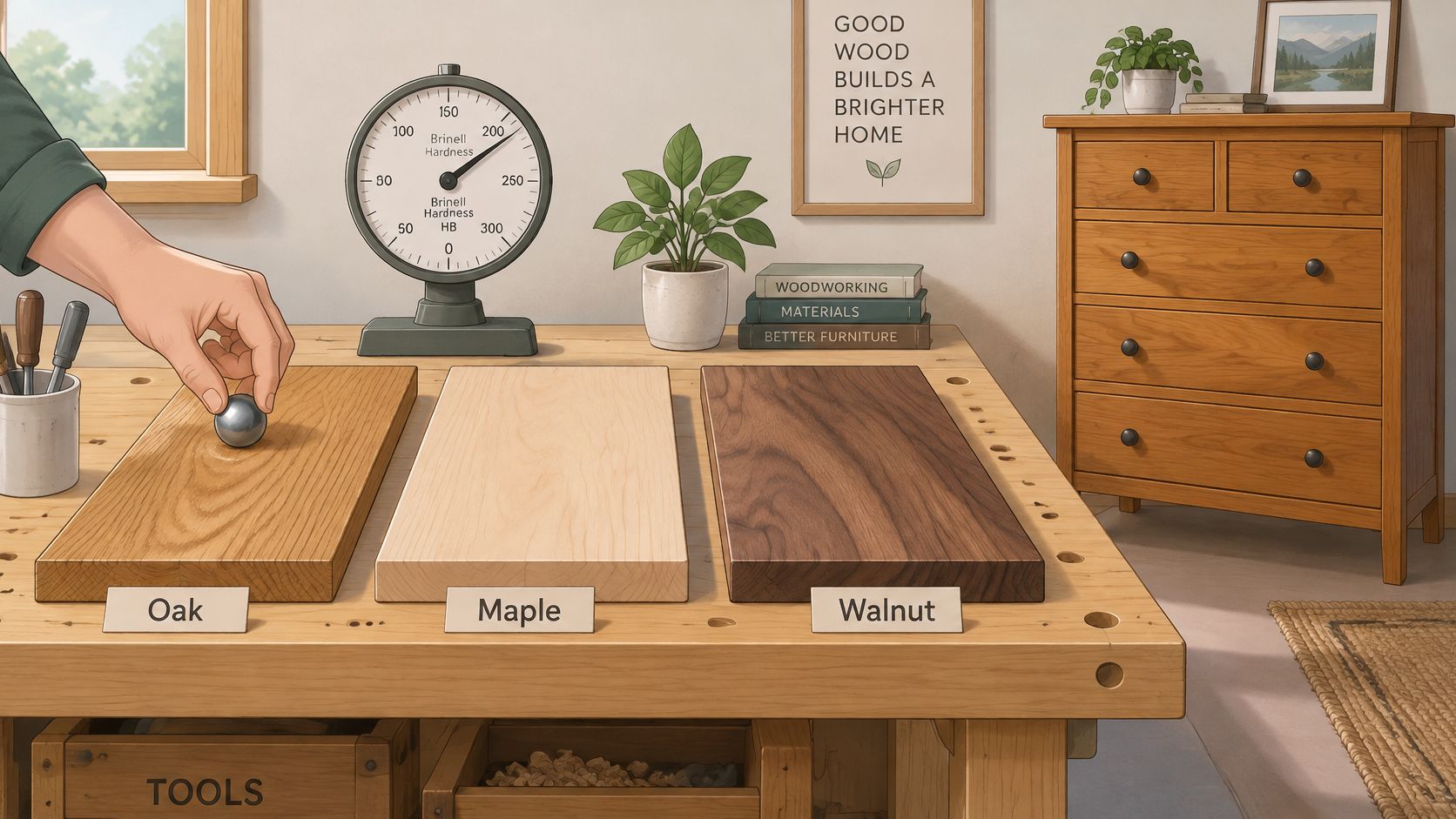
Solid wood species compared
| Species | Look and grain | Best for |
|---|---|---|
| Red oak | Open grain with a warm tone | Traditional look and sturdy drawers |
| White oak | Tighter-looking grain with a neutral tone | Durable frames and drawer fronts |
| Hard maple | Light, fine grain | Smooth finishes and painted pieces |
| Black cherry | Reddish tone that deepens with age | Classic style with softer wear |
| American black walnut | Dark, rich grain | Premium look and fine detail |
| Yellow poplar | Even, plain grain | Painted drawer boxes and hidden parts |
| Eastern white pine | Soft, knotty grain | Rustic style and paint-grade work |
Moisture planning matters as much as species
The USDA Wood Handbook gives approximately 6%–8% moisture content as a typical benchmark for hardwood furniture lumber. Final preparation should still match the building's conditioned environment, with acclimation and a calibrated moisture-meter check before fabrication.
Wood continues exchanging moisture with indoor air after construction. Most dimensional movement occurs across the grain, so wide solid-wood tops, fronts, and panels need connections that permit that movement. Rigidly trapping a wide panel can lead to stressed joints, distortion, or binding drawers.
Use veneered plywood for large concealed cabinet panels, and check each part against its job rather than assuming solid wood is the right answer everywhere. A stable panel that resists seasonal movement can protect drawer fit better than a solid side that swells against a sliding part.
Choose the finish with future care in mind
A clear finish displays natural grain and color. Stain changes the tone while keeping grain visible, although different boards can still absorb color differently. Paint covers the natural color and can disguise grain, but open-grained wood may retain texture unless the shop fills it.
Compare samples on the actual species under consideration. BILTRITE's hardwood selection guide can help narrow the visual choices before a showroom visit.
Confirm the species, whether the build is paint-grade or intended for a transparent finish, and how moisture is checked. Ask whether the back and underside receive finish too, since coating those surfaces moderates moisture exchange. Ask also how a scratch gets repaired on the finish you choose: some finishes accept a spot touch-up, while others mean refinishing an entire drawer front. That difference matters in a household where wear is part of the plan rather than a surprise.
Drawer Construction and Hardware That Holds Up
The first thing a hand meets is the pull. A handsome knob isn't helpful if someone struggles to pinch it or catches clothing on a sharp projection. Test the grip at the intended height, especially when seated use or limited hand strength is part of the household's routine.
Pull fasteners should remain accessible from inside the drawer. Many use machine screws threaded into the pull rather than separate nuts, so the useful question is whether ordinary tools can remove them without disturbing the drawer front. Replacement pulls also need compatible hole spacing unless refinishing is planned.
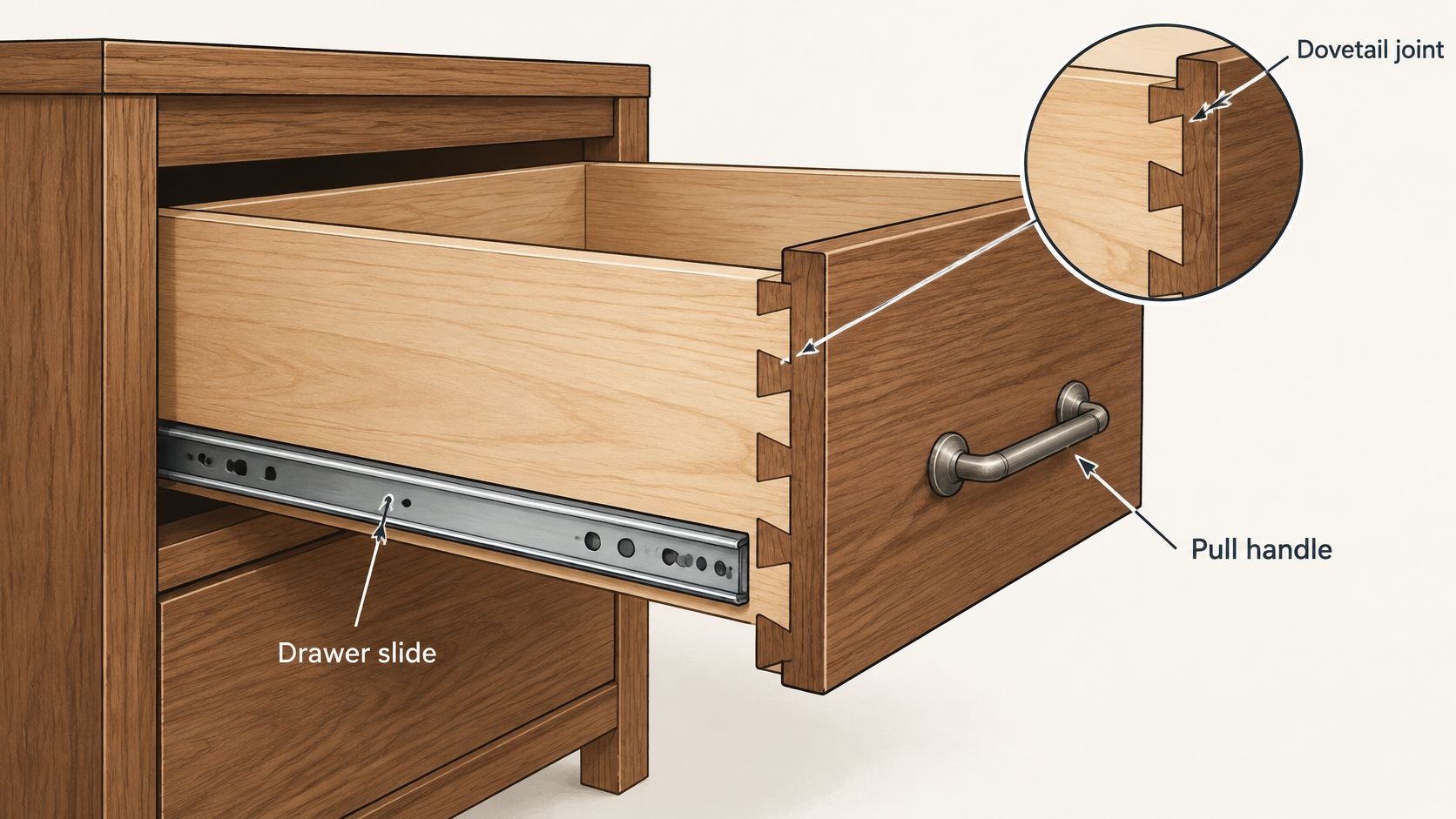
Look beyond the drawer front
Dovetail joints mechanically interlock the drawer sides and front, helping resist separation as the drawer is pulled. BILTRITE's explanation of dovetail joint furniture offers a closer look at that construction. Well-fitted dado or rabbet joints with appropriate glue and fasteners can also perform well; a joint's name doesn't excuse gaps or poor assembly.
Check how the bottom is supported. A panel captured in grooves has support around its edges, and a solid-wood bottom needs allowance for seasonal movement. The maker should distinguish that requirement from the installation method for a dimensionally stable plywood bottom.
Slides determine access and feel. Full-extension describes how far the drawer opens; side-mount describes where the slide attaches. They aren't competing categories, and a side-mounted ball-bearing slide can provide full extension.
Give the mechanism a sensible showroom test
- Open gradually: Pause midway and notice whether the drawer tracks squarely or wants to drift.
- Inspect corners: Look for close-fitting joints, smooth edges, and secure attachment to the front.
- Check travel: Move the drawer through its full permitted range without yanking against the stop.
- Feel for wobble: Excessive side play or rubbing deserves an explanation.
- Identify release points: Have an associate demonstrate removal rather than forcing unfamiliar hardware.
Soft-close is a comfort feature, not proof of a stronger drawer. Stops help prevent accidental removal, while a release mechanism allows intentional removal for cleaning or service.
A drawer that feels good empty still needs hardware suited to its intended contents.
Compare slide suitability for the planned load, replacement access, and the availability of mounting information. Those details are less glamorous than a finish sample, but they can make a later repair much simpler.
Stability, Anti-Tip and Anchoring Requirements
Solid wood doesn't automatically mean stable. A heavy dresser can still tip when open drawers and their contents shift weight forward. Stability has to be designed and tested, not judged by a reassuring thump on the top.
Under the Consumer Product Safety Commission's clothing-storage-unit guidance, 16 CFR Part 1261 generally covers qualifying freestanding clothing-storage pieces at least 27 inches high, weighing at least 30 pounds, with at least 3.2 cubic feet of enclosed storage; requirements include loaded-drawer testing, a 10-pound horizontal force at the highest handhold, a 60-pound child-weight simulation on carpeting, an ASTM F3096-compliant restraint packaged with the unit, and, when interlocks are used, retention of their function under a 30-pound force for five seconds.
Separate product compliance from installation
The maker must determine whether the dresser falls within the rule and document the applicable compliance. A customer's wall anchor doesn't replace required product testing. Likewise, a compliant product still needs its supplied restraint installed according to its instructions.
The restraint needs sound attachment at both ends. At the wall, that may mean a stud or another approved anchoring method suited to the wall construction. At the dresser, the attachment must use the structural location specified by the manufacturer, not an arbitrary spot in a thin back panel.
Drawer interlocks should work during normal operation without an extra action that someone might forget. An interlock is a designed mechanism, not a reminder to keep other drawers shut.
- Identify the floor: Tell the maker whether the dresser will stand on carpet or hard flooring.
- Identify the wall: Note drywall, masonry, trim, or another condition that affects restraint installation.
- Assign installation: Confirm who supplies the appropriate wall fasteners and who completes anchoring.
- Keep documentation: Retain the assembly instructions, restraint instructions, warnings, and compliance information.
Safety check: A dresser that rocks or feels unstable after installation needs attention, not a heavier object placed on top.
After loading, check that the cabinet sits level, the restraint remains properly attached, and drawers operate as intended. This is an installation check, not a home version of the manufacturer's test. Children shouldn't climb drawers, and testing should never involve deliberately pulling the unit toward a tipping point.
Questions, Pricing and Lead Time Before You Order
A useful quote describes a build, not just a style name. Two similar-looking dressers can differ in drawer-box construction, panel materials, finish work, slide quality, and delivery preparation. Comparing totals without those details can hide the reason for a price difference.
BILTRITE Furniture-Leather-Mattresses welcomes custom orders, and sales associates help customers find the right item. BILTRITE's special-order furniture tips can help households prepare before making selections.
Take a concrete checklist into the shop
- Workshop responsibility: Which steps are completed by the maker, including wood preparation, joinery, assembly, and finishing?
- Materials: Where does the wood come from, and which parts use solid wood, veneer, or engineered panels?
- Origin: What does USA-made mean for this particular piece, including hardware and other purchased components?
- Craft tradition: What does Amish-made mean in this workshop, and which operations involve other specialists?
- Options: Which dimensions, finishes, drawer arrangements, and hardware choices are available?
- Delivery condition: Does the dresser arrive assembled, and what preparation or installation remains?
Amish-made furniture has a genuine regional history. Cooper Hewitt's account of an Amish-made rocker identifies Indiana as a major Amish settlement location beginning in the 1840s and describes furniture-making as a persistent nineteenth-century tradition there.
That history doesn't establish the construction quality of every current dresser. Inspect the actual joints, finished edges, drawer action, and material descriptions. Traditional craftsmanship and organized production can coexist; the useful distinction is what gets built and how well.
Compare the specification, not just the total
Wood species, custom dimensions, drawer arrangement, joinery, finish complexity, and hardware all affect pricing. A less expensive species with a straightforward finish may leave room in the budget for better access or more serviceable slides. Extra decorative work won't compensate for an inconvenient layout.
Request an itemized written quote that separates the furniture from delivery, installation, and any other charges. Confirm which selections are included and what would trigger a revised price.
The signed order should identify the intended room, final dimensions, drawer layout, materials, finish sample, hardware, permitted drawer extension, restraint arrangement, and assembled or unassembled delivery status. It should also record who handles installation.
BILTRITE Furniture-Leather-Mattresses provides an estimated time frame for special and custom orders, which is given to the customer and initialed. Treat an estimate as an estimate rather than a guaranteed arrival date. Clarify how changes affect the schedule, when selections become final, and how progress updates will be communicated.
Confirm Repair and Care Terms Before You Order
A dresser that can be repaired and moved keeps working after a household changes rooms, homes, or routines. Durability lowers replacement frequency; repairability gives a damaged piece another useful chapter. The stakes run beyond one purchase: ESG Dive's furniture-decommissioning coverage reports that U.S. furniture waste exceeds 12 million tons annually, with roughly 9 million tons going to landfills. Wood species alone does not decide whether a dresser avoids that outcome.
Get service details in writing
- Replacement components: Confirm whether individual drawer boxes and slides can be ordered or repaired.
- Finish repairs: Ask whether damage can receive a local touch-up or requires broader refinishing.
- Accessible fasteners: Establish what can be removed for service or relocation.
- Parts records: Request hardware identification and any available replacement-part information.
- Future reuse: Ask about resale or take-back options without assuming either service exists.
Repair access matters most on moving day. A dresser bought for a ground-floor bedroom may need to travel up a narrow stairwell later, so confirm which backs, feet, and drawer boxes come out before deciding the piece never has to move. The same questions serve the people using it daily: slides that can be swapped matter more in a child's room or a heavily used primary bedroom than in a guest space.
BILTRITE Furniture-Leather-Mattresses gives each customer written care information for their wood, fabric, or leather furniture and mattresses, and its wood furniture maintenance guidance lays out sensible cleaning and care routines worth starting before the first scratch. Confirm repair terms alongside the final specification and estimated schedule, then keep those documents with the finish identification and installation instructions rather than relying on memory.
The store offers free in-store design services, and its sales associates help customers find the right item. An in-person visit is the practical way to operate drawers, check reach, and weigh trade-offs without pressure.
For households comparing custom built dressers, BILTRITE Furniture-Leather-Mattresses offers affordable, better-quality USA- and Amish-made furniture, solid-wood options, and choices in fabric, leather, wood, finish, and hardware, plus small-scale and heavy-duty lines and a mattress department carrying USA-made models. Shoppers can also explore power lift recliners when mobility assistance is part of the home plan. Bring room measurements and a wall photo to the Greenfield showroom for a no-pressure opportunity to open drawers, test comfort, and ask questions in person.