2 DAY MEGA STOREWIDE SALE! TUESDAY & WEDNESDAY!
98TH ANNIVERSARY SALE-A-BRATION ENDS SATURDAY, NOVEMBER 7TH AT 5PM!
NO CREDIT CARD FEES!
1000's of Items IN-STOCK + 500 Mattresses!
Largest selection of USA Made Furniture & Mattresses + Amish Made!
FREE In-Store Design Services!
BUY LOCAL & LOVE YOUR HOME!
Tuesday-Thursday 10am to 6pm | Friday 10am to 7pm | Saturday 10am to 5pm | Sunday Closed To Be With Family & Friends | Monday Showroom Closed
5430 West Layton Ave, Greenfield - Metro Milwaukee
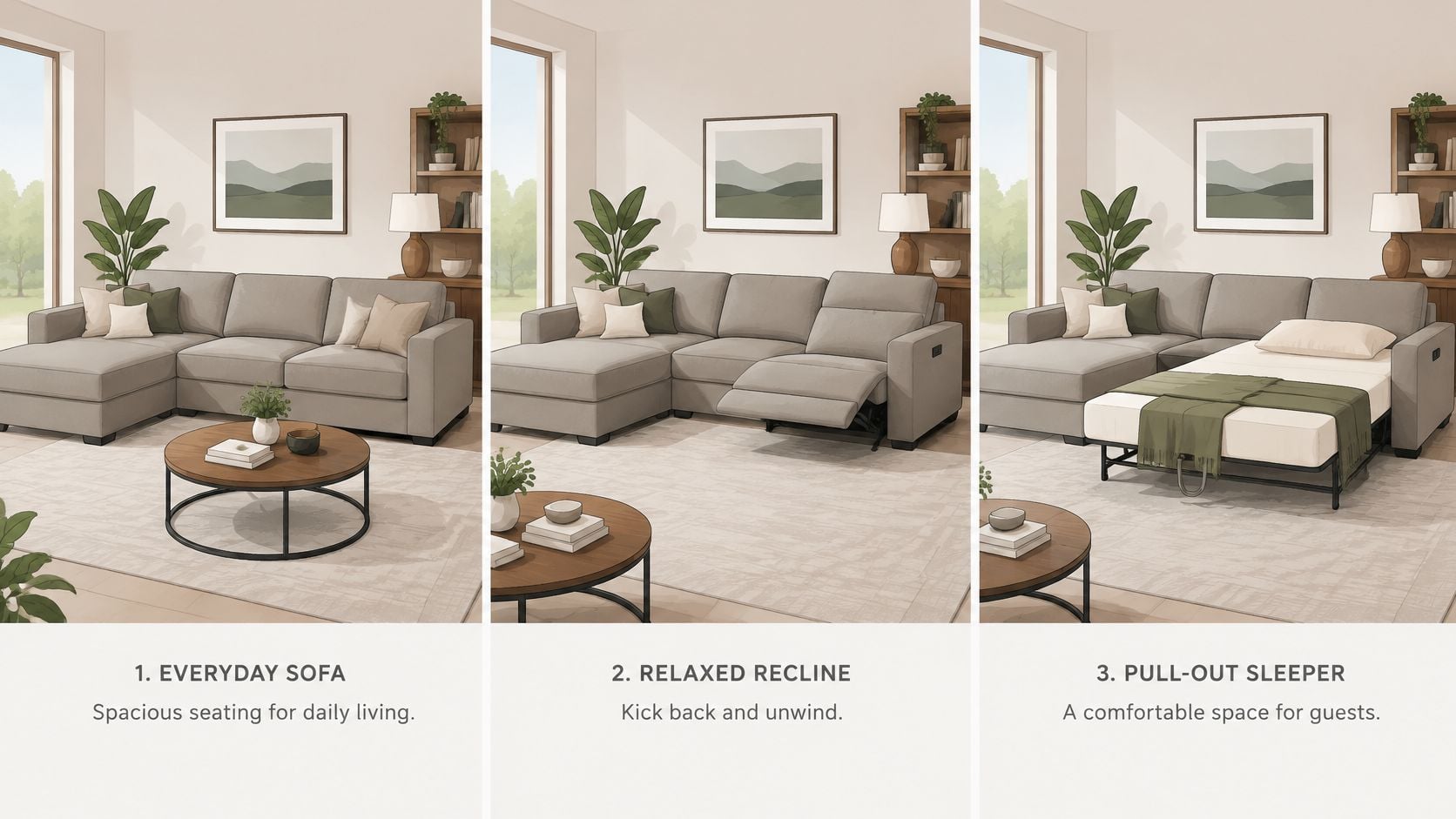
It's Friday at 6 p.m., relatives call to say they're arriving tomorrow, and the living room suddenly has to be a movie spot tonight and a guest room tomorrow night. There's no spare bedroom, the air mattress is buried somewhere, and nobody wants to give up a good seat for the game. That's the everyday pinch a sectional sleeper recliner is built to solve, and it's also where shoppers get tripped up. The piece has to sit well, recline well, sleep well, fit the room in every position, and get through the front door.
The friendly way to shop for one is to slow down and judge each job on its own. A comfy recline doesn't guarantee a good night's sleep, and a closed footprint that looks fine on Saturday afternoon can block the hallway once the bed opens. Treat the purchase as two systems in one frame, a daily seating spot and a sleeping surface, then check the full movement path from delivery truck to bedtime. That simple shift prevents most disappointments.
Say a family in a smaller Metro Milwaukee home gathers after dinner. One person reclines to watch TV, another sits upright with a laptop, a kid stretches out on the end, and later a visiting grandparent needs a place to sleep. One piece handles all of it without a separate guest bed eating up a spare room.
That's the plain definition. A sectional sleeper recliner joins modular sectional seating, at least one reclining seat, and a pull-out sleeping surface in one living-room system. In a 2024 upholstery consumer survey reported by Furniture Today Strategic Insights, 15% of respondents chose a sleeper sofa within a sectional, rising to 22% among Millennials and falling to 6% among Gen X.
For apartments, condos, smaller houses, and rooms that double as guest space, that three-in-one setup matters because a separate sectional, recliner, and guest bed rarely fit together. Shoppers still need to judge three jobs separately, how the sections fit the room, how the recline feels day after day, and whether the sleeper is comfortable enough for real use.
Which job matters most at home, everyday seating, reclining, or overnight guests? That honest answer drives every choice that follows.
Configurations Compared at a Glance
Four layouts show up again and again in showrooms, and they don't behave the same way once the bed opens. The table below puts them side by side so shoppers can shortlist quickly before getting attached to a fabric or color.
Configuration
How the sleeper opens
Best for
Main trade-off
Come-apart sectional with a recliner module
Sleeper module pulls out from the sectional run
Families needing modular delivery and flexible layouts
Each module must pass the route and pull-out space must be planned
Recliner end with pull-out sleeper
Sleeper unit folds out from the end seat
Guest rooms and small living rooms
Smaller sleeping surface and a tighter zone for the recline
Corner sectional with reclining seats
Sleeper section opens within the corner unit
Open-plan rooms needing seating for many people
Largest footprint, and the corner layout sets the opening direction
Sleeper sofa with recliner seat
Sofa bed opens from the center
Shoppers wanting one main sleeping spot
Fewer seats and less modular flexibility
How to Read the Table
Start with opening direction, not looks. A corner layout can force the bed to open toward a coffee table, a doorway, or the main walkway, and no amount of pretty upholstery fixes that at midnight. Shoppers comparing layouts can use this guide to choosing a sectional layout to match shape to room shape before narrowing the list.
Next, ask two practical questions in the store. Is the sleeper a pull-out frame or a fold-out setup, and how many steps does conversion take from sofa to ready-to-sleep bed? A bed that takes five fiddly steps, cushion juggling, and a second person to lift will sit closed while guests end up on the couch cushions anyway.
A layout that opens the wrong way is wrong, no matter how nice it looks closed.
Shortlist one or two rows that match the room and how often guests stay over. A household hosting twice a year can trade a little sleeping width for better daily seating. A household hosting every month should flip that priority and protect the bed first.
Measure Three Footprints Before You Shop
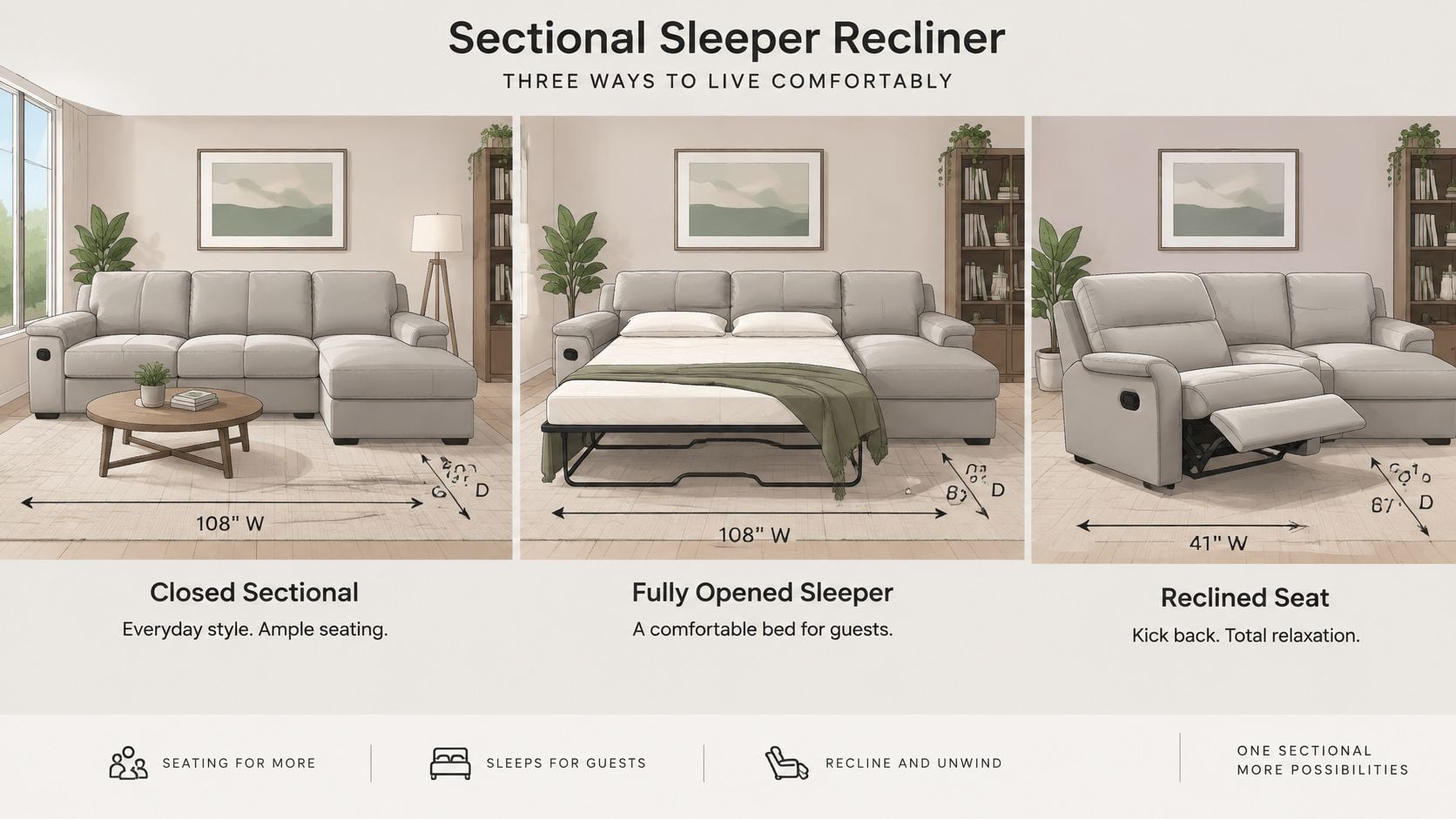
A sectional sleeper recliner doesn't have one footprint. It has three, the closed sectional, the fully opened sleeper, and the reclined seat, and the room has to work in all three. Most measuring mistakes happen because shoppers only tape out the first one.
According to a sectional sofa size guide from Cozey, a typical sleeper sofa runs roughly 78 to 90 inches wide and 36 to 40 inches deep when closed, then opens to about 85 to 96 inches deep. That jump in depth is why a layout that feels roomy for everyday seating can crowd the room at bedtime.
Position
Typical width
Typical depth
Clearance to plan
Closed sleeper sofa
78-90 inches
36-40 inches
Walkway and door clearance
Fully opened sleeper
78-90 inches
85-96 inches
42 inches clear in front, or 60-70 inches of open floor depth
The Painter's Tape Test
Tape is cheap and honest. Mark the closed outline on the floor first, including arms and any chaise or console. Then tape the open outline right over it, from the back of the sofa to the far edge of the bed, and leave both outlines down for a day of normal living.
Walk the routes people use. Can someone reach the bathroom at night without climbing around the bed? Does the open sleeper swallow the coffee table's spot, and if so, where does that table go? Where do the removed seat cushions land? Shoppers who want a step-by-step measuring routine can follow these instructions for measuring a sectional sofa and bring the numbers along on paper.
Don't forget the third footprint while the tape is out. Mark where footrests land when seats recline, because that zone often overlaps the same floor space the coffee table wants. A reclined seat and an open bed rarely run at the same time, but both need their own clear patch of floor at different hours.
Practical rule: If the taped bed blocks a doorway, hallway, or another seat, the model doesn't fit, even if the closed tape outline looks great.
Finally, confirm orientation before comparing models. Some sleepers open straight forward, while others need a specific left-facing or right-facing setup to open correctly. Getting that backwards can put the bed opening into a wall or leave the reclining seat stranded on the wrong end of the room.
How to Check the Delivery Route and Wall Clearance
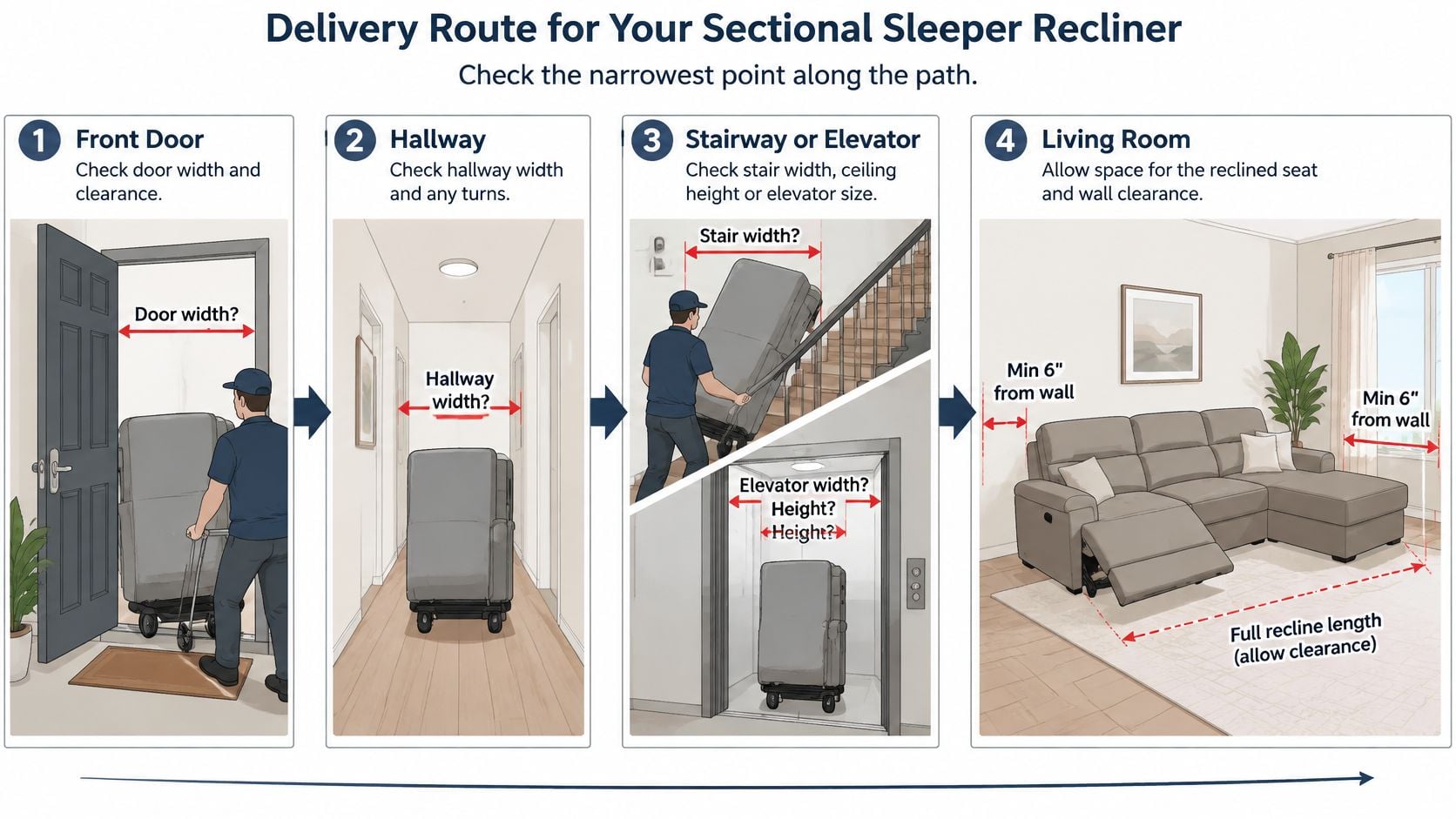
Delivery day is decided by the narrowest point on the route, not by the width printed on a tag. A sectional can fit the living room beautifully and still get stuck at a hallway turn, which is a miserable conversation to have beside a half-delivered sofa. These steps prevent that.
Measure every opening on the route: According to a furniture delivery and sectional guide from Koala, shoppers should measure every doorway, hallway, stairway, elevator, and turn along the route. Open each door as far as it naturally goes, and count trim, handles, hinges, and railings, because those steal real inches.
Measure doorway to opposite wall at each turn: That distance is where a large piece must pivot. A generous doorway followed by a tight turn is still a tight delivery.
Work out diagonal depth for each piece: When a module must enter at an angle, its diagonal depth needs to be smaller than the doorway, stairway, or hallway width. That's the number that decides whether the piece tips through or wedges.
Treat modules as separate deliveries: Separate pieces make hard routes easier, but each packaged module still has to pass on its own. Mechanisms, arms, backs, and pull-out bed hardware can make usable delivery dimensions different from the advertised overall footprint, so ask which sections come apart. Shoppers worried about a tight entry can review what to do when a sofa is too big to fit through the door.
Mark wall clearance behind each reclining seat: A standard recliner generally needs room behind the back so it can move without striking the wall, while wall-hugger designs need less because the seat glides forward as it reclines. Check each reclining seat separately, since a wall-hugger feature on one seat doesn't always apply to every seat in the sectional.
Tape the fully reclined position: Do this before placing a side table, lamp, ottoman, or stack of sleeper bedding in that zone. Leave open space in front for the footrest, too.
One last safety note belongs here. A smaller footprint isn't automatically safer or easier, since reduced size can reduce stability, and sloped or soft surfaces like thick carpet make any tall, heavy piece less steady. Level, stable placement matters just as much as squeezing through the door.
Power or Manual Mechanisms Compared
Choosing between power and manual reclining comes down to who uses the seat and how much control they need. Treat the reclining seat as a daily-use system, separate from the sleeper bed: compare the movement, operation, and setup here, then judge the mattress on its own.
Feature
Power reclining
Manual reclining
Operation
Electric control
Lever or pull handle
Effort to recline
Little, suits limited strength
More force, harder for some users
Positioning
Finer stops at the exact angle
Less precise positioning
Parts to check
Motor, controls and cord
Mechanism and handle only
Setup
Outlet and cord path behind the seat
No outlet needed
Power reclining can suit someone with limited strength or mobility because the controls reduce the effort of adjusting the seat and allow finer positioning. The trade-off is dependence on electricity, a reachable outlet, a cord route clear of walkways, and more components to check over time. Compare types of power reclining seating to understand the available control styles, then check that the controls feel easy to use.
Manual reclining avoids a motor, outlet, and cord. It may take more force to open and close, and the positions can be less precise. For someone who needs to lower into the seat gradually or stop at a particular angle for reading, try the lever and movement before choosing.
Three Checks for Either Type
Ask about warranty and parts: Clarify the mechanism's warranty terms and whether replacement parts are available before buying.
Confirm weight rating and control reach: Check that the person using the seat can reach the lever or buttons without twisting or leaning hard.
Plan cords away from moving parts: Route power cords clear of footrests and out of easy reach of children or pets.
Test the reclining mechanism as a seating feature, including how its controls work and where cords must run. Then assess the sleeper bed separately for its own comfort and support. A power seat and a good bed are separate decisions.
Mattress Types and Sleep Tests
Choose a sleeper mattress by how it supports a body, not by how plush the sofa feels in showroom lighting. Sleeper mattresses are often thinner and less generous than bedroom mattresses because they must fold or stow inside the frame. Check the opened bed on its own terms.
Mattress type
Feel
Strengths
Watch for
Innerspring
Firm and bouncy
Familiar feel and firm support
Can feel thin; check how it sits on the frame
Memory foam
Contouring, slower to rebound
Pressure relief for hips and shoulders
Can run warm; check thickness across the whole bed
Hybrid (coils with foam layers)
Balanced and supportive
Support plus contouring
Heavier; confirm it folds with the mechanism
Thin foam pad
Firm and low profile
Light and compact
Less cushioning for nightly sleep
Judge Sleep on Sleep Terms
Judge the bed by mattress thickness, support, surface flatness, width, partner disturbance, and how often the mechanism will be opened. Memory foam or a hybrid layer may ease pressure on hips and shoulders for regular use. A thin pad may be suitable for occasional guests.
Check the full surface, not just the center. Lie down and notice whether the mattress feels even beneath the hips and shoulders, then turn onto each side. Two adults sharing a narrow sleeper may feel each other's movement, so width and partner disturbance matter alongside softness. For a practical walkthrough, use this guide to testing a mattress. BILTRITE Furniture-Leather-Mattresses has over 60 mattress models on sale, including a selection of flip-able, two-sided mattresses.
Judge Sitting on Sitting Terms
A seat needs a separate check. Focus on seat height, seat depth, lumbar support, control reach, standing effort, and whether the sitter's feet rest on the floor. If the seat is too deep, shorter legs may dangle, making it harder to stand without using the arms for support. For a daily seat, these fit details matter every time someone sits down or rises.
Check the practical bedding routine as well. Try fitting sheets without struggling with the frame, and ask whether bedding can stay on when the bed closes. These details can determine whether opening the sleeper feels manageable or becomes a chore.
Run the Four-Part Test Routine
Sit, then stand, several times: Notice the effort required, knee comfort, and whether the arms offer steady support.
Recline, close, and convert repeatedly: Open and close the bed several times. Listen for grinding or sticking, and check for side-to-side play.
Lie on the opened sleeper for a few minutes: Roll onto each side, check pressure at the hips and shoulders, and feel for bars or dips through the surface.
Confirm the mattress folds properly: Open and close the bed again. The mattress should stow inside the mechanism without forcing the frame.
Test the seat like a chair and the bed like a bed. Passing one test says nothing about the other.
Before choosing, ask for the mechanism warranty, replacement-part availability, weight rating, mattress dimensions, upholstery-cleaning instructions, and the number of transition cycles tested, if the seller has that figure. Specific answers make it easier to compare models and understand routine care. Finally, match the mattress to how often the bed will be used and who will sleep on it. A college kid home for weekends, an aging parent, and a couple visiting twice a year may need different support and space.
Choose the Right Sleeper Recliner for Your Household
A sectional sleeper recliner has to suit the people who use it, not just the room it sits in. A household with children, overnight guests, or someone who needs support standing will weigh different details. Start with the most demanding everyday use, then consider how often the bed will be needed.
Families With Young Children and Pets
Moving footrests, pinch points, and gaps around mechanisms deserve a close look from a child's and pet's height. Keep power-seat cords out of reach and away from places where they could dangle. Also consider how the recliner affects the main walkway. If someone has to squeeze past an extended footrest, it can become a daily source of bumped shins and interrupted movement.
Choose upholstery with the household's routine in mind. Ask for the upholstery-cleaning instructions before buying, and check how the material and seams are likely to handle frequent use and spills. A fabric that looks good in the showroom may require more care than a busy household wants to provide.
Households With Frequent Guests
How often the bed opens should guide the choice of mattress and mechanism. For occasional visitors, a simpler sleeping surface may be adequate. If guests stay often, prioritize a mattress that feels comfortable for the expected sleepers and a conversion mechanism that household members can operate easily.
The room matters during visits, too. Confirm that the bed can open without blocking access to doors or making it difficult to move around the seating area. A comfortable mattress does little good if guests cannot use the bed without shifting other furniture.
Seniors and Caregivers
Daily comfort includes getting in and out of the chair. Check seat height, control reach, and how the reclined position affects standing. If the seat sits too low, getting up may be difficult even when the cushions feel comfortable. Power operation can help a user stop at a preferred angle, while manual operation may suit someone who is comfortable adjusting the chair themselves.
Consider caregiving tasks as well. A bed that is difficult to open or make up can add effort to a routine. Choose a setup the person using it and the caregiver can manage safely.
Apartment and Condo Owners
A come-apart design can help with a difficult delivery route. BILTRITE Furniture-Leather-Mattresses offers come apart sofas and sectionals, which may be useful where an entry or hallway is tight. Each piece still needs to clear the route, and the assembled sectional must work in the room. Small-scale furniture can suit limited spaces, but it does not remove the need to check access and intended use.
The Decision Rule
Prioritize the household's main need: safe daily seating, a bed that gets regular use, or a sectional that can be delivered through a challenging entry. Then confirm that the people who will use it can operate and live with it comfortably. If a key requirement fails, keep considering other options.
A friendly reminder: Measure, try the controls, and ask practical questions before delivery day.
A showroom visit can help you judge upholstery, seat comfort, controls, and the opened bed in person. BILTRITE Furniture-Leather-Mattresses is a family-owned business serving Metro Milwaukee, with its showroom in Greenfield. It carries living-room furniture, including sectionals, recliners, and sleeper sofas, as well as USA-made and Amish-made furniture. The store is closed on Sundays and Mondays, so check the hours before visiting.
Visit BILTRITE Furniture-Leather-Mattresses in Greenfield to see its sectionals, recliners, sleeper sofas, and come-apart options. Bring your room and delivery-route measurements, and consider who will use the chair and bed most often. Try the seating and controls, and look at how the sleeper opens before choosing a piece for your household.