


Bedroom Dresser Espresso: What to Check Before You Buy


The usual advice for buying an espresso dresser starts with matching the bed. That's the easy part, and it shouldn't come first. A handsome dark finish can cover sturdy hardwood construction or a poorly supported drawer box, so the smarter purchase starts underneath the stain.
For shoppers considering “bedroom dresser espresso,” the useful questions concern materials, drawer construction, room measurements, and tip-over protection. Color matters, but it can't make a weak dresser last longer or a tall chest stand more securely.
Table of Contents
- What Espresso Really Means on a Dresser
- Solid Wood, Veneer or Composite Compared
- Drawer Joints and Bottoms That Hold Up to Daily Use
- Sizing Your Dresser and Anchoring It Safely
- Matching an Espresso Dresser to the Rest of the Room
- Caring for the Finish and Keeping Indoor Air Fresh
- Visit Our Greenfield Showroom to Confirm the Fit
What Espresso Really Means on a Dresser
Espresso is typically a dark brown stain or toner that deepens the wood while allowing some grain to show. It isn't a standardized paint code. Named after espresso coffee, the finish sits between dark brown and black, with brown warmth that distinguishes it from a flat black painted surface.
Decorhint's furniture-finish overview traces espresso's popularity to the early 2000s, when the almost-black brown finish spread across bedroom furniture, cabinetry, flooring, and dining pieces. That history helps explain its transitional character: formal enough for traditional furniture, but dark and sleek enough for simpler contemporary shapes.
The finish sets the look. The construction sets the lifespan.
The coffee comparison is useful. A darker roast changes what's in the cup, but the beans and brewing still determine its quality. Likewise, espresso changes a dresser's appearance without establishing anything about its drawer joints, structural strength, or repairability.
A color choice, not a quality grade
Wood represented approximately 39.26% of the U.S. furniture market by material in 2025, according to Grand View Research's U.S. furniture market report. An espresso dresser belongs within that broader materials conversation, not in a separate quality category defined by color.
The move toward lighter natural finishes makes espresso a more deliberate visual anchor today. A dark dresser can give a bedroom definition without requiring every surrounding piece to carry the same visual weight.
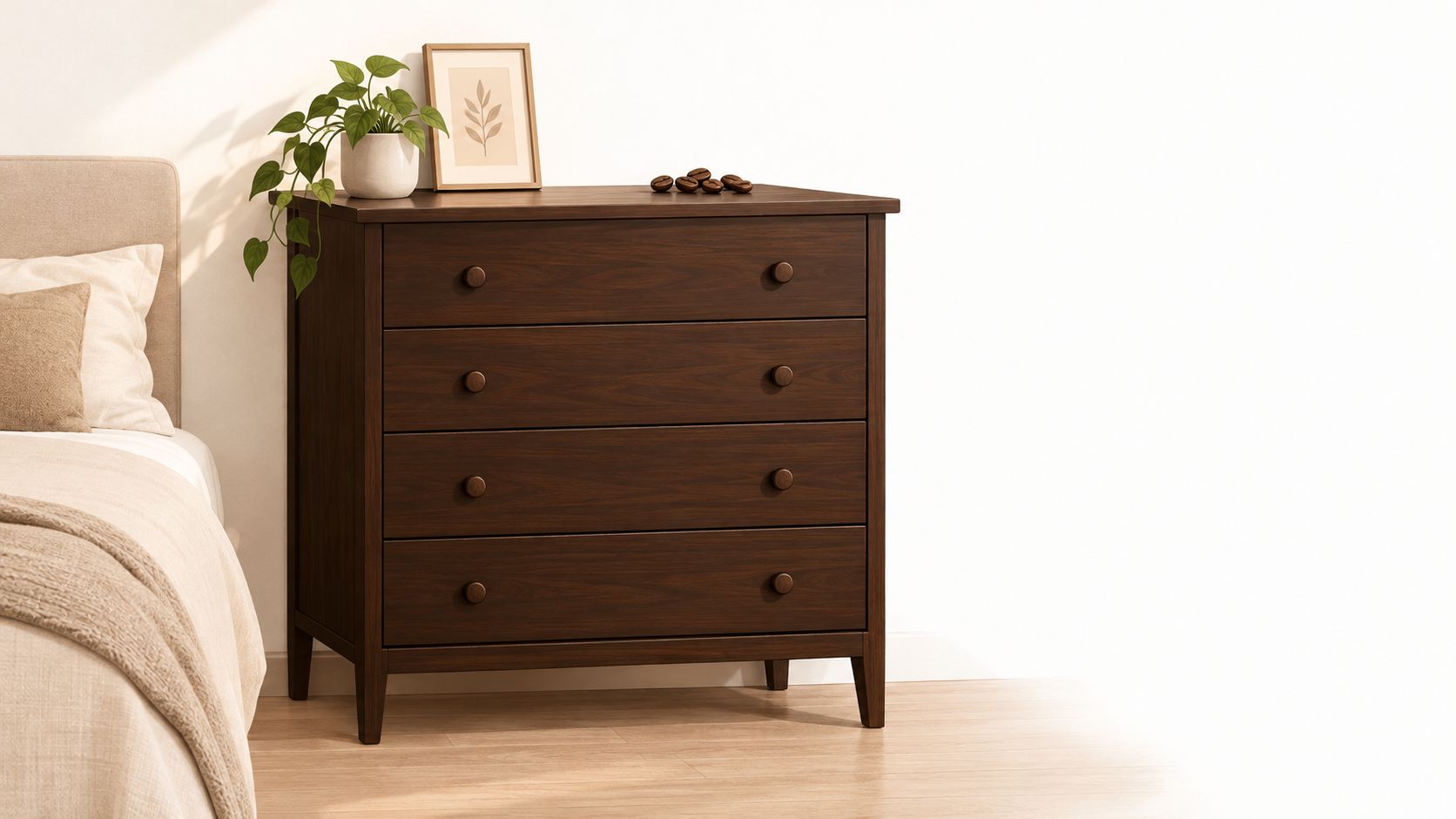
BILTRITE's wood stain color options provide a useful starting point for comparing finishes. But a color name never answers the most important purchasing question: what's underneath it?
Solid Wood, Veneer or Composite Compared
Two dressers can share the same espresso stain and still behave like different purchases after a few winters. The dark finish evens out color across oak, veneer, and MDF in a showroom photo, so read the parts list before the shade.
Espresso dresser materials at a glance
| Material | What It Means | Strengths | What to Check |
|---|---|---|---|
| Solid hardwood, including oak, maple, cherry, and walnut | Espresso stain over natural grain in solid-wood components | Repairable; suitable surfaces can be sanded and refinished | Which parts are solid and how the lumber was dried |
| Veneer over plywood or MDF | Thin wood face glued over an engineered core | Real-wood appearance, stable surface, often lower cost | Veneer thickness, scratch-repair limits, and replacement feasibility |
| Hardwood plywood | Wood layers with grain crossed for stability | Better movement control than a single solid board | Face species, edge banding, and finish type |
| MDF or particleboard | Engineered panel beneath a compatible coating, veneer, or laminate | Flat, consistent surface and budget flexibility | Compliance documentation, edge protection, finish type, and actual weight |
Solid hardwood can be refinished, but it can still dent, split, or warp. Oak, maple, cherry, and walnut all take a dark finish, while their grain patterns stay different. A heavily pigmented espresso coat can mute figure, so identify the species from an unfinished drawer side, back edge, or spec sheet rather than guessing from the showroom face.
Refinishing has limits even on honest solid wood. A broad top may have enough thickness for a careful sand; molded edges, thin aprons, and mixed-material corners often do not. I would treat “solid” as a question about which component and where it sits.
Why engineered components can be the sensible choice
Solid wood moves as household humidity changes. Kiln drying prepares lumber for indoor service, and cross-grained plywood plies counteract seasonal movement better than a single wide board in many large panels. Ask where those methods were used instead of demanding solid lumber in every hidden surface.
That is why a plywood back, dust panel, or drawer bottom can be a deliberate decision. On a wide dark dresser, a stable panel can stay flatter and keep fasteners working evenly; a poor solid board can cup and telegraph a line through the finish.
Veneer deserves the same fair assessment. The face is real wood, which gives grain continuity and a stable surface, but a deep scratch can reach the core. Aggressive sanding is rarely a smart repair, and patching veneer is closer to specialty work than touch-up.
MDF and particleboard can control cost and stay flat under a consistent coating, yet neither term tells you the finished weight. Lift or tilt the piece with help before planning an upstairs delivery or future move, and protect edges because chipped corners expose the core faster on dark finishes.
Questions that clarify the construction
- Which parts are solid? Ask separately about the top, frame, drawer fronts, sides, corner posts, and internal supports.
- What creates the dark surface? Identify stain, paint, wood veneer, or laminate rather than treating them as interchangeable.
- What supports the storage? Confirm the drawer-bottom and back materials, how they are captured or fastened, and what paperwork exists for composite panels.
BILTRITE's guide comparing solid wood and veneer construction helps frame that comparison. Daily-use family bedrooms often justify durable solid frames and drawer fronts; renters or tighter budgets may favor well-built veneer or composite furniture with repair limits explained in plain terms.
Drawer Joints and Bottoms That Hold Up to Daily Use
An espresso finish can make a basic drawer and a well built drawer look identical across a showroom. Read the box instead of the color: corners keep the drawer square, slides carry the load, and the bottom has to stay supported when socks become sweaters.
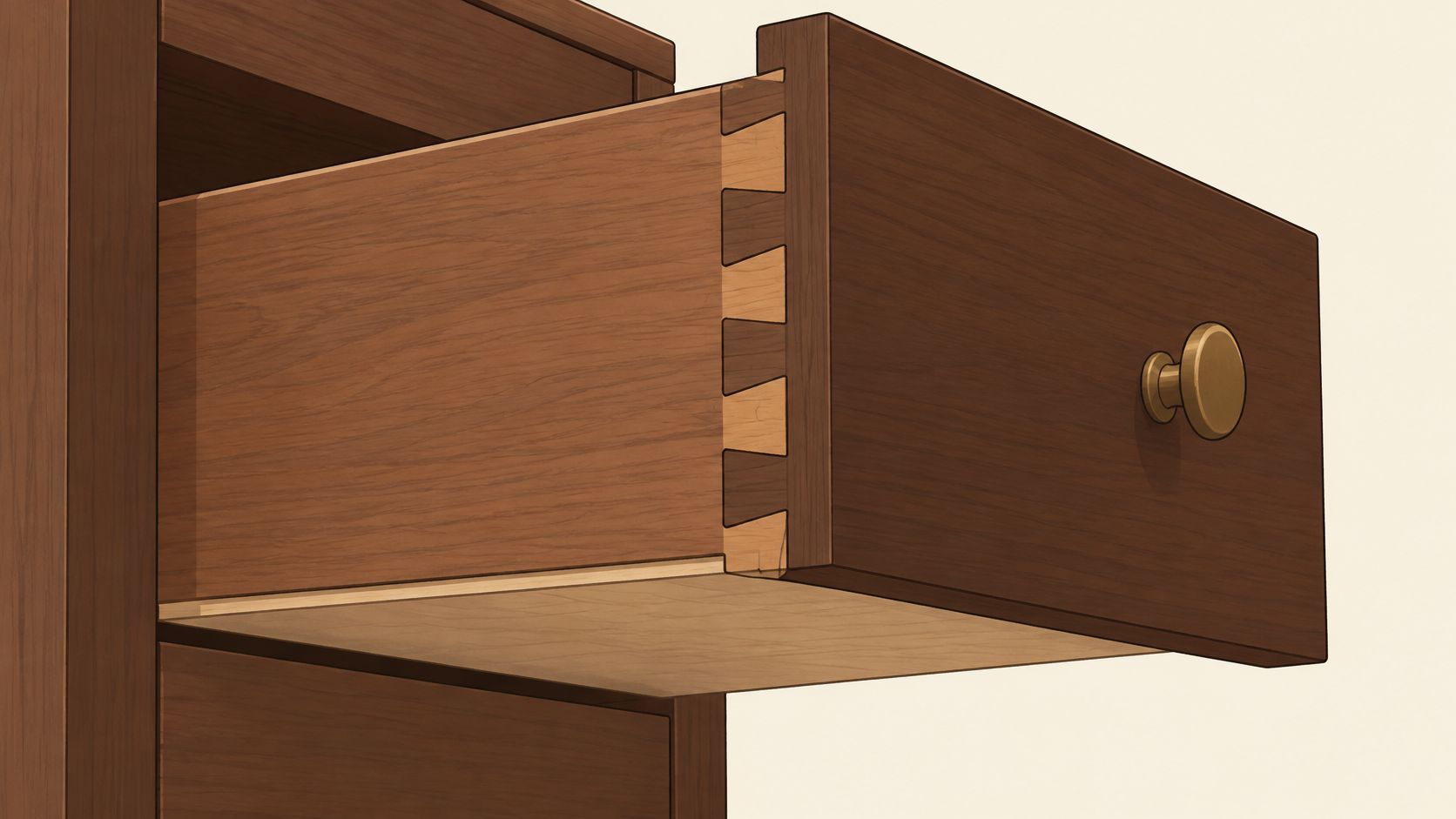
Traditional cabinetmaking uses dovetail, mortise-and-tenon, and tongue-and-groove construction for different jobs. Dovetails resist pull-apart force at drawer corners. Mortise-and-tenon joints help frames stay square. Tongue-and-groove work locates panels and edges; on a dresser, confirm whether a drawer bottom is captured in that groove or only tacked under the box.
A hands-on drawer test
With showroom staff assisting and the dresser secured, test drawers individually.
- Pull each drawer halfway open. It should travel straight without catching or scraping; a smooth empty drawer is the starting point, not proof of its loaded capacity.
- Inspect the front corners. Look for clean dovetail pins and tails or another tightly fitted joint, because visible gaps suggest movement or poor fitting.
- Look underneath. A bottom captured in grooves has edge support; a thin bottom attached only with small fasteners deserves closer questions about loading and repair.
- Check the runners or slides. Full-extension metal slides or well-fitted wooden runners should support the drawer appropriately without pronounced tipping or sideways play.
- Apply gentle pressure to the sides and case. Loose joints or racking warrant investigation, because the drawer and cabinet must remain square to operate properly.
Judge the complete drawer, not the decorative detail
A polished dovetail still needs the rest of the drawer to do its share. An undersupported bottom, loose slide screws, or a flexible cabinet will show up as racking, scraping, or a front that sits out of line. Soft-close hardware can feel refined while hiding a weak corner or a thin bottom; firm, ordinary slides can serve a well made box for years. Hardware feel and structural quality are separate checks.
BILTRITE's dovetail joint furniture guide shows the joint shapes worth recognizing. During a showroom comparison, ask staff to demonstrate slide travel, explain drawer removal for cleaning or moving, and state any loading limits in writing.
A well-made drawer combines sound corners, a supported bottom, and properly fitted runners. No single feature does all the work.
Handmade descriptions deserve the same inspection as factory labels. Craftsmanship varies with the maker, wood species, and design, so ask which joints appear in the exact dresser rather than relying on the word handmade alone.
Sizing Your Dresser and Anchoring It Safely
Typical dresser sizes for bedroom planning
Drawer count doesn't establish reliable dimensions. Use the following checks to compare actual pieces rather than assuming a standard size.
| Dresser Style | Typical Height (in) | Typical Width (in) | Typical Depth (in) |
|---|---|---|---|
| Narrow four-drawer chest | Confirm listed height | Confirm narrowest usable wall fit | Confirm case and handle projection |
| Standard four-drawer chest | Check top-drawer reach | Confirm overall width | Check closed and open depth |
| Six-drawer chest | Confirm layout and height | Check drawer arrangement | Measure full drawer travel |
| Nine-drawer or double dresser | Check top and mirror clearance | Measure complete dresser width | Include handles and drawer travel |
Measure the room and the delivery route
Start with a tape measure, painter's tape, and a sketch of the room. Mark the proposed footprint on the floor, including the space behind the dresser that baseboards or anchoring hardware may require.
- Measure the wall. Record usable width and the height beneath windows, shelves, and other obstructions.
- Check movement space. Allow a comfortable walking path and full drawer opening without blocking the bed, closet, or bedroom door.
- Trace delivery access. Measure door openings, hallway turns, stairs, and landings, including any tight turn immediately inside the bedroom.
BILTRITE's furniture measuring guide can help organize those measurements. A dresser that fits its final wall can still fail to clear the route into the room.
Apartments often benefit from a narrow chest, provided its height remains practical. Senior bedrooms may work better with lower, easy-reach drawers, while family storage needs may favor a wider configuration. Drawer count alone says little about usable capacity, so compare interior space and clothing habits.
Treat stability as a separate buying decision
The CPSC clothing-storage-unit guidance covers qualifying freestanding units at least 27 inches high, at least 30 pounds, and with at least 3.2 cubic feet of enclosed storage volume. Its stability framework considers loaded drawers, extended drawers, pulling forces, and carpeted floors.
A dark finish has no effect on stability. Geometry, weight distribution, drawer extension, flooring, and anchorage matter instead.
- Level the dresser. Correct rocking before loading it, using the product's approved leveling method.
- Install every supplied restraint. Follow the installation instructions and secure the wall connection into a structural member with suitable hardware.
- Store dense items low. Keep heavy belongings out of upper drawers and avoid placing tempting objects where children might climb to reach them.
- Open drawers individually. Never defeat an interlock, and don't assume an interlock replaces wall anchoring.
Safety check: A heavy dresser can still tip. Weight isn't a substitute for an installed restraint.
Smaller furniture and furniture outside a particular rule's scope still deserve careful setup. Anchoring should remain part of the purchase and delivery conversation, not an afterthought.
Matching an Espresso Dresser to the Rest of the Room
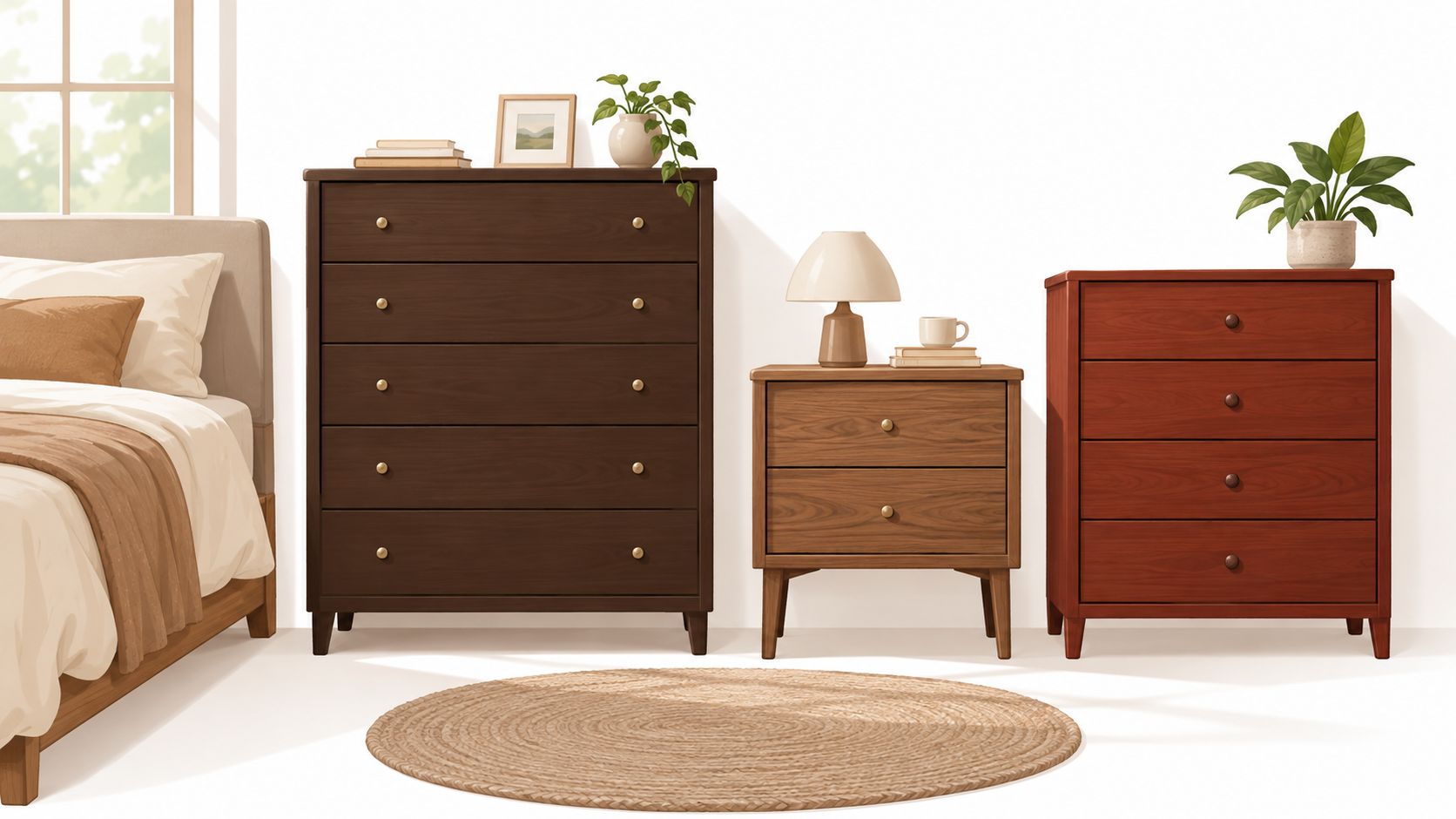
An espresso dresser beside walnut or cherry can look coordinated or slightly wrong, even when both pieces are described as brown. The usual culprit is the undertone. Espresso can read neutral, reddish, or nearly black, so color names alone are not enough.
Two approaches work: match the color family or contrast deliberately. Dark-wood bedroom design guidance emphasizes surrounding finishes, lighting, and proportion rather than treating dark furniture as a problem by itself.
Match the family or make the difference clear
For a quieter room, choose a bed and nightstands with compatible undertones. They do not need identical grain or hardware, but the brown beneath the finish should feel related. A neutral espresso dresser looks wrong beside strongly orange-red furniture, even when the overall darkness is similar.
For intentional contrast, pair the dresser with a lighter nightstand or a natural-wood bed. A clearly different finish reads as a decision. A near-match that misses reads as a mistake.
- Light textiles soften the contrast. Cream, beige, ivory, and light gray keep bedding and curtains from competing with the dresser.
- Hardware changes the mood. Brass adds warmth; black hardware creates a quieter, heavier-looking face.
- Floor contrast matters. Against very dark flooring, a lighter rug or brighter wall helps define the dresser's outline.
Test the sample where the dresser will live
Compare a physical finish sample beside your existing furniture in daylight and again under evening lamplight. View it vertically as well as flat, since reflected light changes the apparent depth of a dark finish. A phone photograph helps with layout, but it should not settle a close color decision.
A dark dresser does not automatically shrink a small bedroom. Visible legs, restrained proportions, layered lighting, and uncluttered surroundings let a substantial piece sit comfortably.
Cap the room at two dark wood tones. Three nearly matching finishes will always disagree with each other, while one espresso piece against lighter wood looks deliberate. BILTRITE keeps finish samples on hand, so undertones can be compared side by side before committing.
Caring for the Finish and Keeping Indoor Air Fresh
Espresso finish problems, causes and fixes
| Symptom | Likely Cause | First Fix |
|---|---|---|
| White rings or haze after a drink or lotion | Moisture or alcohol-containing products affecting the clear coat | Blot dry, avoid further exposure, and check the care card |
| Light scratches exposing pale material | Wear through the dark finish at contact points | Ask about approved touch-up options |
| Lifting or peeling top or drawer edge | Water, heat, or separating veneer | Stop wet cleaning there and seek repair advice |
| Drawers sticking after humid weather | Wood movement or slide misalignment | Inspect the slides and allow conditions to stabilize before adjustment |
| Strong chemical smell after delivery | Emissions from finishes or adhesives | Ventilate and request compliance documentation |
Protect the coating, not just the color
On a stained espresso dresser, a protective clear coat provides the working barrier against abrasion, moisture, and household chemicals. Dark pigmentation makes dust and edge wear conspicuous, so gentle, consistent care usually serves better than occasional aggressive cleaning.
Use a soft dry cloth for dusting, or a lightly damp cloth when permitted by the care card, followed by drying. Coasters prevent repeated exposure beneath drinks; standing water, alcohol-based cleaners, and abrasive pads can damage the coating even while the underlying wood remains sound.
Before purchase, ask about the finish system, approved cleaning products, and replacement hardware. BILTRITE's wood furniture maintenance guidance provides a practical reference, but the piece-specific care instructions should govern treatment.
Ask direct indoor-air questions
The EPA's composite-wood formaldehyde guidance identifies emission limits of 0.09 ppm for particleboard, 0.05 ppm for hardwood plywood, and 0.11 ppm for MDF. These are composite-product standards, not a guarantee about the air concentration in a furnished bedroom.
Pressed-wood furniture can contribute formaldehyde indoors, but composite construction shouldn't automatically be labeled unsafe. Request compliance documentation and identify the materials throughout the piece. Solid-wood furniture also warrants questions about adhesives, coatings, and internal components.
During the first week, a household can follow a simple routine:
- After delivery: Ventilate when outdoor conditions permit and retain the care information.
- During use: Keep damp clothing, lotions, and drinks away from unprotected surfaces.
- If concerns persist: Contact the showroom about continuing odor, irritation, sticking drawers, or coating changes rather than masking the problem with fragrance or polish.
Odor alone can't establish whether a product meets an emissions standard.
Visit Our Greenfield Showroom to Confirm the Fit
BILTRITE has been family-owned and operated since 1928, serving Metro Milwaukee through successive generations. That fourth-generation continuity is meaningful in context: Cornell's family-business summary reports that only about 3% of U.S. family-owned companies survive into the fourth generation or beyond.
At 5430 West Layton Avenue in Greenfield, the showroom gives shoppers something a finish photograph cannot: a chance to examine the furniture up close, operate the drawers, and discuss construction before deciding. Espresso stain reads differently under store lighting than it does on a screen, and a drawer that looks smooth in a product shot may feel loose in your hand.
Compare the details in person
Look for the USA Made, Amish-made, and solid wood icons, then ask what each designation means for the particular piece. Origin and craftsmanship categories are a starting point. The answers should identify the actual woods, joints, components, and finish.
USA-made purchasing supports domestic production work. Ask where construction and finishing occurred and which major components are domestic rather than assuming every material shares the same origin.
The useful comparison between two espresso dressers is what each price includes: drawer joinery, bottom thickness, expected upkeep, and repair options if a runner or finish is damaged later. Ask the team to open a drawer and point out the joints, then run the same questions on a second piece. Small-scale options suit apartments and compact homes, while heavy-duty pieces suit family use, and the icon system narrows the floor before the detailed comparisons begin.
Arrive with a practical shopping kit
- A tape measure and room sketch: Include wall dimensions, drawer-opening space, and delivery restrictions such as narrow doorways or stairs.
- Room photographs and samples: Bring flooring, wall, and existing-furniture references so the espresso tone can be judged against what it will sit near.
- A question list: Cover construction, anchoring, care, repair options, and availability.
- Custom-order priorities: Identify which dimensions, colors, and material choices matter most.
Designers and trade professionals can work with the showroom team on affordable custom options, including fabric, leather, wood species, finish, and hardware where offered. Not every option applies to every piece, so confirming the available combinations avoids assumptions.
Bring the anchoring question to the floor as well. A tall dresser in a household with children needs a plan for wall attachment, and the showroom team can explain what hardware each piece supports and how delivery placement works in rooms reached through tight doorways.
The showroom is closed Sundays and Mondays to support family time. On an open day, shoppers can compare finish samples in available natural light, test drawers, and sit down to try comfort options without rushing a decision.
BILTRITE Furniture-Leather-Mattresses offers affordable, better-quality bedroom furniture, including USA-made, Amish-made, and solid-wood options worth examining beneath the finish. Visit BILTRITE Furniture-Leather-Mattresses in Greenfield with room photos and measurements for a no-pressure opportunity to compare espresso finishes, test drawers and seating comfort, and ask questions in person.