


How to Choose a Large Recliner Sofa Without Regret


Movie night is ready. The snacks are out, the family has claimed their spots, and a beautiful large recliner sofa finally arrives. Then every seat opens, the footrests stretch forward, the hallway narrows, and the dog winds up trapped behind the coffee table. A sofa that looked right in the showroom has changed the whole room.
That mistake is avoidable. A large recliner sofa deserves more than a color and fabric decision. Buyers need to check the fully reclined footprint, the delivery path, and the mechanism's cycle rating before committing. Those three details determine whether the sofa fits the room, reaches the room, and holds up to everyday family use.
Table of Contents
- What Makes a Large Recliner Sofa a Different Decision
- Measure the Room for a Large Recliner Sofa
- Pick the Right Recline Mechanism
- Choose Between Leather and Fabric
- Built to Handle Real Family Life
- Plan the Delivery Path Before You Buy
- Come See a Large Recliner Sofa in Person
What Makes a Large Recliner Sofa a Different Decision
A regular sofa stays close to the shape seen in the showroom. A reclining sofa changes shape every time someone opens a footrest or adjusts a back. That movement affects walking space, coffee-table placement, access to nearby doors, and the distance between the sofa and the television.
The category has also grown far beyond occasional bonus-room seating. One industry estimate values the global recliner sofa market at US$10.4 billion in 2026, with a projection of US$17.4 billion by 2033, representing a projected 7.6% compound annual growth rate. The same source places the market at US$6.9 billion in 2020, evidence that recliner sofas now represent a substantial household furnishing category rather than a niche comfort purchase. Read the recliner sofa market estimate
The three checks buyers forget
The reclined footprint comes first. A sofa can fit neatly against a wall upright and still consume much more floor space when its seats open. That extra depth can block a walkway or leave the person in the footrest competing with the coffee table.
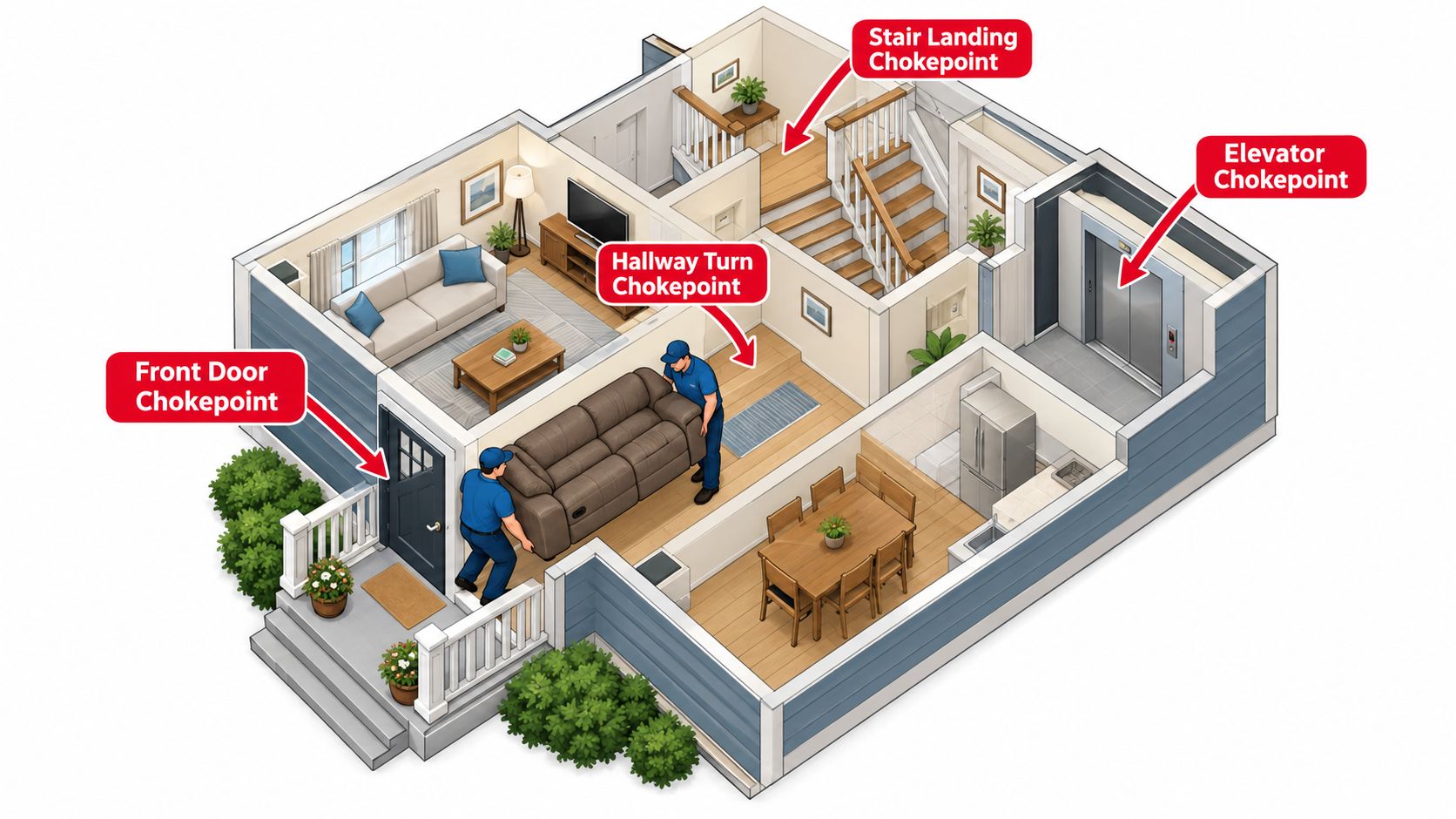
The delivery path matters just as much as the living room. A sofa that fits the floor plan may still fail at the front door, hallway turn, stair landing, or elevator. Large pieces need a route plan, not just a room measurement.
The mechanism cycle rating predicts how the moving parts may handle repeated use. A household that reclines every seat during nightly television needs a different construction standard than a household that opens one seat occasionally.
Practical rule: A large recliner sofa should pass the room test, the route test, and the daily-use test before upholstery becomes the deciding factor.
BILTRITE has served Metro Milwaukee families since 1928, and the showroom experience reflects a straightforward principle. Furniture should work in the home it enters. That means measuring carefully, testing the motion, and choosing construction that matches the people who will use it.
Measure the Room for a Large Recliner Sofa
A large recliner sofa can fit your wall and still crowd the room once the footrests open. Measure before choosing upholstery or color. Three dimensions decide the layout: the upright footprint, the fully reclined footprint, and the required wall gap.
Measure the upright and open positions
A three-seat reclining sofa commonly measures about 79 to 94 inches wide and 35 to 41 inches deep upright. Fully reclined, it may reach roughly 59 to 71 inches deep, according to this reclining sofa sizing guide. Another guide lists typical dimensions of 78 to 90 inches wide, 36 to 40 inches deep upright, and 65 to 72 inches fully reclined. Compare typical reclining sofa measurements
Measure every seat, including the arms and footrests. Mark both positions on the floor with painter's tape. Leave the tape in place while you check the coffee table, television sightline, and walking route.
Use this planning equation:
Fully reclined depth + wall clearance + traffic lane = total usable depth.
For a room-specific reference, see BILTRITE's guide to sofa dimensions in inches for upright and reclined measurements. Keep the main walkway at 30 to 36 inches, the range listed in BILTRITE's sectional sofa measuring guide. If the open footprint takes up that path, the sofa will make daily movement frustrating even if it fits on paper.
Check the wall, ceiling, and doors
Wall clearance varies by mechanism. Wall-hugger designs commonly need about 4 to 6 inches behind the sofa, while standard mechanisms may need about 12 to 18 inches. A broader guide gives practical ranges from 4 to 18 inches behind the furniture, with 20 to 24 inches in front for footrest extension. Review wall-clearance guidance for reclining furniture
Measure the back height against ceiling fixtures, window trim, shelves, and artwork. Check the door swing as well. A door opening toward the seating area should not strike the sofa or lose usable clearance.
Record these measurements before shopping:
- Upright width and depth: Include arms and side controls.
- Fully open depth: Measure to the farthest footrest point.
- Wall gap: Confirm the requirement for each seat mechanism.
- Traffic lane: Keep walking space between the sofa, table, and television.
- Vertical clearance: Check the back against lights, trim, and shelving.
A sofa passes the room test only when its open position leaves the room comfortable to use. Measure that position first, then choose the style.
Pick the Right Recline Mechanism
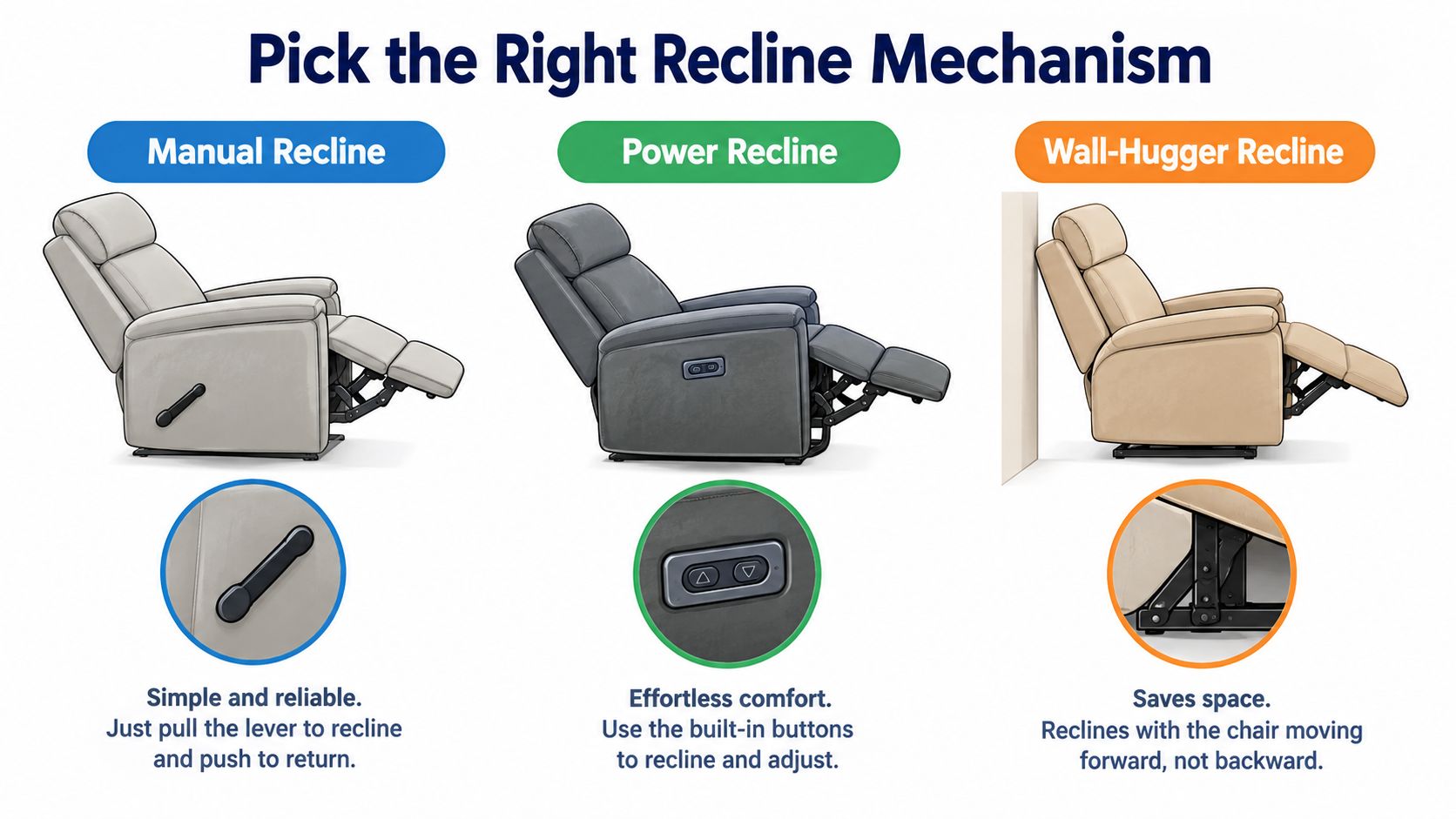
Mechanism choice should follow the household, not the trend. Manual, power, and wall-hugger systems each solve a different problem, and a large recliner sofa may combine more than one of these design priorities.
Manual suits simple, flexible rooms
Manual reclining sofas use a pull lever or push-back motion. They typically cost less, don't need an outlet, and continue working during a power outage. That simplicity appeals to shoppers who want fewer electrical components and more freedom to place the sofa.
The tradeoff is physical effort. A lever requires arm strength, while a push-back seat requires the user to shift body weight. The lever can also occupy the arm area where a small table or cup holder would otherwise sit.
Power helps with precise comfort
Power reclining uses a motor controlled by a button or wand. It makes opening and closing easier for older adults, people recovering from an injury, and anyone who doesn't want to fight a lever. A power seat can also offer more controlled headrest or lumbar positioning when those features are included.
The sofa needs a grounded outlet within about 6 to 8 feet, so cord placement belongs in the room plan. Buyers should run the controls through the full range in the showroom and listen for smooth, quiet movement. BILTRITE's guide to power reclining seating types provides additional context for comparing these configurations.
Wall-hugger solves a space problem
A wall-hugger mechanism moves the seat forward as it reclines instead of sending the back straight into the wall. That design can reduce the rear gap to about 4 to 6 inches, making it a strong choice for a condo, apartment, or tight den.
The front space still matters. The footrest needs room to extend, so wall-hugger does not mean the sofa occupies no extra floor space.
| Household situation | Strong starting choice | Main reason |
|---|---|---|
| Large family room with generous rear clearance | Power | Easy, controlled movement |
| Tight den or smaller living room | Wall-hugger | Reduced wall gap |
| Occasional-use bonus room | Manual | Simple operation without an outlet |
A large family room usually benefits from power operation. A tight den usually needs wall-hugger construction. An occasional-use room can keep things simple with manual reclining.
Choose Between Leather and Fabric
Upholstery should answer four household questions: how the surface feels, what it faces from children and pets, how it behaves through Milwaukee weather, and how much weekly care the household will provide.
Leather feels smooth and structured, with a surface that usually wipes clean easily and doesn't hold odors the way absorbent textiles can. It can feel cool when someone first sits down in winter, then warm with body contact. Genuine leather also develops a softer appearance over time, while lower-quality bonded surfaces can eventually crack or peel at heavily flexed areas.
Fabric brings a softer first impression and often feels warmer in a chilly room. Performance fabrics, microfiber, treated weaves, and tight textures can handle ordinary spills and paw traffic well, but fabric may hold pet hair and show pilling where thighs rub repeatedly.
Match the surface to the household
A young family with juice cups, muddy paws, and frequent snack spills may prefer a forgiving performance fabric. A household seeking an enduring, easy-wipe surface may prefer leather, provided everyone accepts that scratches and surface marks can become part of its character.
Milwaukee's seasonal swings make the hand feel noticeable. Fabric tends to breathe more comfortably in warm weather, while leather's winter chill can be reduced with blankets or room warmth. Neither material removes the need for care. Leather needs appropriate cleaning and conditioning, while fabric benefits from prompt spot treatment and regular vacuuming.
A showroom sample can't make the decision alone. The right upholstery depends on who eats, naps, climbs, spills, and sheds on the sofa.
BILTRITE's fabric selection guide can help shoppers compare performance characteristics before choosing a swatch. The useful question isn't which surface looks most impressive under showroom lighting. It's which one still feels manageable after a busy week.
| Factor | Leather | Fabric |
|---|---|---|
| Hand feel | Smooth, structured, and easy to wipe | Soft, warm, and available in varied textures |
| Kids and pets | Resists many surface spills, but can show scratches | Often more forgiving, especially in performance weaves |
| Milwaukee climate | May feel cool at first in winter | Usually feels warmer in cold weather |
| Weekly upkeep | Wipe and condition with suitable products | Vacuum and treat spills promptly |
| Long-term appearance | Can develop a softer patina | Can show wear, hair, or pilling at busy contact points |
The best choice follows the household's routine. A clean-lined leather sofa isn't automatically practical for every family, and a soft fabric sofa isn't automatically easier.
Built to Handle Real Family Life
The Kowalski family from Bay View had a familiar problem. Their eight-year-old sectional had survived daily movie nights, two Labradors, and a teenager who treated the footrest like a trampoline. Eventually, the sofa gave up, and the family needed more than a comfortable replacement.
Their sales associate started with three questions:
- How many times will each seat recline during a normal day?
- What will sit on the frame?
- What will sit on the cushions?
Those answers pointed toward heavy-duty construction rather than a soft showroom feel. BILTRITE's heavy-duty living room furniture category gives shoppers a place to begin that conversation.
Look underneath the upholstery
A kiln-dried hardwood frame with corner-blocked joinery gives a sofa a stronger structural foundation than stapled particleboard. That difference matters when adults drop into seats, children climb over arms, and legs repeatedly lift and lower.
Cushion construction matters just as much. A cushion can feel wonderful during a short showroom visit and still lose support under constant use if its foam and suspension aren't suited to the household. Buyers should ask what supports the foam, especially in the seat area and at the moving sections.
Some current buying guidance places premium electric mechanisms around 15,000 to 20,000 cycles, while budget mechanisms may be rated around 5,000 to 8,000 cycles. Review recliner durability tradeoffs The mechanism can become the weak point before the frame, so a heavier sofa isn't automatically a better long-term value unless its moving parts match the workload.
The Kowalskis also considered how the cushions would handle dogs and daily lounging. A durable frame won't compensate for cushions that flatten quickly, and a strong mechanism won't fix upholstery that fails at high-contact flex points.
A well-built reclining sofa can last 7 to 10 years or more with regular use, while lower-end models may begin sagging in 2 to 3 years, according to recent buying guidance. Those figures are not promises for every model, but they show why construction deserves as much attention as appearance. Cycle ratings, frame details, foam support, and upholstery grade should all match the family's actual routine.
Plan the Delivery Path Before You Buy
A large recliner sofa has two destinations, the room and the home's entrance route. The delivery route should be measured before the order is placed, because a generous living room can't widen a narrow doorway.
Trace every chokepoint
Start at the street or building entrance and continue to the final wall:
- Front door: Measure clear width and height with the door fully open.
- Porch and foyer: Check steps, railings, ceiling fixtures, and the turn into the home.
- Hallways: Measure the narrowest point and every turn.
- Stair landings: Look for low ceilings, tight pivots, and railings.
- Elevators: Record both opening dimensions and interior depth.
- Final room: Confirm the planned upright and reclined footprint.
A sizing guide recommends comparing the narrowest usable opening with the carton dimensions and the sofa's diagonal or pivot profile. A residential doorway may be around 30 to 36 inches wide, and a large recliner may need its back or feet removed, or the piece tilted, to pass through. Review recliner delivery measuring guidance
Another useful check applies to sectionals and modular furniture. The package should ideally be at least 2 inches narrower than the tightest doorway or turn. See practical sectional access guidance
Use the diagonal, then inspect the turn
For a rectangular piece, diagonal depth can be calculated as √(height² + depth²). The doorway width must exceed that diagonal for a clean straight-through fit, though real delivery teams also need space to pivot.
A 90-degree hallway turn can defeat a sofa that clears the doorway. Low basement bulkheads and an elevator with less than 54 inches of interior depth can create the same problem. These locations deserve photographs and written measurements before choosing a rigid one-piece sofa.
The narrowest turn, not the largest room, controls delivery success.
Come-apart construction is often the practical answer. Some large recliner sofas separate into two or three modules, pass through tight areas, and reconnect with brackets in the living room. A modular piece can be easier to deliver than a smaller rigid sofa if the smaller piece cannot pivot through the route.
BILTRITE's guidance on sofas that are too large for a doorway gives shoppers a useful checklist for access problems. The goal is simple: confirm the sofa can reach its intended location before anyone has to leave it awkwardly on a porch or return it to the warehouse.

Come See a Large Recliner Sofa in Person
The smartest showroom visit is a working test, not a quick glance. Shoppers should bring the room measurements, a list of regular users, and phone photos of the delivery route. Those details let a sales associate focus on fit instead of guessing.
The fully extended position deserves real time. Each regular user should sit with the footrest open, check head and arm height, and notice whether the seat supports the lower back. Power users should run the controls through the full range and listen for smoothness, speed, and unwanted noise.
The family should also test the practical details:
- Does the seat depth suit the shortest regular user?
- Does the footrest support the legs without pressing awkwardly?
- Is the mechanism easy for every household member to operate?
- Will leather or fabric care fit the home's pets, children, and winter routine?
- Does the sofa's construction match its expected daily workload?
BILTRITE is a fourth-generation, family-owned showroom in Greenfield, serving Metro Milwaukee since 1928. The team includes sales associates with more than 400 years of combined experience, and the store carries choices ranging from small-scale furniture for apartments to heavy-duty seating for active families. The showroom also includes USA-made, Amish-made, and solid-wood furniture, along with a mattress department featuring over 60 models.
A visit can also clarify whether a large recliner sofa, a smaller-scale option, or a come-apart design makes the most sense. The right purchase should feel comfortable when open, practical when closed, and realistic for the route through the home.
BILTRITE Furniture-Leather-Mattresses offers manual and power reclining sofas, small-scale and heavy-duty living room furniture, come-apart seating for difficult delivery routes, and USA-made, Amish-made, and solid-wood options. Visit BILTRITE Furniture-Leather-Mattresses in Greenfield with room measurements and delivery-path photos, and let the local team help match the sofa to the family's space and daily routine.