Pull Out Bed Couch: How to Choose the Right One

A cousin is staying over, the living room is already doing double duty, and there's no spare bedroom waiting in the wings. A pull out bed couch can turn that everyday seating area into a welcoming place to sleep without making the home feel like a hotel.
The trick is choosing one that works in both modes. A sofa can look beautiful against the wall yet feel cramped once opened. A mattress can seem plush in a showroom yet be too short or too thick for the folding frame. The right choice balances room dimensions, sleeping comfort, conversion effort, delivery access, and long-term durability.
Table of Contents
- Why A Pull Out Bed Couch Is A Smart Space Saver
- Understanding Sleeper Sofa Mechanisms And Styles
- Navigating Mattress Sizes And Sofa Dimensions
- The Truth About Sleeper Mattress Thickness
- Modern Features And Long Term Durability
- Why Testing In Person Makes All The Difference
- Your Next Steps For Finding The Ideal Fit
Why A Pull Out Bed Couch Is A Smart Space Saver
A pull out bed couch earns its floor space by handling two jobs. During the day, it gives family members a place to sit, read, watch television, or visit. At night, it offers an extra sleeping surface for relatives, friends, or anyone who needs a comfortable place to rest.
That flexibility matters in Metro Milwaukee apartments, condos, starter homes, and busy family rooms. A dedicated guest room isn't always possible, but a living room can often accommodate a sleeper sofa if the closed and open footprints are measured carefully.
From occasional solution to everyday furniture
The sleeper sofa has been around for generations. The first commercially available sofa bed is commonly traced to the 1930s, and Bernard Castro's company was believed to have sold about 5 million sofa beds by 1991, according to this history of sofa beds. That history helps explain why the category moved from a niche product into a familiar part of home furnishing.
Older designs earned a reputation for metal bars, awkward conversion, and uncomfortable sleeping surfaces. Modern designs still have mechanical limits, but better frames, improved mattress materials, smoother opening systems, and more attractive upholstery have changed what shoppers can expect.
A practical rule: A sleeper sofa shouldn't feel like an emergency bed that happens to wear sofa cushions. It should feel like a comfortable sofa first and a dependable guest bed when needed.
A useful choice for real households
The best sleeper may be a compact piece for a condo, a larger option for a family room, or a sectional arrangement where lounging space matters as much as overnight capacity. The important question isn't whether a product is labeled “queen” or “sleeper.” It's whether the furniture suits the room's traffic, the guests' needs, and the household's willingness to open and store it.
BILTRITE Furniture-Leather-Mattresses has served the Metro Milwaukee community as a fourth-generation, family-owned business since 1928. That local perspective matters because sleeper sofas need to work in real homes, with real hallways, doorways, stairs, coffee tables, and family routines.
Understanding Sleeper Sofa Mechanisms And Styles
A sleeper sofa's mechanism determines how the room changes, how much effort conversion takes, and how the piece feels when the bed is stored. Three common styles are traditional pull-out systems, click-clack designs, and classic futons.
The traditional pull-out works like a folded bed hidden beneath the seat. Cushions come off, the frame pulls forward, the mattress unfolds, and support legs settle into place. This style usually provides a separate mattress, which can feel more bed-like, but it needs clear floor space in front of the sofa.
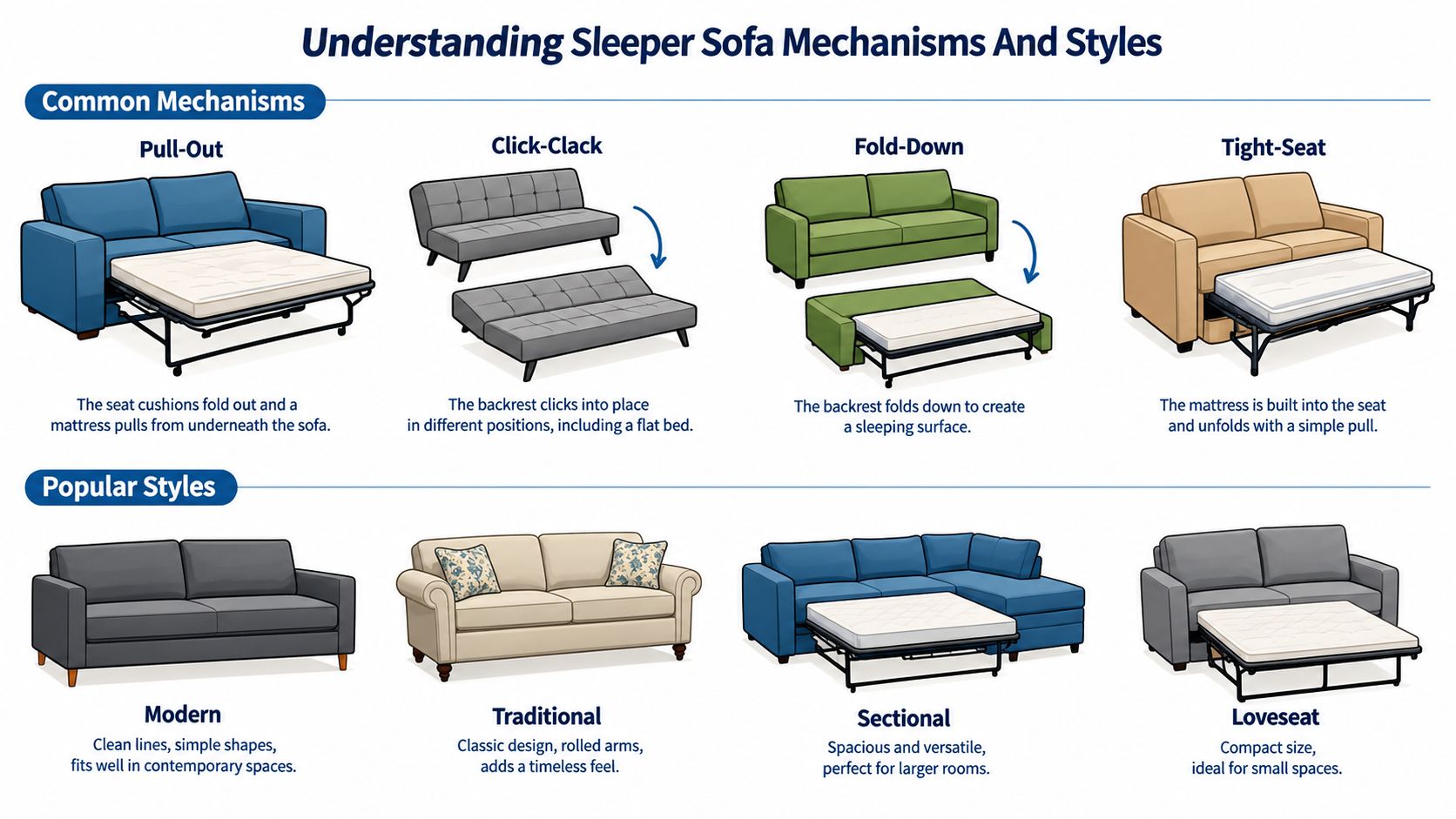
Three ways a sofa becomes a bed
A click-clack sofa uses a hinged back. The back reclines until the seat and back create a flatter surface, much like lowering a theater seat into a lounge position. This design often needs room behind the sofa, and the finished bed can include a seam where the sections meet.
A futon follows a similar broad idea, with a flexible mattress resting on a frame that folds or reclines. It can be straightforward to operate and often suits casual rooms, offices, or compact spaces. Comfort depends heavily on the mattress, frame support, and the way the surface feels when used as a bed.
| Style | How it opens | Main space requirement | What to test |
|---|---|---|---|
| Traditional pull-out | A folded frame and mattress slide forward | Clear floor space in front | Pulling force, leg stability, mattress feel |
| Click-clack | The back reclines into a flatter surface | Clearance behind the sofa | Flatness, hinge movement, seam comfort |
| Futon | The frame or back folds into bed position | Space for the extended frame | Mattress support, sitting angle, conversion ease |
Match the mechanism to the household
A traditional pull-out may suit a household that wants a separate mattress for overnight visitors. A click-clack may make sense where fast conversion matters more than a conventional mattress feel. A futon can work well in a flexible room where relaxed daytime lounging is part of the plan.
The furniture also needs to feel manageable. Someone who struggles with heavy cushions or a stiff handle won't enjoy a mechanism that requires repeated lifting and pulling. Before choosing a pull-out sectional, shoppers should open it fully, close it again, and notice where hands, legs, cushions, and tables need to move.
Navigating Mattress Sizes And Sofa Dimensions
Sleeper sofa sizing becomes confusing when one piece of furniture has several measurements. The overall sofa width includes the arms and upholstery, while the mattress width describes only the sleeping surface. The mattress length can differ just as much, especially in a pull-out design.
A standard queen mattress measures about 60 by 80 inches, but a queen sleeper-sofa mattress is often closer to 60 by 72 inches, according to this sleeper sofa guide. That shorter surface leaves room for the folding mechanism, though taller guests may notice the difference immediately.
Read the measurements in two modes
Read the specification sheet as both a sofa plan and a bed plan. Measure the wall where the sofa will sit, then measure the open depth or length with the bed fully extended. A sofa dimensions resource can help you interpret those measurements. Mark the extended footprint on the floor with painter's tape if possible.
The mattress length is separate from the sofa's outside length. Many pull-out systems use mattresses roughly 72 inches long, so the upholstery and arms can make the sofa much longer than its sleeping surface, as explained in this sofa bed measuring guide.
| Sleeper Size | Mattress Width | Overall Sofa Width |
|---|---|---|
| Twin | About 35 to 39 inches | Varies by design |
| Full | About 52 to 55 inches | About 67 to 83 inches |
| Queen | About 58 to 66 inches | About 75 to 96 inches |
These ranges come from this sleeper sofa size guide. Use them for comparison, then check the product's actual specifications because a particular frame may fall outside a general range.
Don't forget the arms and the route in
Wide arms add visual weight while reducing usable space inside the sofa's footprint. A deep sofa can feel comfortable for sitting yet need substantial clearance when opened. In a compact apartment or den, both the closed and extended measurements matter.
Before delivery, measure doorways, turns, stairways, elevators, and the final placement area. A specialized come-apart frame can solve a tight delivery route by allowing the sofa to be separated and reassembled. Local, in-person testing also helps reveal whether the listed dimensions translate into a comfortable seat and usable bed. A sofa that fits the room but cannot reach it, or feels cramped once opened, creates an avoidable measuring mistake.
The Truth About Sleeper Mattress Thickness
A pull-out mattress has to perform a difficult job. It must provide support while open, then fold into a sofa cavity without forcing the frame, hinges, or upholstery out of alignment. That physical requirement limits how thick the mattress can be.
Most pull-out bed couch mattresses are built around 4 to 4.5 inches thick, while some premium frames may tolerate up to about 5 inches, according to this sofa bed mattress guidance. Going thicker can stop the frame from folding properly or leave too much pressure inside the storage space.
Why a thicker replacement isn't automatically better
A shopper may assume that adding the thickest available mattress will solve every comfort problem. It may instead prevent the bed from closing, distort the frame, strain the mechanism, or create an uneven sleeping surface.
Replacement mattresses need to match the frame's folded dimensions, flexibility, and thickness limit. A mattress that fits the open bed but can't fold correctly isn't a suitable replacement.
Measure before upgrading: Check the sleeper frame's approved thickness and folded dimensions before ordering a replacement or topper.
Look beyond thickness
Within the correct size envelope, construction quality matters. High-density foam can provide a more stable feel, while an innerspring design may offer a different type of support. Neither material guarantees comfort by itself, because the deck, frame, edge support, and upholstery all influence how the sleeper feels.
The support beneath the mattress deserves attention, too. A well-supported deck can make a thinner mattress feel more secure, while a weak or uneven base can make even a carefully chosen mattress disappointing. Shoppers comparing sleep options can also review low-profile mattress choices when a low clearance is part of the room or furniture plan.
Modern Features And Long Term Durability
A sleeper sofa may serve as a bed only occasionally, but it often works harder the rest of the week. In a studio, home office, media room, or apartment, the same piece supports sitting, relaxing, charging devices, and hosting guests. Newer designs respond with USB ports, wireless charging, app-controlled mechanisms, easy-clean fabrics, and materials chosen with sustainability in mind. Recent market trends also point toward growing interest in connected features, recyclable fabrics, compact designs, and furniture suited to smaller rooms. A market summary discusses these broader trends.
Convenience should support good construction, not distract from it. A charging port helps a guest keep a phone nearby, but it cannot make an uncomfortable sofa pleasant. Easy-clean upholstery suits a busy household, while a stable frame still needs to handle daily sitting and repeated conversion. Consider these features like useful kitchen extras: welcome additions, but less important than sound cabinets and reliable hinges.
Durability depends on materials, frequency of use, maintenance, and how gently the mechanism is operated. Sleeper sofas typically last around 8 to 10 years, although no fixed lifespan applies, according to this sleeper sofa buying guidance. A sofa used nightly faces different demands from one opened for visiting family a few times a year.
Details that deserve a close look
Before buying, examine the parts that affect everyday use:
- Frame construction: Choose a frame that feels stable, with no looseness or unnecessary flex.
- Mechanism movement: Open and close the bed slowly. Scraping, grinding, or uneven motion may signal future trouble.
- Seat support: Sit with the bed stored and check that the cushions remain level and supportive.
- Fabric practicality: Match the upholstery to children, pets, guests, and your regular cleaning routine.
- Storage needs: Decide where bedding, pillows, and removable cushions will go when the bed is open.
Size also affects durability. An oversized sofa can place extra demands on a room and delivery route, while a small-scale frame may suit limited space. Heavy-duty construction can make sense for frequent use. Come-apart frames offer another specialized option when a full sofa would be difficult to move through the home, helping preserve access without forcing a compromise on the room's layout.
Why Testing In Person Makes All The Difference
Photos and dimension charts can't reveal how much force a handle requires or whether a mattress feels supportive. A showroom test gives shoppers a chance to sit in sofa mode, open the frame, lie on the mattress, and close the mechanism without guessing.
That hands-on process is especially helpful for households with narrow hallways, tight stair turns, upper-floor apartments, or older homes with challenging entrances. A large sleeper sofa can fit the destination room and still fail at the front door.
Delivery planning belongs in the purchase decision
Come-apart sofas and sectionals address this problem by separating into manageable pieces for delivery, then reassembling inside the home. This option can be valuable when a standard frame won't clear a doorway or when a delivery route includes a sharp turn.
BILTRITE Furniture is a fourth-generation, family-owned showroom in Greenfield that has served Metro Milwaukee since 1928. Its team can discuss sleeper sofa mechanisms, small-scale furniture, heavy-duty choices, custom upholstery, and come-apart options while shoppers test the pieces in person.
A local conversation can prevent a costly mismatch
The sales associates at BILTRITE have more than 400 years of combined experience. Their role is to help shoppers compare fit, comfort, construction, and delivery concerns without turning the visit into a pressure-filled experience.
The same hands-on approach applies to mattresses. Anyone comparing a sleeper mattress or guest-bed solution can use this guide to testing a mattress before making a decision. Sitting, lying down, turning, and checking support are simple actions, but they reveal more than a product photo.
Your Next Steps For Finding The Ideal Fit
A good purchase starts with a short measurement routine, not a favorite color. The household should evaluate the room in sofa mode, bed mode, and delivery mode before choosing a pull out bed couch.
Use this practical checklist
Measure the closed sofa area. Record available width, depth, and height, including nearby tables, lamps, cabinets, and walkways.
Mark the open bed footprint. Use painter's tape to show where the mattress and frame will extend. Make sure family members can still reach doors, bathrooms, kitchens, and other important paths.
Check the delivery route. Measure entry doors, hallways, stair turns, elevators, and tight corners. Ask whether a come-apart frame could make the route easier.
Test the mechanism. Open and close the sleeper without rushing. The movement should feel controlled, and the support legs should settle evenly.
Evaluate both comfort modes. Sit in the sofa for several minutes, then lie on the open bed. Check pressure points, mattress support, edge stability, and the feel of any seams.
Confirm mattress limits. Ask about the approved mattress dimensions and thickness before considering a replacement or topper.
Plan bedding storage. Decide where sheets, blankets, pillows, and sofa cushions will go when guests arrive.
Choose for the household, not the label
A compact sleeper can suit an apartment or condo, while a larger or heavy-duty design may be more appropriate for a busy family room. USA-made, Amish-made, and solid-wood furniture can also be part of a broader furnishing plan when craftsmanship and long-term use matter.
BILTRITE's showroom at 5430 West Layton Avenue in Greenfield, Wisconsin, includes living room furniture, small-scale choices, heavy-duty options, come-apart sofas and sectionals, and a mattress department with over 60 models. The showroom is closed on Sundays and Mondays for family time and welcomes shoppers Tuesday through Saturday.
BILTRITE Furniture-Leather-Mattresses offers sleeper sofas, small-scale furniture, come-apart options, and a mattress department with over 60 models for households working through comfort and delivery challenges. Visit BILTRITE Furniture-Leather-Mattresses in Greenfield to open, test, and compare a pull out bed couch with help from a local team.