OPEN MONDAY, NOVEMBER 23 10AM TO 6PM!
GREBE'S DONUT GIVEAWAY MONDAY, NOVEMBER 23 ONLY!
BLACK FRIDAY + SMALL BUSINESS SATURDAY DEALS ON NOW!
NO CREDIT CARD FEES!
1000's of Items IN-STOCK + 500 Mattresses!
Largest selection of USA Made Furniture & Mattresses + Amish Made!
FREE In-Store Design Services!
BUY LOCAL & LOVE YOUR HOME!
Tuesday-Thursday 10am to 6pm | Friday 10am to 7pm | Saturday 10am to 5pm | Sunday Closed To Be With Family & Friends | Monday Showroom Closed
5430 West Layton Ave, Greenfield - Metro Milwaukee
A standard queen mattress measures 60 inches wide by 80 inches long. The finished bed frame is larger than that mattress, so a room plan that stops at those two numbers often runs out of space.
The jump that made this size the everyday shared bed shows up in square inches. A historical account from ML Linens dates the queen's introduction to 1925 and records it at about 60 by 80 inches. Set that beside a 54-by-75-inch full and the queen adds 750 square inches, about 18.5 percent, along with 5 inches of length and 6 inches of width. The name still isn't a universal measurement. Some markets use a queen near 160 by 200 centimeters, and Japan and China may use queen-like widths with shorter lengths. Inches or centimeters decide whether sheets and a frame will match.
We're a fourth-generation, family-owned showroom in the Metro Milwaukee community, and the families who come in usually aren't stuck on the tag. They want to know whether the whole bed, the walk around it, and the hallway it has to travel will work.
Start with the mattress, because that's the only number a queen bed dimensions in inches chart can promise. A standard North American queen mattress measures 60 inches wide by 80 inches long, which is 5 feet by 6 feet 8 inches, according to Size Hippo's queen size guide. That sleeping surface is 4,800 square inches, or about 33.3 square feet. Split between two adults, the nominal width is about 30 inches per person before pillows, blankets, or anyone rolling over.
Those figures describe the mattress itself, not the complete bed. A frame, headboard, footboard, rails, or upholstery can push the footprint to roughly 62–66 inches wide and 84–88 inches long, depending on construction. That gap is what trips people up during delivery, door clearance, and sheet shopping.
How nearby sizes change the sleep
Size
Dimensions (W x L)
Sleeping surface (sq in)
Best for
Full
54 x 75 in
4,050
Smaller couples and guest rooms
Standard queen
60 x 80 in
4,800
Most primary bedrooms
California queen
60 x 84 in
5,040
Taller sleepers
Olympic queen
66 x 80 in
5,280
Wider shared sleeping
King
76 x 80 in
6,080
Largest shared sleeping
Read the changes as a trade, not a ladder.
Full to standard queen. You gain 6 inches of width and 5 inches of length. Couples who felt jammed on a full usually feel the width first. Guest rooms and smaller couples can still live well on a full if the room is tight.
California queen. Same 60-inch width, 4 extra inches of length, at 60 by 84 inches. That's the pick when feet hang off an 80-inch mattress and the room is long rather than wide. Sheets and the frame opening have to be the California length. Standard queen bedding will come up short.
Olympic queen. Same 80-inch length, 6 extra inches of width, at 66 by 80 inches. Shared sleeping gets roomier without jumping to a king. The cost is walkway space and a harder search for sheets cut to that width.
King. At 76 by 80 inches and 6,080 square inches, this is the wide shared bed. It only earns its place when both side clearances and the delivery path survive.
Bedding has to match the variant you actually bought. A standard queen sheet set will not fit an Olympic queen or a California queen, even if the hang tag still says queen.
International labels add one more check. Don't trust the word queen on an imported set. Measure the mattress in inches or centimeters, then match the frame opening and the sheets to that measurement. Our mattress department carries more than 60 models, from apartment-scale beds to heavier family sets, and the useful question on the sales floor is always the same: which exact rectangle is going into which room?
Queen Bed Frame Size and Total Footprint
The mattress label is a reference, not a promise that every finished mattress hits 60 by 80 to the fraction of an inch. Quilting, foam compression, border materials, and ordinary factory tolerance can shift a mattress slightly. Leesa's queen bed dimension notes put typical queen frames around 63–67 inches wide and 83–85 inches long. Headboards, footboards, side rails, and upholstery can make the piece larger still.
Component
Width (in)
Length (in)
Notes
Mattress only
60
80
Standard reference size from the label
Assembled queen frame
63-67
83-85
Typical published range
Assembled bed with headboard and footboard
62-63
85-89
Reported example, design changes the total
Packaged for delivery
Carton width
Carton length
Record the figure the maker prints for shipping
A published assembly example lands near 62–63 inches wide and 85–89 inches long once the headboard and footboard are on. That's only a few inches past the mattress, and it's enough to hit a closet door or a tight stair turn.
Three numbers to write down
Mattress size. For a standard queen, start at 60 by 80 inches, then confirm the specific model. Don't force a mattress into a smaller opening.
Assembled outside size. Include the headboard, footboard, and any side posts. This is the number that has to live with your nightstands.
Largest delivery size. Ask for the biggest carton or the biggest piece that won't come apart. A heavy solid-wood bed that doesn't knock down needs a clear path, not a hopeful doorway.
Platform and slatted beds are picky about the opening. The support surface has to carry the full 60-inch width and 80-inch length. Too small, and the mattress bows or won't sit flat. Too much gap, and the mattress walks on the slats every time someone sits on the edge.
Custom and solid-wood furniture needs two drawings, not one. Ask for the finished outside dimensions and the mattress opening separately. Nominal queen sizing means the mattresses are interchangeable. It doesn't mean every Amish-made or USA-made frame we build has the same posts, the same headboard thickness, or the same overhang. On a small-scale bedroom, the mattress can fit the floor plan while the headboard you love does not. Confirm all three measurements before you order, especially when the piece is heavy and won't come apart in a hallway. A look at bed types helps sort platform, panel, and storage styles before you fall for a silhouette that won't clear the door.
Clearance Needed Around a Queen Bed
People have to walk around the bed, change the sheets, and open a drawer. Bathroom Explorer's queen mattress chart uses a practical first check: at least 24 inches of walkway along the sides and about 18 inches at the foot. Those gaps sit outside the 60-by-80-inch sleeping area.
Do the arithmetic on the mattress first. 24 inches on each side turns 60 inches of width into about 108 inches of room width, before a dresser. 18 inches at the foot turns 80 inches of length into about 98 inches. If the assembled frame is closer to 66 inches wide, rerun the side math from 66. Two 24-inch walks then need about 114 inches of clear width, not 108.
Clearance Type
Each Side
Foot of Bed
Room Size Needed
Minimum walkway
24 in
18 in
About 108 in wide by 98 in long
Common planning range
24-30 in
About 36 in when the foot is a walkway
About 108-120 in wide and 116 in long from the mattress
Accessible layout
36 in clear on one side
60 in turning space in the room
Wider than a comfort layout; confirm the project standard
What steals the walkway
Nightstands. A 20-inch table on the 24-inch side leaves a sliver, not a path. Measure the table, then the leftover floor.
Dresser drawers. A drawer that opens toward the bed needs its full pull plus room for a person. Closed, the dresser looks fine. Open, it blocks the side you use every morning.
Doors and closets. A door swing is floor you can't stand on. Mark the arc with tape before you commit to a headboard wall.
Windows, sills, and radiators. A low sill can collide with a thick mattress. A radiator steals both inches and the place you'd have put a nightstand.
These thresholds are a first check, not a law for every private bedroom. Comfort depends on how you use the room. Give the side you use most the wider end of the range, about 30 inches when you can. Keep the foot clear if that end of the bed is the path to the closet or the hall. A pretty layout that makes you sidestep the bed every night won't stay pretty for long.
Room Widths That Fit a Queen Bed
Use the frame, not the mattress, when you test a real room. Take 66 inches as a working frame width, a figure inside the usual published frame band, and see what common room widths leave beside it.
Room Width
Space Beside a 66 in Frame
Space Per Side
Verdict
9 ft (108 in)
42 in
21 in
Tight, below the 24 in guideline
10 ft (120 in)
54 in
27 in
Meets the 24-30 in guideline
11 ft (132 in)
66 in
33 in
Comfortable, room for nightstands
Ten feet is the common case. A 120-inch room minus a 66-inch frame leaves 54 inches, or 27 inches a side. That sits inside the 24–30 inch planning band, so two people can pass, and a slim nightstand can live on one side if you're careful with the other.
Nine feet is the compromise.108 inches leaves 42 inches total, about 21 inches a side. That's under the 24-inch guideline. It can work for one sleeper who only needs one open side, or for a guest room used a few nights a month. It doesn't work well for two adults, two nightstands, and a laundry basket.
Eleven feet is where furniture returns.132 inches leaves 66 inches, or 33 inches a side. Nightstands fit, and you can still open a closet if the doors aren't huge. A 12-foot room, 144 inches, would leave 78 inches, or 39 inches a side, which is enough for a dresser on one wall and a chair for reading.
The table is width only. Room length, door swing, and window placement can still knock out a layout that looks fine on paper.
An Olympic queen mattress is 6 inches wider than a standard queen. In a 10-foot room that extra width takes about 3 inches off each side, dropping a 27-inch walk toward 24 inches. You meet the minimum and lose the cushion. Treat this table as a first pass, then measure your own walls. For tight Metro Milwaukee bedrooms and apartments, our small-bedroom arrangement guide walks through furniture placement once the bed claims its share of the floor.
How to Measure Your Room Before You Buy
Bring a tape measure and a notepad. Phone photos help, but the numbers are what you'll compare to a frame.
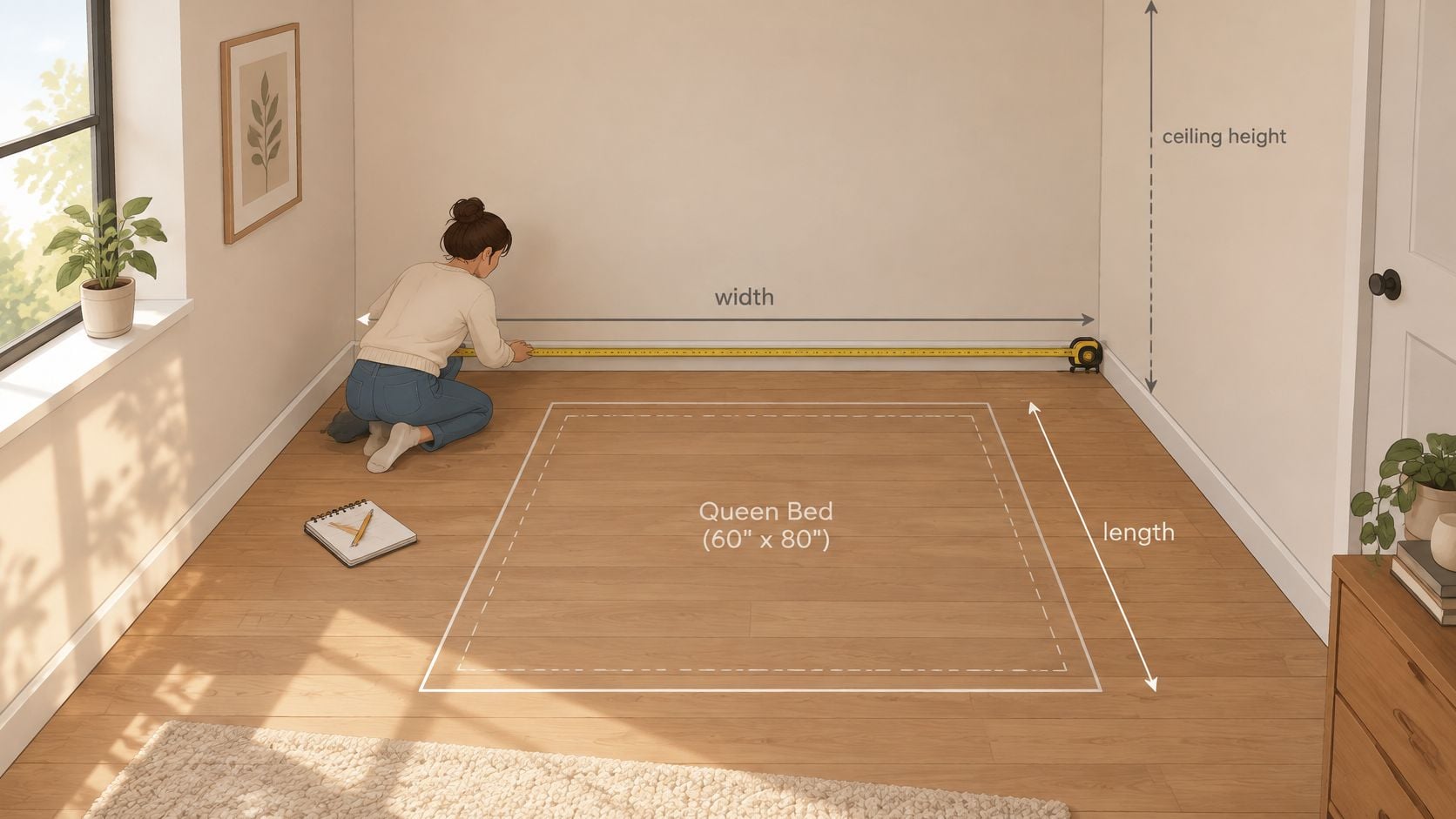
Measure wall to wall where the bed will sit. Record width, then length. Note ceiling height if you want a tall headboard. The common slip is measuring the open floor and ignoring baseboard heaters that steal two inches.
Mark every swing and obstacle. Doors, closet doors, windows, radiators, and outlets all reduce usable space. People measure to the wall and forget the door that opens onto the mattress corner.
Record the mattress from the label. A standard queen is usually 60 by 80 inches. Write the model name too, so a California or Olympic queen doesn't get ordered by accident.
Get the frame's outside size. Include the headboard and footboard. Assuming the frame matches the mattress is the mistake that crowds a nightstand into the doorway.
Check the side math. Subtract the frame width from the room width and divide by two. Compare each side with 24 inches. If one side is the only walk, that side needs the full clearance and the other can be tighter.
Walk the delivery path. Front door, hall, stairs, and any elevator. Write the narrowest width and the lowest headroom. A bed that fits the room and not the stair turn doesn't get upstairs.
Note mattress thickness. If the bed sits under a low window or beside a nightstand, height matters as much as the footprint. Measure the opening, not just the floor.
What to carry to the showroom
Bring three numbers: room width and length at the bed wall, the frame's outside width and length, and the narrowest point on the delivery path. With those, a conversation about solid-wood rails or a lower-profile frame stays honest. Our furniture measuring guide is the same routine our team uses when a piece has to fit a specific wall.
We don't sell online, so this notepad is how the visit starts. You can lie on a mattress, look at the posts, and check the tape against the piece in front of you.
Accessible Clearance for Seniors and Caregivers
A queen mattress starts at 60 by 80 inches, but the usable bedroom plan depends on the frame, the clear walking paths, and how the person gets in and out of bed. Ordinary bedroom planning often leaves about 24–30 inches beside the bed and roughly 36 inches at the foot when that end is a real walkway. Accessibility-oriented layouts ask for more. A discussion of ICC A117.1-2017 in The Homestead Post's clearance guide identifies a 60-inch wheelchair turning circle and 36 inches of clear width on one side of the bed in applicable accessible settings.
Those figures belong to particular regulated or accessible projects. They are not an automatic rule for every private bedroom in Metro Milwaukee. Applying them blindly in a small guest room can remove a layout that works for someone who walks without aids. Ignoring them when a parent is moving in with a walker can turn a bed that technically "fits" into a nightly struggle.
A queen can sit inside a 10-by-10-foot room and still be hard to use once the frame, nightstands, doors, drawers, and mobility equipment are counted. The mattress size is only the starting point. The full footprint includes posts, rails, headboards, footboards, and the space needed to stand beside the bed.
For senior living and caregiver setups, plan three scenes separately: sleeping comfort, daily circulation, and transfers or care. Give the main side about 36 inches clear when a person needs room to sit, stand, or have a caregiver beside the mattress. The other side can be tighter if nobody uses it as a route.
Keep the path from the bed to the door open at all hours. Nighttime bathroom trips, emergency access, and caregiver movement all depend on that lane staying clear. A walker, chair, or laundry basket parked in the route can matter more than a few inches of extra mattress width.
Leave room to pull linens from both sides when the layout allows it. If one side is against the wall, sheet changes become a reach-and-climb job. That adds strain for the person living there and for the person helping. We usually favor the setup that makes the daily care task simpler, even if it means giving up a larger nightstand.
Mattress height and an adjustable base change how easy it is to sit, stand, and transfer. That is a separate issue from floor clearance, and our notes on adjustable bed height cover that part of the fit. If the same household is also planning a safer place to sit during the day, ask about tax treatment for power lift recliners rather than assuming one rule applies to every purchase. We would rather sketch the room around how you move than give you a single minimum room number that ignores walkers, caregivers, door swings, and the frame you plan to buy.
Mattress Height and Sleep-Surface Fit
Width and length get the headlines. Thickness decides whether the edge is easy to sit on, whether the lamp is in reach, and whether the sheets stay on. Bottle Dimension's queen mattress notes put reported queen thicknesses from roughly 8 inches to about 14 inches. The thicker mattress sits higher on the same frame. A higher top helps some people stand up and makes the edge feel like a climb if the foundation was already tall.
Nightstands should land close to the mattress top so a glass or a lamp is an easy reach. A top that sits several inches above the table is a mismatch, and so is a table that towers over a low mattress. Headboards and footboards should meet the pillow at a comfortable height rather than vanishing under it or poking the shoulder.
Fitted sheets and protectors have to match depth as well as queen width and length. A thick mattress usually needs a deep pocket. A thin mattress can slide inside a pocket cut for a much deeper bed, and then the corner pops off at 2 a.m. Read the pocket depth on the package and match it to the mattress you measured, not to the word queen.
Measure thickness from the top cloth to the mattress base. Leave the frame and the foundation out of that number. People often measure from the floor and then buy the wrong pocket.
Add the foundation or platform height. Sit on the edge. If your feet don't rest comfortably, the stack is too tall, even if the mattress itself is a modest 10 inches.
Compare the mattress top with the nightstand top. A couple of inches of difference is usable. A large gap means you're reaching down or knocking things off.
Read the sheet and protector labels. Confirm pocket depth and that the size is standard queen, not a short queen or a specialty width.
Check frame clearance at windows and footboards. A 14-inch mattress on a tall platform can crowd a low window or rise past a low footboard you wanted as a backrest for reading.
Measure the mattress, not the memory of the last one. Two queens with the same 60-by-80 footprint can differ by half a foot in height, and that half foot changes sheets, nightstands, and how easy it is to stand.
Our mattress measuring steps keep thickness, width, and length in one pass so the bedding you bring home stays on.
Confirm Your Queen Size and Visit Our Greenfield Showroom
A standard queen mattress is 60 by 80 inches. That is the starting point, not the final footprint. The frame adds width and length, the headboard and footboard can add more, and the room still needs clear space for walking, making the bed, and moving it through the doorway. Bring those measurements with you when you shop, because the label only tells part of the fit story.
At our Greenfield showroom, we help you compare the mattress, frame, and room layout together. We are a fourth-generation, family-owned furniture, leather, Amish furniture, and mattress showroom serving Greenfield and Metro Milwaukee since 1928. Our mattress selection includes Twin, Twin XL, Full, Full XL, Queen, King, California King, King 2PC, and California King 2PC, so the size conversation can stay specific. We also carry more than 60 mattress models, including flip-able, two-sided styles, with comfort levels from Extra Firm to Ultra Plush.
You can lie on a queen, compare solid-wood frames, and ask how a USA-made or Amish-made bed will sit in your room. Our sleep specialists can walk through the practical trade-offs: a thicker mattress may feel better but change sheet fit and nightstand height, while a larger frame can turn a comfortable 60-by-80 mattress into a tight room layout. Free white glove delivery is offered on mattress-only purchases of $999 or more.
We're closed on Sundays and Mondays so we can be with our families. Visit BILTRITE Furniture-Leather-Mattresses at 5430 West Layton Avenue, say hello, and test the bed that fits your room.