OPEN MONDAY, NOVEMBER 23 10AM TO 6PM!
GREBE'S DONUT GIVEAWAY MONDAY, NOVEMBER 23 ONLY!
BLACK FRIDAY + SMALL BUSINESS SATURDAY DEALS ON NOW!
NO CREDIT CARD FEES!
1000's of Items IN-STOCK + 500 Mattresses!
Largest selection of USA Made Furniture & Mattresses + Amish Made!
FREE In-Store Design Services!
BUY LOCAL & LOVE YOUR HOME!
Tuesday-Thursday 10am to 6pm | Friday 10am to 7pm | Saturday 10am to 5pm | Sunday Closed To Be With Family & Friends | Monday Showroom Closed
5430 West Layton Ave, Greenfield - Metro Milwaukee
A mattress protector shields the mattress. A mattress pad changes how the bed feels. Pick the protector when the problem is liquid, sweat, stains or dust mites, and pick the pad when the bed itself feels too firm, because the barrier behind a real protector is a measurable number: at least 3,000 mm H₂O on a hydrostatic-head test when new, and still 3,000 mm after five wash cycles.
That distinction carries real money. The global mattress-protector market was valued at USD 3.14 billion in 2024, according to Dataintelo, and most buying guides still stop at the tidy summary that a protector is waterproof and a pad is cushioned. That summary leaves the two expensive questions unanswered.
The first is whether a waterproof layer blocks allergens or only spills. The second is whether a pad is a genuine comfort fix or a way to postpone a mattress decision by six months. This guide separates liquid protection from allergen protection, puts the test numbers next to both claims, and finishes with a verdict by household rather than a generic checklist.
One question settles the shopping trip. Do you need to stop something from reaching the mattress, or do you need the mattress to feel different under you? Everything else follows from that answer.
The stakes aren't abstract. A 2025 survey of more than 1,000 British consumers, reported by Furniture News, found that 37% of women and 36% of men had experienced mattress stains or spills that a protector could have prevented. That's roughly one in three adults living with a mark on a mattress they can't put in a washing machine.
What you're comparing
Mattress protector
Mattress pad
Main job
Blocks liquids, sweat, stains, and allergens
Adds softness, loft, and a little warmth
Liquid barrier
Yes on waterproof models, usually a polyurethane backing
Elastic skirt fitted style, or zippered full encasement
Elastic skirt or anchor bands
What to check before buying
Waterproof rating, wash durability, quiet backing
Fill type, loft, quilting, pocket depth
Care
Machine wash, follow the care label closely
Machine wash and dry, expect some batting shift
Best for
Kids, pets, seniors, allergy concerns, an expensive mattress
A bed that feels too firm or too thin
Used together
Goes directly on the mattress
Goes above the protector, under the sheet
Three details the table can't say out loud.
A thin waterproof protector barely changes firmness. If the mattress is comfortable now, a quiet fitted protector won't turn it into a different bed. It sits close to the surface, keeps its shape, and lets the mattress do the support work.
A pad is a comfort purchase, not spill insurance. A quilted pad may absorb a small spill or slow it down, but that's a side effect of the fill, not a design promise. Treat anything that isn't a tested waterproof membrane as decorative protection.
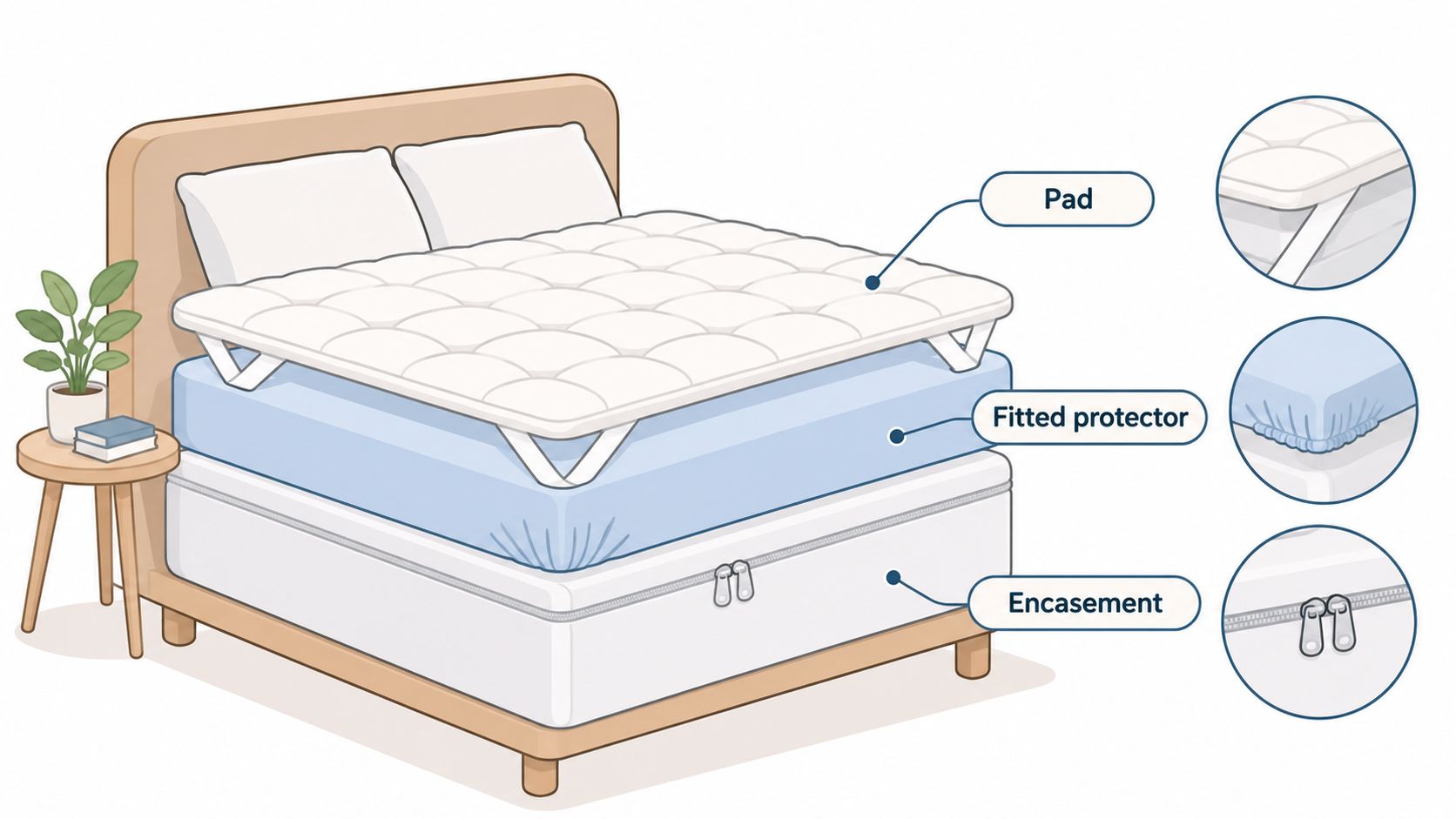
Using both layers is a normal setup. A side-by-side bedding comparison puts it this way: the protector goes on the mattress, the pad goes above it, then the sheet. Protection stays at the bottom where spills land, and softness stays at the top where you feel it.
Want the test numbers behind the word waterproof? The protection section has them. Worried about heat? Skip ahead to the comfort section. Chasing allergy answers? The dust mite section is the honest one. Fit, order, and washing each get their own walkthrough.
How Much Protection Each Layer Actually Gives
Waterproof is a specification, not a compliment. For a protector, the relevant benchmark is resistance to liquid penetration, and procurement guidance for protector fabrics names hydrostatic-head testing under ISO 811 or AATCC 127 as the way to measure it, according to a textile guide to mattress ticking and protector fabric.
In practice, the numbers look like this. Retail targets start at at least 3,000 mm H₂O when new, and the requirement is that it still reaches 3,000 mm after five wash cycles. Hospitality and medical-grade constructions push to 5,000 to 10,000 mm H₂O and hold that after as many as 20 washes at 60 °C.
Liquid resistance and breathability are two different tests
A high hydrostatic head tells you water won't pass. It tells you nothing about whether vapor will, and that's the difference between a protector that sleeps neutral and one that feels like a plastic bag by 2 a.m.
Moisture-vapor transmission rate, usually measured with ASTM E96, reports vapor movement in g/m²/24h. Two protectors can post the same waterproof figure and sleep completely differently because their vapor numbers sit far apart. Hydrostatic head measures liquid. MVTR measures breathability. Ask for both.
Spec or claim
What it measures
Target to look for
Hydrostatic head (ISO 811 or AATCC 127)
Resistance to liquid water
At least 3,000 mm H₂O when new
Hydrostatic head after laundering
How the barrier holds up to washing
Still 3,000 mm H₂O after 5 wash cycles
Hospitality or medical grade
Heavier-duty liquid barrier
5,000–10,000 mm H₂O after up to 20 washes at 60 °C
MVTR (ASTM E96)
Vapor movement, in g/m²/24h
Compare published numbers, not the word breathable
Dimensional stability
Shrinkage after washing
No more than about ±2.5% change
Coverage
How much of the mattress is shielded
Fitted skirt covers top and sides, zippered encasement covers everything
Backing material
The film doing the waterproofing
Polyurethane or similar barrier under a fabric surface
Coverage splits the category in two. A fitted protector shields the sleeping surface plus whatever sides its skirt reaches. A zippered encasement closes around the entire mattress, which is the version that matters when allergen exposure is the concern.
Pads deserve a straight answer too. A quilted pad can absorb or slow a spill, but unless it carries a tested membrane it is not waterproof, no matter how thick it feels. If a spill has already reached the ticking, follow this guide to getting urine smell out of a mattress before you layer anything new on top.
Three questions to ask before buying: where does the waterproof layer sit, what test backs the claim, and is the product quiet and cool enough to sleep on for eight hours.
What a Cushioned Pad Adds to Comfort and Warmth
A pad is chosen for surface modification: softness, loft, pressure distribution, and modest thermal or moisture buffering. It isn't built for full spill containment, and textile guidance on pad construction ties its performance to fill type, loft, quilting, shell fabric, and the attachment system. Most fills land in one of four groups: polyester, cotton, wool, or foam.
The trade-off a sleeper notices within a week
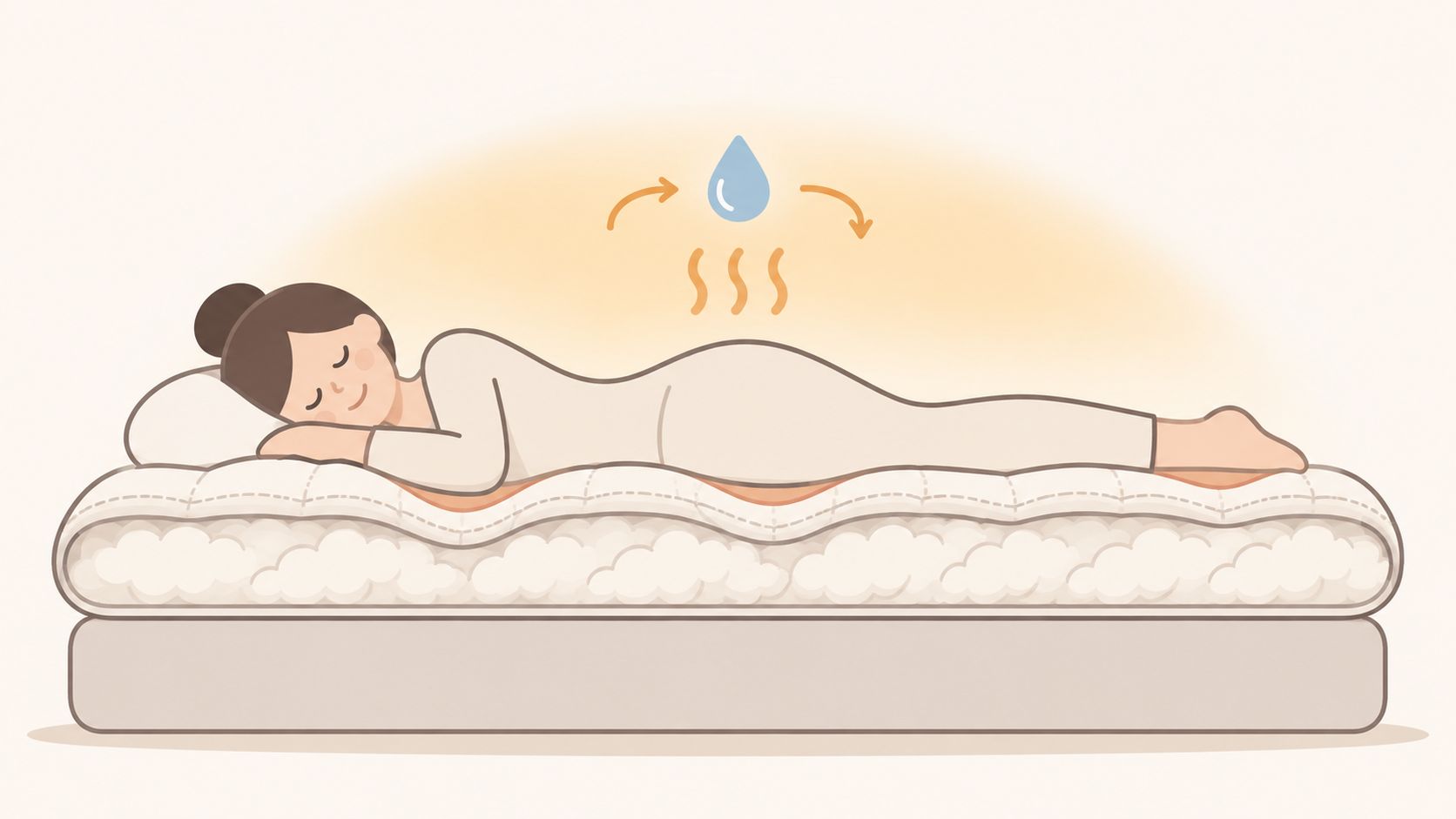
A thick quilted pad can soften a firm bed for a side sleeper. It can also trap heat, change how a fitted sheet sits, and nudge firmness in a direction nobody planned for. Thicker quilting adds insulation, and insulation is the last thing a warm sleeper needs.
Say it plainly: a pad cannot fix sagging or weak support. On a worn mattress, cushioning hides the problem for a few months and then the dip comes back through. If the bed has lost its structure, the answer is a mattress, not a topper.
The layer test: if the mattress feels supportive but hard, buy a pad. If it feels like a hammock, buy nothing and start shopping.
Cooling claims split the trustworthy from the noisy. Thermal and evaporative resistance get measured with methods such as ISO 11092, which tests under controlled hotplate conditions. A brand that publishes those figures is giving you something checkable. A brand that prints the word breathable is giving you an adjective.
A thin protector adds almost no cushioning, so nobody should buy one hoping for comfort. And when a pad isn't enough of a change, a mattress topper is the next step up in thickness and effect.
Two questions to answer at home before spending anything: does the bed feel too firm, and does the sleeper run hot at night? If the answer to the first is yes and the second is no, a pad earns its place. If the second is yes, keep the stack thin.
Dust Mite and Allergy Claims Explained
Here's where the two products stop being interchangeable. A fitted waterproof protector is not the same thing as a fully enclosing, tested allergen-barrier encasement, and the research treats them as different tools. A protector's job is barrier duty against liquids, stains, allergens, and other contaminants, while a pad adds cushioning, softness, warmth, or limited surface defense, as a review of protector and pad functions in clinical studies describes.
What the studies measured
In a randomized Dutch study, researchers followed 150 children at risk of allergy and their parents for 12 months, comparing dust-mite-impermeable encasings against cotton placebo encasings. The active encasings cut mattress Der p 1 allergen by a factor of 2.1 and combined Der p 1 plus Der f 1 by a factor of 2.5, both statistically significant with P values of .007 and .005.
A separate clinical study reported an 87% reduction in Der p 1 allergen after mattresses were covered with mite-impermeable protectors, with P < .001.
Then comes the part most allergy marketing skips. That Dutch study found no significant improvement in clinical atopic-dermatitis outcomes. Fewer allergens in the bed is a real, measurable change. It is not the same as fewer symptoms, and bedding alone doesn't flip that switch.
The same pattern shows up in household data. In homes with high mite exposure, bedding allergen fell from 24 micrograms per gram at baseline to 0.9 micrograms per gram at one month and 1.0 micrograms per gram at six months after mite-impermeable mattress and pillow covers were installed, reductions of about 96% and 95.8%, per an EPA-indexed study record. Read that scope carefully. It's a sealed cover on both the mattress and the pillow, and it's exposure control, not a symptom cure. A quilted pad can't claim any of it.
Barrier is not a marketing word: sealed coverage is what moves allergen numbers. A slightly thicker surface layer doesn't.
Label checks separate a barrier from a cushion. Look for full encasement rather than a fitted skirt, a breathable membrane so the cover is livable, and a wash temperature hot enough for mite control. Then treat it as one piece of a broader routine, which is exactly what a dust and allergen-free bedroom plan is built around. Persistent symptoms deserve a doctor's input, not a shopping cart.
Fit and Layering Order on the Bed
Attachment decides whether a layer stays put. A fitted protector uses elastic around its edges, a full encasement wraps all sides and closes with a zipper, and a pad uses an elastic skirt or anchor bands. Most protectors are built as a breathable fabric face over a waterproof coating, with polyurethane as a common material for that lower layer. That construction is why a protector can feel thin and still stop more liquid than a quilted pad.
Coverage follows the same logic. A fitted style shields the sleeping surface and the sides under its skirt. An encasement leaves nothing exposed. If the goal is allergen control, the difference isn't cosmetic.
Match the skirt to the mattress depth
Pocket depth is where most returns come from. A standard mattress usually needs a skirt sized for roughly 8 to 12 inches, and a deep or pillow-top model needs about 14 to 18 inches. Add room for the pad when both layers go on, and measure before you buy rather than stretching a skirt that already pops at the corners. This walkthrough on how to measure a mattress takes about two minutes with a tape.
Sizes run in a predictable set: Twin, Twin XL, Full, Full XL, Queen, King, California King, King 2PC and California King 2PC. The two-piece King and two-piece California King setups need two protectors, not one, which is the detail shoppers discover at the register.
The layering order, in four steps:
Stretch the protector directly over the mattress. Barrier goes on first so spills never reach foam or ticking.
Add the cushioned pad above the protector. Softness sits where your body meets the bed, not between the barrier and the mattress.
Fit the sheet over both layers.
Smooth from the center out and check that every corner is anchored.
Stacked layers can change firmness and sheet fit, so re-check after the first night. A loose skirt bunches, slides, and wears unevenly, and a tight one can pull the mattress corners up.
Washing Drying and When to Replace
Care is where a good protector either lasts five years or fails in eight months. Work in the order a household does it, and read the sewn-in label before the first wash, not after the backing cracks.
Wash a protector hot when mites are the target. Around 60 °C is the temperature that matters for dust-mite control, then tumble dry on low or line dry so the waterproof film stays intact. High dryer heat, bleach, and fabric softener are the three ways people destroy a polyurethane backing without realizing it.
Wash a quilted pad on the cycle its label allows. Expect polyester, cotton, wool, or foam batting to shift or clump over time. Batting doesn't recover, so a pad that used to feel even will start to show thin spots.
A rhythm a family can keep:
Protector: about monthly, plus immediately after any spill or illness in the house.
Pad: every two to four weeks when pets share the bed or the sleeper sweats at night.
Both: skip softener and bleach entirely on any waterproof membrane.
Before buying, check the label for waterproofing, fitted skirt versus full encasement, breathability, washability, and any safety claim. Pad and protector are built to different standards, and treating them as the same product is how people end up disappointed. When a protector starts to fail, the maintenance habits in this guide to extending mattress lifespan with proper cleaning will buy back the years.
Replace the layer when the backing peels or cracks, the elastic no longer grips the corners, the batting bunches into lumps, or the skirt stops reaching the mattress edges. Any one of those means the barrier is gone, even if the fabric still looks fine.
Which One Fits Your Household
Skip the generic list. Find the household that sounds like yours.
Household situation
Buy this
Why
Toddler in potty training
Waterproof protector
Accidents stay out of the mattress, not just the sheet
Pets who sleep on the bed
Waterproof protector plus a washable pad
Barrier for accidents and a layer you can strip fast
Senior or caregiver managing incontinence
Washable waterproof protector or encasement
Frequent hot washing matters more than loft
Allergy sufferer focused on dust mites
Full allergen-barrier encasement
Sealed coverage, not a waterproof top alone
Hot sleeper
Thin breathable protector, skip the thick pad
Vapor transmission beats extra fill
Bed feels too firm
Cushioned pad
Loft softens the surface without buying a mattress
Mattress is sagging
Neither, start mattress shopping
A pad hides the problem instead of fixing support
Guest room
Pad, if anything
Easy to wash after visits and adds comfort for occasional sleepers
Valuable two-sided or flip-able mattress
Thin waterproof protector
Protects both sleeping surfaces without changing firmness
When both layers are the right call
Many households land on both, in the order described earlier: protector on the mattress, pad above it, sheet over everything. Caregivers usually get there first, because washable liquid protection is the priority and a little softness is a bonus. Allergy-focused shoppers often skip the pad entirely and put the budget into a properly sealed encasement.
Breathability deserves its own line. Impermeable designs reduce allergen transfer, but vapor-permeable waterproof fabrics exist, so breathability is a design variable rather than an all-or-nothing feature, as a review of encasement and bedding performance notes. A hot sleeper should read that as an instruction: thin and breathable over thick and quilted.
A side sleeper with pressure discomfort may enjoy cushioning, even though no pad will correct major sagging or weak support. And check the practical details before buying: pocket depth, elastic security, laundering instructions, noise, surface feel, and whether the waterproof backing covers the whole mattress or only the top.
The mattress itself sets the ceiling on what a layer can do. Flip-able, two-sided models and comfort levels running from Extra Firm through Firm, Medium, Plush and Ultra Plush all change how much protection versus cushioning makes sense on top. A firm bed rewards a pad. An ultra plush bed usually rewards a thin protector and nothing else.
Come Feel the Difference in Greenfield
The fastest way to settle mattress protector vs mattress pad is to put a hand on both. A protector feels like a slightly crisp sheet. A pad feels like a thin quilt. That difference answers most of the question in about ten seconds, especially when you can feel each layer over the same mattress.
BILTRITE Furniture-Leather-Mattresses is a fourth-generation, family-owned showroom serving Greenfield and Metro Milwaukee since 1928. A bed is easier to judge when you can press on it, compare comfort levels out loud, and ask what a layer will do. The mattress department carries more than 60 models on sale and over 500 mattresses in stock, with options ranging from Extra Firm to Ultra Plush and including flip-able, two-sided designs.
Bring the mattress size and depth, or describe how the bed feels now.
Say what you are solving: stopping spills, adding softness, or both.
Feel a thin protector next to a cushioned pad so the difference is clear before anything goes home.
The Greenfield showroom was updated in 2025 with an expanded gallery of flip-able, two-sided, and heavy-duty mattresses. Ask about the free mattress protector or free heavy duty bed frame included with select model sets, and about free white glove delivery on mattress-only purchases of $999 or more. The sales team can also explain fit details like pocket depth and layering order without pushing a decision.
The showroom closes on Sundays and Mondays so the families who run it can be with their own. Visit BILTRITE Furniture-Leather-Mattresses at 5430 West Layton Avenue and compare the layers on the bed you are considering.