Heavy Duty Mattress Protector Waterproof: What to Check

If a package says waterproof, how much water pressure can it hold back before liquid reaches the mattress? That question exposes the gap in most protector shopping. Families compare softness, noise, and price, then trust a label that may describe only the top fabric. A heavy duty mattress protector waterproof enough for real accidents works differently. It's a barrier system made of fabric, film, seams, skirt, and fit, and every part has to hold when a sleeper's weight presses liquid downward. Learning to read the test numbers turns a vague promise into a check anyone can make.
Table of Contents
- Waterproof Ratings Worth Checking Before You Buy
- Membrane Choices and Breathability Questions
- Fit, Seams and Skirts That Keep Liquid Out
- Matching a Protector to Your Real Risk
- How to Care for Your Protector So the Barrier Lasts
- Pick Your Protector and Visit Our Greenfield Showroom
Waterproof Ratings Worth Checking Before You Buy
A waterproof label earns trust only when a test number stands behind it. A heavy-duty protector works as a liquid-barrier system, with fabric, film, seams, and fit sharing the load. Press a knee, an elbow, or a seated adult down on a spill and the liquid gets pushed. Pushed liquid finds pinholes and weak seams fast.
How Hydrostatic Head Testing Works
The clearest benchmark is hydrostatic-head resistance. Under the AATCC 127 hydrostatic pressure test described by Centexbel, water pressure rises against the material until penetration occurs, and the failure pressure is recorded in centimeters of water, kilopascals, or millibars. ISO 811 works on the same idea.
Shoppers often assume "centimeters of water" describes how much liquid can pool on the surface before soaking through. It measures the pressure pushing the liquid, which is exactly what body weight creates during an accident. A higher pressure number matters only when the test conditions come with it, because a number without its method is still a bare claim.
One published AATCC 127 based procedure in a Journal of Industrial Textiles study raises pressure at 612 mmH2O per minute at approximately 20°C and 65% relative humidity until water passes through. Stated conditions matter because they let shoppers compare results fairly instead of comparing two unlabeled numbers.
Waterproof Test Methods and What to Look For
| Test or check | What it measures | What a good result looks like | What to ask for |
|---|---|---|---|
| Hydrostatic head (AATCC 127 or ISO 811) | Water pressure before penetration, in cm of water, kPa or mbar | A stated pressure reached before leakage | Testing on the finished protector, seams included |
| Controlled pressure ramp (AATCC 127 based) | Pressure rising until water passes through | Documented ramp rate and conditions, such as 612 mmH2O per minute at about 20°C and 65% humidity | Test conditions stated with the result |
| Support-surface cover | Leakage under sustained hydrostatic pressure | No leakage under sustained pressure | Confirmation that film and seams both passed |
| Rating after repeated washing | Whether the barrier holds after laundering | A post-wash pressure result close to the new-protector result | Retest results or manufacturer wash data |
A support-surface test that holds the cover under sustained pressure goes far beyond a spilled glass, and that severity is the point. Sustained pressure exposes hidden paths created by aging, chemical wear, or repeated washing that a gentle pour test would miss. Families who've cleaned a mattress after an accident, following steps like those for cleaning urine from a mattress, know prevention is far easier.
Practical rule: Ask for three things: the test method, the pressure achieved, and whether seams were part of the test.
Membrane Choices and Breathability Questions
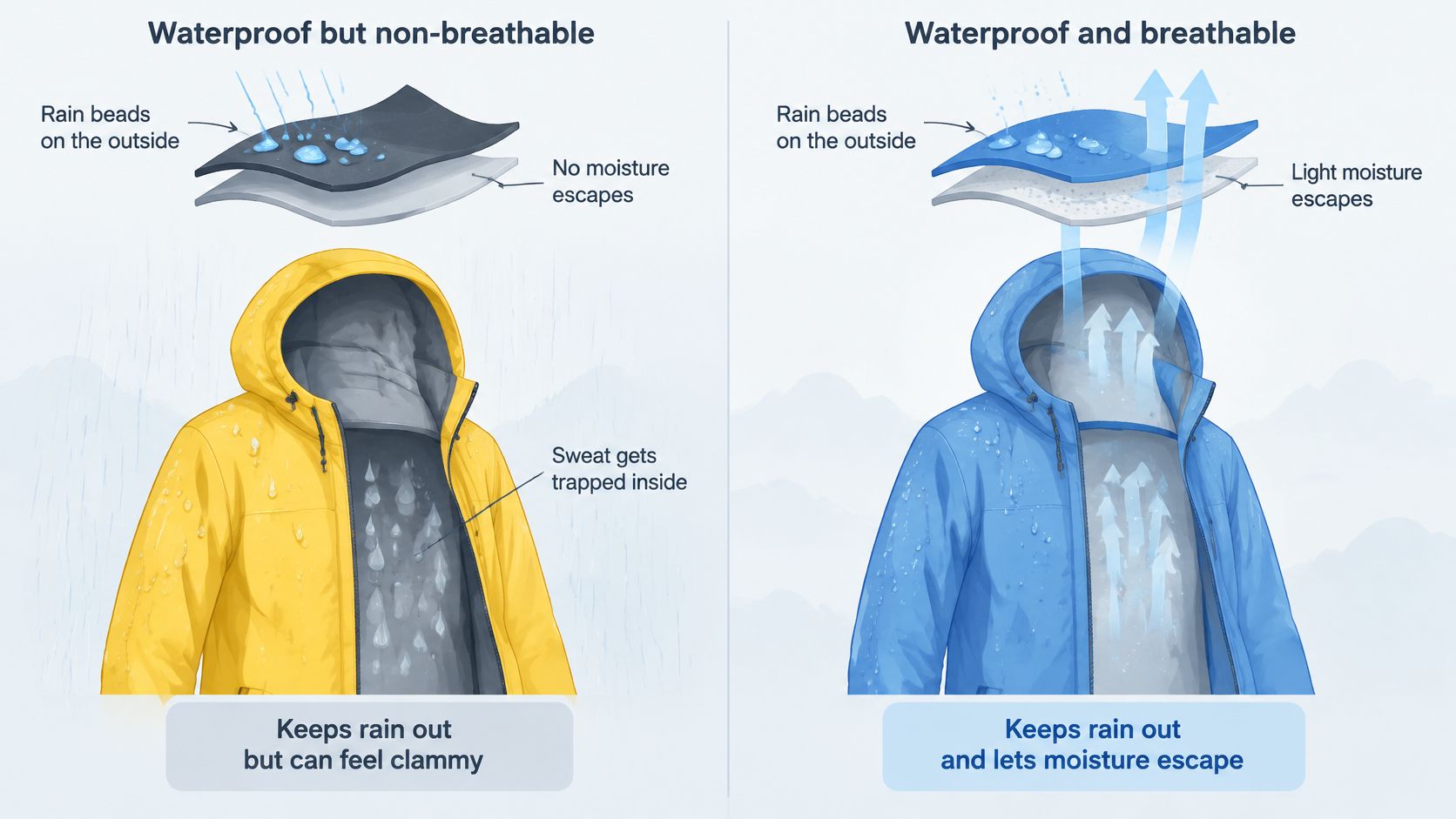
A rain jacket explains the membrane trade-off well. One jacket keeps rain out but traps sweat inside until the wearer feels clammy. Another lets some moisture vapor escape, so it feels drier even though rain still can't get through. A mattress protector faces the same balancing act, only the sleeper stays in it for hours.
Why Polyurethane Beats a Plastic Feel
Polyurethane-coated textiles can block liquid water while allowing some water vapor to diffuse through, a balance covered in Arjo's guidance on support surface covers. That vapor movement reduces the chance that perspiration stays trapped against the sleeper. No coating makes a protector as airy as an uncoated sheet, and honest labels never claim it does.
A plastic feel isn't proof of quality either. A thick vinyl layer is a solid, nonporous sheet, so it resists liquid pressure well but lets almost no vapor through. It also adds noise, heat retention, and cracking risk as it flexes night after night. A thinner engineered membrane can deliver a better comfort-to-barrier balance when its pressure and wash performance are documented. Thickness alone tells a shopper almost nothing.
Two Membranes Side by Side
A comparative study of polyurethane materials in PMC found a nonporous film with water-pressure resistance of 31 kPa and moisture permeability of 2,567.55 g/(m²·24 h), while a microporous membrane showed 19.98 kPa and 8,651.34 g/(m²·24 h). Read that slowly. The stronger barrier moved far less vapor, and the freer-breathing membrane gave up some pressure resistance. Neither wins for every bed.
| Membrane type | Water-pressure resistance | Moisture permeability | Best fit |
|---|---|---|---|
| Nonporous film | 31 kPa | 2,567.55 g/(m²·24 h) | Maximum spill protection |
| Microporous membrane | 19.98 kPa | 8,651.34 g/(m²·24 h) | Everyday comfort with stronger vapor flow |
| Thick vinyl layer | High (solid sheet barrier) | Very low, below typical coated fabrics | Heavy caregiving use where vapor flow matters least |
Reading a Breathability Number
Treat breathable as a claim to check against a stated vapor test method. An industry technical review in PCI Magazine identifies 500 g/m²/day as a commonly used minimum threshold for breathable applications under the upright ASTM E96 water-cup method. The same review puts existing commercial breathable fabrics commonly around 450–1,000 g/m²/day, while the inverted version of the test can show roughly 3,000–7,500 g/m²/day.
That gap confuses many shoppers. Two protectors can carry wildly different vapor numbers because different test versions produced them, so comparing those figures head to head misleads. The useful question is always the same: which method produced this number?
Chemicals and Cleaning Durability
Fluorinated waterproofing treatments also deserve a direct question. A review of PFAS textile finishes and regulation notes EU rules set very low thresholds for targeted PFAS and total PFAS in covered products. Ask whether a specific PFAS or fluorine test backs any non-toxic claim instead of accepting the claim alone.
Cleaning durability matters just as much. Repeated exposure to detergents, disinfectants, heat, and flexing can create microscopic cracks or delamination that nobody sees until a leak appears. A credible product states its laundering temperature, drying restrictions, coating construction, and resistance to cleaning chemicals. Where relevant, ISO 20342-5:2024 provides a durability-testing framework for mattress-cover materials exposed to cleaning agents.
Households managing frequent accidents should prioritize the barrier first. Everyday sleepers usually do better with a documented balance of pressure resistance and vapor flow.
Four plain questions sort a solid product from a hopeful label. Which membrane does this use? Which test produced the vapor figure? What wash temperature does the label allow? Did independent testing cover the finished protector? Clear answers signal a heavy duty mattress protector waterproof claim built on evidence.
Fit, Seams and Skirts That Keep Liquid Out
A barrier only works if it stays where it belongs. A protector that creeps off a corner at 2 a.m. leaves exactly the edge exposed where a spilled drink runs. Fit is part of the waterproof system, as much as the membrane underneath it.
Measure Before Choosing a Size
Start with a tape measure, not the size printed on old sheets. These steps take two minutes:
- Measure length and width: Run the tape edge to edge across the top, not diagonally.
- Measure depth at the tallest point: Include any pillow-top crown, since skirt depth keys off total height. A guide on how to measure a mattress helps confirm each dimension.
- Match the protector exactly: A loose cover shifts under body weight and exposes mattress edges, while an undersized one strains its seams.
What Secure Construction Looks Like
A deep fitted skirt with strong elastic anchors the protector at the corners through nightly movement. Weak elastic feels fine on day one, then relaxes after laundering. Look for elastic that runs fully around the edge rather than small corner straps alone.
Seams and corners are where leaks usually start. Reinforced or bound seams resist the pulling that happens when someone sits on the bed edge. Raised, uneven stitching or visible gaps along a seam invite liquid through under pressure.
Quick Checks Anyone Can Do
In a showroom or at home, three quick checks reveal a lot:
- Pull one corner firmly: It should stay seated instead of snapping off.
- Run a hand along the seams: Fingers catch gaps, loose threads, and lifted binding quickly.
- Scrunch the fabric near an ear: Crinkling in hand usually means noise under bedsheets at night.
If the design has a zipper, open and close it fully. It should glide without catching and close without gaps at either end.
Buyers who skip the post-wash recheck often find corners loosened after the first month. A fit that looks right on the sales floor can shift as fabric relaxes and elastic settles into the laundry cycle. Rechecking all four corners after early laundering, and smoothing the top panel flat before adding sheets, keeps the barrier positioned where accidents land.
Matching a Protector to Your Real Risk
What is the bed being protected against? That question sorts the whole purchase. A toddler's juice, a caregiver's nightly reality, and a bed-bug worry call for different construction, even though all three shoppers type the same search words. Read “waterproof” as a barrier system that needs proof: the membrane stops liquid, and the closures decide what else gets in or stays out.
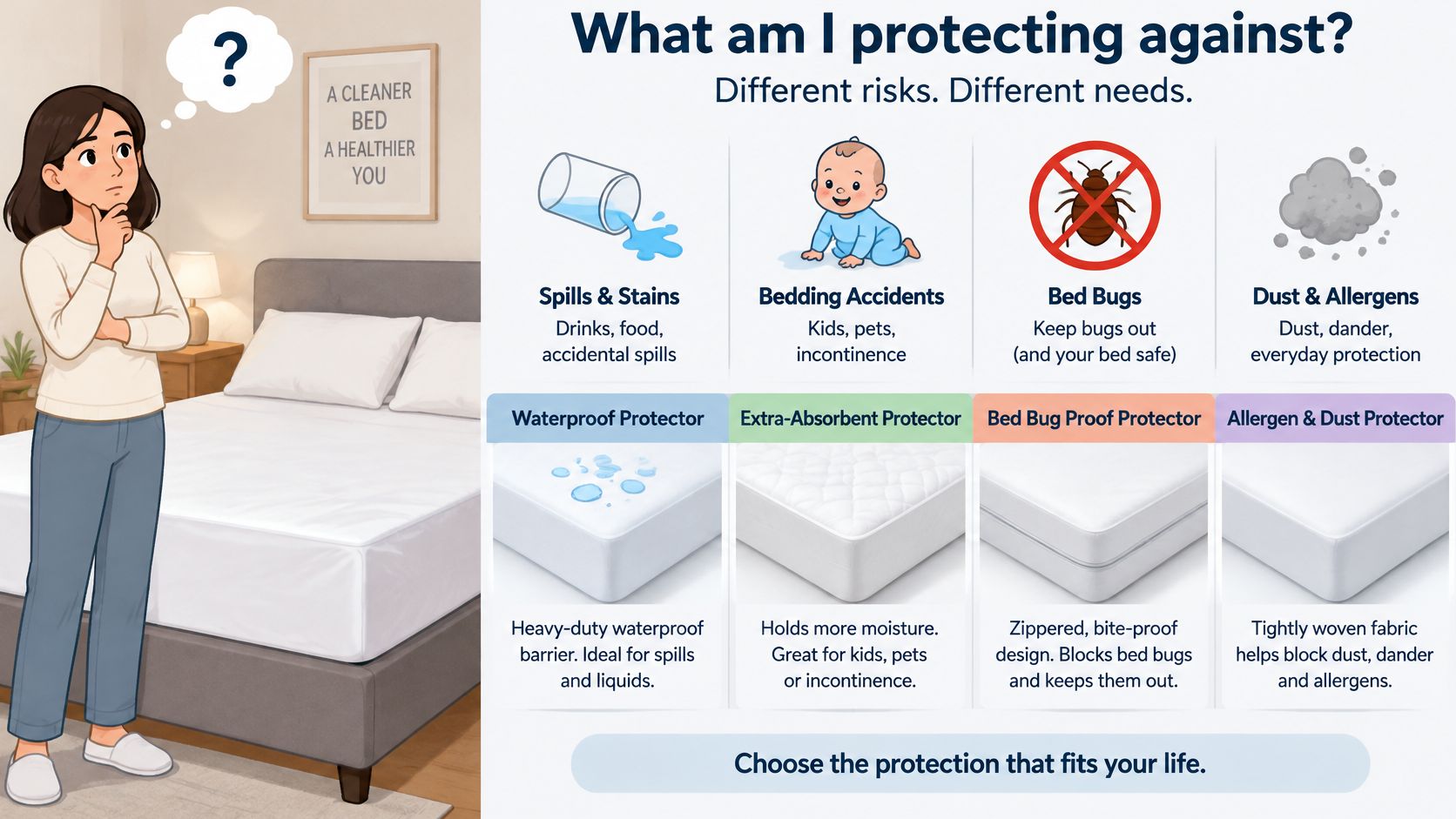
Protector Construction by Main Risk
| Main risk | Construction to look for | Check before buying |
|---|---|---|
| Spills and bodily-fluid accidents | Waterproof membrane with reinforced seams and a close-fitting skirt | Hydrostatic rating and skirt depth |
| Bed bugs | Fully enclosed six-sided zippered encasement | Sealed sides and a zipper that closes without gaps |
| Dust mites and allergy concerns | Membrane plus enclosed design, with testing beyond a hypoallergenic label | Independent testing on the finished encasement and zipper closure |
| Heavy daily use, caregiving or medical settings | Durable laminate that tolerates repeated hot washing | Wash temperature limits and tear resistance |
| Hot sleepers | Membrane with documented vapor transmission | Test method behind any breathability figure |
Fitted Protector Versus Full Encasement
The confusing part is that both products can carry a waterproof label. A top-only fitted protector covers the sleeping surface and sides like a fitted sheet. It stops liquid from above, and it's easy to remove for washing, while the underside and lower seams stay exposed.
A six-sided zippered encasement works more like a sealed envelope around the mattress. That full enclosure can keep bed bugs from reaching the mattress or escaping from inside it. It cannot clear pests from baseboards, upholstered furniture, or luggage. A standard waterproof cover stops liquid, not bed bugs.
The scale of that pest concern is real. A joint federal statement archived by the CDC cites a New York City health assessment estimating probable bed-bug infestation in 5.1% of households in 2014, reaching as high as 12% in some regions. Those figures do not prove any protector prevents infestation. They explain why families with pest concerns should choose a tightly fitted, fully enclosed design with secure seams as one layer of defense.
Allergy Friendly Labels Need Proof
A hypoallergenic label describes materials less likely to trigger reactions; proof of allergen blocking requires independent testing on the finished encasement, including its zipper closure. That distinction keeps a comfort claim from being mistaken for a barrier claim.
For seniors and caregivers, the practical benefits land daily. Waterproof coverage simplifies cleanup after bodily-fluid incidents and protects a costly mattress, including durable models like those covered in the benefits of a heavy-duty mattress. Prompt removal and drying still matter, because no cover rescues a mattress once liquid gets past it.
Before checkout, name the risk out loud and ask for the matching proof: hydrostatic rating for spills, a gap-free six-sided zipper for pests, independent allergen testing for allergies, wash-temperature limits for caregiving, and the vapor-transmission method for hot sleepers. If the tag cannot show the test behind the claim, keep looking.
How to Care for Your Protector So the Barrier Lasts
Care is part of buying, because washing, heat, and stretching slowly wear the barrier down. A gentle routine protects the coating that does the waterproofing. Harsh treatment can end a good protector early.
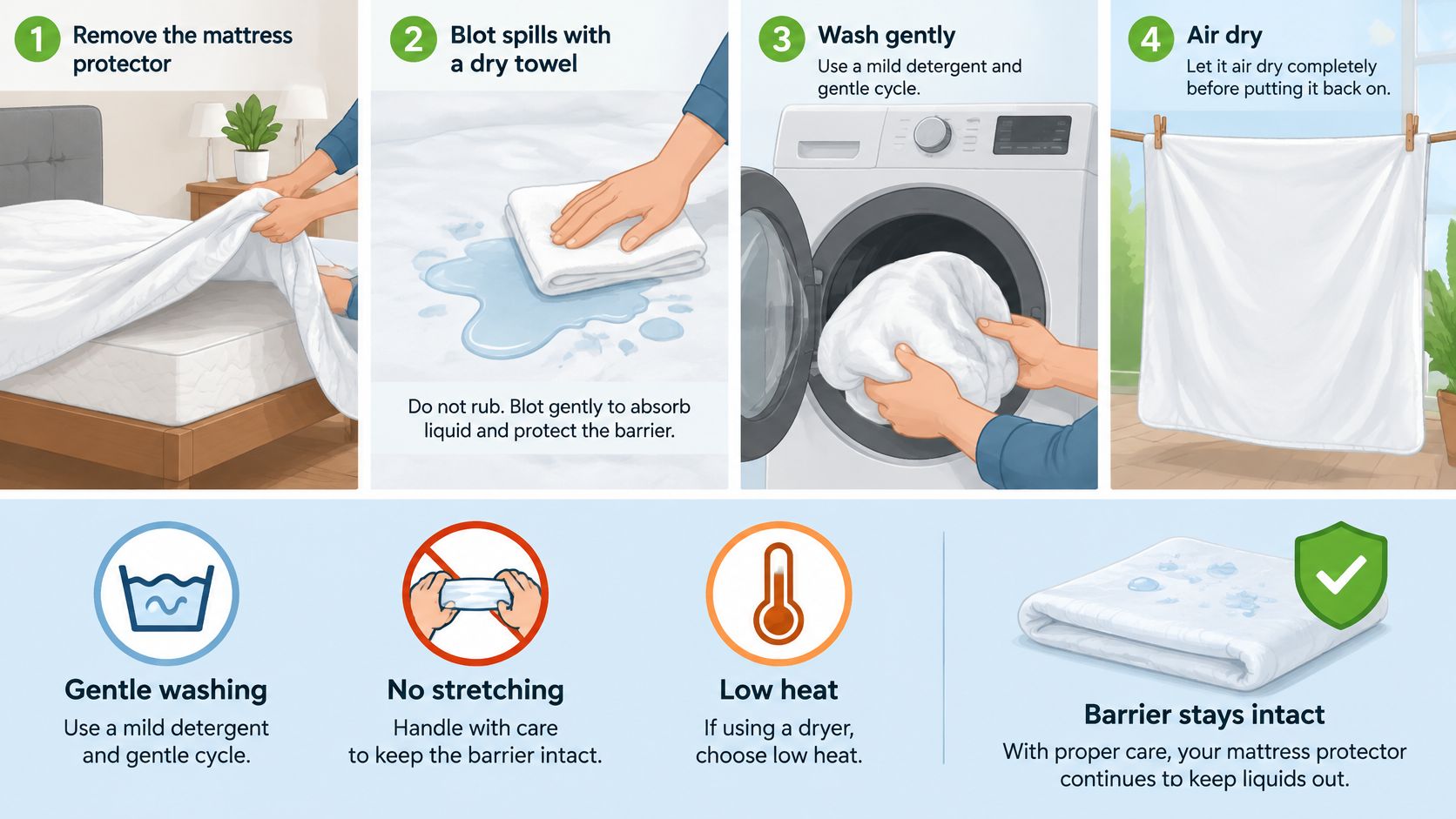
A Six Step Routine After Any Accident
- Lift the protector off right away. Blot any spill with a dry towel, working from the edge inward so liquid doesn't spread under the cover. Speed matters more than scrubbing.
- Check the label before the first wash. Note the allowed water temperature and drying limits, since exceeding them can crack or delaminate the membrane.
- Wash gentle with mild detergent. Skip harsh chemicals and extra heat, both of which attack coatings. Broader habits in these mattress maintenance and cleaning tips support the same gentle approach.
- Dry it fully before putting it back. Public-health guidance summarized in National Law Review reporting on water damage describes a 24-to-48-hour response window for water-damaged materials, while noting growth can occur sooner. A damp protector returned to the bed traps moisture against the mattress.
- Inspect seams, skirt, and zipper after each wash. Look for stiffening, cracks, peeling, or elastic that no longer grips. Catching wear early prevents a surprise leak.
- Retest or replace at the first leak. Pour a small amount of water on the surface over a dry towel and press firmly. Any dampness underneath means the barrier has failed.
Keeping a spare protector simplifies this routine. One stays on the bed while the other washes and dries fully, so nobody rushes a damp cover back into service at bedtime. For caregiving households, that spare turns a stressful night into a quick change.
One honest limit deserves emphasis. A protector intercepts liquid before it reaches expensive, hard-to-clean cushioning, but it cannot repair a saturated mattress or replace prompt drying. Fast action after an accident, paired with a sound barrier, gives the mattress its longest useful life.
Pick Your Protector and Visit Our Greenfield Showroom
Everything covered so far condenses into four checks. Run them in order and the right cover usually picks itself:
- Match construction to the main risk: fitted for spills, encased for pests, wash-tough for caregiving.
- Ask for the hydrostatic number and method: a pressure result with seams included carries more weight than a bare waterproof claim.
- Confirm size against mattress depth: measured dimensions prevent shifting and exposed edges.
- Read the care label before the first wash: temperature and drying limits decide how long the membrane lasts.
Those checks get easier with the product in hand. A protector works like a roof for the mattress: the label promises shelter, but the seams, skirt, and membrane decide whether a spill stays out. Feeling fabric, tugging corners, and running a hand along stitching tells a shopper more than any product photo. BILTRITE Furniture-Leather-Mattresses is a fourth-generation, family-owned showroom serving Greenfield and Metro Milwaukee since 1928, and the case for buying locally when purchasing a new mattress comes down to testing comfort and construction in person.
The mattress department has over 60 models on sale, with over 500 mattresses in stock across Twin, Twin XL, Full, Full XL, Queen, King, California King, King 2PC, and California King 2PC sizes. A free mattress protector or a free heavy duty bed frame is included with select model sets. The showroom stays closed on Sundays and Mondays, so a Tuesday through Saturday visit works best.
Choosing a heavy duty mattress protector waterproof families can trust gets easier with the fabric in hand and a knowledgeable neighbor to ask. BILTRITE Furniture-Leather-Mattresses invites Metro Milwaukee shoppers to visit the Greenfield showroom, feel protector surfaces side by side, check seams and skirts in person, and talk through fit for any mattress at home. Come on down, take all the time needed, and head home confident the next spill stays on the surface where cleanup is easy.