


Boxspring and Frame Queen Guide: Choose, Measure, Assemble

The new mattress is picked out, the old frame is still upstairs, and the question sounds simple: will everything fit together? Then someone looks underneath the bed and finds open rails, a missing center leg, or slats that look farther apart than expected.
For Milwaukee households shopping for a boxspring and frame queen setup, the queen label is only the starting point. The useful question is whether the mattress, foundation, and frame can work together without shifting, bowing, or making getting out of bed a daily workout.
Table of Contents
- Which Queen Setup Needs a Boxspring and Which Does Not
- Measuring Your Queen Boxspring, Frame and Doorways
- Matching Mattress Support to Your Base
- How to Assemble Your Queen Boxspring and Frame Step by Step
- Delivery, Stairs and Daily Use at Home
- Confirm Your Queen Setup Before You Come In
Which Queen Setup Needs a Boxspring and Which Does Not
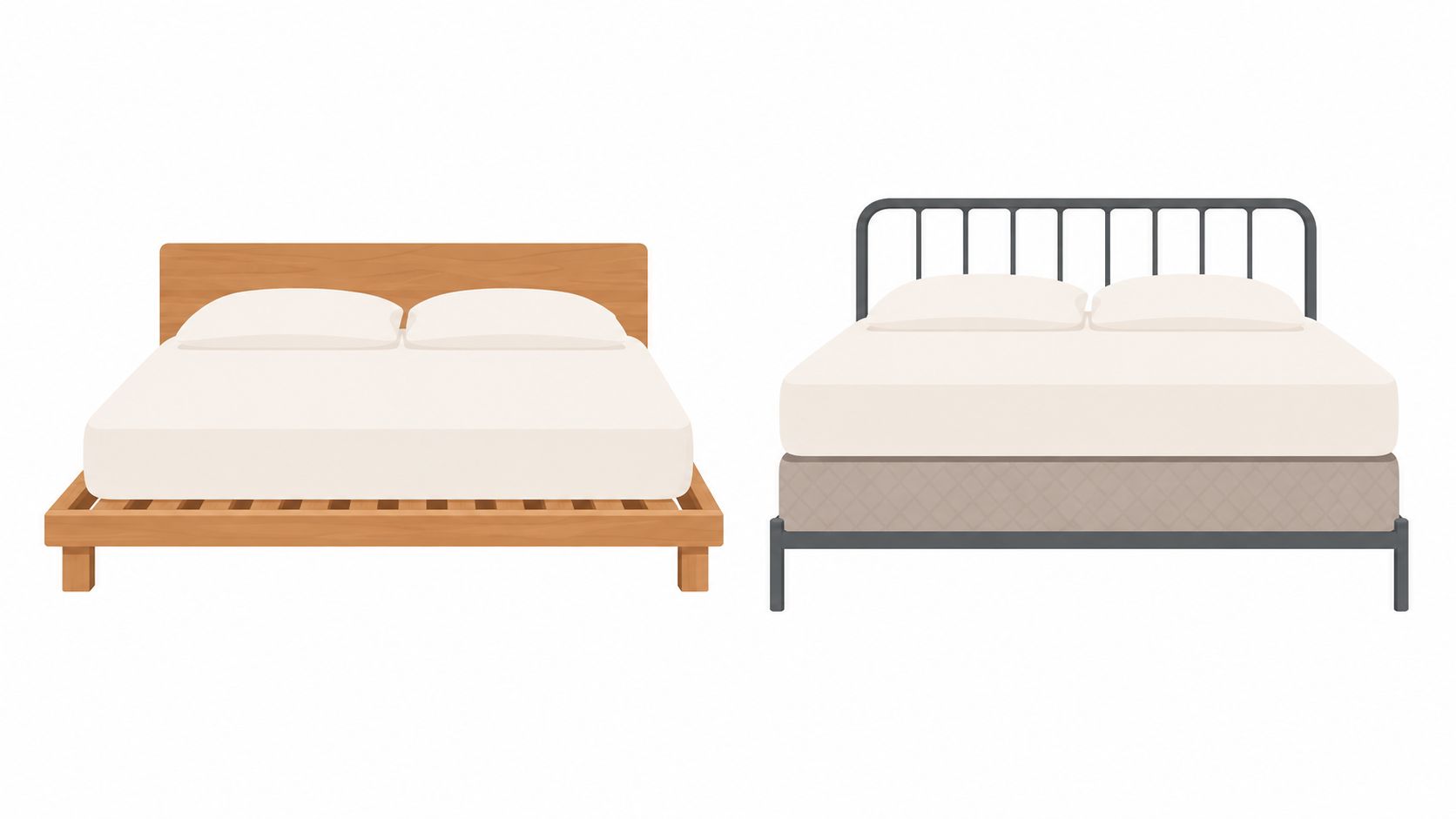
A platform or properly specified slatted frame usually needs no separate boxspring. A basic rail frame needs a boxspring or foundation. The difference is underneath the mattress, not in the headboard style.
A platform supplies the mattress-supporting surface itself. A rail frame holds a separate foundation that supplies that surface, so placing a mattress straight across open rails isn't a substitute.
Queen frame types and whether a boxspring is needed
| Frame or base type | Separate boxspring needed? | Best for | Watch for |
|---|---|---|---|
| Platform frame with solid deck | No | Low profile and a clean look | Confirm the deck is solid, not widely spaced |
| Slatted platform or slat base | No, if approved for the mattress | Foam and hybrid mattresses on a fixed support system | Slat gap and the mattress maker's support rules |
| Metal or wood frame with side rails only | Yes | Traditional setups built to hold a foundation | A center rail with a leg that reaches the floor |
| Traditional frame with boxspring or foundation | Yes | Existing boxsprings and familiar bed height | Frame interior must accept the foundation without overhang |
The standard U.S. queen mattress measures 60 by 80 inches, approximately 152 by 203 centimeters, and its foundation is sized to match that mattress rather than the frame's outside edges, as explained in this queen mattress sizing reference. That standardized footprint helps with shopping, but it doesn't settle the support question.
Try the Under-the-Mattress Test
Look beneath the mattress, or ask to see the display without it. Does the frame have a continuous deck, a slat system, or mostly open space between its side rails?
A deck or approved slat system can support the mattress directly. Open rails need the separate supporting component shown in the table. BILTRITE's explanation of what a platform bed frame is can help distinguish the designs before shopping.
The practical trade-off is height. Adding a foundation raises the finished sleeping surface; a platform can offer a lower, cleaner-looking arrangement. Neither choice automatically makes the mattress more comfortable, and stacking extra components isn't a reliable way to improve support.
Decision rule: Open rail frames need their intended foundation. A complete platform usually doesn't need another layer, provided the mattress maker approves its construction.
Measuring Your Queen Boxspring, Frame and Doorways
Queen dimensions to check before buying
| Item | Typical size | What to check |
|---|---|---|
| Queen mattress, nominal | Standard queen footprint described above | Compare the label with the actual mattress |
| Queen boxspring or foundation | Matched to the nominal mattress footprint | Confirm it sits fully on the frame's support rails |
| Queen frame, outside | About 62 to 65 inches wide and 82 to 86 inches long | Rail thickness, headboard design, and construction |
| Frame interior opening | Manufacturer-specific clearance | Slightly larger than the foundation without excessive side-to-side play |
| Split queen foundation, each half | Narrower sections that assemble into a queen footprint | Confirm the actual packaged and assembled dimensions |
| Narrowest doorway or hallway corner | Home-specific measurement | Compare with the largest rigid piece being carried |
Measure the actual pieces, not just the labels. The mattress label identifies the category, while the tape measure establishes whether an existing component matches the proposed replacement. Record width and length separately, and keep photos of any product labels.
The outside frame measurement answers a different question: how much bedroom space will the assembled bed occupy? Include projecting headboard sections, upholstered edges, and the footboard rather than measuring only the rectangle beneath the mattress.
Interior Fit Isn't the Same as Room Fit
Measure inside the frame where the foundation will actually sit. A broad outside measurement doesn't prove that the usable opening is large enough, particularly when rails or upholstery extend inward.
There isn't a universal allowable clearance that works for every frame and foundation combination. Confirm the manufacturer's tolerance rather than adding an arbitrary gap, following the fit-check approach associated with these standard queen foundation specifications.
The foundation should land fully on its intended supporting surfaces. Binding against the frame, hanging past a support rail, or sliding noticeably sideways calls for another compatibility check, not a forceful shove.
For a separate explanation of nominal mattress sizing, consult BILTRITE's queen mattress dimensions guide. Keep those mattress measurements distinct from the room-planning measurements.
Check the Route Before Delivery
A bed can fit the bedroom and still be difficult to get upstairs. Measure the narrowest doorway, hallway corner, stair turn, and overhead restriction along the actual delivery route.
Compare that route with the largest rigid component, not merely the assembled bed's dimensions. Ask which frame pieces arrive separately and whether the foundation travels as a single unit.
- Mattress label and actual size: Record both rather than assuming they match.
- Foundation dimensions: Include its depth when evaluating turns.
- Frame interior and exterior: Keep separate entries for fit and floor space.
- Delivery pinch points: Photograph corners and note nearby railings, trim, and doors.
A photo helps explain a tight landing. It doesn't replace a measurement, but it gives the delivery conversation useful context.
Matching Mattress Support to Your Base
Base requirements by mattress type
| Mattress type | Base it needs | Maximum slat gap |
|---|---|---|
| Innerspring | Compatible boxspring, foundation, or solid deck | Check the mattress maker's written requirement |
| Memory foam | Firm, evenly distributed support | Manufacturer-specific; common guidance below |
| Latex | Firm, evenly distributed support | Check the mattress maker's written requirement |
| Hybrid | Firm, evenly distributed support | Manufacturer-specific; common guidance below |
Start with the mattress's support requirements, then choose the base. Foam, latex, and hybrid mattresses generally need a firm, evenly distributed surface; open rails alone don't provide it, as outlined in this mattress-to-frame fitting guidance.
That distinction matters when reusing an older bed. A frame may be sound enough to hold a foundation but still be unsuitable for direct mattress placement. Removing the foundation changes the support arrangement, not just the appearance.
Measure the Open Gap Between Slats
Common guidance places the maximum slat gap at about 3 inches, while some mattress makers require 2.75 inches or less, according to this queen frame support reference. Those figures are checkpoints, not permission to ignore a stricter product requirement.
Measure the open space between neighboring slat edges, not from the center of one slat to the center of the next. Check across the base rather than assuming every opening is identical.
A visibly sturdy slat isn't enough if the unsupported openings exceed the mattress maker's limit. Likewise, adding loose boards without approval can create a different arrangement from the one covered by the written instructions.
Check the Support Beneath the Support
Center reinforcement deserves attention even when the top surface looks complete. Inspect the longitudinal support and its floor-contact points, or confirm that the platform uses an equivalent engineered arrangement.
A few widely spaced crossbars shouldn't be mistaken for a complete mattress deck. They may be intended to carry a foundation instead.
A mattress warranty's support clause belongs on the shopping list, not in a drawer until something sags.
BILTRITE's guide to choosing a compatible mattress foundation provides another way to approach the pairing. Bring the mattress label, care card, or support instructions to the Greenfield showroom so the discussion can focus on the actual model.
Testing firmness remains important, but it shouldn't happen in isolation. A comfortable showroom impression won't answer whether the mattress is approved for the base waiting at home.
How to Assemble Your Queen Boxspring and Frame Step by Step
The manufacturer's assembly instructions take priority over any general procedure. Lay them beside the hardware, identify the supporting components, and stop if a required part is missing or damaged.
Use the following sequence for a conventional rail-style setup where the instructions permit it. It keeps the frame adjustable until its shape and floor contact have been checked.
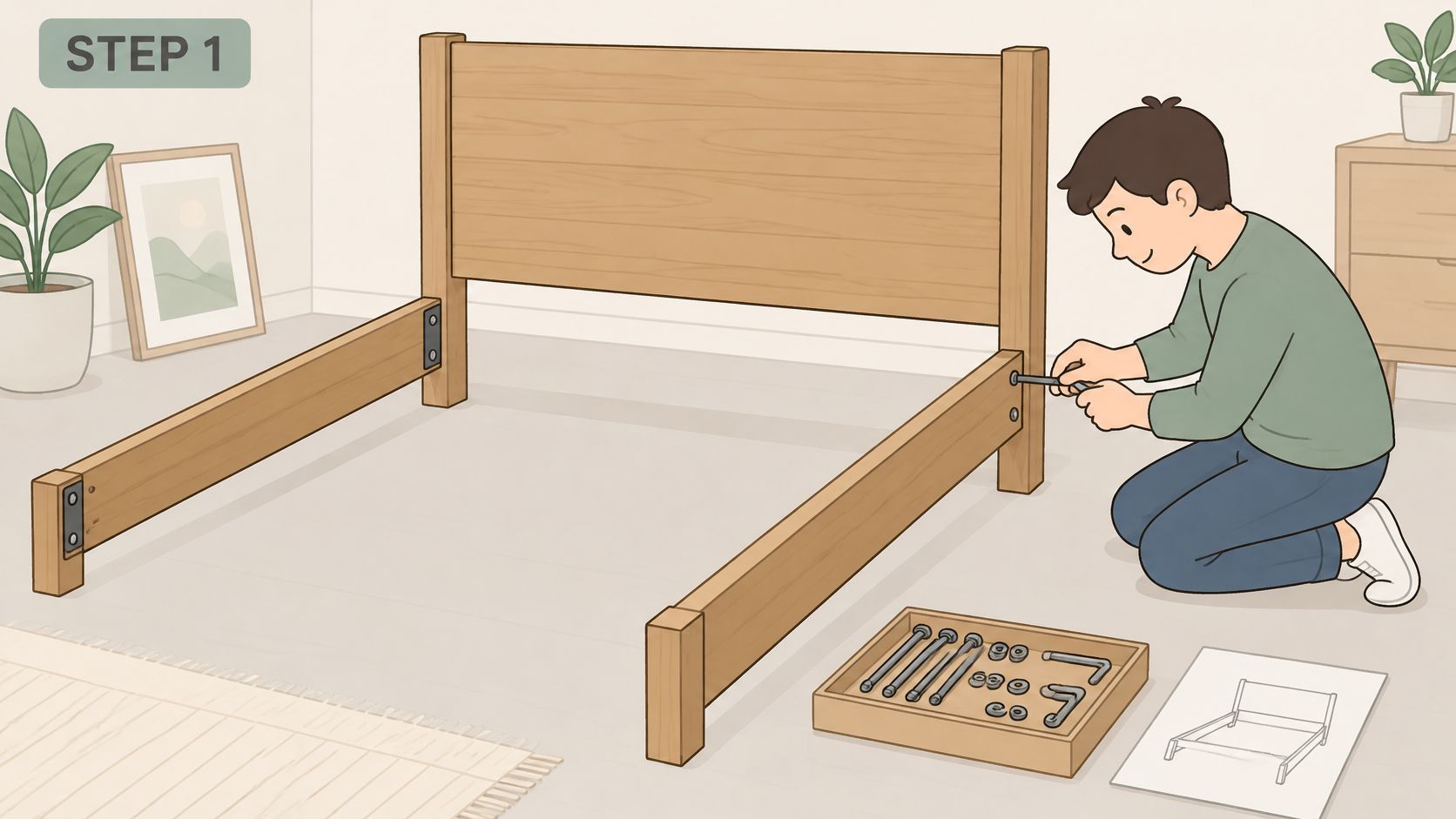
Clear a flat work area and sort the hardware.
Leave room to reach the joints without leaning over a partly assembled frame. Match bolts, brackets, and tools to the instruction sheet before connecting anything.Connect the side rails to the head and foot pieces.
Start the specified fasteners without fully tightening them yet. Where the instructions allow, that small amount of movement makes alignment easier.Install the center rail and its floor support.
Confirm that the leg bears firmly on the floor rather than hovering above it. Use manufacturer-provided adjustments for carpet or uneven flooring, not improvised packing.Square the frame.
Measure diagonally between corresponding opposite corners and compare the readings. Equal diagonals indicate a square rectangular layout, helping prevent the foundation from binding in a skewed opening.Tighten the rail and leg fasteners.
Secure the joints only after alignment is correct, following the manufacturer's tightening directions. Don't substitute extra force for a bracket that hasn't seated properly.Set the foundation onto its intended supports.
Check along the perimeter and middle rather than looking only at the visible corners. The foundation should settle onto the frame without overhang or rocking.Place the mattress and test the assembled bed.
Press at the edges and across the middle, watching for movement, unexpected gaps, and center deflection. If something shifts, remove the bedding components as needed and inspect the structure.Recheck after initial use.
Inspect the accessible connections and look again for movement after several nights. The importance of floor-loaded center support, tightening after squaring, and follow-up checks is covered in this frame-buying and structural-support guidance.
Avoid the Quick Fixes That Hide a Problem
Skipping the center leg, tightening the frame before squaring it, and placing stacked books beneath a short support are poor substitutes for correct assembly. Each can leave the bed looking finished while an important connection remains wrong.
Assembly tip: A floating center leg is a frame problem, not a bedding problem. Use the manufacturer's approved correction rather than disguising the gap.
BILTRITE's bed frame assembly guide can help with preparation and common checkpoints. A completed bed should feel stable across the middle, without rocking or unexplained support gaps large enough to slip a hand into.
That hand check isn't a universal clearance specification. Any visible mismatch still needs to be judged against the product instructions.
Delivery, Stairs and Daily Use at Home
Start with the route into the house, especially in a Milwaukee home with a tight stair landing. A split queen foundation uses sections approximately 30 by 80 inches each, which assemble into the standard queen footprint and can be easier to maneuver than a single rigid foundation, according to this split-foundation sizing guidance.
The narrower pieces can help with carrying and turning, but they don't correct an unsuitable frame. The assembled foundation still needs the perimeter and center support specified for it, and the mattress must suit its construction.
Bring doorway measurements and stair-turn photos when discussing split options. BILTRITE's advice on furniture for narrow doorways can help identify the delivery details worth recording.
Test Sitting and Standing, Not Just Lying Down
Finished bed height deserves a hands-on check. Sit at the edge with feet flat on the floor and knees bent comfortably near a right angle, then try standing without scrambling or sliding forward.
An excessively low bed can make rising difficult, while a tall stack can make getting onto the mattress awkward. Check stability during those movements, particularly when planning for an older adult or someone with limited mobility.
- Try normal transfers: Sit down, stand up, and shift position as during an ordinary morning.
- Discuss handholds: Ask about appropriate assistance rather than relying on decorative rails.
- Avoid improvised risers: Resolve height and leveling concerns with approved components.
Take Structural Warning Signs Seriously
A 2024 CPSC recall followed 128 reports of beds breaking, sagging, or collapsing, including 36 injuries, and covered both platform beds and beds requiring boxsprings, according to the official bed recall notice. That's a reason to check the exact model, not a reason to assume every bed of either type is unsafe.
If a frame develops cracking, persistent movement, or an unexpected dip, contact the maker and check applicable recall notices. Don't cover a structural concern with a thicker mattress topper.
For households also considering mobility seating, Wisconsin's sales-tax exemption for power lift recliners is worth discussing in store. Bed-transfer needs and seating needs should be evaluated separately.
Confirm Your Queen Setup Before You Come In
A useful showroom visit starts with information about the bed already at home. Bring enough detail to compare compatibility rather than relying on memory.
- Mattress support rules: Pack the warranty, care card, or a clear photo of the label.
- Frame measurements: Record the usable interior opening and the complete outside footprint.
- Support photos: Show whether the frame has a deck, slats, or open rails.
- Delivery details: Include doorway measurements and photos of difficult turns.
- Expected load: Account for the mattress, foundation, and sleepers, then ask how the frame's stated capacity is defined.
Make the Visit Hands-On
BILTRITE is a fourth-generation, family-owned business with a long history serving Metro Milwaukee and a buy-local approach. Its selection includes USA-made, Amish-made, and solid-wood furniture, along with small-scale and heavy-duty options for different households.
The emphasis is affordable, better-quality furniture, not merely the lowest price. In the mattress department, compare comfort in person and ask associates to discuss the supporting components as part of the same decision.
BILTRITE doesn't sell online, so the Greenfield showroom is the place to lie down, test finished bed height, and ask practical questions without pressure. The store is closed Sundays and Mondays for family time, so plan the visit accordingly.
Bring a tape measure, take time with the displays, and ask to see what sits beneath the mattress. That's often more useful than another photograph of a headboard.
BILTRITE Furniture-Leather-Mattresses offers mattresses, foundations, and furniture options that can be discussed together for a compatible queen setup. Visit BILTRITE Furniture-Leather-Mattresses in Greenfield with measurements and support photos for a no-pressure opportunity to test comfort, compare bed heights, and ask questions in person.