


Self Rocking Recliner Guide: Mechanism, Safety, and More

After a long day, the right chair can become the place everyone in the house claims. One person settles in for a movie, another rocks gently while reading, and a family member who needs extra support looks for a seat that feels steady rather than fussy. A self-rocking recliner can bring those motions together, but its comfort depends on much more than soft upholstery.
For families in Metro Milwaukee, BILTRITE has helped people choose furniture with practical needs in mind since 1928. As a fourth-generation, family-owned business, the store focuses on affordable, better-quality furniture, including USA-made, Amish-made, and solid-wood pieces. The showroom experience matters because a recliner should fit the person using it, the room around it, and the way that person moves through the day.
Table of Contents
- The Perfect Spot for Relaxation
- How a Self-Rocking Recliner Works
- Rocking vs Reclining vs Self-Rocking
- Safety and Stability Features
- Who Should Consider a Rocker Recliner
- Testing Your Recliner In-Store
The Perfect Spot for Relaxation
The evening usually starts out easy. A family member brings a book into the living room, someone else turns on a favorite program, and the most comfortable chair becomes the natural gathering point. A gentle rocking motion can make that chair feel more inviting, especially when the backrest and footrest also adjust to support the body.
That's where a self-rocking recliner earns its place. It combines the familiar ease of a rocker with the leg support and back adjustment of a recliner. The useful version isn't merely soft or attractive. It should move in a controlled way, keep the occupant supported, and remain stable as the chair changes position.
At BILTRITE, those details are part of the conversation. Since 1928, the family-owned store has served the Metro Milwaukee community with furniture selected for real homes, from small-scale pieces for apartments to heavy-duty options for families who need more room and support. The assortment also includes USA-made and Amish-made furniture, solid-wood pieces, and a mattress department with over 60 models.
A peaceful reading corner can start with the chair, but the surrounding space matters too. A clear path to the chair, a nearby table, and lighting that doesn't require twisting or reaching can make the entire setup easier to use. Ideas for arranging that kind of space appear in this guide to creating a reading nook.
Practical rule: A relaxing chair should make sitting down easy, but it should also make standing up predictable.
The best fit will vary. A shorter person may need a different seat depth than a taller family member, while someone with limited mobility may need firm armrests and a chair that can stop rocking during transfers. Comfort starts with the way the furniture works, not just the way it looks.
How a Self-Rocking Recliner Works
A self-rocking recliner combines the platform rocker with the reclining chair. That combination has a long engineering history. A U.S. patent for a “combined platform-rocker and reclining-chair” was filed on April 15, 1884, showing that combined rocking and reclining furniture reaches back at least 140 years (U.S. patent documentation).
The mechanism continued to develop through later designs. A fixed-base reclining and rocking chair with a track was patented in 1952, followed by a platform rocker design in 1963 and a reclining platform rocking chair in 1967. Each addressed the same practical problem: permit forward-and-back movement while controlling the recline and keeping the chair stable.
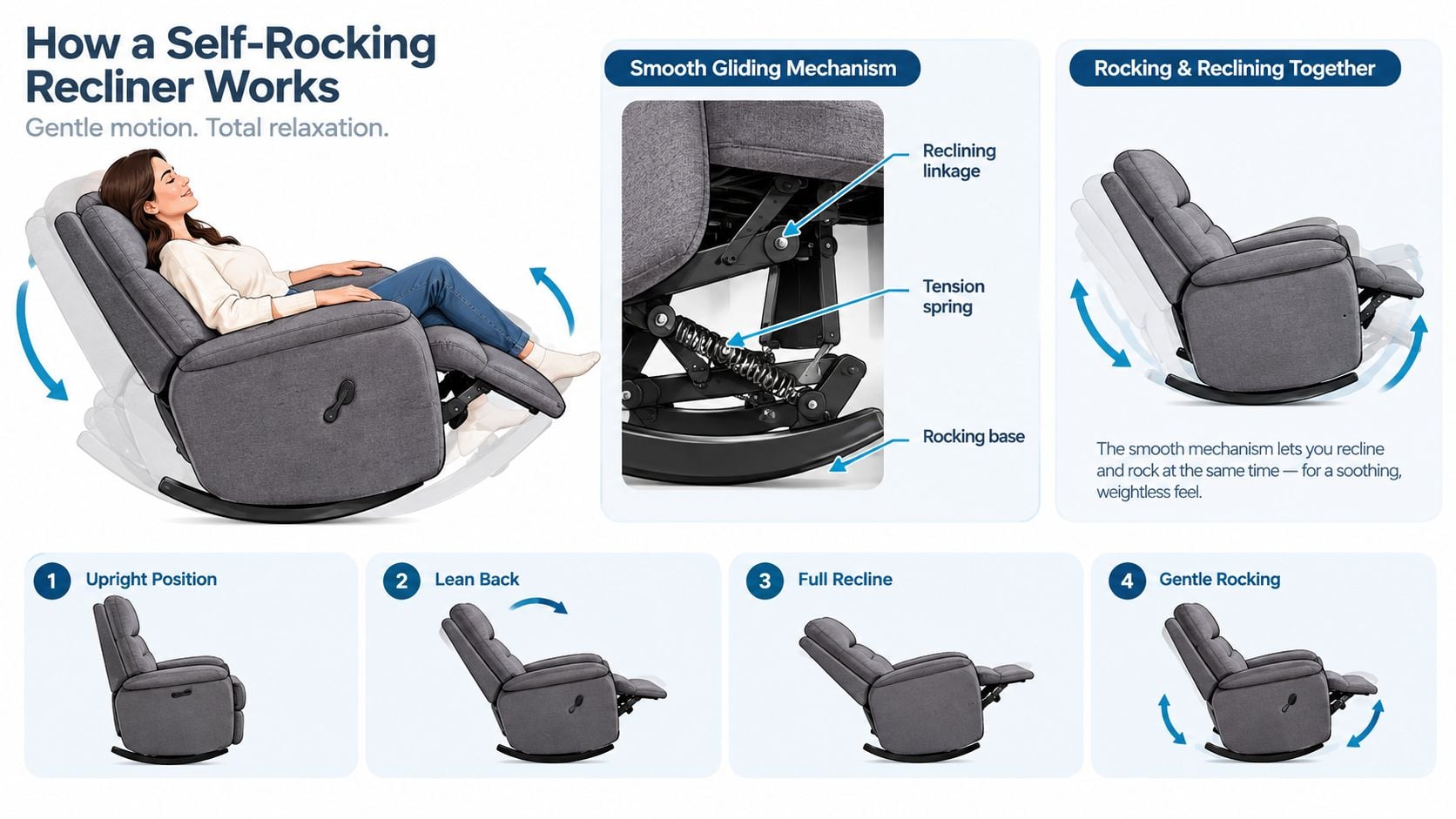
What moves beneath the upholstery
A conventional rocker may use curved runners or a rocking platform. A rocker recliner needs several parts to work together:
- Rocker cams guide the forward-and-back motion.
- Side rails support the seat and reclining structure.
- Pivoting links manage changing angles.
- Interconnected components coordinate the footrest and backrest.
- A stationary support frame or chassis gives the moving seat assembly a stable reference point.
Using a lever or power control changes more than the back angle. The linked parts alter the relationship among the seat, back, footrest, and rocker assembly. In powered furniture, a linear actuator can sequence those movements. One documented mechanism opens the footrest first, then moves the chair from the extended-footrest position toward full recline (patent description of sequenced movement).
For an older adult or anyone with limited balance, the transfer matters as much as the motion. Return the chair to its most upright position, retract the footrest, and confirm that the rocking function is locked if the model provides that setting. Place both feet firmly on the floor, use the armrests for guidance rather than pulling sharply on the moving parts, and rise slowly. A caregiver should check the chair's stopping points before regular use.
Rocking may work only when upright, or it may continue through selected reclined positions. The upholstery will not always reveal the difference. Anyone comparing a self-rocking recliner with a swivel rocker glider should test which motions operate independently and which are linked.
The category rests on mature mechanical principles. Durability still depends on construction, maintenance, proper use, and the quality of the individual mechanism. Smooth motion comes from coordinated parts, controlled stops, and a stable frame.
Rocking vs Reclining vs Self-Rocking
The simplest way to compare these chairs is to separate the motions.
| Seating type | Rocking motion | Reclining motion | Main consideration |
|---|---|---|---|
| Traditional rocking chair | Yes, usually through curved runners or a rocker base | No | Simple movement, limited positioning |
| Standard recliner | No, the chair remains stationary | Yes | Backrest and footrest support |
| Self-rocking recliner | Yes, through a controlled rocker assembly | Yes | Coordinated movement and stability |
A traditional rocker gives a familiar forward-and-back sway, but it doesn't extend a footrest or change the back angle. A standard recliner supports the legs and torso in different positions, but it won't provide that rhythmic movement. A self-rocking recliner is designed to combine the two, although the exact motion depends on the mechanism.
Some chairs rock while upright and lock the rocker once the back moves into a television or fully reclined position. Others may permit rocking in additional positions. The label alone doesn't settle the question, so shoppers should operate the chair in every position before making a decision. A broader overview of power reclining seating types can help families sort through the available functions.
Comfort comes from coordinated movement
Rocking can feel soothing, but the motion shouldn't be abrupt. In a peer-reviewed sleep study, the test recliner used a 200 W linear-actuator motor, approximately 10 cm of head-end travel, peak acceleration of 0.3 m/s², and a 4-second rocking cycle, equal to 0.25 Hz (the published sleep study). The study reported longer sleep-spindle duration and increased deep-sleep time during rocking conditions.
Those values are experimental reference points, not universal consumer settings. The useful lesson is mechanical: actuator control, linkage geometry, travel limits, and cycle frequency influence how smooth, quiet, and secure the movement feels.
Pressure distribution adds another layer. Research on articulating chairs found that back recline can increase pressure in the buttocks and lower back while reducing pressure in the upper back and thighs. Adding seat-pan tilt can reduce buttock and lower-back pressure and improve buttock blood flow, while whole-body tilt shifts more load toward the back (pressure-distribution guidance).
That means a self-rocking recliner should support the pelvis, fill the lumbar area, and avoid forcing the knees into a sharp bend. A rocking base alone can't compensate for a seat depth or recline angle that doesn't match the occupant.
Safety and Stability Features
A chair that rocks in one position may lock itself in another. That isn't a missing feature. It can be an intentional safety decision.
As the footrest opens and the backrest moves rearward, the occupant's center of gravity changes. An earlier recliner-mechanism patent describes a rocker-lock linkage that permits rocking while the chair is upright but locks the rocker in the television and fully reclined positions. The design aims to prevent the extended footrest and the occupant's leg weight from tipping the rocker forward or allowing the footrest to contact the floor (the rocker-lock mechanism).
Look for controlled transitions
Early-2000s patent activity focused heavily on locking, synchronized linkages, and controlled transitions. A patent application for a “Self-locking rocker recliner chair” was filed on June 26, 2002, and issued as U.S. Patent 6,733,071 in 2004. Related mechanism patents from 1999, 2000, 2001, and 2003 addressed rocker assemblies, adjustable rocker-recliner mechanisms, handle-operated rocker recliners, and rocker-recliner systems (the documented safety and mechanism development).
That history gives shoppers a useful checklist. The chair should transition without sudden jerks, excessive looseness, or scraping. The rocker should stop when the controls say it should, and the footrest should move without forcing the occupant to shift position.
A shopper should ask:
- Rocking range: Does the chair rock only while upright, or during recline too?
- Lock behavior: Does the rocker lock automatically as the chair reclines?
- Base stability: Does the chair remain planted when the footrest extends?
- Control independence: Can rocking stop without changing the recline position?
- Travel limits: Does the mechanism prevent excessive movement?
A weight rating also deserves careful attention, especially for households considering supportive seating for different body sizes. BILTRITE provides guidance on lift chair weight capacity, but the rating for any individual chair should be confirmed before purchase.
For upholstered furniture made, imported, or reupholstered in the United States on or after June 25, 2021, federal rules require compliance with the smolder-resistance method in California Technical Bulletin 117-2013 (Consumer Product Safety Commission upholstery guidance). That requirement addresses fire performance, not rocking quality, so both areas still deserve separate attention.
Who Should Consider a Rocker Recliner
A self-rocking recliner fits households that want gentle movement and adjustable leg support. An older adult may enjoy changing position without leaving the chair, but rocking does not help someone stand. That distinction matters for anyone with reduced strength, balance problems, or limited joint movement.
Getting in and out safely requires a separate test. Research on older adults found that lower seat height, greater backward seat tilt, increased backrest recline, and softer cushions can interfere with rising from a chair (research on chair design and rising). A low, heavily padded chair can feel comfortable while demanding more effort during the transfer.
Test the sit-to-stand movement
Use this deliberate showroom check:
- Sit with your pelvis fully supported.
- Place both feet flat on the floor.
- Check that your knees are not pushed too high or held too far forward.
- Use the armrests to rise. Do not pull on the footrest.
- Sit down again after changing the recline position.
- Confirm that the rocker can be locked or controlled during the transfer.
The chair should remain stationary while the user sits down or stands up. Caregivers should operate the controls as well. If the user cannot stop the motion, reposition independently, or reach the control easily, a different seating category may be safer.
A power lift recliner raises and tilts the seat to assist with standing. A self-rocking recliner only rocks, so families should match the chair to the person's actual needs rather than relying on labels such as “senior-friendly.”
Fit matters as much as motion
Body size changes the experience. A seat that is too deep can leave the lower back unsupported, while a seat that is too low can make standing harder. A footrest that extends too far may leave the heels unsupported or place the knees at an uncomfortable angle. Shoppers comparing proportions can also review a guide for plus-size recliners.
People who sit for long periods should not treat rocking or reclining as medical pressure management. Cornell ergonomic guidance identifies supported recline around 110° to 130° as the range associated with lower lumbar-disc pressure and back-muscle activity (ergonomic chair guidance). Pressure-relieving seating research also cautions that recline alone can increase shear. Combining tilt with recline may be preferable when pressure-injury risk is a concern.
Anyone at risk of skin breakdown, or anyone with significant weakness, balance limitations, arthritis, or restricted hip and knee movement, should ask a clinician or occupational therapist about specialized seating. A supportive chair can still be ordinary furniture, not a medical device.
Testing Your Recliner In-Store
A recliner can't be judged properly from a photograph. The hands-on test reveals whether the seat supports the pelvis, whether the controls are reachable, and whether the rocker feels smooth instead of loose or abrupt.
BILTRITE doesn't sell furniture online. The Greenfield showroom gives shoppers room to sit, move, compare sizes, and ask questions without pressure. The sales associates bring over 400 years of combined experience, and their role is to help families match furniture to their homes and routines.
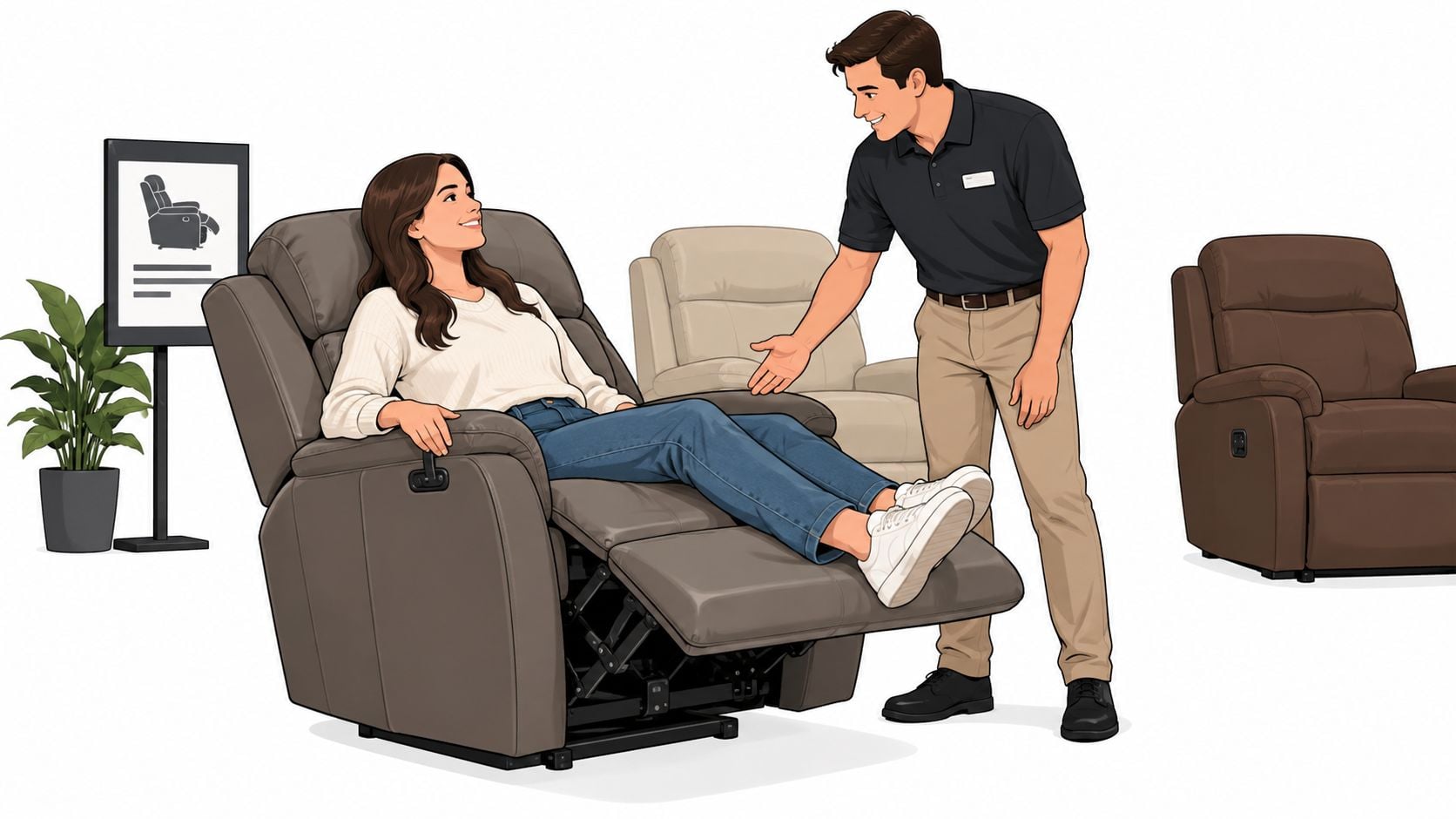
A practical showroom test
Start with the chair closed and upright. Sit all the way back, place both feet on the floor, and rock at a gentle pace. The motion should feel controlled, with no alarming shift in the base.
Then operate the recline function. Watch what happens to the footrest before the back moves, and note whether the rocker locks. Try the chair in each available position rather than testing only the one that looks most comfortable.
Bring the person who'll use the recliner most often. If a caregiver is involved, that person should test the controls and the transfer space too. Room dimensions matter as well, so shoppers should bring measurements of doorways, walls, and nearby furniture.
A recliner buying guide can help organize questions before the visit, but the chair still needs to be tried in person. BILTRITE's selection includes furniture for apartments, larger families, senior living spaces, and homes that need come-apart delivery options. The store also carries mattresses, with over 60 models and 500+ mattresses in stock, for families furnishing more than one room.
Wisconsin shoppers considering a power lift recliner should also ask about the state's sales-tax treatment. All power lift recliners are exempt from sales tax in Wisconsin, which can make mobility-supportive seating more affordable.
BILTRITE Furniture-Leather-Mattresses offers hands-on access to rocker recliners, power reclining seating, lift chairs, USA-made furniture, Amish-made pieces, and supportive mattresses in its Greenfield showroom. Visit BILTRITE Furniture-Leather-Mattresses at 5430 West Layton Avenue to test the motion, check the fit, and talk with the team in a friendly, no-pressure setting.