Difference Between Wicker and Rattan: A Guide


You’re standing in a furniture showroom, looking at two chairs that seem almost identical. One tag says rattan. The other says wicker. You squint at the labels, look at the weave, then wonder if the furniture industry is just playing a word game.
That confusion is common, especially when you’re trying to buy something that will hold up in a Wisconsin home. The difference between wicker and rattan matters because one word tells you what the furniture is made from, and the other tells you how it was made. If you mix those up, it’s a lot easier to bring home something that looks right but doesn’t fit how you’ll use it.
Folks around Metro Milwaukee often ask this when they’re shopping for a sunroom, three-season room, covered porch, or patio set. They want that light, woven look, but they also want something sensible. That’s a smart question. A woven chair that sits happily in a bright living room may not be the same one you’d trust through a humid summer and a snowy winter.
Wicker or Rattan Lets Clear Up the Confusion
A neighbor walks in looking for a casual chair for the den. She points to a woven piece and says, “I love this rattan wicker thing.” That’s usually where the mix-up starts. The words get tossed around together so often that people assume they mean the same thing.
They don’t.

Rattan is a natural material. Wicker is a weaving technique. That’s the core of the difference between wicker and rattan, and once you understand that, furniture labels start making a lot more sense.
Rattan comes from a specific natural material derived from over 600 species of climbing palm, primarily found in tropical regions of Southeast Asia, Africa, and Australia, while wicker refers to the woven method used on materials like rattan and others, as explained in this overview of rattan versus wicker in homeware. The same source notes that rattan became much more popular in the 19th century because it was easier to transport than heavy timber, and by 1920, wicker-woven rattan furniture was found in 80% of middle-class households.
A simple way to remember it
Think of it this way:
| Term | What it means | Easy example |
|---|---|---|
| Rattan | A material | Like oak, maple, or leather |
| Wicker | A method of weaving | Like braided, tufted, or knitted |
A chair can be made of rattan.
A chair can also be woven in wicker style.
So yes, a piece can be both.
Neighborly rule: If a tag says wicker, your next question should be, “Woven from what?”
That one question helps you judge strength, upkeep, and whether the piece belongs indoors, outdoors, or only in a covered area.
If you enjoy comparing furniture looks and build styles in plain English, our guide to different furniture styles and types can help connect the visual side with the practical side.
What Is Rattan The Strong and Sturdy Material
Rattan is the part people often think is just a style name. It’s a real, natural material. It grows as a vine-like palm, and furniture makers value it because it’s both sturdy and bendable.
That combination is what makes rattan useful. You can shape it into curves, loops, and rounded frames without it snapping the way more brittle materials can.
Why the solid core matters
Rattan has a solid core, which is different from hollow bamboo. That solid structure is a big reason it works so well for furniture frames that need to carry weight and keep their shape over time.
According to this explanation of cane, rattan, bamboo, and wicker, rattan stems typically measure ¾ to 2 inches in diameter. The same source says its solid structure gives it high tensile strength for load-bearing furniture frames, and that tightly woven rattan can achieve 20% to 30% higher compressive loads than looser weaves.
How furniture makers use it
Rattan usually gets processed into different parts.
- The core becomes strong round reeds and frame pieces.
- The outer peel can be used for finer woven surfaces and details.
- Bent sections help create the curved arms, backs, and bases that give rattan furniture its easygoing shape.
If you’ve ever seen a woven lounge chair with a rounded back and a light feel, there’s a good chance rattan is doing the heavy lifting underneath. It often acts like the bones of the piece.
A woven look doesn’t tell you much by itself. The frame underneath tells you a lot.
Where rattan shines
Natural rattan tends to make sense in spaces where you want warmth and texture without the heaviness of bulkier furniture. It works nicely in:
- Sunrooms with good airflow
- Living rooms where you want a casual accent chair
- Bedrooms for benches or occasional seating
- Covered spaces where moisture is controlled
That said, “natural” doesn’t automatically mean “goes anywhere.” Rattan is strong, but it still needs the right setting. For Milwaukee homeowners, that means treating it more like an indoor or protected-space material than something you’d leave out against the weather.
What Is Wicker The Weaving Technique Explained
Wicker sounds like a material, but it isn’t one. Wicker is the weaving method. That’s the whole trick.
A quick kitchen analogy helps. Flour is an ingredient. Bread is the result of a process. In furniture, rattan is more like the ingredient, and wicker is more like the method used to shape the final surface.

What wicker can be made from
Furniture makers can weave wicker using several materials, such as:
- Natural rattan
- Cane or reed
- Willow
- Bamboo
- Synthetic resin materials
That’s why the word wicker by itself doesn’t tell you enough. Two wicker chairs can look similar from across the room and perform very differently in daily life.
Why shoppers get tripped up
A lot of product labels use “wicker” as shorthand for the whole look. That’s understandable, but it can blur the facts. If you only hear “wicker chair,” you still don’t know whether you’re looking at a natural woven piece for a cozy reading corner or a synthetic all-weather piece for the patio.
Here are the questions worth asking:
- What material is woven here?
- What is the frame made from?
- Is it meant for indoor, covered, or full outdoor use?
- How much maintenance does it need?
The practical takeaway
Wicker tells you about the surface and construction style. It does not tell you durability on its own.
A wicker chair woven from natural fibers usually brings a softer, more organic look. A wicker chair woven from synthetic material often aims for weather resistance and easier cleanup. Same weaving idea. Different real-world use.
If you remember only one sentence, make it this one: rattan is what something can be made from, and wicker is how it can be woven.
Comparing Natural Rattan vs Synthetic Wicker Furniture
Practical considerations guide shopping. Once you know the difference between wicker and rattan, the next question is usually about use. What belongs in a living room? What belongs on a patio? What needs babysitting, and what can handle a little weather?
For most homeowners, the choice isn’t “wicker or rattan.” It’s natural woven furniture or synthetic woven furniture.
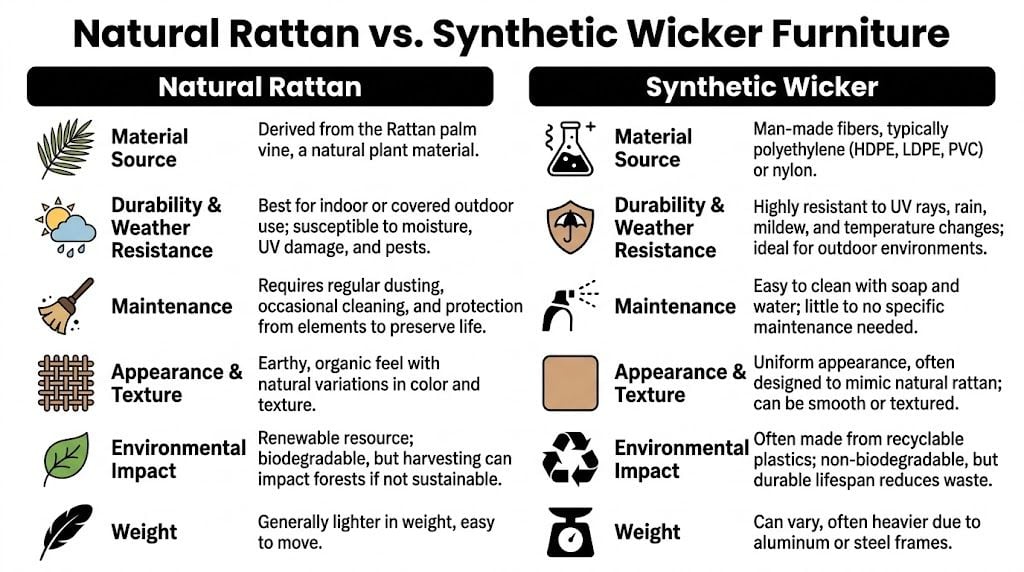
Natural vs Synthetic Woven Furniture at a Glance
| Feature | Natural Rattan/Wicker | Synthetic “All-Weather” Wicker |
|---|---|---|
| Main material | Natural plant-based material | Man-made resin such as HDPE or PVC |
| Best setting | Indoors or covered spaces | Outdoor patios, decks, and exposed areas |
| Look and feel | Organic, warm, varied | More uniform, often designed to mimic natural weave |
| Sun and moisture | More sensitive | Built for better weather resistance |
| Upkeep | Needs regular care and protection | Generally easier to clean and maintain |
| Wisconsin winters | Better stored indoors | Better suited for outdoor use, though storage still helps |
How they age
Natural rattan has a charm that a lot of people love. It feels relaxed, textured, and homey. But it’s not a fan of prolonged exposure to sun and moisture.
This comparison of rattan, wicker, and all-weather wicker notes that natural rattan wicker can fade in 2 to 3 years from UV exposure, and outdoor use can reduce its lifespan to 5 to 7 years. The same source says synthetic all-weather wicker offers 25 to 50 times the outdoor longevity, retains 90% integrity after 1000 hours of salt spray testing, and shows less than 5% fade over 10 years.
That doesn’t mean natural is bad. It means natural has a lane. If you keep it in the right lane, it can be a very satisfying choice.
Practical rule: If the furniture will live through rain, direct sun, and seasonal swings, synthetic wicker usually makes more sense.
How each one fits a real home
Natural woven furniture often works best for people who want a softer indoor look. Think sunrooms, bedrooms, quiet corners, and covered porches where the piece won’t get soaked or baked.
Synthetic all-weather wicker fits households that want easier ownership. You still want decent care, but you’re not worrying the same way every time the forecast changes.
A quick way to decide:
- Choose natural rattan or natural wicker if you care most about warmth, texture, and an indoor-friendly organic look.
- Choose synthetic all-weather wicker if the furniture will sit outside and you want less fuss.
- Choose something else entirely if you want a patio piece that faces hard Midwest weather year after year and you’d rather not think about woven maintenance much at all.
If you’re comparing deck, patio, and porch options, this guide to essential outdoor furniture pieces can help you match the furniture type to the way you use your outdoor space.
One more detail shoppers miss
The word “wicker” often sounds old-fashioned and delicate. Synthetic wicker has changed that picture. It can still give you the woven look, but with a more weather-ready build. So if you like the style but not the upkeep, that’s often the best middle ground.
Styling Your Home With Woven Furniture
Woven furniture has range. It can feel breezy and casual, or it can add just enough texture to keep a room from feeling flat. The trick is matching the material to the room and not overloading the space.
Natural woven pieces tend to soften a room. They play well with wood, linen, simple upholstery, and warm paint colors. If you’ve got a living room that feels a little too boxy or a bedroom corner that needs life, a woven accent can break up all the straight lines.
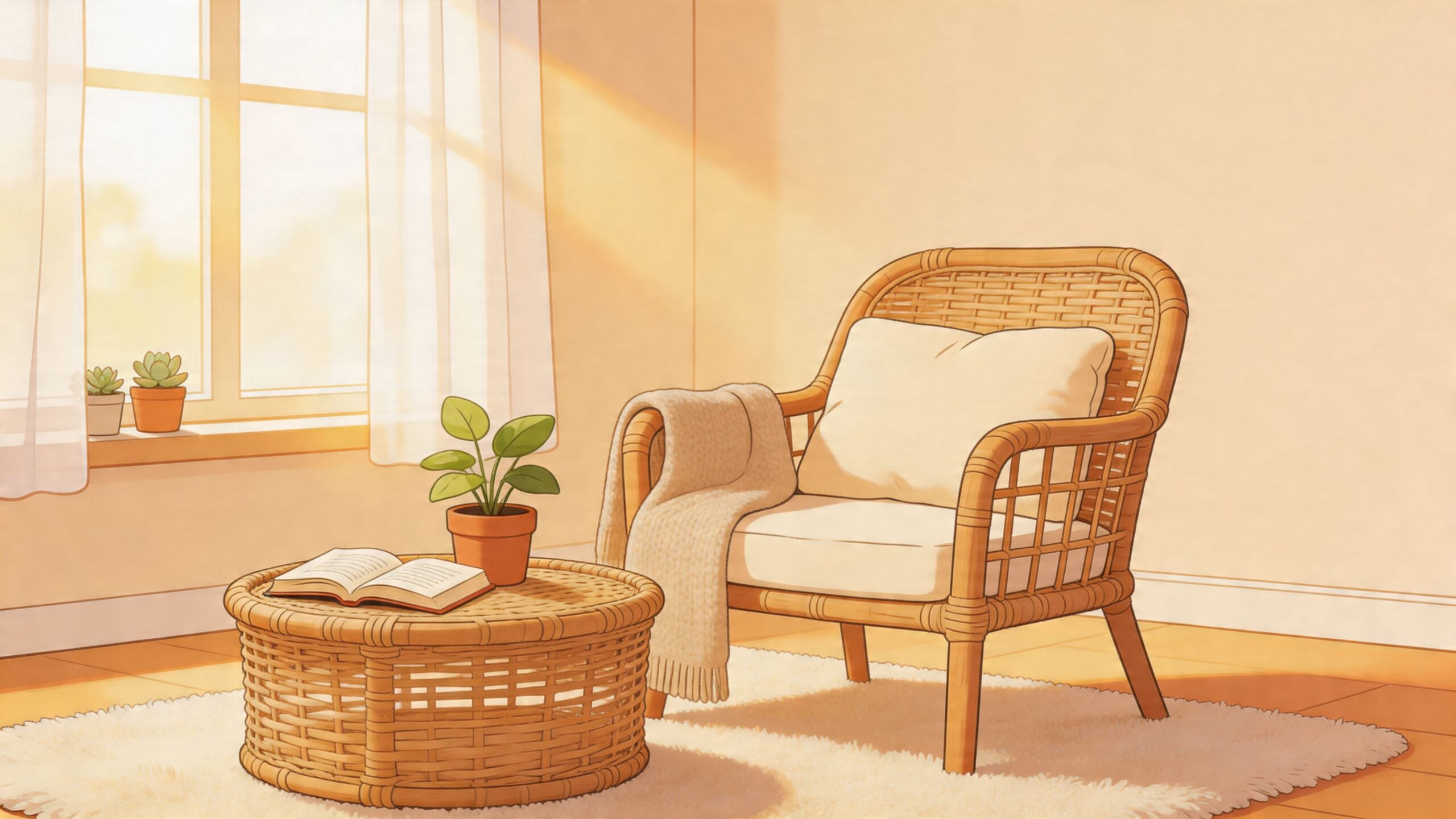
Where natural woven furniture looks at home
A natural rattan chair with a seat cushion can work beautifully in a reading corner. Add a floor lamp, a small wood table, and a throw blanket, and the space feels settled without feeling heavy.
It also works nicely in:
- Sunrooms, where daylight brings out the texture
- Bedrooms, as a bench or accent chair
- Entryways, where a woven seat lightens the look
- Living rooms, paired with solid wood pieces for balance
How synthetic woven furniture fits in
Synthetic wicker isn’t limited to patios. It can also suit enclosed porches, casual family spaces, and homes where you want the woven look without worrying as much about day-to-day wear.
Its cleaner, more uniform finish often leans a little more polished. That can work well if your home style is less cottage and more tidy, modern, or transitional.
Woven furniture usually looks best when it’s the texture in the room, not every texture in the room.
Three easy styling combos
Here are a few combinations that tend to work well in Wisconsin homes:
| Room | Woven piece | Pair it with |
|---|---|---|
| Living room | Accent chair | Solid wood side table, neutral rug, soft lamp |
| Sunroom | Lounge chair or loveseat | Indoor-outdoor fabric cushions, small drink table, plant stand |
| Bedroom | Bench or occasional chair | Wood dresser, woven basket, simple bedding |
If you’re trying to make a room feel layered without making it busy, woven furniture can do a lot of the work. One accent chair or one occasional table may be all you need.
For more room-by-room inspiration, our article on how to style a living room shows how to mix texture, scale, and comfort in a way that still feels livable.
Choosing The Right Furniture for Our Milwaukee Climate
Milwaukee weather asks a lot from furniture. We get humid stretches, bright summer sun, wet spring days, and winters that can be rough on just about anything left outside. That matters a lot when you’re shopping woven furniture.
Natural rattan can be a smart choice indoors or in a protected area. But on an exposed patio, it usually asks for more care than most homeowners want to give.
What works outside here
For climates like ours, this comparison of wicker and rattan care in humid and variable weather notes that natural rattan needs protection from humidity and sun, while synthetic HDPE resin wicker offers 300% more water resistance. The same source says a quarterly silicone spray can extend the life of natural pieces by 50%, but indoor winter storage is essential.
That last point matters. “Covered” is not the same as “safe all winter.” Cold, damp air still gets to furniture, and repeated exposure can shorten its useful life.
A practical Milwaukee checklist
If you’re choosing woven furniture for this area, keep it simple:
- For open patios and decks, synthetic all-weather wicker is usually the safer pick.
- For three-season rooms and covered porches, natural pieces can work if you stay on top of care.
- For winter, bring natural woven furniture indoors or store it somewhere dry.
- For lower maintenance, consider materials that handle weather with less fuss.
Don’t overlook solid wood alternatives
A lot of Wisconsin homeowners like the look of woven furniture but end up deciding they want something sturdier and simpler for the long haul. That’s where solid wood outdoor options can make a lot of sense.
Wood gives you a different look, of course, but it brings the kind of substance many families want, especially for frequently used seating. If your household includes kids, guests, or anyone who wants a chair that feels planted and supportive, it’s worth comparing woven pieces with heavier-duty alternatives.
If you love the woven look, use it where it will be happiest. If you want less maintenance, choose the material that matches the climate instead of fighting it.
For more local outdoor planning ideas, our tips on staying cool and styling outdoor furniture in warm weather are useful when you’re setting up a porch, patio, or deck in Southeast Wisconsin.
Come See The Difference at BILTRITE in Greenfield
Reading about furniture helps. Sitting in it helps more.
A woven chair can look sturdy in a photo and feel completely different in person. One may feel light and airy in a good way. Another may feel too bendy for the way your family lives. That’s why touching the weave, checking the frame, and seeing the finish up close makes such a difference.
We’ve been helping Milwaukee-area families since 1928, and as a 4th-generation, family-owned business, we still believe furniture shopping should feel human. We don’t sell online, so we put our energy into the showroom experience. You can compare materials, ask real questions, and get straightforward answers from people who know furniture.
Our team brings over 400 years of combined experience, and that shows up in the little details. We can help you sort out whether you want the warmth of woven texture, the easier upkeep of synthetic materials, or a completely different direction like USA-made or Amish-made solid wood. We’re proud to offer affordable, better-quality furniture, including small-scale options, heavy-duty pieces, come-apart seating for tight spaces, lift chairs, and a huge mattress department with over 60 models.
Why people like shopping with us in person
- You can test comfort yourself instead of guessing from a photo.
- You can compare build quality side by side.
- You can ask about durability for your home, your family, and your space.
- You can work with experienced people without pressure.
We’re also proud to be closed on Sundays and Mondays so our team can spend time with family. That family-first mindset has been part of who we are for generations, and we think it matters.
If you’ve been trying to figure out the difference between wicker and rattan and want to see it up close, we’d love to meet you in Greenfield.
Your Wicker and Rattan Questions Answered
A few good questions usually come up after people learn the basics. Here are some of the ones we hear most often.
| Question | Answer |
|---|---|
| Is wicker always natural? | No. Wicker is the weaving method, not the material. It can be made from natural or synthetic materials. |
| Is rattan good for everyday furniture? | It can be, especially indoors or in protected spaces where moisture and harsh weather aren’t a constant issue. |
| Can I use natural woven furniture on my patio? | You can in a covered setting, but it needs more care in our climate and should be stored indoors for winter. |
| Is synthetic wicker cheap-looking? | Not necessarily. Many synthetic pieces are designed to mimic natural texture while being easier to live with outdoors. |
| What if I have kids or pets? | Focus on frame strength, cleanable surfaces, and how the piece will really be used day to day. Our guide to kid-friendly and pet-friendly furniture is a helpful next read. |
| Should I choose woven furniture or solid wood? | If you want texture and a lighter visual feel, woven furniture can be a nice fit. If durability and heft matter most, solid wood is worth serious consideration. |
The main thing is to buy for real life. A beautiful chair that doesn’t suit your room, your routine, or our weather won’t feel like a smart purchase for long.
If you’d like help comparing woven furniture, solid wood options, or finding something built for the way your family lives, visit BILTRITE Furniture-Leather-Mattresses in Greenfield. We’d love to see you in our showroom, answer your questions, and help you find a comfortable, better-quality piece that fits your Wisconsin home.