How to Move Heavy Furniture Upstairs Without Breaking Your Back


Moving heavy furniture upstairs safely boils down to three things: a great game plan, using proper lifting techniques, and having the right equipment like dollies and straps. It’s a team effort that starts long before you lift anything, with smart prep work to protect your back, your furniture, and your home.
Your Pre-Move Huddle For Moving Furniture Upstairs
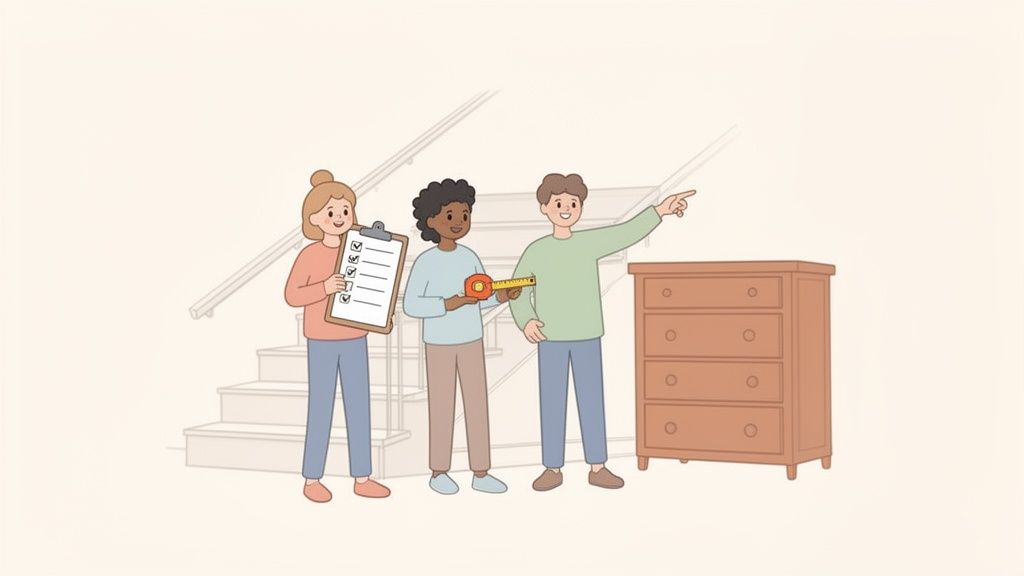
Welcome, neighbor! We know that feeling. You've found a beautiful, solid wood piece, and then it hits you… it needs to go upstairs. It can feel like a huge challenge, but we're here to help you create a friendly game plan before a single muscle gets strained.
As a 4th generation family business serving the Metro Milwaukee community since 1928, we’ve learned a thing or two about navigating tricky staircases. The most important lesson? A little smart planning is the secret to success! This is much less about raw strength and more about understanding the job at hand.
Why Planning Beats Brute Force
Let’s be honest—moving heavy items comes with risks to you, your new furniture, and your home. Scuffed walls, scratched floors, or a pulled muscle can turn an exciting day into a frustrating one. But just a few minutes of prep work can prevent a world of hurt. Think of us as your friendly moving coaches, getting you ready for a safe and successful move.
The real challenge isn't just the weight; it's physics. A typical sofa can weigh between 150 and 250 pounds, but when you tilt it on a standard 37° staircase, the person at the bottom feels a much heavier load. That 200 lb sofa can suddenly feel like 240-260 lbs thanks to gravity and a shifted center of mass.
Our Family Tip: Always start with a walk-through. Before touching the furniture, walk the entire path from where it is now to its final spot. Look for tight corners, low-hanging light fixtures, and any other surprises waiting for you.
What to Consider Before You Lift
Your pre-move huddle should cover a few key areas to make sure everything goes smoothly. Don't skip this part! A great starting point is to measure everything. To help with that, check out our guide on how to measure furniture for your home.
Here’s a quick checklist to run through:
- Your Crew: Do you have at least one strong, reliable helper? This is definitely not a one-person job!
- Your Path: Is the walkway completely clear of toys, rugs, and shoes?
- Your Gear: Do you have moving blankets, sliders, or lifting straps ready to go?
- Your Furniture: Can any parts, like legs or cushions, be removed to make it lighter and less bulky?
Thinking through these points turns a stressful task into a manageable project.
Mapping Your Route To Avoid Stuck Furniture
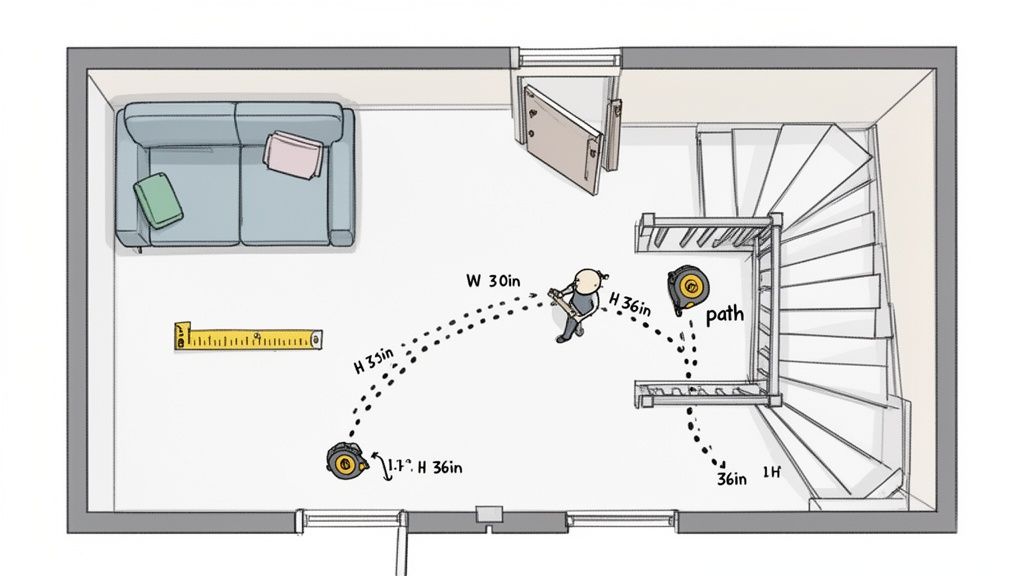
Alright, let's grab a tape measure and think like a pro for a minute. This is the part of the process where a few simple measurements can save you from scuffed walls, a scratched dresser, and that sinking feeling of a sofa stuck halfway up the stairwell.
We’ve seen it happen, and it’s no fun for anyone! The goal is to chart the safest, clearest path for your furniture before you even think about lifting it. It’s like creating a roadmap for your move.
Measure Everything Twice
First things first, measure your furniture. You'll need its three key dimensions: height, width, and depth. Write them down! Then, it’s time to measure the path it needs to take. This includes every doorway, hallway, and threshold it must pass through.
When you're heading upstairs, the staircase itself is the main event. Measure its width, but pay close attention to the ceiling clearance, especially at the bottom and top where the angle gets tight.
Our Family Tip: Always account for handrails, banisters, and light fixtures. These common obstacles can easily shrink your available space by a few crucial inches. Measure from the narrowest points to get the most accurate number.
Charting Your Path with Confidence
Once you have your numbers, you can visualize the journey. Will that tall armoire clear the low-hanging chandelier on the landing? Does that wide sofa have enough room to pivot around the corner at the bottom of the stairs? Comparing these measurements will tell you if your move is a green light or if you need a new plan.
A simple table can help you keep everything straight and see any potential red flags before you start lifting.
Your Pre-Move Measurement Checklist
| Item to Measure | Dimension (Height/Width/Depth) | Path Measurement (Doorway/Hallway) | Clearance (Path – Item) |
|---|---|---|---|
| Sofa | 35" H / 84" W / 38" D | Front Door: 36" W | 1" (too close!) |
| Dresser | 48" H / 60" W / 20" D | Stairway: 34" W | -26" (won't fit) |
| Armoire | 72" H / 40" W / 22" D | Landing Ceiling: 75" H | 3" (tight squeeze) |
This quick check makes it obvious where the problem spots are, so you can plan your next move.
Sometimes, you can create extra space with a few simple tricks. Temporarily removing a door from its hinges is a classic move that can gain you an extra inch or two of clearance—often just enough. For more ideas on navigating these tricky spots, check out our guide to furniture for narrow doorways.
The Power of Disassembly
Here's a secret the pros know well: the easiest way to move a big piece of furniture is to make it smaller. Before you start, inspect your furniture to see what can be taken apart. Many of the sturdy, USA-made pieces we carry at BILTRITE are designed with this in mind!
Look for things you can easily remove to lighten the load and make the piece less awkward to carry.
- Legs: Many sofas, tables, and dressers have legs that simply unscrew.
- Cushions and Pillows: Remove all of them—it makes a surprising difference in weight and bulk.
- Drawers: Taking drawers out of a dresser can reduce its weight by 25% or more.
- Shelves: Pop out any adjustable shelves from bookcases or entertainment centers.
At BILTRITE, we even have a fantastic selection of "Come Apart Sofas & Sectionals" specifically designed for homes with challenging layouts. These pieces are built in sections so they can be moved into your room of choice with ease and then securely reassembled. It’s a brilliant solution we love showing families in our Greenfield showroom! Taking a piece apart can turn a daunting, one-piece monster into several manageable parts.
Gearing Up For A Safer Move
Having the right tools in your corner is half the battle when you're figuring out how to move heavy furniture upstairs. It’s the secret to working smarter, not harder—and it’s all about protecting your back, your beautiful furniture, and your home. Let's talk about the essential gear that makes a tough job feel much more manageable.
Think of these tools as your temporary best friends for the day. Using them properly turns a potentially dangerous lift into a controlled, strategic move. It's an approach we’ve valued since our family started BILTRITE back in 1928—doing things the right way to protect the investment you’ve made in your home.
Your New Best Friends: The Dolly and Straps
First up is the furniture dolly. This simple wheeled platform is an absolute lifesaver for moving heavy items across flat surfaces. Once you get that heavy dresser downstairs or need to move it across the living room to the base of the stairs, a dolly does all the heavy gliding for you. This saves your energy for the main event—the staircase.
Next are lifting straps, sometimes known by brand names like Forearm Forklifts. These are true game-changers for stairs. These heavy-duty straps use the power of leverage, making items feel significantly lighter than they actually are. By distributing the weight across your shoulders and core, they take the strain off your back and arms, giving you far better control and balance as you ascend.
Our Family Tip: When using lifting straps, communication with your partner is everything! Make sure you both lift and step in unison. A simple "one, two, three, lift!" can prevent the jerky movements that lead to accidents.
Simple Must-Haves For Protection
Beyond the heavy-lifting gear, a few simple items are non-negotiable for protecting your furniture and your home.
- Thick Moving Blankets: These are your furniture’s armor. Drape them over your pieces and secure them with tape or plastic wrap. They shield those beautiful solid wood corners on an Amish-made piece from bumps and protect your walls and banisters from scuffs.
- Furniture Sliders: For maneuvering furniture into its final position once upstairs, these little plastic or felt-bottomed discs are fantastic. They allow you to easily slide a heavy item across carpet or hardwood without scratching the surface or straining your back.
Properly protecting your surfaces is a crucial step that many people overlook in the heat of the moment. We believe in being proactive, which is why we've put together some helpful advice on how to protect your floors from your furniture.
Rent or Buy What You Need
So, do you need to go out and buy all this equipment? Not necessarily! For a one-time move, renting a high-quality furniture dolly and lifting straps from a local hardware or moving supply store is a very affordable option.
Moving blankets and sliders are inexpensive to purchase and are always handy to have around the house for future projects anyway.
Getting the right gear isn't about spending a lot of money; it's about making a small investment to ensure your move is safe and damage-free. It protects the beautiful, better-quality furniture you've chosen for your family and prevents costly repairs to your home. Taking this extra step shows you're serious about doing the job right.
Mastering The Lift And Carry With A Partner
Alright, now for the main event. Getting that beautiful piece up the stairs is absolutely a team sport, and we’re going to walk through the safe lifting techniques our own delivery teams use every single day. Think of it like a coordinated dance—you and your partner have to stay perfectly in sync to make it look easy and avoid any disasters.
The golden rule, and you've definitely heard it before, is to always lift with your legs, not your back! Keep your back straight, get low by bending your knees, and let your powerful leg muscles do the heavy lifting. It's the single most important thing you can do to prevent a serious injury.
The High-Low Technique On Stairs
Moving heavy furniture up a flight of stairs requires a specific strategy. This isn't just a simple lift and carry; it's a coordinated effort on an incline. This is where the "high-low" technique is non-negotiable.
- The stronger person should always take the lower end of the staircase. Gravity is not your friend here, and they'll be supporting the bulk of the weight.
- The person at the top ("high") position is the guide. They have the best view of the path ahead and are in charge of steering, setting the pace, and navigating tricky corners.
- Both of you should maintain a solid grip and keep the furniture tilted to match the angle of the stairs. This simple adjustment keeps the center of gravity stable and the load manageable.
This method ensures the person bearing the most weight has the most stable footing, while the person with the better vantage point can safely direct the whole operation.
This diagram shows the essential gear that makes this process so much smoother.
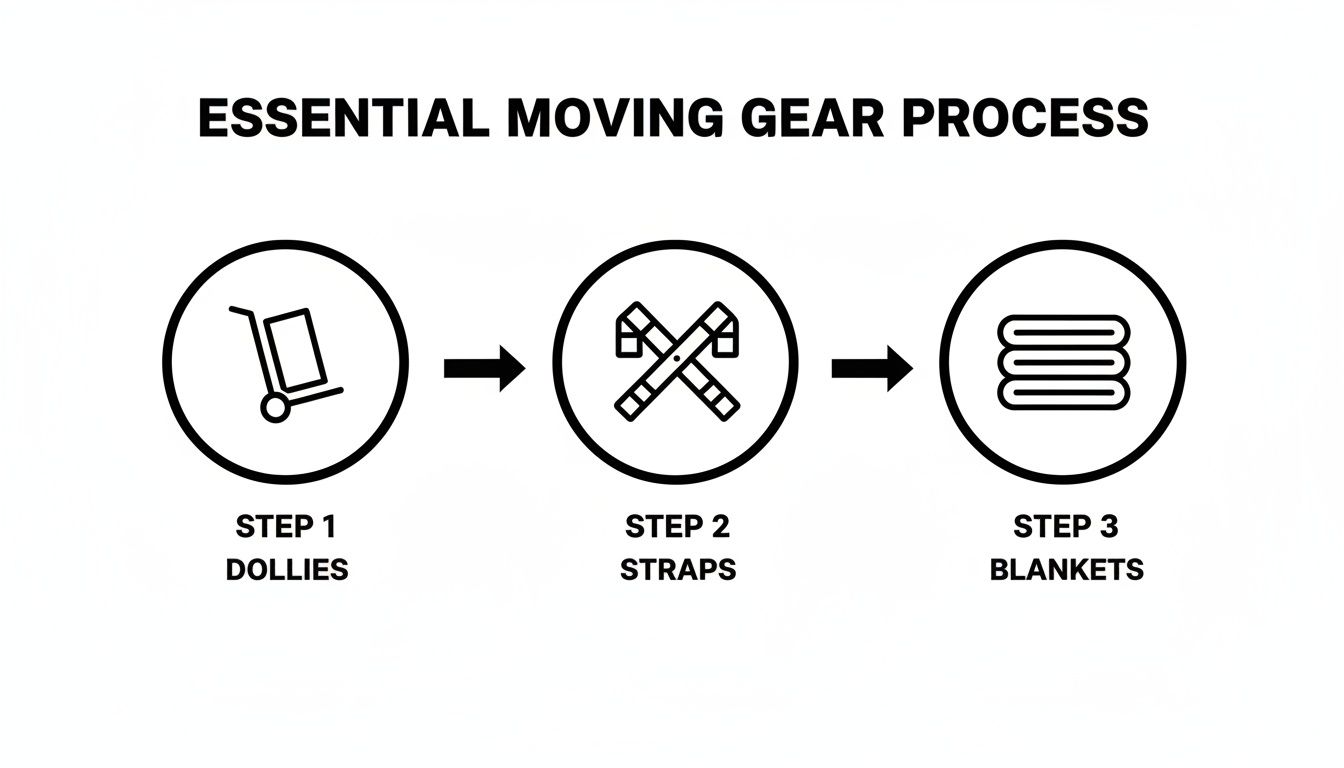
Using dollies for the flat ground, straps for the stairs, and blankets for protection gives you a complete system for a much safer move.
Clear Communication Is Everything
You can have all the muscle in the world, but if you're not talking to your partner, you're asking for trouble. Constant, clear communication is what keeps you synchronized and safe.
Agree on a few simple, direct commands before you even touch the furniture. Things like:
- "Ready? Lifting on three. One… two… THREE!"
- "Stopping on this step."
- "Hold up, I need to adjust my grip."
- "Slow down, tight corner coming up."
The person at the top should be the lead communicator, calling out instructions and warnings. Never, ever assume your partner knows what you're about to do—say it out loud!
Tackling Different Types of Furniture
Not all furniture is built the same. A tall, solid Amish-made dresser is a completely different beast than a long, sprawling sectional sofa.
For tall pieces like an armoire or a heavy dresser, stick to the "high-low" method and try to keep it as vertical as you can to clear landings. If you absolutely have to tilt it, do it slowly and make sure you communicate the shift in weight.
For long items like a sofa, you'll probably need to use a pivot technique. This usually means standing the sofa on its end on a landing, carefully rotating it, and then lowering it back down to continue the climb. This is where those moving blankets become your best friend, protecting both the upholstery and your walls!
Our Family Tip: When pivoting a sofa, the person at the bottom needs to brace it securely while the person at the top guides the rotation. It’s a slow, deliberate movement—never rush a pivot!
Staircases are notoriously high-risk zones in any home, especially when you're lugging heavy objects. Data shows that stair-related incidents are a huge cause of injuries, with reports indicating that well over 100,000 injuries each year are linked to carrying things like furniture up or down stairs. Beyond personal safety, the financial cost of damages from DIY moves—dented walls, smashed banisters, and scratched furniture—adds up to hundreds of millions of dollars annually for American households. You can read more about recent moving industry trends to see why proper technique is so critical.
Taking the time to lift correctly, communicate clearly, and use the right technique for each piece turns a risky job into a successful one. And remember, when you visit us in our Greenfield showroom, our team—with over 400 years of combined experience—is always happy to share a few more tips.
Knowing When To Call In The Professionals
Hey, there’s absolutely no shame in asking for help! At BILTRITE, we're all about family, and that means looking out for each other. Sometimes, the smartest—and safest—move you can make is knowing when not to move that heavy piece of furniture yourself.
This is our honest, neighborly advice on when to pause the DIY effort and call in a professional moving team. We want you to make the best choice for your safety and your home. After all, the goal is to enjoy your beautiful new furniture, not to end up with a strained back or a damaged wall.
Telltale Signs It's Time for a Pro
Let's get real about the situation. Are you looking at a piece of furniture that’s incredibly heavy, like one of our gorgeous, solid oak Amish-made armoires? These heirloom pieces are built to last for generations, and their weight reflects that quality. An awkward, heavy piece is a prime candidate for professional help.
Then, take a good, hard look at your staircase. Is it narrow, winding, or even spiral? These layouts dramatically increase the difficulty and the risk of something going wrong. Add in a tight landing or a low ceiling, and the challenge multiplies. If you look at the path from the front door to the final room and your gut tells you "this looks impossible," it's probably time to trust that instinct.
Finally, just be honest with yourself. Are you truly comfortable with the physical demands and the risk involved? If the answer is no, that's completely okay! Your peace of mind is worth everything.
Why We Offer Our Own White-Glove Delivery
This is a huge reason why we offer our own white-glove delivery service right here in the Metro Milwaukee area. We don't just sell you a piece of furniture; we want to make sure it gets into your home safely and is set up exactly where you want it. You can learn more about what our white-glove delivery service includes and see how it offers total peace of mind.
Our experienced team handles our heavy-duty, Amish, and solid wood furniture every single day. They know how to navigate the unique homes in our community, from historic houses in Wauwatosa to modern condos in Bay View. They have the right equipment, the right training, and the teamwork down to a science.
We’ve been helping families since 1928, and we believe in doing things right. Letting our team handle the delivery and setup means you can relax, knowing your investment is in the best hands.
The moving industry itself shows why this service is so valuable. With millions of Americans relocating each year, a significant number are now choosing to hire professionals specifically for complex tasks like stair carries. Industry data reveals that the U.S. moving services sector is a massive $23.2–$23.4 billion industry, with a growing number of people opting out of DIY moves to avoid injury or damage. You can discover more insights about moving industry statistics that highlight this trend.
Ultimately, choosing professional movers isn't giving up—it's a smart, strategic decision to protect yourself, your family, and your beautiful new furniture. When you're ready to find your next great piece, come on down to our Greenfield showroom. We’d love to see you!
Choosing Smarter Furniture For Upstairs Rooms
What if your furniture was designed to make this whole moving process easier from the start? At BILTRITE, helping Metro Milwaukee families find practical, better-quality solutions is what we’ve been doing since 1928. The real secret to moving heavy furniture upstairs sometimes isn't brute force—it's choosing smarter pieces in the first place.
Thinking ahead can save you a world of hassle. Instead of wrestling with a bulky, one-piece sofa that feels impossible, picture one that’s actually designed to navigate the quirks of your home. It’s a value we’ve always held dear.
Finding Your Stair-Friendly Solution
When families visit our Greenfield showroom, we love showing them options that solve these exact problems. It’s all about sharing our family's knowledge to help you find a piece that truly fits your life and your home.
A great example is our collection of ‘Come Apart Sofas & Sectionals.’ These are a brilliant solution for tight stairwells, narrow hallways, or those tricky apartment layouts. They arrive in smaller, manageable sections that you can easily carry upstairs and then lock together securely once they’re in the room. No more pivoting, scraping, or squeezing!
Our Family Tip: Always ask about assembly when you're shopping! Many of our heavy-duty pieces, including some gorgeous USA and Amish-made furniture, are specifically designed to be assembled in the room, turning a massive challenge into a simple task.
Smart Choices For Every Space
Every home is different, and we take pride in offering something for everyone. Our awesome team, with over 400 years of combined experience, is here to help, not to pressure you. They are happy to help you find just the right fit.
For those in apartments, condos, or older homes with charming but narrow layouts, our Small-Scale Furniture is a lifesaver. These pieces are thoughtfully designed to give you maximum comfort and style without the oversized footprint that makes moving a nightmare. You can find some great ideas in our guide to the best furniture for apartments.
On the flip side, our Heavy-Duty Furniture is built for families who need serious durability. Many of these robust pieces, from bed frames to entertainment centers, are engineered to be assembled right where they’ll live, bypassing the staircase struggle altogether.
Stair-Friendly Furniture Solutions at BILTRITE
To make things a little clearer, we've put together a quick comparison of the furniture types we offer that are specifically designed to make moving upstairs a breeze. These options are engineered with real-world homes in mind.
| Furniture Type | Key Feature | Best For… | Why It Helps |
|---|---|---|---|
| Come Apart Sofas | Modular, sectional design | Tight stairwells, narrow halls | Moves in smaller, lighter pieces that connect |
| Small-Scale Furniture | Compact, space-saving design | Apartments, condos, older homes | Easier to maneuver, pivot, and fit tight spots |
| Heavy-Duty Pieces | In-room assembly option | Any home with access challenges | Bypasses the staircase problem completely |
Ultimately, choosing furniture that works with your home, not against it, just makes life easier. We’d love to see you in our Greenfield showroom to show you exactly how these pieces work. Our friendly team is always here to help you find an amazing, stair-friendly option for your family.
Common Questions About Moving Furniture
We get asked these questions all the time in our Greenfield showroom. As a family that’s been in the furniture business since 1928, we're always happy to share what we've learned over the decades! Here are a few common queries we hear about the challenge of getting beautiful new furniture up the stairs safely.
What Is the Pivot Technique for Tight Corners on a Staircase?
Ah, the classic mover's trick for a tricky landing! The "pivot" is all about using vertical space to your advantage. For a tall item like a dresser or a sofa, you’ll want to carefully stand it up vertically.
For a sofa, this usually means turning it on its end, then carefully "walking" it around the tight turn before lowering it back down. One person’s job is to hold it steady from below while the other repositions at the top to guide it through the corner.
Our Family Tip: Always wrap the furniture in thick moving blankets for this maneuver. It’s the best way to prevent scuffs and scratches on your new piece and your walls.
Is It Better to Push or Pull Furniture Up Stairs?
That’s a great question, and the honest answer is you need to do both. Moving heavy furniture upstairs is a coordinated dance between two people.
- The person at the bottom does the heavy lifting, pushing upwards and providing most of the power.
- The person at the top guides the piece, pulling gently and navigating around obstacles. They're in charge of the pace.
The most important part is constant communication. The person at the top has the best view and needs to lead the way, while the person at the bottom provides the muscle. Simple cues like “Ready? Lift on three!” are absolutely essential for keeping everyone safe and in sync.
Can I Use a Regular Dolly on Stairs?
A standard four-wheel dolly is a lifesaver on flat surfaces, but it's incredibly dangerous on stairs and should never be used. You’ll lose control in a heartbeat.
However, there are specialized "appliance dollies" or "stair-climbing dollies" designed for this exact job. They have straps to secure the item and either tracks or special wheels made to handle steps. For extremely heavy or awkward pieces, renting one of these can be a smart move. For most furniture, though, a good set of lifting straps and a strong partner is often the safer, more nimble choice.
At BILTRITE Furniture-Leather-Mattresses, we believe you should love your furniture without the stress of getting it home. Our white-glove delivery team handles tricky staircases every single day! Come on down to our showroom and let us take care of the heavy lifting for you! We'd love to see you in our store. Come say hi and let us help you find a great piece for your home. We're proud to be family-owned and are closed on Sundays so our team can be with their families too